 Wondershare EdrawMind
MindMap Gallery Human Parasitology Chapter 17 Introduction to Medical Arthropods
- 35
Human Parasitology Chapter 17 Introduction to Medical Arthropods
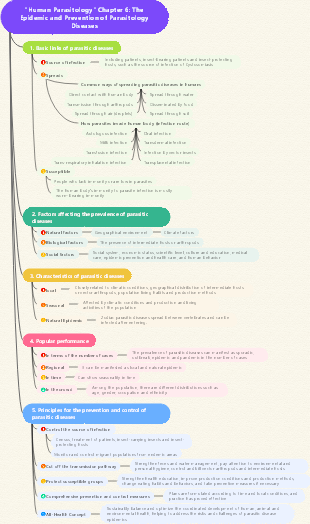
This is a mind map about Chapter 17 of "Human Parasitology", the introduction to medical arthropods, the main contents include: 1. Basic concepts, 2. Characteristics, 3. Main categories, 4. Ecological factors, 5. Hazards to humans, 6. The basis for determining vector arthropods, 7. Prevention methods.
Edited at 2025-02-24 22:33:36
- Reproductive system
This template shows the structure and function of the reproductive system in the form of a mind map. It introduces the various components of the internal and external genitals, and sorts out the knowledge clearly to help you become familiar with the key points of knowledge.
- Interpretation and summary of relationship field e-book
This is a mind map about the interpretation and summary of the relationship field e-book, Main content: Overview of the essence interpretation and overview of the relationship field e-book. "Relationship field" refers to the complex interpersonal network in which an individual influences others through specific behaviors and attitudes.
- Accounting books and accounting records
This is a mind map about accounting books and accounting records. The main contents include: the focus of this chapter, reflecting the business results process of the enterprise, the loan and credit accounting method, and the original book of the person.
Human Parasitology Chapter 17 Introduction to Medical Arthropods
- Reproductive system
This template shows the structure and function of the reproductive system in the form of a mind map. It introduces the various components of the internal and external genitals, and sorts out the knowledge clearly to help you become familiar with the key points of knowledge.
- Interpretation and summary of relationship field e-book
This is a mind map about the interpretation and summary of the relationship field e-book, Main content: Overview of the essence interpretation and overview of the relationship field e-book. "Relationship field" refers to the complex interpersonal network in which an individual influences others through specific behaviors and attitudes.
- Accounting books and accounting records
This is a mind map about accounting books and accounting records. The main contents include: the focus of this chapter, reflecting the business results process of the enterprise, the loan and credit accounting method, and the original book of the person.
- Recommended to you
- Outline
Appendix 4 Parasitology, Human Body, Mind Map, Experimental Diagnosis Technology of Parasitology Experimental Diagnosis Technology
- 36
Human Parasitology Chapter 7 Modern Parasitology Prevention and Research Development Direction
- 16
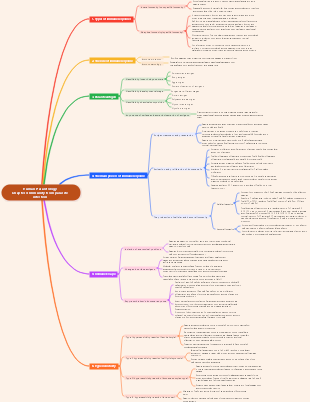
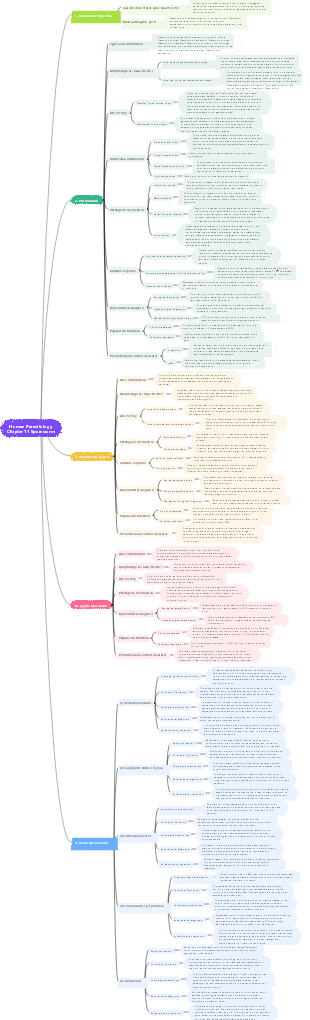



Human Parasitology Chapter 17 Introduction to medical arthropods
1. Basic concepts
Definition description
Arthropods that can endanger human and animal health through harassment, sting, blood sucking, poisoning, parasitizing and spreading pathogens
Detailed explanation of the research subject
Research scope
Covering the classification, morphology, life history, ecology, habits, geographical distribution, pathogenicity and prevention methods of medical arthropods
Discipline significance
It helps to gain an in-depth understanding of medical arthropods and provides a theoretical basis for preventing and controlling their hazards
2. Features
Analysis of body structure
Sectional features
The body segmentation structure makes the body movement of arthropods more flexible, and different body segments can assume different functions.
Symmetrical form
The symmetrical body shape of left and right is conducive to the balance and directional movement of arthropods, and is of great significance in activities such as finding food and escaping natural enemies.
Appendix features
The appendage with segmented parts has various shapes and functions, such as being used for walking, predation, sensation, etc.
Interpretation of body surface characteristics
Ingredient composition
Body surface skeletonization, consisting of chitin and quinone tannin exoskeleton, providing protection and support to the body
Exoskeleton action
Exoskeleton not only prevents water loss, but also resists external physical and chemical damage, while providing attachment points for muscles.
Circulation system analysis
System Type
The circulatory system is open, unlike the closed circulatory system, whose blood flows in the blood cavity and comes into direct contact with tissues and organs.
Blood cavity and hemolymph
The main body of the entire circulatory system is the blood cavity, which contains hemolymph. Hemolymph plays a role in transporting nutrients, metabolic waste and immune cells.
Developmental process description
The molting process
Molting is an important phenomenon in the growth of arthropods. When the old exoskeleton restricts the body's growth, it will remove the old shell and grow new and larger exoskeletons.
Perverted Type
Perversion is divided into complete perversion (such as mosquitoes and flies, which undergo four stages: eggs, larvae, pupa, and adults, with great differences in morphology and living habits) and incomplete perversion (such as cockroaches, etc., which undergo three stages: eggs, nymphs and adults, and the nymphs and adults have similar morphology and living habits)
3. Main categories
Detailed view of the Insecta
Body Division
The insect body is obviously divided into three parts: head, chest and abdomen, and the division of labor is clear.
Head features
There is a pair of tentacles on the head, which is an important sensory organ used to sense chemical and physical information about the surrounding environment.
Chest characteristics
There are 3 pairs of feet on the chest, which are the main parts of exercise. The feet of different insects vary greatly in shape and function, such as jumping feet, walking feet, etc.
Examples of common types
Mosquitoes can spread malaria, filariasis, etc.; flies can spread dysentery, typhoid fever and other diseases; white flies can spread black fever
Detailed description of the arachnid
Body structure
The insect body is divided into the chest and abdomen, or the cephalosa and abdomen heal into the body, with various appearances and shapes
Head features
There are no antennae on the head and chest, but have other sensory structures, such as sensory hair, etc.
Features of foot
There are 4 pairs of feet for walking, predation and perceive the environment
Examples of common types
Ticks can spread forest encephalitis and Lyme disease; mites can cause mite dermatitis, lung mites, etc.
Crustacea analysis
Body composition
Split the head, chest and abdomen, and the body structure adapts to aquatic life
Tentacle characteristics
There are 2 pairs of tentacles on the head and chest, which have functions such as touch, smell and balance.
Step characteristics
5 pairs of footsteps, with diverse shapes and functions, some used for swimming, some used for predation and defense
Examples of common types
Freshwater crabs and freshwater shrimps are the intermediate hosts of pulmonary tidum; Swordflyfly is the intermediate hosts of certain parasites
Interpretation of lip foot radiography
Body shape
The insect body is narrow and long, with a flat abdomen and dorsal, and two parts are divided into two parts, and the overall shape is suitable for moving in a narrow space.
Head features
There is 1 pair of tentacles on the head to perceive the environment
Characteristics of foot
Except for the last two sections, each has one pair. The first pair of feet is transformed into poisonous claws, which is an important organ for defense and predation.
Examples of common types
The poisonous claws of centipedes can secrete venom. After being stung, people will experience local pain, redness, and swelling.
Introduction to the Belief
Body shape
The insect body is long tube-shaped, composed of a head and several similar body segments, and the body structure is relatively simple.
Head features
There is a pair of tentacles on the head to feel the surroundings
Features of foot
Except for the first body section, each section has two pairs of feet, which is more large, which helps to move slowly.
Examples of common types
Gland secretions in the hormonal zodiac often cause skin allergies, and symptoms such as rash and itching may occur after contact.
4. Ecological factors
Temperature influence
Arthropods are temperature-changing animals, and temperature affect their metabolism, growth, reproduction and lifespan. The temperature range is usually 5 - 30°C, and too high or too low can lead to developmental delay, reproductive stagnation and even death. At the same time, temperature also affects the development and reproduction of pathogens in arthropods.
Humidity effect
Relative humidity affects the water balance and metabolism of arthropods, and thus affects their life activities. Different arthropods have different requirements for humidity. Too high or too low humidity will affect their reproduction, survival, etc., and humidity and temperature often work together.
Lighting Relationship
Periodic changes in light affect diapause, diurnal activity and mating in arthropods. Arthropods are phototaxis or light-shielding, and different types of activity time are affected by the intensity of light.
Food factors
Food affects the life activities, population distribution and number of arthropods. Medical arthropods are divided into hematopoietic and non-hematopoietic. Hematopoietic arthropoie has a closer relationship with medicine, and the range of diseases transmitted by monohematopoietic and polyhematopoietic insect species is different.
Biological factors
The biological factors that affect medical arthropods include natural enemies, vegetation, parasites and pathogenic microorganisms. Natural enemies and parasites can be used for biological control, and vegetation provides food and habitat for arthropods.
5. Hazard to humans
Direct hazard
Harassment and blood sucking
Various arthropods such as mosquitoes and fleas suck blood, which affects people's lives and may also cause symptoms such as dermatitis.
Clerot poison
The poisonous glands, poisonous hairs or toxic body fluids of some arthropods can cause harm to people, resulting in local or systemic symptoms, and in severe cases can endanger life.
Hypersensitivity reaction
The saliva, secretions, etc. of arthropods can trigger hypersensitivity reactions in people with allergic constitutions, such as dust mites causing allergic asthma.
Parasitic causes disease
Some arthropods parasitize in the human body can cause a variety of diseases, such as myiasis, scabies, etc.
Indirect hazards (insect-article)
Mechanical transmission
Arthropods only carry pathogens mechanically and spread through contaminated food, etc. The morphology and number of pathogens remain unchanged, such as flies spreading intestinal infectious diseases.
Biological transmission
Pathogens are infectious only after they need to develop and/or reproduce in the body of arthropods, including four types: developmental, reproductive, developmental and transegg transmission.
6. The basis for determining vector arthropods
Biological Evidence
It is closely related to humans, has a large population and is a common local species, and has a long lifespan to ensure that pathogens can develop and proliferate in their bodies.
Epidemiological evidence
The geographical distribution and seasonal growth of arthropods are consistent with or basically consistent with the endemic regions and seasons of insecticide diseases.
Laboratory evidence
Under artificial infection conditions in the laboratory, it can be proven that the pathogen can develop or proliferate in the arthropod and infect susceptible experimental animals.
Evidence of natural infection
Suspicious arthropods collected in endemic areas and epidemic seasons can be isolated naturally infected pathogens after examination, and some pathogens need to be found to be found during the infection period.
7. Prevention method
Environmental protection
According to the ecological characteristics of arthropods, through environmental transformation, treatment and improvement of living conditions, they will reduce their breeding and habitats, and protect the environment of beneficial insects and natural enemies.
Physical defense
Using physical methods such as mechanical force, heat, light, sound, radiation, etc. to hunt, isolate or drive away arthropods, which has the advantages of being easy to use, pollution-free and drug-resistant.
Chemical control
Using natural or synthetic chemicals to poison, repel or lure arthropods. Although there are drug resistance and pollution problems, it is easy to use and quick to achieve results. It is still an important means of prevention and control. You need to understand the characteristics of the vector before use.
Biocontrol
Using organisms or their metabolites to control arthropods has the advantages of being highly specific, harmless to beneficial organisms, and not pollute the environment, such as using viruses, bacteria, fungi, parasitic wasps for prevention.
Genetic prevention
By changing the genetic material of arthropods, reducing their reproductive ability or survival competitiveness, such as releasing sterilized male insects or genetically mutated species, the population is reduced.
Regulations and Prevention
Use laws and regulations to prevent the incoming or outgoing vector arthropods, strengthen inspection and quarantine, and control the spread of insects and vectors, such as eliminating breeding grounds for Aedes mosquitoes when preventing and controlling dengue fever.
"Human Parasitology" Chapter 17 Introduction to Medical Arthropods
1. Basic concepts
i. Definition description
Arthropods that can endanger human and animal health through harassment, sting, blood sucking, poisoning, parasitizing and spreading pathogens
ii. Detailed explanation of the research subject
Research scope
Covering the classification, morphology, life history, ecology, habits, geographical distribution, pathogenicity and prevention methods of medical arthropods
Discipline significance
It helps to gain an in-depth understanding of medical arthropods and provides a theoretical basis for preventing and controlling their hazards
2. Features
i. Analysis of body structure
Sectional features
The body segmentation structure makes the body movement of arthropods more flexible, and different body segments can assume different functions.
Symmetrical form
The symmetrical body shape of left and right is conducive to the balance and directional movement of arthropods, and is of great significance in activities such as finding food and escaping natural enemies.
Appendix features
The appendage with segmented parts has various shapes and functions, such as being used for walking, predation, sensation, etc.
ii. Interpretation of body surface characteristics
Ingredient composition
Body surface skeletonization, consisting of chitin and quinone tannin exoskeleton, providing protection and support to the body
Exoskeleton action
Exoskeleton not only prevents water loss, but also resists external physical and chemical damage, while providing attachment points for muscles.
iii. Circulation system analysis
System Type
The circulatory system is open, unlike the closed circulatory system, whose blood flows in the blood cavity and comes into direct contact with tissues and organs.
Blood cavity and hemolymph
The main body of the entire circulatory system is the blood cavity, which contains hemolymph. Hemolymph plays a role in transporting nutrients, metabolic waste and immune cells.
iv. Developmental process description
The molting process
Molting is an important phenomenon in the growth of arthropods. When the old exoskeleton restricts the body's growth, it will remove the old shell and grow new and larger exoskeletons.
Perverted Type
Perversion is divided into complete perversion (such as mosquitoes and flies, which undergo four stages: eggs, larvae, pupa, and adults, with great differences in morphology and living habits) and incomplete perversion (such as cockroaches, etc., which undergo three stages: eggs, nymphs and adults, and the nymphs and adults have similar morphology and living habits)
Human Parasitology Chapter 17 Introduction to medical arthropods
3. Main categories
I. Detailed view of the Insecta
Body Division
The insect body is obviously divided into three parts: head, chest and abdomen, and the division of labor is clear.
Head features
There is a pair of tentacles on the head, which is an important sensory organ used to sense chemical and physical information about the surrounding environment.
Chest characteristics
There are 3 pairs of feet on the chest, which are the main parts of exercise. The feet of different insects vary greatly in shape and function, such as jumping feet, walking feet, etc.
Examples of common types
Mosquitoes can spread malaria, filariasis, etc.; flies can spread dysentery, typhoid fever and other diseases; white flies can spread black fever
II. Detailed description of the arachnid
Body structure
The insect body is divided into the chest and abdomen, or the cephalosa and abdomen heal into the body, with various appearances and shapes
Head features
There are no antennae on the head and chest, but have other sensory structures, such as sensory hair, etc.
Features of foot
There are 4 pairs of feet for walking, predation and perceive the environment
Examples of common types
Ticks can spread forest encephalitis and Lyme disease; mites can cause mite dermatitis, lung mites, etc.
III. Crustacea analysis
Body composition
Split the head, chest and abdomen, and the body structure adapts to aquatic life
Tentacle characteristics
There are 2 pairs of tentacles on the head and chest, which have functions such as touch, smell and balance.
Step characteristics
5 pairs of footsteps, with diverse shapes and functions, some used for swimming, some used for predation and defense
Examples of common types
Freshwater crabs and freshwater shrimps are the intermediate hosts of pulmonary tidum; Swordflyfly is the intermediate hosts of certain parasites
IV. Interpretation of lip foot radiography
Body shape
The insect body is narrow and long, with a flat abdomen and dorsal, and two parts are divided into two parts, and the overall shape is suitable for moving in a narrow space.
Head features
There is 1 pair of tentacles on the head to perceive the environment
Characteristics of foot
Except for the last two sections, each has one pair. The first pair of feet is transformed into poisonous claws, which is an important organ for defense and predation.
Examples of common types
The poisonous claws of centipedes can secrete venom. After being stung, people will experience local pain, redness, and swelling.
V. Introduction to the Belief
Body shape
The insect body is long tube-shaped, composed of a head and several similar body segments, and the body structure is relatively simple.
Head features
There is a pair of tentacles on the head to feel the surroundings
Features of foot
Except for the first body section, each section has two pairs of feet, which is more large, which helps to move slowly.
Examples of common types
Gland secretions in the hormonal zodiac often cause skin allergies, and symptoms such as rash and itching may occur after contact.
"Human Parasitology" Chapter 17 Introduction to Medical Arthropods
4. Ecological factors
i. Temperature influence
Arthropods are temperature-changing animals, and temperature affect their metabolism, growth, reproduction and lifespan. The temperature range is usually 5 - 30°C, and too high or too low can lead to developmental delay, reproductive stagnation and even death. At the same time, temperature also affects the development and reproduction of pathogens in arthropods.
ii. Humidity effect
Relative humidity affects the water balance and metabolism of arthropods, and thus affects their life activities. Different arthropods have different requirements for humidity. Too high or too low humidity will affect their reproduction, survival, etc., and humidity and temperature often work together.
iii. Lighting Relationship
Periodic changes in light affect diapause, diurnal activity and mating in arthropods. Arthropods are phototaxis or light-shielding, and different types of activity time are affected by the intensity of light.
iv. Food factors
Food affects the life activities, population distribution and number of arthropods. Medical arthropods are divided into hematopoietic and non-hematopoietic. Hematopoietic arthropoie has a closer relationship with medicine, and the range of diseases transmitted by monohematopoietic and polyhematopoietic insect species is different.
v. Biological factors
The biological factors that affect medical arthropods include natural enemies, vegetation, parasites and pathogenic microorganisms. Natural enemies and parasites can be used for biological control, and vegetation provides food and habitat for arthropods.
5. Hazard to humans
i. Direct hazard
Harassment and blood sucking
Various arthropods such as mosquitoes and fleas suck blood, which affects people's lives and may also cause symptoms such as dermatitis.
Clerot poison
The poisonous glands, poisonous hairs or toxic body fluids of some arthropods can cause harm to people, resulting in local or systemic symptoms, and in severe cases can endanger life.
Hypersensitivity reaction
The saliva, secretions, etc. of arthropods can trigger hypersensitivity reactions in people with allergic constitutions, such as dust mites causing allergic asthma.
Parasitic causes disease
Some arthropods parasitize in the human body can cause a variety of diseases, such as myiasis, scabies, etc.
ii. Indirect hazards (insect-article)
Mechanical transmission
Arthropods only carry pathogens mechanically and spread through contaminated food, etc. The morphology and number of pathogens remain unchanged, such as flies spreading intestinal infectious diseases.
Biological transmission
Pathogens are infectious only after they need to develop and/or reproduce in the body of arthropods, including four types: developmental, reproductive, developmental and transegg transmission.
"Human Parasitology" Chapter 17 Introduction to Medical Arthropods
6. The basis for determining vector arthropods
i. Biological Evidence
It is closely related to humans, has a large population and is a common local species, and has a long lifespan to ensure that pathogens can develop and proliferate in their bodies.
ii. Epidemiological evidence
The geographical distribution and seasonal growth of arthropods are consistent with or basically consistent with the endemic regions and seasons of insecticide diseases.
iii. Laboratory evidence
Under artificial infection conditions in the laboratory, it can be proven that the pathogen can develop or proliferate in the arthropod and infect susceptible experimental animals.
iv. Evidence of natural infection
Suspicious arthropods collected in endemic areas and epidemic seasons can be isolated naturally infected pathogens after examination, and some pathogens need to be found to be found during the infection period.
7. Prevention method
i. Environmental protection
According to the ecological characteristics of arthropods, through environmental transformation, treatment and improvement of living conditions, they will reduce their breeding and habitats, and protect the environment of beneficial insects and natural enemies.
ii. Physical defense
Using physical methods such as mechanical force, heat, light, sound, radiation, etc. to hunt, isolate or drive away arthropods, which has the advantages of being easy to use, pollution-free and drug-resistant.
iii. Chemical control
Using natural or synthetic chemicals to poison, repel or lure arthropods. Although there are drug resistance and pollution problems, it is easy to use and quick to achieve results. It is still an important means of prevention and control. You need to understand the characteristics of the vector before use.
iv. Biocontrol
Using organisms or their metabolites to control arthropods has the advantages of being highly specific, harmless to beneficial organisms, and not pollute the environment, such as using viruses, bacteria, fungi, parasitic wasps for prevention.
v. Genetic prevention
By changing the genetic material of arthropods, reducing their reproductive ability or survival competitiveness, such as releasing sterilized male insects or genetically mutated species, the population is reduced.
vi. Regulations and Prevention
Use laws and regulations to prevent the incoming or outgoing vector arthropods, strengthen inspection and quarantine, and control the spread of insects and vectors, such as eliminating breeding grounds for Aedes mosquitoes when preventing and controlling dengue fever.