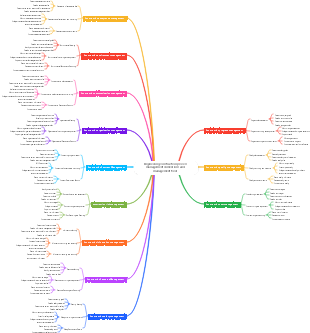
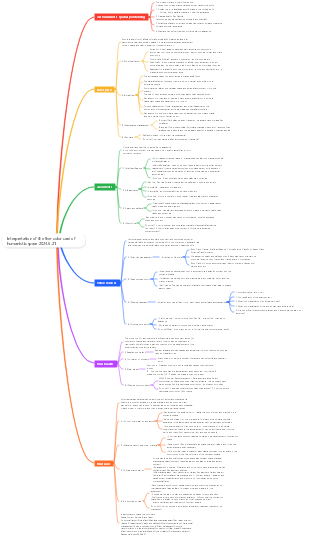
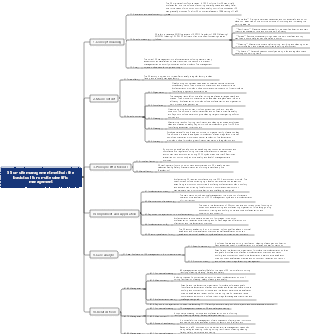
Lesson 12 Tools you must know for marketing—4P, 4C, 4R
Focus on products - focus on the seller's market - focus on users - focus on the buyer's market
4C
4C strengthens a marketing group centered on consumer needs
4R
4R marketing focuses on establishing a win-win relationship between enterprises and customers/truly embodies and implements the idea of relationship marketing
Lesson 11 Strategic Tools for Strategic Business Selection-BCG Matrix
(Horizontal axis: relative market share/vertical axis: market growth rate)
Corporate strategy and product structure tools
Star business: high growth/high market share
A leader in a fast-growing market/it will bring future cash flow business to the company
Problem Business: High Growth/Low Market Share
Affirmative answer: Growth strategy, aiming to expand business market share
Cash Cow Business: Low Growth/High Market Share
Stable strategy/purpose to maintain business unit market share
Thin Dog Business: Low Growth/Low Market Share
Shrink strategy/sell or liquidate
The essence of BCG: the optimized combination of business to achieve the balance of corporate cash flow
Lesson 1: The Knack of Situational Management-SKILL WILL Model
How managers can unleash the potential of team members at different stages of the team
MS1 stage: low skills and high enthusiasm
Corresponding management method: skills training
MS2 stage: Ability has just been developed, setbacks need to be overcome and work enthusiasm needs to be improved
Corresponding management method: inner counseling, giving confidence
MS3 stage: medium to high ability and fluctuating enthusiasm
Corresponding management methods: give trust, do more authorization, employee autonomy, and exert value
MS4 stage: High skills and high enthusiasm stage
Corresponding management style: Give new challenges and recognize their abilities
At different stages of development, with different characteristics and characteristics, corresponding management methods are given
Lesson 2: A powerful tool for resolving team conflicts-TK model
Identify the details of a conflict and find a course of action to resolve it
Different strategies are adopted based on the leader’s attitude towards conflict (vertical axis)/whether the conflict parties in the team are willing to cooperate with the leader in resolving conflict scenarios.
Zero-sum game, there are not enough resources and methods to resolve/adopt conflict avoidance strategies
Be sure to solve the problem in a win-win situation. You must be tough and express your own ideas, goals, and bottom lines/adopt competitive strategies.
There is a conflict, and there is no solution. Make an offer while giving in, and maintain the balance of power during equilibrium/adopt an accommodating strategy.
For expedient measures, we must repeatedly weigh whether the relevant conflict parties are willing to accept this strategy/adopt selective compromise.
Win-win and multi-win/collaboration
Encourage meaningful conflict and stifle unhealthy conflict
Lesson 3: Find the most scientific model for accurate user positioning-RFM
Understand customers, customer segmentation
R: RECENCY: The customer’s last consumption time (recency)
F: FREQUENCY: Frequency of customer transactions or visits (frequency)
M: MONETARY user’s consumption amount and purchasing power (amount)
Segment customer groups through the RFM model, screen valuable customers, find the reasons for customer churn, discover potential customers using different strategies, retain and improve customer loyalty to build relationships and better market.
important value customers
Important development customers
Important to keep customers
Important to regain customers
General development customers
General customer retention
Lesson 10 The best combination of strategic decoding and goal management-BSC
BSC Balanced Scorecard
Financials: What we show shareholders in terms of financial performance
Internal processes: To satisfy shareholders and customers, what key business processes should we do well?
Learning and growth: To achieve performance targets, we learn to master what we change and what we create
Customers: What should we show to customers to achieve performance planning?
strategic map
Determine the shareholder value gap
Align your customer value proposition
Emphasis on product innovation and leadership
Emphasis on providing comprehensive customer solutions
Determine value improvement timeline
Determine the theme of the strategy
Internal operation management process of the enterprise
Customer management process
Improve strategic readiness
Develop a series of execution plans
Lesson 13 McKinsey’s classic strategic planning tool-3 levels (growth ladder concept)
The first level is to expand and ensure the core
operating costs and productivity
The second level: developing new business
capital investment efficiency
The third level: new business
The future development direction of listed companies and the seeds of business selection
The development engine for the company’s sustainable operations
Lesson 14 Effective methods to improve organizational capabilities-Yang Sanjia
The success of an enterprise is based on strategy and organizational capabilities, improving organizational capabilities
Lesson 7 Huawei’s strategic planning and execution secrets-BLM
Tools for corporate strategy and organizational execution
Market results: performance gaps - discovering opportunities - deploying strategies
2.Strategy
strategic intent
Vision, mission and mid- and long-term strategic goals
market insights
Influencing factors: politics/economics/society/environment
innovation focus
future business portfolio
business design
Understanding strategic intentions/external analysis of the industry/analysis of our innovation points
3.Execution
Talent
1. What are the requirements for key positions and talents - they need to be defined in detail
2. Gaps and challenges in talents and abilities – what abilities are lacking?
3. Acquisition - internal acquisition, timely cultivation, external acquisition
4. Motivation and retention
atmosphere and culture
1. Culture: social control system norms
2. Organizational climate: perception of the work environment
Critical tasks/dependencies
Lesson 6: Methods to unearth the core competition of enterprises-VRIO
Determine whether the company's resource capabilities can continue to bring competitive advantages to the company
Lesson 5 Product and Business Selection Strategy Model-Ansoff Model
Business analysis tools to select strategic models
Markets and Products
Market development (new markets, old products))
Markets in different regions/markets with different customer groups
Diversification
horizontal diversification
Market Penetration (Existing Market, Existing Products)
Increase purchase quantity
Promotion/diversified prices/acquisition of peers
Product extension (existing market, new products)
Extended to peripheral products
New products and product portfolio
personal career development
Lesson 4: Practice Basic Skills for Manager Interviews-STAR
Structured interview methods provide a more accurate understanding of the interviewer’s true situation and find outstanding talents
Lesson 8 The classic method of management by objectives-SMART
1. It is a reference tool when setting goals. 2. It will be used as a tool when we work on performance in the team or company.
S: specific clear and specific
M: measurable can be measured
A: Attainable can be achieved
T: time-bound has a time limit
Lesson 9 Timeless performance evaluation method-360 evaluation
All-round, multi-dimensional, comprehensive
 Wondershare EdrawMind