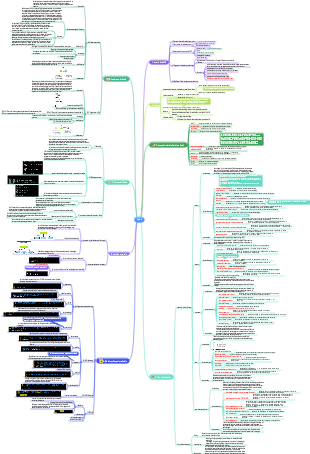
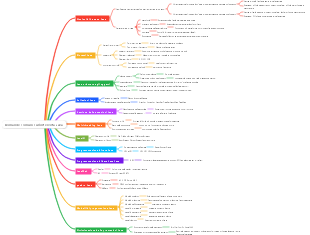
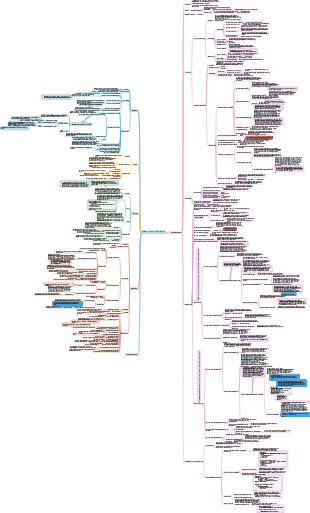
Complement law:
(i) A∪A' = U (ii) A∩A'= φ
De morgan’s Law:
(i) (A∪B)' = A'∩B' (ii) (A∩B)' = A'∪B
Double Complement law: (A')' =A
Law of empty set and universal set φ'=U and U' = φ
If U is a universal set and A is a subset of U, then complement of A is the set which contains those elements of U, which are not present in A and is C denoted by A’ or A . Thus, c A = {x: x∈U and x∉A} e.g.: If U = {1, 2, 3, 4, …} and A = {2, 4, 6, 8, ….} c then A = {1, 3, 5, 7, …}
1.The set of natural numbers N={1, 2, 3, 4, 5, – – –}
2. The set of integers Z={. . . –3, –2, –1, 0, 1, 2, 3,– – –}
3.The set of irrational numbers, T = {x: x∈R and x∈Q}
4. The set of rational number Q={x : x = pq , p, q ∈Z and q ≠ 0} Relation among these subsets are N ⊂ Z ⊂ Q, Q ⊂ R,T ⊂ R, N ⊄T
The symmetric difference of two sets A and B, denoted by A ∆ B, in defined as
(A ∆ B)=(A–B) ∪ (B – A)
Eg. If A = {1, 2,3,4,5} and B = {1,3,5,7,9} then (A ∆ B)= (A–B) ∪ (B – A) = {2, 4,} ∪ {7, 9} = {2, 4, 7, 9}
If A and B are two sets, then their difference A‐B is defined as: A–B = {x : x ∈ A and x ∉B} Similarly, B – A = {x : x ∈B and x ∉A}
Eg. If A={1,2,3,4,5,} and B={1,3,5,7,9} then A–B={2,4} and B–A={7,9}
The intersection of two sets A and B, written as A∩B (read as ‘A’ intersection ‘B’) is the set consisting of all the common elements of A and B. Thus, A∩B = {x : x∈Aand x∈B} Clearly, x∈A∩B⇒ {x∈A and x∈B} and x∉A∩B ⇒ {x ∉A or x ∉B}.
Eg: If A={a,b,c,d} and B={c,d,e,f} Then A∩B = {c,d}
Two sets A and B are said to be disjoint, if A∩B =φ i.e, A and B have no common element. e.g: if A = {1, 3, 5} and B = {2, 4, 6} Then, A∩B =φ , so A and B are disjoint.
The union of two sets A and B, written as A∪B (read as A union B) is the set of all elements which are either in A or in B in both. Thus, A∪B = {x: x ∈A or x ∈B} clearly, x ∈ A∪B ⇒ x ∈A or x ∈ B and x ∉A∪B⇒x ∉A and x ∉B
eg: If A = {a, b, c, d} and B ={c, d, e,f } then A∪B = {a, b, c, d, e, f}
1. For any set A, we have (a) A∪A=A, (b) A∩A=A, (c) A∪φ=A, (d) A∩φ=φ, (e) A∪ U=U (f) A∩U=A, (g) A− φ=A, (h)A−A=φ
2. For any two sets A and B we have (a) A∪B = B∪A, (b) A∩B= B∩A, (c) A−B⊆ Α, (d) B−A⊆B
3. For any three sets A,B and C, we have (a) A∪(B∪C)= (A∪B)∪C, (b) A∩(B∩C)= (A∩B)∩C (c) A∪(B∩C)=(A∪B)∩(A∪C), (d) A∩(B∪C)=(A∩B) ∪(A∩C) (e) A−(B∪C)=(A−B) )∩(A–C), (f) A–(B∩C)=(A–B)∪(A–C)
A Venn diagram is an illustration of the relationships between and among sets, groups of objects that share something common. These diagrams consist of rectangle and closed curves usually circles In the given venn diagram U={1,2,3,.......10} universe set of which A={2,4,6,8,10} and B={4,6} are subsets and also B⊂A
The set containing all objects of element and of which all other sets are subsets is known as universal sets and denoted by U. E.g : For the set of all intergers, the universal set can be the set of rational numbers or the set R of real numbers
The set of all subset of a given set A is called power set of A and denoted by P(A). E.g : If A ={1,2,3,}, then P (A)={φ}, {1},{2}, {3},{1,2},{1,3},{2,3},{1,2,3}. Clearly, if A has n elements, then its power set P (A) contains exactly n2 elements.
In this form, we first list all the members of the set within braces
(curly brackets) and separate these by commas.
Eg: The set of all natural number less than 10 in this form is written
as: A = {1, 3, 5, 7, 9}
In roaster form, every element of the set is listed only once.
The order in which the elements are listed is immaterial.
Eg. Each of the following sets denotes the same set
{1, 2, 3}, {3, 2, 1}, {1, 3, 2}
In this form, we write a variable (say x) representing any member
of the set followed by property satisfied by each member of the set.
eg.: The set A of all prime number less than 10 in set builder form is
written as
A = {x | x is a prime number less than10}
The symbol “|” stands for the word “such that”. Sometimes, we use
symbol “:” in place of symbol “|”
A set is collection of well‐defined distinguished objects. The sets are
usually denoted by capital letters A, B, C etc., and the members or
elements of the set are denoted by lower case letters a, b, c etc.., If x is
a member of the set A, we write x ∈A (read as ‘x’ belongs to A) and if
x is not a member of set A, we write x ∉A(read as ‘x’ doesn’t belongs
to A). If x and y both belong to A, we write x, y ∈ A.
Some examples of sets are: A: odd numbers less than 10
N: the set of all rational numbers
B : the vowels in the English alphabates
Q: the set of all rational numbers.
A set having one element is called singleton set.
e.g.: (i) {0} is a singleton set, whose only member is 0.
(ii) A = {x: 1<x <3, x is a natural number} is a singleton set
which has only one member which is 2.
Two sets A and B are set to be equal, written as A = B, if every
element of A is in B and every element of B is in A.
e.g.: (i) A = {1, 2, 3,4} and B = {3, 1, 4, 2}, then A = B
(ii) A = {X: X − 5 = 0} and B = {X : X is an integral positive root of the equation x −2x−15 = 0}
Then A = B
A set which has finite number of elements is called a finite set. Otherwise, it is called an infinite set.
E.g.: The set of all days in a week is a finite set whereas the set of all integers, denoted by
{……−2, −1, 0, 1, 2,……} or {X | X is an integer} is an infinite set.
An empty set φ which has no element is a finite set A is called empty or void or null set.
A set which has no element is called null set. It is denoted by symbol φ or {}.
E.g: Set of all real numbers whose square is −1.
In set-builder form: {X : X is a real number whose square is −1}
In roaster form: { } or φ
Two finite sets A and B are said to be equivalent, if
n(A) = n(B). Clearly, equal set are equivalent but equivalent
set need not to be equal.
e.g.: The sets A = {4, 5, 3, 2} and B = {1, 6, 8, 9} are equivalent, but are not equal.
The number of elements in a finite set is
represented by n (A), known as cardinal
number.
Eg .: A = {a, b, c, d, e} Then, n (A) = 5
Let A and B be two sets. If every element of A is an
element of B,then A is called a subset of B and
written as A ⊂ B or B ⊃ A(read as ‘A’ is contained in
‘B’ or ‘B contains A’). B is called superset of A.
Note:
1. Every set is a subset and superset of itself.
2. If A is not a subset of B, we write A ⊄ B.
3. The empty set is the subset of every set.
4. If A is a set with n(A) = m, then no. of element
A are 2 and the number of proper subsets
n of A are 2
Eg. Let A = {3, 4}, then subsets of A are φ, {3}, {4},
{3, 4}. Here, n(A) = 2 and number of subsets
2 of A = 2 =4