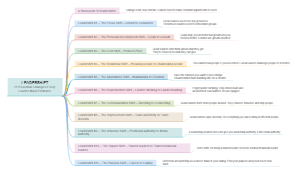
“…it was Shakespeare who said, “When in disgrace with fortune and men’s eyes”. It was a state with which I felt myself most familiar” [pg. 14]
Maya feels unfortunate that she is bound by racial circumstances, and her relatability to those that are “disgraced” displays that she feels humiliated and shunned by the judgements of others. She views herself as the result of a fallout with fortune as she has been ‘cursed’ to live the life of a lowly, black girl. This allusion to Shakespeare’s sonnet demonstrates that even as Maya escapes from reality to literature, her insecurities follow as she is able to easily identify and retain relatable pieces.
“If growing up is painful for the Southern Black girl, being aware of her displacement is the rust on the razor that threatens the throat. It is an unnecessary insult.” [pg. 4]
Maya always dwells on how she lacks in comparison to others instead of appreciating what she has. It is her awareness and obsession with her shortcomings, or in other words, it is her insecurity that acts as “the rust on the razor” - a metaphor - that threatens her security and identity. The two sentences serve as an allegory as it paints an abstract concept: Maya is already born into a segregated black community only to suffer further isolation from her own community. This is a tragic state of living, “an unnecessary insult”.
“What you looking at me for? I didn’t come to stay…” [pg. 1]
Wouldn’t they be surprised when one day I woke out of my black ugly dream, and my real hair, which was long and blond, would take the place of the kinky mass that Momma wouldn’t let me straighten? My light-blue eyes were going to hypnotize them…Because I was really white and because a cruel fairy stepmother, who was understandably jealous of my beauty, had turned me into a too-big Negro girl, with nappy black hair, broad feet and a space between her teeth that would hold a number-two pencil” [pg. 2-3]
This quote exemplifies how Maya would rather be someone else and is particularly insecure about her black skin. She refuses to identify herself with her own race and seeks acceptance by adopting a physical appearance she would much rather be confident in. The visual imagery illustrated by the use of hyperboles coupled with the allusion to fairytales (fairy stepmother), demonstrates Maya’s childishness and shocking self-evaluation and degradation.
The repetition of this phrase in the prologue serves as a denotation of the situation: Maya’s self-consciousness causes her to hesitate and forget the hymn. However the connotation of this incomplete phrase introduces the sense of displacement that carries throughout her life. This displacement consequently leads to her self-isolation and feeling that she doesn’t belong.
“After a month my thinking processes had so changed that I was hardly recognizable to myself. The unquestioning acceptance by my peers had dislodged the familiar insecurity.”
After spending time living in the junkyard with the other teenagers, Maya finds comfort and security through the acceptance of her peers. She continues to abandon the insecurity she experienced during her childhood and begins to grow older, find her identity and feel like a different person.
“Just as gratefulness was confused in my mind with love, so possession became mixed up with motherhood. I had a baby. He was beautiful and mine. Totally mine.”
With the birth of her son, Maya seems to finally find and accept her identity and becomes more secure as a result. She realizes that it does not matter who or what she is, a woman, child, or ugly, she was now a mother of a beautiful child and that is all that is important. Her struggles with insecurities have diminished as she is able to confirm her identity as a mother.
The caesura which is caused by the short remarks near the end of this quotation (such as “I had a baby.”) represent Maya’s happiness concerning her child and the fact that he was completely hers.
“Bailey and Mother encouraged me to take dance, and he privately told me that the exercise would make my legs big and widen my hips. I needed no greater inducement. My shyness at moving clad in black tights around a large empty room did not last long. Of course, at first, I thought everyone would be staring at my cucumber-shaped body with its knobs for knees, knobs for elbows and, alas, knobs for breasts. But they really did not notice me, and when the teacher floated across the floor and finished in an arabesque my fancy was taken. I would learn to move like that"
Maya decides to start dance because she is told it will give her a more womanly body. This persuades her to start dancing since she is uncomfortable with her underdeveloped body. Maya is first concerned that everyone would be looking at her unattractive body while she danced. Then, she begins to realize that no one even takes notice of her body and she becomes more focused and interested on learning how to dance. This shows her transition from an insecure girl to becoming more comfortable and confident with herself.
“‘Those things growing on my… vagina, and my voice is too deep and my feet are big, and I have no hips or breasts or anything. And my legs are so skinny.’”
Maya believes she is a lesbian because she does not see herself as a typical girl, instead she feels she is different and ugly. She questions her identity and sexuality.
Once again we recognize a polysyndeton through the repetition of the word “and” to emphasize Maya’s insecurity concerning her body. Also, the caesura present in this quotation can be seen through the use of the ellipses and symbolizes the discomfort which Maya feels speaking about the topic of sexuality and the human body due to her insecurity in herself.
“What I needed was a boyfriend. A boyfriend would clarify my position to the world and even more important, to myself. A boyfriend’s acceptance of me would guide me into that strange and exotic land of frills and femininity.”
Maya believes in order for her identity to be accepted by herself and others, she needed a boyfriend. She would then be sure of her heterosexuality and femininity since having a boyfriend would provide her with this validation. Her dependence on a boy’s acceptance displays her insecurities.
The caesura which is caused by the short remarks near the end of this quotation (such as “I had a baby.”) represent Maya’s happiness concerning her child and the fact that he was completely hers.
“Signs with arrows around the barbecue pit pointed MEN, WOMEN, and CHILDREN toward fading lanes, grown over since last year. Feeling ages old and very wise at ten, I couldn’t allow myself to be found by small children squatting behind a tree. Neither did I have the nerve to follow the arrow pointing the way for WOMEN… So when the urge hit me to relieve myself, I headed toward another direction.”
Maya is unsure of her identity displaying her insecurity. She cannot decide whether she is a woman, child, or something else when she goes to use the bathroom and ultimately decides to head in another direction.
. “And the recording angel was gone. He was gone, and a man was dead because I lied. Where was the balance in that? One lie surely wouldn’t be worth a man’s life” [pg. 86] . “I could feel the evilness flowing through my body and waiting, pent up, to rush off my tongue if I tried to open my mouth. I clamped my teeth shut, I’d hold it in. If it escaped, wouldn’t it flood the world and all the innocent people” [pg. 87] “Just my breath, carrying my words out, might poison people and they’d curl up and die like the black fat slugs that only pretended. I had to stop talking” [pg. 87]
While the misconception of Mr. Freeman’s death is rooted in Maya’s naivety, it is strengthened by her insecurity and understanding of self. Her misconstrued sense of self causes her to constantly blame herself. Throughout her childhood, Maya has a distorted view of herself and in this situation she lacks faith in her own innocence. Maya’s allusion to the police officer as a “recording angel” (an angel assigned by God to record events, actions etc. in Christian, Judaic and Islamic angelology) exemplifies her moral and religious self-conviction as she even personifies evil to be “flowing” through her body.
“Then the possibility of being compared with him occurred to me, and I didn’t want anyone to see him. Maybe he wasn’t my real father” [pg.55] Mother’s beauty literally assailed me…I was struck dumb. I knew immediately why she had sent me away. She was too beautiful to have children. I had never seen a woman as pretty as she who was called “Mother”...They were more alike than she [Vivian] and I, or even he [Bailey] and I. They both had physical beauty and personality, so I figured it figured” [pg. 60]
Due to her childishness and naive nature, Maya has an awestruck perception of her seemingly perfect parents. Their perfection however only deepens the supposed contrast between them and their daughter. They embody all that Maya desires: physical beauty and an aura that captivates people. Hence Maya’s insecurities twistedly justify her parents’ abandonment as she reasons that she is easily dispensable.
“Then came the terrible Christmas with its awful presents…the gifts opened the door to questions that neither of us wanted to ask. Why did they send us away? and What did we do so wrong?” [pg. 53]
Her childhood abandonment can be seen as the source of her insecurity as it developed her doubts about whether she is good enough; Maya concludes that if she wasn’t worth much to her parents, how much more could she be worth to others.
 Wondershare EdrawMind