MindMap Gallery Nature vs. Nurture
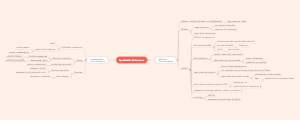
The nature-nurture debate is an ancient one that asks the question: To what extent are human traits and behaviors determined by nature (genes or biology) and to what extent are they determined by nurture (environment or experience)?
Edited at 2021-06-30 09:03:11Nature vs Nurture
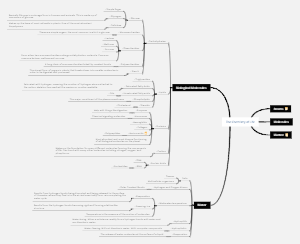
Nature
The contributions of heredity to our physical structure and behaviours
HISTORICALLY
Francis Galton (1869) viewed Nature and Nurture as competing for control over structure and behaviour, but today psychologists believe that the two are closely intertwined in particular types of behaviour.
Nurture
The contributions of environmental factors and experience to our physical structure and behaviours
Nature & Nurture Intertwined
Subtopic
Genetics
7. Gene Expression
This occurs when genetic instructions are used to produce a particular protein
The process in which genetic instructions are converted into a feature of a living cell
Although each cell contains the instructions for the entire human organism, only a subset of instructions is expressed at any given time and location
Gene expression in a nerve cell is different from that in a muscle or skin cell.
Subtopic
8. Allele
One of several versions of a gene
9. Homozygous
Having 2 of the same alleles for a gene
If both parents contribute the same type of allele, the child would be considered homozygous for that gene.
10. Heterozygous
Having two different alleles for a gene
If parents contribute two different alleles, the child is geterozygous for that gene
11. Recessive Alleles
These determine a phenotype only when an individual is homozygous for a particular gene
Written as lower case letters
12. Dominant Alleles
These determine a phenotype in either homozygous or heterozygous condition.
Written as a capital letter
6. Gene
A small segment of DNA located in a particular place on a chromosome
Each gene contains instructions for making a particular type of protein
5. Phenotype
Observable and physical characteristics
4. Genotype
A personal set of instructions
Half come from Mother and Half come from Dad
3. Chromosome
A structure found inside the nucleus of a single cell
Made up of proteins and DNA organized into genes
Each cell normally contains 23 pairs of chromosomes
2. Genome
A set of intructions for building a human
1. Cell
Basic building blocks of all living things.
In most cells there is a structure called the Nucleus which contains the genome.
In humans the genome is split between 23 pairs of chromosomes
Relatedness
The prbability that two people share copies of the same allele from a common ancestor.
Relatedness is usually computed within a limited number of generations
The chances that you share an allele with one of your parents is 1/2. Same as for a sibling. First cousins have a 1/8 likelihood of sharing an allele.
Sex chromosomes
Of the 23 pairs of human chromosomes from each parent, 22 are perfectly matched. ie. A gene appearing on one of a pair of chromosomes has a corresponding gene on its partner.
X chromosome is larger and contains roughly 2000 active genes.
Y chromosomes have fewer than 100 active genes.
Females carry XX Chromosomes
Males carry XY Chromosomes
Info graphic
How does evolution occur
Evolution
Descent with modification from a common ancestor
Charles Darwin proposed that species evolve or change from one form to the next in an orderly manner.
A farmer's goal to raise the strongest oxen might be accomplished by the breeding the strongest available oxen with each other. This is known as artificial selection
Natural selection is the process by which survival and reproduction pressures act to change the frequency of alleles in subsequent generations
Mechanisms of evolution
Evolution can result from mutation, migration and genetic drift
A mutation is an error that occurs when DNA is replicated. Mutant alleles providing some advantage spread through the population. While those that result in a disadvantage disappear from future generations.
Migration occurs when organisms move from one geographical location to the next.
Genetic drift produces change from one generation to the next through chance or accident
Any consideration of evolution must include the question of what natural selection selects. Natural selection favours the organism with the higest degree of fitness.
Fitness is defined as the ability of one genotype to reproduce relative to other genotypes. The concept of fitness includes survival to adulthood, ability to find a mate and reproduction.
Fitness describes the interaction between characteristics and the environment in which they exist
Adaptation
Refers to the process or result of change because of natural selection. ie. a species can respond to an environmental change by adapting, and features of the new phenotype are called adaptations
Adaptations can be behaviours (jumping higher) or anatomical features (eyes that see colour)
Any adaptation that is good enough to contribute to the fitness of the organism will carry forward into future generations.
Evolution of the human brain
Over 7 million years homonims (species that walked on 2 feet and had large brains) brains grew quickly, suggested improved intelligence was translated into substantial advantages in survival.
The major factor distinguishing human intelligence from that of other species is the richness and complexity of social behavior.
Distinguishing between friend or foe, imitate the behaviour of others, use language, recognize and anticipate emotions, thoughts and behaviour of others, maintain relationships and cooperate required the evolution of a special brain.
How does evolution influence behaviour
Evolutionary psychology perspective
Evolutionary psychology is a direct descendant of the functionalism support by William James
Current behaviour exists because it provided some advantage in survival and reproduction to our ancestors
Behaviour is seen as promoting survival as opposed to being random and pointless. It serves as a function for a species survival.
The goal of evolutionary psychology is to explain how the patterns of behaviour that we share with other humans have been shaped by evolution.
Origins of social behaviour
Belonging to a social group provides the benefits of mutual protection and assistance. Being on the perimeter is risky for fish swimming in a ball as predators will hunt on the perimeter as it is easier to isolate prey. The same is true for humans and explains why we reacts emotionally when we believe we are being socially excluded.
Being social carries costs and benefits. Social animals face injury in competition for food and mates and are exposed to contagious illness.
Individuals either benefit or do not benefit from the interaction, ultimately affecting their survival and reproductive success.
Cooperation - if 2 hunters work together to hunt an animal neither could successfully hunt alone. Sharing the meat would contriute to their survival and reproductive success.
Selfishness - one person could steal food from another, allowing the thiefs family to survive while the victim's familt starves to death.
Spite - in this interaction, both parties lose. In some divorce proceedings, the partners are so determined from maintaining resources that everything goes to the attorneys.
Altruism - one individual's self-sacrifice is designed to benefit another individual. This behaviour is more common among related individuals. Honeybees sting to defend the hive, but die in the process.
Reciprocal altruism - occurs when we help another individual who is likely to return the favour at some future time.
Sexual Selection
Darwin's term for the development of traits that help an individual compete for mates.
Parental Investment
Sexual selection is inluenced by the different investments in parenting made by males & females. For the most part, the female bears most costs of reproduction, from carrying (pregnancy) of the developing organism until birth to the nurturing of the young until adulthood. As a result females are more limited than males on the number of children they can produce in a lifetime.
Because males have a lower investment of time and resources in reproduction the best reproductive strategy would be promiscuity. However this is not the case - a male who abandons his offsrping puts their survival at risk. Even if he fathers many children, his genes are less likely to make it to the next generation if most or all perish from lack or care or protection.
A mother can maximise her children's chance of survival by choosing a father who will pass along healthy genes and participate in the raising of the children. Women have the ability to make accurate oredictions of a man's interest in children by looking at a photograph of his face.
Traits influenced by sexual selection
Intrasexual selection is when members of one sex compete with one another for access to the other sex. Deers engaged in fights that determine which males are allowed to mate and which aren't. Features like antlers assist in winning a fight.
In Intersexual selection characteristics of one sex that attract the other might become sexually selected. The male peacock's luxurious tail appears to have developed for the sole purpose of attracting mates.
Human males use humour and vocabularies to impress females with their inteligence because of intersexual selection. However, risky behaviour, which is not attractive to females, can have indirect positive outcomes for males. Dominant, successful males are likely to attract more females...dominance being decided on the intrasexual competition in risky endeavors.
Culture
Human societies are directly influenced by our biological history but also culture. Cultures provide practices, values and goals shared by a group of people. Experiences shapes by culture interact with survival and reproductive pressures.
With all the flaws of our groups: families, communities or nations, humans retain a strong need to belong. Humans do not thrive in isolation. Humans dependence on kinship, friendship and group membership continues to influence our behaviour.