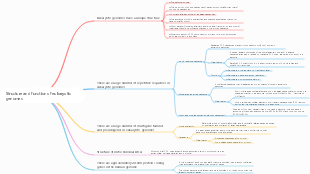
MindMap Gallery Structure and function of eukaryotic genes
Molecular Biology, Human Resources and Social Security 9th Edition, It is a basic unit that can encode proteins or RNA and other products with specific functions and carry genetic information.
Edited at 2024-02-08 16:49:42Avatar 3 centers on the Sully family, showcasing the internal rift caused by the sacrifice of their eldest son, and their alliance with other tribes on Pandora against the external conflict of the Ashbringers, who adhere to the philosophy of fire and are allied with humans. It explores the grand themes of family, faith, and survival.

This article discusses the Easter eggs and homages in Zootopia 2 that you may have discovered. The main content includes: character and archetype Easter eggs, cinematic universe crossover Easter eggs, animal ecology and behavior references, symbol and metaphor Easter eggs, social satire and brand allusions, and emotional storylines and sequel foreshadowing.
[Zootopia Character Relationship Chart] The idealistic rabbit police officer Judy and the cynical fox conman Nick form a charmingly contrasting duo, rising from street hustlers to become Zootopia police officers!
Avatar 3 centers on the Sully family, showcasing the internal rift caused by the sacrifice of their eldest son, and their alliance with other tribes on Pandora against the external conflict of the Ashbringers, who adhere to the philosophy of fire and are allied with humans. It explores the grand themes of family, faith, and survival.
This article discusses the Easter eggs and homages in Zootopia 2 that you may have discovered. The main content includes: character and archetype Easter eggs, cinematic universe crossover Easter eggs, animal ecology and behavior references, symbol and metaphor Easter eggs, social satire and brand allusions, and emotional storylines and sequel foreshadowing.
[Zootopia Character Relationship Chart] The idealistic rabbit police officer Judy and the cynical fox conman Nick form a charmingly contrasting duo, rising from street hustlers to become Zootopia police officers!
Structure and function of eukaryotic genes
Overview
Gene: It is a basic unit that can encode proteins or RNA and other products with specific functions and carry genetic information.
Genome: The sum of genetic information in an organism
Structural features of prokaryotic genomes
① Usually composed of only one circular double-stranded DNA
②The genome has only one origin of replication and has an operon structure
③Genes are usually continuous and have no introns
④The genome has very few repetitive sequences, and most of the genes encoding proteins are single-copy genes.
⑤Recognition regions with multiple functions in the genome, such as replication initiation region, replication termination region, transcription initiation region and termination region.
⑥There are mobile DNA sequences in the genome, including insertion sequences and transposons, etc.
gene function
① Load genetic information
②Transfer genetic information
③ Gene mutations occur, providing materials for biological evolution
④Coding RNA and proteins
Basic structure of eukaryotic genes
The most prominent feature of eukaryotic genes is their discontinuity, which is called break genes or split genes.
Exons: In gene sequences, the sequences that appear on mature mRNA are called exons.
Intron: A spacer sequence between exons that corresponds to the portion that is deleted during mRNA splicing.
The number of introns per gene is one less than the number of exons Prokaryotic cell genes basically have no introns Most protein-coding genes in higher eukaryotes have introns, with the exception of histones
The 5’ end of a gene is called the upstream, and the 3’ end is called the downstream
In order to calibrate the specific position of the DNA information, the base corresponding to the first nucleotide that starts RNA chain synthesis in the gene sequence is marked as 1, the sequence upstream of this base is recorded as a negative number, and the sequence downstream of this base is marked as A positive number, 0 does not hold the position of the labeled base.
Gene coding regions encode polypeptide chains and specific RNA molecules
Some genes only encode some RNAs with specific functions, such as rRNA, tRNA, etc.; while most genes further encode protein polypeptide chains through mRNA.
The coding sequence of a gene determines the sequence and function of its encoded product
Some identical DNA sequences can encode different proteins or polypeptide chains due to changes in starting points or different splicing products of mRNA.
Regulatory sequences participate in the regulation of eukaryotic gene expression
The DNA sequences located before and after the transcribed region of the gene and immediately adjacent to it are usually the regulatory regions of the gene, also known as flanking sequences, and these regulatory sequences are also called cis-acting elements.
Cis-acting elements include promoters, upstream regulatory elements, enhancers, insulators, tailing signals and some cell signals
Trans-acting factors: proteins or RNAs that can directly or indirectly recognize or bind to the core sequences of various cis-acting elements and participate in regulating the transcription efficiency of target genes.
1. The promoter provides the transcription initiation signal
A promoter is a sequence on a DNA molecule that mediates the binding of RNA polymerase and the formation of a transcription initiation complex.
(1) Class I promoter [GC box]: mainly starts genes encoding rRNA, including core promoter and upstream promoter elements
(2) Class II promoter [TATA box]: mainly starts encoding mRNA and snRNA
(3) Class III promoter: mainly starts encoding 5S rRNA, tRNA, U6snRNA, etc.
2. Enhancers enhance neighboring genes
Enhancers are homeopathic elements that can enhance the working efficiency of eukaryotic promoters. They are the most important regulatory sequences of eukaryotic genes and determine the expression level of each gene in the cell. It functions independently of the orientation of its position.
3. Silencers are negative regulatory elements
Silencers are specific DNA sequences that can inhibit gene transcription. When combined with some trans-acting factors, they inhibit gene transcription and silence the gene.
4. Insulators hinder the action of enhancers
Insulators are elements on the genome that play an important role in transcriptional regulation. They can block the effect of enhancers on promoters or protect genes from the influence of the nearby chromatin environment.