 Wondershare EdrawMind
MindMap Gallery Management Research Methods (Management Paper Writing Guide)
- 55
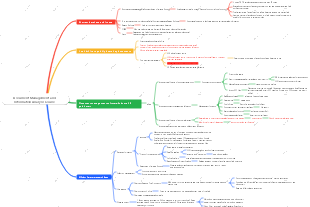
Management Research Methods (Management Paper Writing Guide)
Including introduction to management research, management research topic selection and research design, QCA analysis method, case study method, questionnaire survey method and common statistical analysis, experimental research method, meta-analysis method, experience sampling method, multi-level linear model analysis method, endogeneity And its solutions, big data text analysis method, social network analysis method.
Edited at 2024-02-04 13:40:04
- New Employee First - week Onboarding Plan
Mappa mentale per il piano di inserimento dei nuovi dipendenti nella prima settimana. Strutturata per giorni: Giorno 1 – benvenuto, configurazione strumenti, presentazione team. Secondo giorno – formazione su policy aziendali e obiettivi del ruolo. Terzo giorno – affiancamento e primi task guidati. Il quarto giorno – riunioni con dipartimenti chiave e feedback intermedio. Il quinto giorno – revisione settimanale, definizione obiettivi a breve termine e integrazione culturale.
- Analisi del campo di allenamento inglese
Mappa mentale per l’analisi della formazione francese ai Mondiali 2026. Punti chiave: attacco stellare guidato da Mbappé, con triplice minaccia (profondità, taglio, sponda). Criticità: centrocampo poco creativo – la costruzione offensiva dipende dagli attaccanti che arretrano. Difesa solida (Upamecano, Saliba, Koundé). Portiere Maignan. Variabili: gestione infortuni e condizione fisica dei big. Ideale per scout, giornalisti e tifosi.
- Analisi della lineup francese
Mappa mentale per l’analisi della formazione francese ai Mondiali 2026. Punti chiave: attacco stellare guidato da Mbappé, con triplice minaccia (profondità, taglio, sponda). Criticità: centrocampo poco creativo – la costruzione offensiva dipende dagli attaccanti che arretrano. Difesa solida (Upamecano, Saliba, Koundé). Portiere Maignan. Variabili: gestione infortuni e condizione fisica dei big. Ideale per scout, giornalisti e tifosi.
Management Research Methods (Management Paper Writing Guide)
- New Employee First - week Onboarding Plan
Mappa mentale per il piano di inserimento dei nuovi dipendenti nella prima settimana. Strutturata per giorni: Giorno 1 – benvenuto, configurazione strumenti, presentazione team. Secondo giorno – formazione su policy aziendali e obiettivi del ruolo. Terzo giorno – affiancamento e primi task guidati. Il quarto giorno – riunioni con dipartimenti chiave e feedback intermedio. Il quinto giorno – revisione settimanale, definizione obiettivi a breve termine e integrazione culturale.
- Analisi del campo di allenamento inglese
Mappa mentale per l’analisi della formazione francese ai Mondiali 2026. Punti chiave: attacco stellare guidato da Mbappé, con triplice minaccia (profondità, taglio, sponda). Criticità: centrocampo poco creativo – la costruzione offensiva dipende dagli attaccanti che arretrano. Difesa solida (Upamecano, Saliba, Koundé). Portiere Maignan. Variabili: gestione infortuni e condizione fisica dei big. Ideale per scout, giornalisti e tifosi.
- Analisi della lineup francese
Mappa mentale per l’analisi della formazione francese ai Mondiali 2026. Punti chiave: attacco stellare guidato da Mbappé, con triplice minaccia (profondità, taglio, sponda). Criticità: centrocampo poco creativo – la costruzione offensiva dipende dagli attaccanti che arretrano. Difesa solida (Upamecano, Saliba, Koundé). Portiere Maignan. Variabili: gestione infortuni e condizione fisica dei big. Ideale per scout, giornalisti e tifosi.
- Recommended to you
- Outline
Introduction to Management Studies
The mission and scientific attributes of management research
Principles and Mission of Management Research
Principles of Management Research
universal applicability
systematic suspicion
Sharability
Management Research Mission
General Mission of Management Studies
Solve problems encountered in management practice
Be a responsible scholar, better contribute new management knowledge and serve the society, make the organization more efficient and effective, and make the society better.
The mission of Chinese management scholars—constructing management theory with Chinese characteristics
Chinese management scholars should base their efforts on China's national conditions and practice, strive to study local theories and Chinese situational theories, conduct more basic and original research, improve the academic system and discourse system of Chinese management research, and explore the inherent laws of Chinese management, so as to Better serve Chinese enterprises and national strategies. At the same time, we build a global perspective and promote the theory of Chinese elements and Chinese practices to the world through standardized research paradigms.
Scientific attributes of management research
Falsifiability
Falsifiability refers to the conflict between the conclusion of the theory and the inconsistency with observation. All scientific theories are falsifiable.
objectivity
Objectivity refers to the objective existence that can be directly obtained in the world.
Replicability
Replicability refers to whether research is robust, consistent, and rigorous across a variety of contexts.
Management theory, research gaps and contributions
management theory
The connotation and characteristics of management theory
Management theory refers to systematic knowledge that can be abstracted into some constructs and related relationships and explain how complex temporal phenomena occur and develop.
A truly valuable theory should be simple, accurate and universal, and often provide insights that can break through existing theoretical frameworks and cognitive boundaries.
5W1H Management Theory
what
what is
how
How did it happen and develop?
why
Why does such a relationship and logic exist?
who
useful to whom
when
When is it useful?
where
Where is it more suitable to use?
Research Gaps and Contributions
Research Gap Type
evidence gap
Evidence gaps are also considered research conflict gaps, where empirical studies have inconsistent findings.
To solve this gap, it is generally necessary to introduce some adjusting variables to tell readers that the possible reason for the gap is that existing studies have ignored some important boundary conditions, or that some phenomena have a U-shaped/inverted U-shaped relationship or other non-linear relationships.
Writing method
Existing studies on XX have inconsistent views.
Literature gap
The literature gap means that the existing literature does not discuss a certain issue, which means that through combing the existing literature to find the existing deficiencies or gaps, the proposed research just fills this gap.
Writing method
Existing research has mainly explored XX, but has not explored XX. This article develops the conceptual theory of XX for the first time.
practice gap
One type of practice gap is that practice is important, but previous research has not explored it; the other type of practice gap is that practice and literature have conflicting views on a certain type of phenomenon.
Writing method
Existing practices have emphasized the importance of XX, but existing research has not fully explored it.
Theoretical gap
Theoretical gaps are research flaws caused by the failure of theories to apply in certain fields.
Writing method
XX theory is mainly applied in XX field, and we extend it to XX.
research design gap
Research design gaps refer to research biases that may result from different methods.
Writing method
Existing studies have used small-scale questionnaires to measure XX, which may cause some bias in the results. This study uses panel data to reveal XX.
Empirical gap
Empirical gaps are gaps where some research hypotheses need to be empirically tested.
Writing method
Existing research mainly points out XX qualitatively without conducting empirical testing.
population gap
A population gap refers to an insufficient amount of data from existing research, meaning that richer or more diverse data could explore richer theories.
Writing method
Through data from different sources, we can solve XX challenges.
research contribution
theoretical contribution
originality
Originality refers to providing new directions for existing research or providing new solutions to management phenomena.
Originality can be achieved by providing enlightening or progressive contributions.
usefulness
Usefulness refers to being helpful to existing research and practice.
Usefulness can be reflected by scientific usefulness as well as practical usefulness.
method contribution
Methodological contributions often help scholars answer questions about how individuals, businesses or organizations behave, and explain existing management issues in a more rigorous way.
Misconceptions about research contributions
Use existing ideas as contributions
Treat unique data or methods as research contributions
Treat new variables and constructs as research contributions
Treat hypothesized relationships as research contributions
In fact, a real research contribution should be able to bridge the research gap, or be able to explain the reasons behind the research problem and explain how to make a contribution and what kind of contribution it makes, rather than simply pointing out what others have ignored.
The process and characteristics of high-quality management research
Practical usefulness of high-quality research
Research questions come from management practice
Theoretical construction should be combined with practice
Research design should be closer to management practice
Data analysis should try to reflect the true situation of the enterprise and point out the specific impact on the enterprise.
Results reporting should also be rooted in practice
high quality literature dialogue
literature review
Literature review refers to the process of sorting out, summarizing, and commenting on the existing literature in a certain field, which includes both "summary" and "description."
High-quality research needs to achieve the following goals through a clear review: comprehensively sorting out the core findings of previous research; providing readers with an overview of previous research through comparison, classification, comparison, and analysis; and in-depth commenting on possible shortcomings of previous research. Or there is no corresponding research on specific issues; accurately refine the specific aspects in which current research can make up for existing theoretical deficiencies, thereby achieving an in-depth dialogue between current research and existing literature.
Typical literature review types
narrative review
Does not pursue systematic literature review, usually focusing on reviews of a small number of documents
descriptive review
Structured search, elaborating on each document as a unit
contextual review
In terms of reviews of existing literature, focus on breadth rather than depth, focusing on describing the development of research activities in the past few years.
systematic review
It often explores and summarizes key research theories, methods, perspectives, and conclusions based on a certain theory, relationship, or method, etc., and has certain research comprehensive characteristics.
Overview of umbrella hat style
Similar to a systematic review, it is usually a further qualitative or quantitative critique, summary and clarification of literature (including literature reviews) in certain mature fields.
Quantitative Overview
Review the literature from the perspective of literature citation data, which can provide data-related clues to review the literature.
Hypothesis proposed
1. List the hypothetical literature table
2. Hypotheses should be based on existing theories
3. Hypotheses should be specific and clear
4. The logic of assumptions must be consistent
5. Misunderstandings raised by assumptions
logical inconsistency
The logic is obvious or convoluted
High quality research conclusions
1. Research conclusions should be consistent and appropriate
2. Research conclusions should be convincing
3. The conclusion should be clear
Management research topic selection and research design
Proposal of management research topics
Propose high-quality research topics: “Stand upright”
"Heaven" who understands theory
The “top” of management research usually refers to whether a certain research constructs, expands or tests the corresponding management theory, which is mainly reflected in the following two aspects: theory construction and theory testing.
contextualizing theory
An in-depth understanding of the core assertions of specific theories and the problems they intend to solve can provide scholars with research ideas that are different from previous ones in analyzing new management phenomena.
Theoretical Insights into Conflict Perspectives
How to analyze phenomena from different theoretical perspectives is a very good topic choice, which can often provide more insights.
The explanatory power of theory to reality
Theory can help scholars dialectically analyze paradoxical phenomena in practice. The selection of research topics in this area can help establish a dialogue between different theories, which can often produce more theoretical contributions and research insights, and can provide information for understanding the real world. Many explanations.
Based on the "place" of practice
The "location" of management research aims to emphasize that research topics should be based on practice and have practical value in serving enterprises and serving society.
Propose two routes for selecting research topics
paradox route
1. Stakeholder perspective: conflicting demands
This route mainly has three key points, which are also difficult issues. First, how to define equally important stakeholders and their demands, and whether their specific roles and demands can be clearly defined; secondly, what perspective should be used to excavate the antecedents of decision-making that may cause conflicts of interest demands, which is related to the reasonable explanation of the theoretical perspective. ; Finally, if we further explore the boundary conditions that promote positive effects and inhibit negative effects, it is related to whether it can provide valuable enlightenment for management practice.
2. Dynamic perspective: dialogue across time and space
The key to refining valuable management paradox topics from a dynamic perspective lies first in whether equally important results can be identified in different time and space. In particular, it is necessary to clarify the necessity or importance of analyzing such results from a dynamic perspective; Secondly, whether it can be identified which key management decision-making activities will have contradictory effects on the results in different time and space; finally, after discovering this paradox, whether it can further seek possible ways to break the situation is even more important. Thinking based on this approach often helps researchers refine valuable management paradox topics.
3. Dimensional perspective: hidden paradox
For some ambiguous relationships, subdividing dimensions may be an effective way to further explore the paradox mechanism.
Researchers should not only pay attention to the rationality of the basis for dividing dimensions, but also the necessity of dividing dimensions. If the causes, consequences and regulatory mechanisms after dividing the dimensions are the same, then the meaning of the division is often very limited. More importantly, whether we can identify the unique paradox mechanisms contained in different dimensions and clarify their causes will be a very important contribution and inspiration to both theory and practice.
fun route
Starts with creative thinking about phenomena
When analyzing management issues from different angles, especially when analyzing emerging phenomena, going deep into the context of management practice may bring important and even unexpected gains to researchers in determining topic selection.
counter-intuitive insights
Counterintuitive topic selection is related to the aesthetic art of academic research. Insights different from previous research can often be obtained by changing research objects, changing new independent variables or outcome variables, changing research perspectives, changing data analysis methods, etc.
Management Research Design
Management Research Design
Philosophical Foundations of Management Research Design
Theoretical reasoning logic of management research design
The application of inductive reasoning in management research
For a research design based on inductive reasoning, the starting point is the observation of phenomena, aiming to summarize general rules or patterns based on the phenomena, and then make achievements in theory construction.
The problems that inductive reasoning focuses on are usually exploratory, relying on the analysis of management practice information, and then refining key knowledge at the theoretical level. It is a bottom-up research process.
Researchers can apply inductive reasoning through the observational and analytical means of case studies, thereby proposing new laws or even constructing new theories.
The application of deductive reasoning in management research
Deductive reasoning is a top-down process, mainly based on general rules extended to specific cases.
Deductive reasoning research mainly starts from existing theories, then proposes specific hypotheses, and then uses data to verify the proposed hypotheses, thereby testing the applicability and boundaries of the theory.
Selection and combination of management research methods
Typical management research methods
qualitative research methods
QCA analysis method
case study method
Quantitative research methods
Questionnaire method
experimental research method
meta-analysis
experience sampling method
Multilevel linear model analysis method
Endogeneity test
Big data text analysis method
social network analysis
Principles for selecting high-quality research methods
1. Matching of research methods and research questions
2. Reliability and validity of research methods and research conclusions
Clarify the differences in data types between different research methods
Different research methods have different data processing methods
3. Reasonable mixed research design
4. Clearly report research methods and present robust results
Preparation of research data
Clarify research methods
Is the research design committed to building theory or testing theory?
What type of data needs to be collected when and where? Is it cross-sectional or longitudinal?
Are there multiple different levels of research involved?
Does the research design include a single method or multiple quantitative/qualitative methods or a mixed methods approach?
Data sampling
What type of enterprise or individual is the research object?
What is the specific sampling method?
Which databases should be chosen for research requiring archival data?
Data preprocessing (cleaning and transformation)
How to clean data?
What are the sources of error? How to control errors?
Is and how to correct the data?
What data needs to be transformed?
How to transform data?
Missing value handling
What software was used to analyze the data?
What are the reasons for missing values, such as whether they were missing during data collection? How to deal with missing values?
Outlier handling
How are outliers defined, identified, and treated in this study?
How do outliers affect corresponding research conclusions?
QCA analysis method
The philosophical basis of QCA analysis
Introduction to QCA analysis method
Based on set theory and Boolean operations, QCA analysis is aimed at case-level research and conducts cross-case comparative analysis. It regards cases as configurations of conditions and analyzes the collective relationship between specific combinations of antecedent conditions (configurations) and outcomes. As a typical set theory method, QCA analysis uses set relationships to conduct comparative analysis across cases, that is, to explain phenomena through structured comparisons of specific cases.
set relationship
Type of set relationship
The first set relationship is qualitative
The second type of set relationship reflects causality
Characteristics of set relationships
The set relation is asymmetric
In set relations, antecedent conditions and consequences are treated as sets. Antecedent conditions are interdependent, and the effect of each antecedent condition is related to its combination with other conditions. This assumption makes the causal relationship no longer additive, and what is studied and analyzed is no longer the net effect of a single antecedent condition.
Analytical Strategies for Set Relationships
1. Among the cases that share a specific outcome, identify whether they have common antecedent conditions (combinations), that is, observe the antecedent conditions (combinations) shared by cases with a specific outcome. This tests whether the cases in which a particular outcome occurs have common antecedent conditions (combinations) for a subset of cases, and is primarily used in necessary condition analysis.
2. In cases that share specific antecedent conditions (combinations), identify whether they will have the same outcome. This tests whether cases where a specific antecedent condition (combination) exists has a common subset of outcome cases and is primarily used in sufficient condition analysis.
Fuzzy sets and fuzzy set relationships
Fuzzy sets are represented using values between 0.0 (completely non-membership) and 1.0 (complete membership).
Fuzzy sets combine categories and membership degrees, allowing both qualitative analysis (categories) based on set theory and fine-level classification (membership degrees) for empirical research.
The membership degree of a case in the set of antecedent conditions is the minimum value of the membership scores of the antecedent conditions. Comparing the size of the case's antecedent condition membership degree and the result membership degree can identify whether the antecedent condition set is a fuzzy subset of the result set, thereby conducting a sufficiency test. When the membership degree of a case in the antecedent condition set is less than or equal to the membership degree of the case in the result set, it indicates that there is a fuzzy subset relationship.
Set relationship calculation
Logical AND (Intersection)
Logical AND (Union)
non-set
The core assumptions of QCA analysis
1. Concurrent causality
The QCA analysis method is based on holism, which believes that the various parts that make up the whole do not exist independently, but exist in the political system. Each antecedent condition works interdependently, and QCA analyzes the interdependence of antecedent conditions and the multiple concurrent causal relationships composed of different combinations.
2. Equivalence
The combination (configuration) of antecedent conditions that leads to the same result Y is not unique, that is, multiple combinations are equivalent. Since multiple configurations lead to the same result, there is no longer a single optimal solution in traditional statistical analysis. An outcome can be caused by many different combinations of antecedent conditions, and we regard these combinations of antecedent conditions as alternative paths to the outcome that are logically equivalent.
3. Asymmetry of cause and effect
First, the reasons leading to the occurrence of result Y and non-Y are different, and the opposite of the cause leading to the result cannot be used to explain the non-occurrence of the result.
The logical basis of QCA analysis
Consistency method: If two or more instances of the phenomenon under study have only one condition in common, then this condition that all instances show consistency is the cause (or effect) of these phenomena.
Difference method: If an instance of the object under study occurs in one situation and does not occur in another situation, but everything else is the same, then the only situations that make the phenomenon under study show a difference are these phenomena The result, cause, or an integral part of the cause.
Advantages of QCA analysis
Unlike quantitative analysis that focuses on large samples and qualitative analysis that focuses on small samples, the QCA analysis method can be used to conduct research on small sample numbers, medium sample cases, or large sample numbers.
It is a method that combines qualitative research and quantitative research. It can be used for both exploratory inductive research and testing deductive research. It not only focuses on analyzing cases, ensuring the transparency of the analysis process, but also integrates The quantitative method was adopted to achieve the repeatability of the analysis process.
The QCA analysis method based on set theory makes it possible to study complex causal relationship problems.
Three analysis techniques of QCA analysis
csQCA technology
When the antecedent conditions and results can be binary divided, that is, when each antecedent condition and result can be assigned a value of 0 or 1, it is suitable to use csQCA technology for analysis.
mvQCA technology
The antecedent conditions and results cannot be binary divided, but need to be divided into multiple categories. That is, when each antecedent condition and result can be assigned a value of 0, 1, 2, 3, etc., it is suitable to use mvQCA technology for analysis.
fsQCA technology
csQCA technology and mvQCA technology can only handle categorical variables, while fsQCA technology can not only handle categorical variables, but also degree issues. When the current conditions and results are not easily divided into 0 or 1, and the situation between 0 and 1 needs to be considered, fsQCA technology is suitable for analysis.
Symbolic expression of QCA analysis method
the presence and absence of conditions
boolean expression
Main steps of QCA analysis method
1. Raise research questions
The QCA analysis method analyzes configuration problems, that is, the combination of multiple antecedent conditions jointly leads to a certain result.
2. Select case
Case selection should be based on theory
"Results" are clearly defined
Cases need to have common background characteristics
Researchers should maximize the heterogeneity between cases as much as possible to achieve diversity in the selected cases
During the research process, researchers can add or delete cases.
For small and medium samples, researchers need to have an in-depth understanding of each case; for large samples, researchers cannot fully understand each case, but being familiar with its types or categories can help deepen the research.
3. Select antecedent conditions
The extraction of antecedent conditions follows relevant theoretical or practical knowledge and is well-founded.
The antecedent conditions for inclusion should vary
The number of conditions should be kept within a moderate range
4. Collect data
5. Calibration
Calibration is a common research practice in which a variable to be measured is calibrated so that the original measurement has an interpretable set membership.
During the QCA analysis process, variables need to be recalibrated to measure whether each case belongs to a certain set and its degree of membership in the set.
Calibration must be based on in-depth thinking combining theoretical knowledge and practical knowledge, rather than mechanical and automatic operations. Researchers should clearly explain the sources of external standards and apply these standards systematically and transparently.
6. Necessity of analysis conditions
consistency
Clear-set consistency refers to the proportion of cases with a specific antecedent condition or combination of antecedent conditions that show the same outcome.
Coverage
In a clear set, coverage is the ratio of the number of cases (intersection) in which a particular antecedent condition leads to the outcome to the total number of outcome cases or the total number of cases of the antecedent condition.
Separate coverage
When more than one antecedent condition is sufficient to cause an outcome, a measure of unique coverage of each solution can illustrate their relative empirical importance.
7. Analyze the adequacy of condition configuration
Set case frequency threshold
Set original consistency threshold
Set PRI threshold
PRI refers to the rate of reduction in inconsistency, which is a complementary measure to the consistency measure.
Dealing with conflicting configurations
A contradictory configuration refers to a situation where a certain combination of antecedent conditions has result values of 0 and 1 at the same time.
counterfactual analysis
prohibit
complex solution
fully allowed
Simple solution
Partially allowed
intermediate solution
8. Report results
9. Robustness test
Robustness testing method based on set theory
Adjust case frequency threshold
Change consistency threshold
Adjust calibration threshold
Remove or add cases
Robustness testing method based on statistical theory
case study method
Overview of the Case Study Method
Definition of case study method
The theory-building case study method is a research method that selects one or more cases or multiple cases for analysis, and proposes new concepts, relationships between concepts, process mechanisms, and theoretical explanations behind them, so as to achieve the goal of building a theory.
Main features of the case study method
Mainly aimed at building theory
The philosophical foundation and basic operations are quite different from quantitative research methods.
Quality evaluation of case study method
validity
construct validity
Construct validity means that the construct can form a set of correct and operational research indicators. The key is the operationalization quality of the construct.
internal validity
Internal validity is to find causal relationships from phenomena, events, and data, that is, it is necessary to find that a specific condition, situation, and cause causes another specific result.
external validity
External validity means that the theory constructed can not only explain problems in the research situation, but may also explain problems in other situations, that is, it has situational transferability.
The above three points are closely related. If there is no clear theory and causal logic (internal validity), and there is no close connection between theoretical assumptions and empirical observations (construct validity), there will be no external validity. .
reliability
Reliability means that each key step in the case study is repeatable, that is, if the study is repeated, similar results will be obtained. The key dimensions of reliability in the case study method are transparency, trustworthiness and repeatability.
Application of case study method
construct new theories
Able to closely integrate academic achievements with practice
More diversified value
Types of case study methods
Positivist orientation and interpretivist orientation
positivist-oriented case study method
Positivist-oriented case studies adopt a multi-case research design, using the replication logic of item-by-item replication and differential replication (theoretical replication) to conduct cross-case analysis, and then summarize and propose propositions. At the same time, some of the characteristics of positivist-oriented case studies sometimes resemble those of quantitative research.
Interpretivist Oriented Case Study Method
Interpretivism-oriented case study articles emphasize the understanding of the meaning of the phenomenon. Researchers and research subjects engage in in-depth interaction and dialogue, thereby strengthening the process of cognitive transformation from superficial to deep levels and jointly constructing results.
Single case research method and multiple case research method
single case study method
The principle of single case study method
The single case study method emphasizes telling a good story and constructing new theories through "storytelling".
Types of single case study method
Extreme or unusual single case
This type of single case is more common, and this type of case is significantly different from existing common sense, norms, or daily events.
Inspiring single case
When the researcher has the first opportunity to observe and analyze a phenomenon or event that could not be studied before, and has the resources and conditions to pay attention, and enters a company in a unique situation to conduct research, the single case study method is suitable.
Vertical single case
Longitudinal single-case research studies the same case at two or more different time points and time periods. This type of research can reveal how the case to be studied changes over time.
Multiple case study method
Principles of multiple case study method
According to the logic of replication, each case is regarded as an independent experiment, and a multi-case study is a series of interrelated multiple experiments through which the theory to be generated is repeated, compared and expanded.
Characteristics of multiple case study method
It takes into account the "rigor" of research and the "relevance" of research and practice, and has advantages in the universality of the theory and the external validity of the research design.
Types of multiple case studies
variation design
The standard for this type of multiple case research design when selecting cases is to control and exclude variations in variables that are irrelevant to the research question, focusing on finding common characteristics between multiple cases, while focusing on variations in core variables, so as to discover differences between variables. relationship, clearly presenting the causal chain between concepts.
competition design
The case enterprises have similar conditions at the starting point, but through "competition", they reach the "end point" in some natural state. However, the behaviors and paths from the starting point to the end point are different, and the results may be different.
Result design
The case companies have the same or similar results, but the starting conditions may be different, and the paths and mechanisms to achieve the results are also different. Therefore, the goal is to discover the causes, processes, and mechanisms that lead to the same results. This type of research design is relatively common.
Extreme case design
Researchers choose to compare cases with extreme characteristics against each other and build theory by creating and contrasting the relative outcomes of variation levels in two extreme cases.
Main steps of the case study method
1. Determine the research question
Research questions that the case study method is suitable to address
Explore new concepts and concepts
Explore processes and mechanisms
Explore unknown phenomena, major challenges, and other issues
Several Strategies for Identifying Research Questions
Use the “hourglass model” to gradually focus on research questions
From fields to topics to issues, the scope gradually narrows and the content gradually focuses.
Determine the research question based on the source of the problem
Finding research problems from practice
Literature is an important source of research questions
2. Prepare theoretical basis
3. Theoretical sampling and determination of research units
theoretical sampling
Theoretical sampling refers to selecting cases that may supplement or modify existing theories or expand emerging theories, so it is necessary to consciously select cases that can serve to build theory.
Determine the research unit
4. Data collection
Collect data from multiple sources
Interview
participant observation
non-participant observation
Secondary information (such as archives, documents, literature, etc.)
Main steps of data collection
1. Data collection work required before the survey
2. Before conducting research, preparations such as determining the interview outline need to be done.
3. Data collection during the research period
4. Data sorting work
5. Key points that need to be reminded in data collection work
The case study method collects data from many sources, types, and huge amounts of data. Sometimes the data collection work needs to last for a long time. Therefore, it is necessary to establish a case study database to guide and standardize the data collection process. The database is generally in the form of a file package.
Data collection is to provide evidence for the development of data analysis and to display the evidence chain.
5. Data analysis
Data analysis for single case studies
Data coding principles for single case studies
Single case study data presentation
Data analysis for multiple case studies
Conduct within-case analysis
Conduct cross-case analysis and propose propositions
6. Theoretical dialogue
The general idea of theoretical dialogue
Based on the research questions and theoretical gaps or contradictions mentioned in the literature review, discuss the relationship between the research findings of the article and the original literature theory.
The specific content of the theoretical dialogue
Fill the theoretical gaps in original research
Have higher-order theoretical conversations
Discuss the applicable conditions and scope of the constructed theory
Draw theoretical model diagrams
Questionnaire survey method and common statistical analysis
Overview of Questionnaire Survey Method
What is questionnaire survey method
The questionnaire survey method is a survey method in which the researcher uses a set method and uses a series of processes and means to understand the situation of the respondents.
The inferential principle of questionnaire survey method
The basic principle of the questionnaire survey method is to draw inferential conclusions based on sample surveys.
Common misunderstandings in applying questionnaire survey method
Ignoring the research design and questionnaire optimization before conducting the questionnaire survey
Over- or under-understanding of the functions of the questionnaire method
Blindly pursuing innovation or not paying attention to advancing with the times in the selection of analysis methods
The implementation process of questionnaire survey method
Research and Questionnaire Design
Selection of research objects
appropriateness
Representative
feasibility
Choice of sampling method
simple random sampling
systematic sampling
stratified sampling
cluster sampling
convenience sampling
quota sampling
judgment sampling
snowball sampling
Questionnaire preparation
Questionnaire sample size
Questionnaire structure
Choose a maturity scale
New scale
Questionnaire distribution and survey implementation
Pre-research
Implementation of questionnaire survey
Data cleaning and organization
Data analysis and results reporting
Common statistical analysis and software examples
Scale reliability and validity analysis
reliability
Reliability reflects the degree of deviation between the measured value and the true value, expressed as a value between 0 and 1.
validity
Validity testing is a process of demonstration, which means that the developers of the scale collect relevant theoretical basis and empirical evidence from all aspects to prove that the scale can indeed effectively measure the target construct.
Validity type
content validity
internal construct validity
convergent/convergent validity
discriminant/discriminant validity
criterion validity
Common method deviation and its test
Common method bias refers to the bias caused by common method variation, which will affect the validity of the measurement.
How to test for common method bias
Harman's single factor method
Controlling for unmeasured latent method factors (ULMC) method
Confirmatory factor analysis label variable method
Descriptive Statistics and Correlation Analysis
exploratory factor analysis
The basic connotation and function of exploratory factor analysis
By exploring the intrinsic relationships between variables and the structural relationships behind them, a larger number of variables can be simplified into a relatively smaller number of other variables.
Basic steps of exploratory factor analysis
1. Design exploratory factor analysis
2. Test the premise assumptions of exploratory factor analysis
3. Extract factors
4. Explanatory factors
5. Validity verification of exploratory factor analysis
6. Processing of results of exploratory factor analysis
Basic steps of exploratory factor analysis
1. Implement EFA operation settings
2. EFA result output and analysis
linear regression analysis
The basic connotation of linear regression analysis
Operation and result interpretation of multiple linear regression
Structural equation modeling and confirmatory factor analysis
Features of Structural Equation Models
Structural equation model (SEM) is also called covariance structure model, covariance structure analysis, etc. Its basic feature is to analyze the relationship between variables based on the covariance matrix of variables.
The role and operation of confirmatory factor analysis
Operation of Structural Equation Modeling
Testing of mediating and moderating effects
The connotation and testing method of mediating effect
Mediation effect test operation
1. Mediation effect analysis without considering the measurement model: based on PROCESS plug-in
2. Mediation effect analysis considering the measurement model: based on Mplus
The connotation and testing method of moderating effect
Moderating effect test operation
1. Moderating effect test operation based on multiple regression analysis
2. Moderating effect testing operation based on structural equation model
experimental research method
Overview of Experimental Research Methods
Definition of experiment
An experiment is the systematic manipulation of an independent variable of interest to the researcher, and then observing how changes in the independent variable affect a specific outcome variable while controlling for interference from additional factors.
Classification of experiments
True experiment and quasi-experiment
Experiments that can randomly assign participants to different groups are called true experiments, while experiments that cannot randomly assign participants due to ethical or practical constraints are called quasi-experiments.
Laboratory experiments and field experiments
Experiment classification summary
Experimentation and Causal Inference
causation
Experimental Research Methods and Causal Inference
Implementation process of experimental research method
1. Determine the research question
2. Operational definition, manipulation and testing of independent variables
Factors and Factor Levels
Number of factor levels
Differences between factor levels
The necessity of a pure control group
Determination of the number of factors
Experimental design: between-subjects design VS within-subjects design
Definition of between-subjects design and within-subjects design
The logic behind experimental design
Advantages and Disadvantages of Different Experimental Designs
The within-subjects design better controls experimental errors, making it easier for researchers to obtain significant statistical results.
Within-subjects designs help conserve research resources.
The within-subjects design makes it easy for participants to guess the purpose of the experiment.
Within-subjects designs are prone to practice effects or reference point effects.
Compared with within-subjects design, between-subjects design is a more conservative design scheme.
Experimental Design: Mixed Design
A mixed design is an experimental design that includes both a within-subjects design and a between-subjects design.
Operational definition and manipulation of independent variables
Operational definition of independent variables
Variable operationalization refers to establishing some specific procedures or indicators to measure an abstract concept.
Manipulation of independent variables
The "quality" of independent variable manipulation
Implement improved experimental materials to avoid the creation of confusing content.
Post hoc statistics control for the effects of confounding variables.
Pay attention to the applicability of experimental materials in China.
Multiple methods manipulate independent variables to avoid the shortcomings of a single manipulation method.
The "amount" of independent variable manipulation
Ensure that there is enough variation between the levels of the variable.
Pay attention to experimental design to prevent the occurrence of ceiling effects and floor effects.
independent variable manipulation test
1. Validity of manipulation test indicators
Accuracy requires that the manipulation test indicator reflect the construct underlying the indicator.
Sensitivity requires that the manipulation test index quickly captures changes between different levels of the independent variable.
2. Manipulate the measurement location of the inspection indicators
The manipulation test indicator is tested after the outcome variable, so as to prevent participants from guessing the purpose of the experiment and affecting the results by answering the manipulation test indicator in advance.
The manipulation test indicator is administered before the outcome variable, which may also interfere with participants' responses to the outcome variable.
Manipulation checks are performed separately.
3. Manipulate the number of inspection indicators
4. The necessity of manipulation inspection
extra variables
3. Measurement of outcome variables
Validity of outcome variable indicators
Where the outcome variable is measured
Multiple means to measure variable outcomes
4. Mediating variables
The concept and connotation of mediating variables
The mediating variable is a description of the independent variable affecting the outcome variable through a certain process.
rule out alternative explanations
multiple mediating variables
parallel mediation
sequence intermediary
offsetting intermediaries
Verification of mediating effect
Mediating effect measurement design
Experimental causal chain design
Mechanism adjustment design
Comparison and selection of different testing methods
5. Setting of experimental environment
authenticity in experiments
Analysis framework
Some misunderstandings
How to improve authenticity in experiments
cover story
6. Experimental participants, sample size and testing
Screening participants for their seriousness
"Crime and Punishment" by Student Sample
Determination of sample size
statistical power
effect size
Estimated sample size
G
Examples of application of experimental research methods
1. Determine the research question
2. Manipulation of independent variables
Manipulation of independent variables
manipulation test
3. Measurement of outcome variables
4. Setting of experimental environment
5. Participants and sample size setting
6. Prediction value and experimental improvement
7. Experimental results
Experimental Failure and the Beauty of Experimental Research Method
1. Interpretation of “failed” experiments
2. The beauty of experimental research method
meta-analysis
Overview of meta-analysis
The origin and development status of meta-analysis
The origin of meta-analysis
The current development status of meta-analysis in the field of management
The uniqueness of meta-analysis: comparison with qualitative reviews and empirical studies
Types of meta-analysis
standard meta-analysis
Mainly includes two types of inspections
Testing of mediating variables (building a meta-analytic structural equation model)
Moderator variable test (implementing meta-regression)
Single article meta-analysis
second-order meta-analysis
The value of meta-analysis
The academic value of meta-analysis to management research
Provide research conclusions with general applicability
Provides deep boundary condition insights
Provide comprehensive analysis of intermediary mechanisms
The value of meta-analysis to individual researchers
Helps gain a deeper understanding of a research field
Helps build academic reputation
Helps scholars who lack data to conduct research
Basic steps of meta-analysis
Identify research questions
Find important research questions
Focus on divisive research questions
Identify divisive research questions
Striving to be the first meta-analytic study
Conduct a differentiated meta-analysis
Search literature
Define the scope of variables
Explicit search keywords
Language-based literature screening
Search for unpublished studies
Determine search path
Search and filter literature
Coding documents
Develop a coding scheme
Train coders
coding effect size
1. Direct extraction of correlation coefficients
2. Calculation of correlation coefficient
Coding the moderator variable
Coding mediating variables
Effect size analysis
1. Correction of scale reliability
2. Conversion of effect size
3. Outlier test
4. Descriptive statistical analysis
5. Calculate the main effect
One of the calculation models for main effects: fixed effects model
One of the calculation models for main effects: random effects model
One of the calculation models for main effects: multi-level random effects model
Heterogeneity test
Publication bias test
Moderator variable analysis
Mediating variable analysis
Practical operation of meta-analysis based on R language software
Reasons for choosing R language
1. R language is open source and free
2. R language requires writing codes. Compared with menu-based operation codes, it is reproducible and greatly improves analysis efficiency.
3. Provides a very comprehensive meta-analysis statistical model and test
4. The metafor program package has received widespread attention and application in the academic community
Calculate main effects
1. Installation of R language software and metafor package
2. Data import
3. Handling of missing values in scale reliability
4. Correction and transformation of effect size and calculation of variance
5. Outlier test of effect size
6. Descriptive statistical analysis of effect size
7. Calculation of main effects and related statistical tests
8. Display of main effect analysis results
9. Save the data set
Moderator variable analysis
Conditions for carrying out moderator variable analysis
Steps to Conduct Moderator Variable Analysis
1. Import of data
2. Handling of missing values of adjustment variables
3. Descriptive statistical analysis of regulating variables
4. Estimation of moderating effects
5. Display of moderation effect analysis results
Mediating variable analysis
Theoretical Framework for Mediating Variable Analysis
Analysis steps
1. Calculate the main effect
2. Calculate the sample size of the correlation coefficient matrix
3. Estimation of mediating effects
4. Display of mediation effect analysis results
experience sampling method
Overview of Experience Sampling Method
Definition of experience sampling method
Experience sampling method, also called experience sampling method, is a continuous and repeated data collection method, and it is also a dynamic and high-frequency questionnaire survey method.
Characteristics of experience sampling method
1. Authenticity
2. Immediacy
3. Reliability
Advantages of experience sampling method
1. ESM can not only help researchers explore the patterns and characteristics of participants’ thoughts, attitudes, and behaviors at the time they occur, but also explore the dynamic change process of these contents “over time.”
2. ESM can be combined with other data sources and has great potential for conceptual integration across methods and disciplines.
3. ESM focuses on reporting individual status, reactions, or relationships between variables in natural, spontaneous, and daily situations, and the research conclusions have high practical applicability.
Disadvantages of experience sampling method
1. Most ESM uses the method of self-evaluation by subjects. There may be self-evaluation bias, which will affect the mean value and cannot be effectively eliminated, which will affect the research results. In addition, the problem of homologous method bias may still occur.
2. The negative impact of high-frequency answering on the subjects cannot be ignored. High-frequency answering is a burden or worry outside of work for the subjects. They need to fill in the answers regularly within a period of time, and the constant repetition of questions and negative questions The review of items may have a certain negative impact on the life of the subject.
3. The design of the ESM questionnaire will lead to inertia in the subjects' responses. Due to the need for repeated testing, the subjects are required to fill in the same questionnaire repeatedly within a certain period of time. After answering several times, the subjects may have become overly familiar with the questionnaire or become bored. This leads to the emergence of inertia in answering questions, which may have a certain impact on data quality.
4. ESM has high requirements on the subjects' willingness to cooperate. If the subjects do not cooperate or their answers are interrupted, a complete experience sampling method survey cannot be completed.
5. The cost of implementation is high. Certain rewards are needed to motivate subjects to fill in the answers. Using the data collection platform requires a certain amount of money.
Sampling strategy for experience sampling method
1. Event-based sampling strategy
2. Sampling strategy based on variable time
3. Sampling strategy based on fixed time
Basic requirements and processes of experience sampling method
Basic requirements of experience sampling method
sample size
Daily measurement frequency
overall duration
Incentive method
The operation process of experience sampling method
1. Preliminary preparation
Establish sample resources
Select sampling method
Determine the sampling period
Make advance arrangements
2. Process tracking
Subject communication
Subject tracking
problem coordination
Research records
3. Later work
data processing
data analysis
Subject maintenance
Make a summary
Hypothesis testing method of experience sampling method
Multilevel linear model analysis method
Overview of multilevel linear model analysis method
Basic types of multilevel theoretical models
Limitations of Multiple Linear Regression Models for Analyzing Nested Data
One of the important statistical assumptions of the multiple linear regression model is that the observed values in the data are independent of each other. However, due to the nested nature of the data structure in multi-level research, there will be interdependence between the observed values, resulting in the multiple linear regression model. produce estimation bias.
Basic principles of multilevel linear model analysis method
When processing nested data, multi-level linear models (HLM) first establish regression equations with low-level variables, then use the intercept and slope in the equation as outcome variables, and use high-level variables in the data as predictor variables to create new equation. By establishing multi-level regression equations, researchers can clearly distinguish the levels at which variables are located, explore the impact of variables at different levels on outcome variables, and the cross-level interaction effects between variables at different levels.
Advantages and limitations of multilevel linear model analysis
Advantage
1. HLM can effectively analyze nested data, while estimating the impact of different levels of predictor variables on low-level outcome variables while maintaining the appropriate level of analysis for the predictor variables.
2. HLM can produce empirical test estimates, thereby improving estimates of low-level effects.
3. HLM uses the generalized least squares method to estimate high-level fixed effects, providing more accurate estimates.
4. HLM provides robust standard error estimates.
5. HLM uses interactive calculation technology of imbalanced data to provide effective estimates of variance and covariance components.
limitation
1. In HLM analysis, researchers can only analyze a single outcome variable at a time.
2. In the HLM setting, the outcome variable can only exist at the lowest level, that is, the first level.
3. Like the multiple linear regression model, HLM software cannot consider the impact of variable measurement errors, but can only be solved through MSEM.
4. HLM software cannot directly perform Monte Carlo parameter boot method analysis on indirect effects in mediation effect analysis. Researchers need to use R language software to calculate the confidence intervals of indirect effects.
Development history and new trends of multi-level linear model analysis method
The main steps of multilevel linear model analysis method
1. Data sorting
2. Reliability and validity test
3. Variable aggregation
Types of high-level variables
common unit
shared unit
co-structural unit
Co-plastic unit
Statistical criteria that need to be met for aggregation of shared unit variables
Intra-rater reliability Rwg
Intraclass correlation coefficient ICC1
Intraclass correlation coefficient ICC2
4. Model testing
null model
multilevel main effects model
Multi-level moderating effect model
Multi-level 2×(1—>1) moderating effect model
Multi-level 1×(1—>1) moderating effect model
Multi-level 1×(2—>1) moderating effect model
Multi-level 2×(2—>1) moderating effect model
multilevel mediating effect model
Multilevel 2—>1—>1 mediating effect model
Multilevel 2—>2—>1 mediating effect model
Multilevel 1—>1—>1 mediating effect model
Multi-level linear model analysis method practical operation and software examples
Multilevel Confirmatory Factor Analysis Example
Variable aggregation indicator calculation example
Example of multi-level theoretical model testing
1. Data import
2. Null model testing
3. Multi-level main effect model
4. Multi-level moderating effect model
5. Multi-level mediating effect model
Application of multilevel linear model analysis in high-quality research
Multilevel linear model analysis method and trickle-down effect
Multilevel linear model analysis and frog pond effect
Multilevel linear model analysis method and nonlinear effects
Multilevel linear model analysis and repeated measures
Endogeneity and its solution
Understanding endogeneity
exogeneity assumption problem
consequences of endogeneity
The existence of endogeneity will significantly change the significance of the coefficient of the independent variable in the regression analysis, leading us to draw wrong conclusions about the relationship between the independent variable and the dependent variable.
Sources of Endogeneity Problems
omitted variables
The most intuitive reason for endogeneity may be omitted variable bias. Omitted variable bias is caused by omitting one or some variables that may be related to both the dependent variable and the independent variable when setting the model.
bidirectional causation
Bidirectional causation is considered to be the second major source of endogeneity. Mutual causation means that the explanatory variable and the explained variable are mutually causal. This will cause the explanatory variable to be related to the error term, causing endogeneity problems.
Measurement error
selection bias
Summary of sources of endogeneity
Instrumental variables of endogeneity correction method
The basic idea of instrumental variable method
The instrumental variable Z must be able to predict the endogenous explanatory variable Xi
exclusivity hypothesis
Choice of instrumental variables
Aggregate data
Instrumental variables from nature: phenology and astronomical phenomena
Variable tools from physiological phenomena: birth, old age, illness and death
Instrumental variables from social space: distance and price
Instrumental variables from experiments: natural experiments and quasi-experiments
Implementing a simple instrumental variable method based on Stata
Theoretical Judgment on Endogeneity Issues
Instrumental variable estimation based on two-stage least squares method
Post hoc tests on instrumental variable methods
Endogeneity test
Weak instrumental variables test
overidentification test
Some details of Stata implementing the instrumental variable method
Interaction terms and square terms of endogenous variables
Instrumental variables method for nonlinear models
Report the results of instrumental variable estimation
Panel data model of endogeneity correction method
Definition of panel data
Dynamic panel bias
Endogeneity correction method: generalized method of moments
Stata application of generalized method of moments
Endogeneity correction method: double difference method
Understand the difference-in-difference method
Identification hypothesis of double difference method
common trend hypothesis
Unit treatment variable value stability assumption
Basic types of double difference methods
Classic DID
Multi-period DID
QueueDID
Endogeneity correction method propensity score matching
The basic idea of propensity score matching
Prerequisites for propensity score matching
Basic steps for propensity score matching
Model settings for estimating propensity scores
Build paired samples
Evaluating Paired Samples: Testing the Parallel Hypothesis
Estimating treatment effects
Endogeneity correction method: breakpoint regression
The principle of breakpoint regression
Estimation steps for breakpoint regression
1. Observe the breakpoint effect
2. Use samples on both sides of the breakpoint for regression
3. Conduct robustness testing on the results of breakpoint regression
Big data text analysis method
Big Data Text Analysis Overview
The value of text data in the era of big data
Classification and principles of big data text analysis methods
Based on word frequency
Based on semantics
Big data text analysis process
text collection
Text preprocessing
text cleaning
text segmentation
Remove stop words
text normalization
Text feature learning
Lexical (entity) features
Theme features
relationship characteristics
Validity analysis
construct validity
outcome validity
causal effect
Application of big data text analysis in research
Research on big data text analysis based on lexical features
Research on text analysis of intended data based on topic characteristics
Research on big data text analysis based on relational characteristics
social network analysis
Overview of social network analysis
The connotation of social network
Concept definition of social network analysis
Uses of social network analysis
Understand the causes and effects of social structure
Main steps in social network analysis
1. Question raising
structural capital issues
Resource access issues
environmental shaping issues
social communication issues
2. Data collection
Which actors should be included in a social network?
How to collect social network data
Nomination Act
Positioning method
resource generation method
social network construction
Graphical representation
matrix method
Clarify Social Network Analysis Metrics
Node level analysis
Spend
shortest path length
local clustering coefficient
Centrality
Structural equivalence and similarity
Network level analysis
average degree
density
Average road strength length and diameter
Global/average clustering coefficient
central potential
cohesive subgroup
community detection
core-periphery structure
structural hole