MindMap Gallery Chapter 10 Incentives
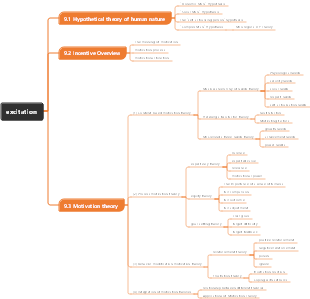
This is a mind map about motivation. The main content includes: motivation methods, motivation theory, and motivation foundation. Friends in need hurry up and collect it!
Edited at 2024-01-28 15:01:45This article discusses the Easter eggs and homages in Zootopia 2 that you may have discovered. The main content includes: character and archetype Easter eggs, cinematic universe crossover Easter eggs, animal ecology and behavior references, symbol and metaphor Easter eggs, social satire and brand allusions, and emotional storylines and sequel foreshadowing.

[Zootopia Character Relationship Chart] The idealistic rabbit police officer Judy and the cynical fox conman Nick form a charmingly contrasting duo, rising from street hustlers to become Zootopia police officers!
This is a mind map about Deep Analysis of Character Relationships in Zootopia 2, Main content: 1、 Multi-layer network of relationships: interweaving of main lines, branch lines, and hidden interactions, 2、 Motivation for Character Behavior: Active Promoter and Hidden Intendant, 3、 Key points of interaction: logic of conflict, collaboration, and covert support, 4、 Fun Easter eggs: metaphorical details hidden in interactions.
This article discusses the Easter eggs and homages in Zootopia 2 that you may have discovered. The main content includes: character and archetype Easter eggs, cinematic universe crossover Easter eggs, animal ecology and behavior references, symbol and metaphor Easter eggs, social satire and brand allusions, and emotional storylines and sequel foreshadowing.
[Zootopia Character Relationship Chart] The idealistic rabbit police officer Judy and the cynical fox conman Nick form a charmingly contrasting duo, rising from street hustlers to become Zootopia police officers!
This is a mind map about Deep Analysis of Character Relationships in Zootopia 2, Main content: 1、 Multi-layer network of relationships: interweaving of main lines, branch lines, and hidden interactions, 2、 Motivation for Character Behavior: Active Promoter and Hidden Intendant, 3、 Key points of interaction: logic of conflict, collaboration, and covert support, 4、 Fun Easter eggs: metaphorical details hidden in interactions.
excitation
Motivational basis
Human behavior process and characteristics
Definition: Incentive is a management process in which the organization induces individuals to have the motivation to satisfy certain needs and thereby promotes the convergence of individual behavior with organizational goals.
definition of behavior
Behavior is the collective name for all external reactions of human beings under the influence of the environment. The components of behavior are: behavior subject, behavior object, behavior environment, behavior means, and behavior results.
Behavior can be divided into two types
Motivated behavior: It is an activity that is carried out according to certain norms and achieves certain results under the control of human rational consciousness.
Three major characteristics of motivated behavior: purpose, predictability, and directionality
Unmotivated behavior: It is a purposeless activity carried out by people in an unconscious state.
the process of motivated behavior
The process includes: stimuli, needs, motivations, behaviors, goals,
The human behavior process is a cycle of stimulation-need-motivation-behavior-goal-satisfaction [frustration].
Characteristics of motivated behavior
Spontaneity: Motivated behavior is initiated and carried out consciously by the person's self-awareness.
Purpose: Motivated behavior does not happen blindly, but is always directed towards a certain goal and performed for a certain purpose.
Persistent:
Plasticity: When the environment changes, behavior can actively adjust needs, motivations and even goals to change the direction and mode of behavior.
Causality: The direct cause of motivated behavior is human motivation, and the process of its occurrence will be accompanied by corresponding results. Therefore, there is an inevitable causal connection between the behavioral results and the initial motivation of the behavior.
Assumptions about human nature and their development
1. Economic Man Hypothesis [Theory Responsibility 3. Coercion and punishment methods must be used to force them to work hard to achieve organizational goals. 4. Most jobs are to meet basic needs, and only money and status can motivate them to work. 5. Only a few people can encourage themselves, Overcoming emotional impulses, these people should assume management responsibilities
2. Self-actualizing person hypothesis [Y theory]: proposed by McGregor 1. Most people are diligent and are willing to work as long as the environment allows. 2. People can self-direct and control themselves when performing tasks. 3. Under normal circumstances, most people will not only accept tasks, but also actively seek responsibilities, evade responsibilities, lack ambition, and emphasize that security is the result of experience and is not human nature. 4. Most people have a considerable degree of imagination, resourcefulness and creativity, which can be used normally if they are not controlled by the external environment. 5. Most of the human body contains great potential, but under modern industrial conditions, only a small part of the potential can be exerted. 5. There is no conflict between the individual self-actualization tendencies of employees and the behaviors required by the organization.
3. Social person hypothesis [interpersonal relationship theory]: 1. The basis of the interpersonal relationship hypothesis is the interpersonal relationship theory, which was proposed by Mayo. 2. People not only have economic needs but also social needs. The relationship between people and the sense of belonging to the organization can motivate people's behavior more than the economic rewards given by workers. 3. Workers are motivated to work by social needs. And gain a sense of identity through relationships with colleagues. 4. Workers find the meaning of work through social relationships at work. Workers’ social influence on colleagues is more important than the economic incentive control given by managers. 5. Workers’ productivity varies with the extent to which their bosses meet their social needs
4. Complex Person Hypothesis [Super-Y Theory]: American scholar Schein proposed this theory 1. Differences in subject needs: Some people need strictly organized institutions and do not need to assume responsibilities, while some people need autonomy. Need creative opportunities and achieve a sense of competence 2. Differences in organizational methods. Management work should be a combination of the nature of work and people's needs, coordinated with people's qualities, and appropriate organizational forms and leadership methods 3. Changes in the degree of control Nature: The arrangement of the degree of control should be considered from the perspective of work objectives, work content and employee quality. 4. The progressive nature of goal establishment: When a goal is achieved, it stimulates people's sense of competence and they can work towards new and higher goals.
Incentive mechanism
According to the rules of human behavior, the human behavior process contains three types of basic variables: stimulus variables, body variables, and response variables.
Stimulus variable: It is an external stimulus that affects an individual's response, also called an inducement.
Body variables: are internal determinants that influence individual responses and are characteristics of the individual itself.
Response variables: are the changes in individual responses caused by stimulus variables and body variables.
The key to effective incentive measures is to identify the advantages and needs of different people at different times and under different circumstances and stimulate them
motivation theory
Behavior-based theory: focuses on the study of human needs and answers the question of "what is the basis for motivating people?" It mainly includes need hierarchy theory, two-factor theory, and achievement need theory.
1. Need Hierarchy Theory: [American psychologist Maslow first proposed it in his article "Human Motivation Theory" in 1943, and elaborated it more comprehensively in his 1954 monograph "Motivation and Personality"] 1. This theory believes that Human needs are divided from low to high into physiological needs, safety needs, social needs, self-actualization needs and esteem needs 2. Among them, physiological needs, safety needs and social needs are low-level needs, which can be satisfied through the external environment, while self-actualization needs Needs and esteem needs are high-level needs, which can be satisfied through internal factors. 3. Human needs are a process of development from low levels to high levels. 4. Any kind of needs will not disappear because of the emergence of high-level needs. Hierarchical needs are interdependent and evolve in overlapping waves. 5. Unmet needs are motivating.
2. Two-factor theory: [Proposed by American psychologist Herzberg] 1. Satisfaction and dissatisfaction do not coexist on a single continuum, but are completely separate. 2. What makes people feel dissatisfied is often the work environment and external factors. aspect, becoming a health factor. 3. What makes people moved and satisfied is often the work itself and the work content, which are called motivating factors. 4. Hygiene factors can only eliminate dissatisfaction, while motivational factors are the key to mobilizing enthusiasm.
3. Achievement needs theory: [It was jointly explained by McGlelland, a professor at Harvard University in the United States, and in the two books "Achievement Society" and "Inspiring Economic Achievement"] 1. There are three types of high-level needs of people: They are achievement needs, power needs, and affiliation needs. 2. The need for achievement is the need to strive for success and hope to do better. The need for power is the need to influence and control others without being controlled by others. The need for affiliation refers to the establishment of friendly and close interpersonal relationships. 3. Characteristics of high achievement needs: Strong ambition, dare to take responsibility, like to set moderately challenging goals, do not like easier or more difficult work tasks, like tasks with immediate feedback, and emphasize achievements over rewards. 4. The need for achievement is not innate, but is more the result of the combined effects of environment, education and practice. 5. The need for achievement is an internalized need and is the main driving force for enterprises and countries to achieve high-level performance.
Process Motivation Theory: Focuses on the mechanism of behavior and answers the question of "how to have needs to cause motivation, motivation to promote behavior, and behavior to guide goals". It mainly includes equity theory, expectation theory and goal setting theory.
1. Equity theory: [Also known as social comparison theory, it was proposed by Adams in the United States in the article "Inequity in Social Exchange"] 1. Equity theory, also known as social comparison theory, was proposed by Adams 2. Whether people are satisfied with rewards Satisfaction depends not only on absolute rewards, but also on relative rewards. 2. People’s comparison of remuneration is reflected in horizontal comparison and vertical comparison. Horizontal comparison means that people compare their own remuneration with the remuneration of others. Vertical comparison means that people compare their current remuneration with their past remuneration. 3. The result of relative remuneration comparison will make people feel unfair and fair, and the unfairness will cause tension and imbalance. Relative remuneration = O/I = remuneration/contribution
2. Expectation theory: [Also known as "Valence-Means-Expectation Theory" was proposed by the American psychologist Vroom in the book "Work and Motivation"] 1. Expectation theory was proposed by the psychologist This theory proposed by Vroom believes that people will be motivated to do certain things to achieve the goals set by the organization when they expect that their actions will bring specific results to the individual, and the results have a history of attracting the individual. . 2. Employees' attitude towards work depends on the judgment of the following three relationships: the relationship between effort and performance, the relationship between performance and rewards, and the relationship between rewards and need satisfaction. 3. The enthusiasm of employees at work is the product of valence and expected value, that is: M=V*E. Only when both valence and expected value are achieved can a higher motivational effect be produced.
3. Goal setting theory: 1. Goal setting theory was proposed by Edwin Locke. 2. This theory believes that goals themselves have a motivating effect. Goals convert people's needs into motivations and direct people's behavior toward a certain goal. Work hard in the right direction, and compare the results of your behavior with the established goals to make timely adjustments and modifications to achieve the goals. 3. Personal effort depends on four aspects: goal difficulty, goal clarity, goal acceptability, and goal responsibility clarity. 4. In addition to personal effort, work performance also depends on organizational support and individual ability and personality. Characteristics also play a certain role in work performance. 5. The rewards that individuals deserve should be based on actual work performance. Rewards are divided into intrinsic rewards and extrinsic rewards.
Behavior reinforcement theory: focuses on the study of modification and solidification of behavior, answering the question of "how to solidify positive behavior and transform negative behavior". Representative theories include reinforcement theory
Behavioral reinforcement theory: [Proposed by American psychologists in books such as "Organismal Behavior" and "Science and Human Behavior"] 1. Reinforcement theory was proposed by American psychologist Skinner. 2. This theory believes that people will adopt certain behaviors to affect the environment out of certain motives. When the results of this behavior are beneficial to people, this behavior will be repeated in the future. When the results of this behavior are beneficial to people, When unfavorable, the behavior is weakened or reduced. 4. According to the purpose of reinforcement, reinforcement can be divided into four types: positive reinforcement, negative reinforcement, punishment and natural extinction. The first two can enhance or maintain behavior, and the latter two can weaken or reduce behavior. 5. According to the purpose of reinforcement Method, reinforcement can be divided into continuous reinforcement and intermittent reinforcement
Motivational methods
work incentives
Work motivation: refers to stimulating employees’ inner work enthusiasm through reasonable design and appropriate assignment of work tasks.
job enlargement act
horizontal expansion work
vertical expansion work
job enrichment
Technology diversification
work integrity
Participate in management decisions
grant necessary autonomy
Focus on information communication and feedback
job rotation method
Determine job rotation for new employees
Cultivate versatile veteran employees for rotation
Rotation of management personnel to cultivate key management personnel
Achievement incentives
Achievement incentives: refers to an incentive method that gives corresponding rewards to employees based on their work performance.
material incentives
salary
Welfare
employee stock ownership plan
Mental stimulation
Emotional motivation
Honor Incentive
Trust Incentives
Comprehensive incentives
Inspiring by example
crisis incentives
training motivation
environmental incentives