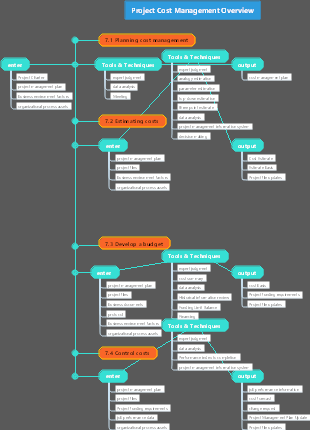
MindMap Gallery Advanced Software Exam Chapter 7 Project Cost Management
[Project cost management] is a part of the information system project manager in the soft exam. It mainly manages project cost from the following aspects: reasons for cost control, planning costs, estimating costs, formulating budgets, controlling costs, cost analysis technology, and cost management technology. , very practical for students preparing for software exams or engaged in project management
Edited at 2022-06-30 15:19:03Ce calendrier annuel, créé avec EdrawMax, présente une disposition claire et organisée des mois de janvier à décembre. Chaque mois est affiché dans un cadre distinct, montrant les jours de la semaine et les dates correspondantes. Les weekends (samedis et dimanches) sont mis en évidence pour une meilleure visibilité. Ce format est idéal pour la planification et l'organisation des activités tout au long de l'année, offrant une vue d'ensemble rapide et facile à consulter.

This quarterly calendar overview for 2026, created with EdrawMax, presents a structured and colorful layout of the entire year divided into four quarters. Each quarter is displayed in a separate column, showcasing the months within that quarter in a clear grid format. The days of the week are labeled, and each date is marked within its respective cell, allowing for easy identification of dates across the year. This calendar is an excellent tool for long-term planning, providing a comprehensive view of the year at a glance.
This weekly calendar for 2026 is designed using EdrawMax to provide a detailed and organized view of each week, starting from January. The left side features a mini monthly calendar for quick reference, highlighting the current week in yellow. Below it, there's a section for weekly goals to help prioritize tasks. The main area is a time-grid from 6:00 AM to 12:00 AM, divided into half-hour slots, allowing for precise scheduling of daily activities throughout the week. This layout is ideal for managing a busy schedule efficiently.
Ce calendrier annuel, créé avec EdrawMax, présente une disposition claire et organisée des mois de janvier à décembre. Chaque mois est affiché dans un cadre distinct, montrant les jours de la semaine et les dates correspondantes. Les weekends (samedis et dimanches) sont mis en évidence pour une meilleure visibilité. Ce format est idéal pour la planification et l'organisation des activités tout au long de l'année, offrant une vue d'ensemble rapide et facile à consulter.
This quarterly calendar overview for 2026, created with EdrawMax, presents a structured and colorful layout of the entire year divided into four quarters. Each quarter is displayed in a separate column, showcasing the months within that quarter in a clear grid format. The days of the week are labeled, and each date is marked within its respective cell, allowing for easy identification of dates across the year. This calendar is an excellent tool for long-term planning, providing a comprehensive view of the year at a glance.
This weekly calendar for 2026 is designed using EdrawMax to provide a detailed and organized view of each week, starting from January. The left side features a mini monthly calendar for quick reference, highlighting the current week in yellow. Below it, there's a section for weekly goals to help prioritize tasks. The main area is a time-grid from 6:00 AM to 12:00 AM, divided into half-hour slots, allowing for precise scheduling of daily activities throughout the week. This layout is ideal for managing a busy schedule efficiently.
Chapter 7 Project Cost Management
Reasons for out-of-control costs
Insufficient understanding of engineering projects
Insufficient understanding of the characteristics of information system engineering cost control and insufficient estimation of the difficulty
The scale of the project is unreasonable
The design and implementation personnel of the engineering project lack cost awareness, resulting in the design of the project not meeting the requirements of cost control.
Lack of responsibility for the use of project costs, arbitrary spending, extravagance and waste
The organizational system is not sound
The system is imperfect
Failure to fulfill responsibilities
There is no clear division of investment among the project managers of the construction unit, resulting in ineffective leadership supervision of investment and control.
Methodological issues
Lack of reporting and data processing methods required for project investment control
Lack of systematic cost control procedures and clear specific requirements
Unclear requirements for cost control tasks at different stages of project progress
Lack of scientific, strict, clear and complete cost control methods and work systems
Lack of utilization of computer-aided investment control procedures
Lack of dynamic comparative analysis between planned values and actual values
technical constraints
In the early stages, the project-related information is not well understood, the project planning and design are not perfect enough, and cannot meet the requirements of cost estimation.
The project cost estimation method used is inappropriate, inconsistent with the actual situation of the project, or inconsistent with the obtained project data.
Project cost calculation data is inaccurate or has missing items, resulting in low calculation costs.
The designer failed to optimize the design plan, causing the project design plan to exceed the project cost target.
The price of materials or equipment rises significantly beyond the expected range
Increased costs associated with changes in project planning and design
Improper demand management
Errors occurred in the project requirements analysis and the project scope changed frequently
Related terms
Product life cycle cost
Consider the total cost of equity, which is development costs plus maintenance costs
It is the total cost incurred during the entire life cycle of the product or system, during the acquisition phase (activities such as design, production, installation and testing, that is, during the project duration), operation and maintenance, and disposal of the product at the end of the life cycle.
cost type
Variable costs: Costs that change with production volume, workload or time are variable costs
Fixed costs: Non-recurring costs that do not change with production volume, workload or time are fixed costs.
Direct costs: Costs that are directly attributable to project work are direct costs.
Indirect costs: expenses allocated to the project from the general overhead account or project costs shared by several projects, such as additional benefits
Opportunity cost: When a certain amount of time or resources is used to produce a commodity, the opportunity to use these resources to upgrade other best substitutes is lost.
Cost: refers to the cost that has already occurred due to past decisions. costs that cannot be changed by any decision now or in the future
Contingency Reserves and Management Reserves
A contingency reserve is a portion of the budget included in the cost baseline to address identified risks that have been accepted and for which contingency or mitigation measures have been developed
Management reserve is a project budget specifically set aside for management control purposes to deal with unforeseen work within the project scope.
cost basis
The cost baseline is an approved time-based cost expenditure plan that reflects approved project cost changes at any time and is used to measure and monitor the actual execution costs of the project.
management process
planning costs
enter
Project management plan: scope baseline, schedule baseline, other information
Project Charter: Specifies the overall project budget from which detailed project costs can be determined
business environment factors
organizational process assets
output
cost management plan
Unit of measurement: The unit of measurement for each resource needs to be specified
Accuracy: Sets the degree to which cost estimates are rounded up or down based on scope of activity and project size
Accuracy: Specifies an acceptable range for activity cost estimates, possibly including a certain amount of contingency reserves
Organizational Procedures Link: The work breakdown structure provides a framework for the cost management plan so that cost estimating, budgeting, and control can be carried out in a disciplined manner.
Control thresholds, which may require deviation thresholds, to monitor cost performance
Performance Measurement Rules: Need to specify Earned Value Management (EVM) rules for performance measurement
Report format: The format and frequency of preparation of various cost reports need to be specified
Process Description: Provide a written description of each other cost management process
Estimate cost
Cost Estimation Steps
Step 1. Identify and analyze the component accounts of the cost. The main task of this part is to determine the types of material resources (people, equipment, materials) required to complete the project activities to form "resource requirements"
Step 2: Estimate the cost of each account based on the identified project cost components. Based on the resource requirements in step 1, consider the cost of all resources needed for the project
Step 3: Analyze the cost estimation results, find out various costs that can replace each other, and coordinate the proportional relationship between various costs
enter
Cost Management Plan: Specifies how project costs will be managed and controlled, including methods for estimating activity costs and the accuracy required
Human resources management plan: Provides project staffing status, labor rates and related reward/recognition plans, which are factors that must be considered when formulating project cost estimates.
Scope Baseline
Scope statement: Provides product description, acceptance criteria, key deliverables, project boundaries, and project assumptions and constraints
Work breakdown structure: Specifies the interrelationships between all components of the project and between all deliverables
WBS Dictionary: Provides details of the deliverables and describes the work required by each component of the WBS to produce the deliverables
Project schedule
The type, quantity and usage time of resources required for project work will have a great impact on project costs. The resources required for schedule activities and their usage time are important inputs to this process.
risk register
Consider the costs of responding to risks by reviewing the risk register
Generally speaking, after a project encounters a negative risk event, the near-term cost of the project will increase
Organizational process assets: including cost estimation policies, cost estimation templates, historical information, and lessons learned
Business environment factors: market conditions, released business information, etc.
output
Activity cost estimates
Is a quantitative estimate of the costs that may be required to complete project work
Cost estimates should cover all resources used by the activity, including direct labor, materials, equipment, services, facilities, information technology, and special cost categories.
Indirect costs can be charged at the activity level or higher if they are also included in the project estimate
Estimate basis
Documentation of the basis for the estimate (e.g. how the estimate was prepared)
Documentation of all assumptions
Documentation on various known constraints
A description of the estimate interval
A description of the confidence level in the final estimate
Project file updates
Project documents that may need to be updated include the risk register
Make a budget
enter
Cost Management Plan: Describes how project costs will be managed and controlled
Scope Baseline
Scope statement: Provides product description, acceptance criteria, key deliverables, project boundaries, and project assumptions and constraints
Work breakdown structure: Specifies the interrelationships between all components of the project and between all deliverables
WBS Dictionary: Provides details of the deliverables and describes the work required by each component of the WBS to produce the deliverables
Activity cost estimate: After summarizing the cost estimate of each activity in each work package, the cost estimate of each work package is obtained.
Basis of estimate: Include basic assumptions in the basis of estimate, such as whether overhead or other costs should be included in the project budget
Project schedule: Includes planned start and finish dates for project activities, milestones, work packages, and control accounts. This information is used to summarize planned and actual costs into corresponding calendar periods.
Resource Calendar: Understand the types and usage times of project resources from the resource calendar, and determine the resource costs at each stage of the project cycle based on this information.
Risk Register: Review the risk register to determine how to aggregate risk response costs, updates to the risk register are included in project document updates
Agreements: When developing a budget, consider the cost of products, services or results to be or have been purchased, as well as applicable agreement information
organizational process assets
output
cost basis
The cost baseline is the approved, time-perioded project budget and does not include any management reserves
The cost baseline is the sum of the approved budgets for different schedule activities
First, summarize the cost estimates of project activities and their contingency reserves to obtain the costs of related work packages. Then summarize the cost estimates and contingency reserves of each work package to obtain the costs of the control account. Then summarize the costs of each control account to obtain the cost baseline.
Finally, add management reserves to the cost baseline to get the project budget
Project funding requirements
Determine total funding requirements and periodic (e.g. quarterly or annual) funding requirements based on cost baseline
The cost baseline includes both projected expenses and projected debt
Project document updates: including risk register, activity cost estimates, project schedule, etc.
Control costs
Project cost control includes
Influence factors that cause cost baseline changes
Ensure all change requests are processed promptly
Manage changes as they actually occur
Ensure that cost expenditures do not exceed the approved funding limit, neither exceeding the limit allocated by time period, by WBS structure, by activity, nor exceeding the total project limit
Monitor cost performance and identify and analyze deviations from cost baselines
Monitor work performance against capital expenditures
Prevent unapproved changes in cost or resource usage reports
Report all approved changes and their associated costs to relevant stakeholders
Try to keep expected cost overruns within acceptable limits
enter
Project management plan: cost baseline, cost management plan
Project funding requirements: Includes project expenses plus estimated debt
Work performance data: data about the progress of the project, such as which activities have been started, how they are progressing, and which deliverables have been completed, etc.
Organizational process assets: such as policies, procedures and guidelines related to cost control, cost control tools, available monitoring and reporting methods
output
Work performance information: The CV, SV, CPI, SPI, TCPI and VAC values of each component of the WBS need to be recorded and communicated to stakeholders
In cost management technology, the definitions and calculation formulas of CV, SV, CPI, SPI, and TCP will be discussed.
Cost forecast: Whether it is a calculated EAC value or a bottom-up estimated EAC value, it needs to be recorded and communicated to stakeholders
Change Requests: After analyzing project performance, change requests may be made to the cost baseline or other components of the project management plan
Project management plan updates: including updates to cost baselines and cost management plans
Project document updates: including updates to cost estimates and estimates basis
Organizational process asset updates: causes of deviations, corrective actions taken and justifications, financial database, other lessons learned from project cost control
cost management tools
cost analysis techniques
technical analysis
Payback period: refers to the time that elapses when the future net cash flow of an investment project is equal to the original investment amount.
Return on investment ROI: refers to the value that should be returned through investment, that is, the economic return that a company gets from an investment activity
Internal rate of return (IRR): It is the discount rate that makes the net present value of the investment project equal to zero, reflecting the real return of the investment project.
Cash flow discounting: It is to restore the expected cash flow of the enterprise in a specific future period to the current present value.
Net present value (NPV): refers to the difference between the present value of cash inflows expected to be realized by a project and the present value of cash expenditures to implement the plan.
expert judgment
Based on historical information, expert judgment can provide valuable insights into the project environment and information about previous similar projects
Meeting
Conduct planning meetings to develop cost management plans
analogy estimation
Cost analogy estimation refers to estimating similar parameters or indicators of the current project based on parameter values (such as scope, cost, budget, and duration, etc.) or scale indicators (such as size, weight, complexity, etc.) of similar projects in the past.
When estimating costs, this technology uses the actual costs of similar projects in the past to estimate the cost of the current project.
This technique is often used to estimate cost values when there is insufficient project detail, such as in the early stages of a project.
Analogous estimating is generally less expensive and time-consuming, but also less accurate
Analogous estimation can be used in conjunction with other methods
parameter estimation
Parametric estimating refers to the use of statistical relationships between historical data and other variables, such as square footage in building construction, to estimate the cost of project work
The accuracy of parameter estimation depends on the maturity of the parameter model and the reliability of the underlying data
Parameter estimation can be used in conjunction with other methods
Bottom-up estimation
Bottom-up estimating is a method of estimating work components
Start by developing the most specific, detailed estimate of the cost of an individual work package or activity
These detailed costs are then reported or “rolled” up to a higher level for subsequent reporting and tracking.
Bottom-up accuracy, and its required cost, often depends on the size and complexity of the individual activity or work package
three point estimate
Use three estimates to define approximate ranges for activity costs by taking into account uncertainty and risk in estimates
Most likely cost (Cm): The cost of an activity based on a more realistic estimate of the work required and related expenses.
Most Optimistic Cost (Co): The activity cost obtained based on the best case scenario of the activity
Pessimistic cost (Cp): the activity cost based on the worst case scenario of the activity
Use the formula to calculate expected cost cE
Based on triangular distribution: triangular distribution cE=(Co Cm Cp)/3
Based on beta distribution: beta distribution cE=(Co 4Cm Cp)/6
Reserve analysis
A contingency reserve is usually a portion of the budget that is used to deal with known-unknown risks that could affect the project.
Management reserve is a project budget specifically set aside for management control purposes to deal with unforeseen work within the project scope.
Management reserves are used to address “unknown-to-unknown” risks that may affect the project
Management reserves are not included in the cost baseline but are part of the funding requirements of the overall project budget
When management reserves are used to fund unforeseen work, the used management reserves are added to the cost baseline, resulting in a change in the cost baseline.
Cost of Quality (CQQ): When estimating activity costs, various assumptions about the cost of quality may be used
Project management software: it can be used to assist with cost estimation
Seller bid analysis
During the cost estimating process, it may be necessary to analyze project costs based on bids from qualified sellers
group decision making techniques
Team-based methods (e.g., brainstorming, nominal group techniques) can engage team members to improve estimation accuracy
cost management technology
cost summary
First, the cost estimate is summarized into the work package in the WBS, and then the work package is summarized to a higher level of the WBS (such as the control account), and finally the total cost of the entire project is obtained.
Reserve analysis
Reserve analysis can be used to monitor the use of contingency and management reserves within a project to determine whether these reserves are still needed or whether additional reserves need to be added.
historical relationship
There may be some historical relationships between relevant variables that can be used for parameter estimation or analogy estimation.
Based on these historical relationships, project characteristics (parameters) can be used to build mathematical models to predict the total project cost.
Funding limit balance
Balance capital expenditures against any restrictions on project funding
If discrepancies between funding limits and planned disbursements are discovered, the work's schedule may need to be adjusted to balance the level of funding expenditures
Earned value management (EVM)
It is a method that comprehensively considers scope, schedule and resource performance to evaluate project performance and progress.
Planned Value (PV)
PV is the approved budget allocated for planned work
An approved budget prepared to complete an activity or work breakdown structure component, excluding management reserves
The sum of PV is sometimes called the Performance Measurement Baseline (PMB)
The total planned value of the project is also known as the budget at completion (BAC)
Earned Value (EV)
Earned value (EV) is a measurement of work performed, expressed in terms of the budget allocated to that work
is an approved budget for work completed
The resulting EV value must not be greater than the total PV budget of the corresponding module
EV is often used to calculate the completion percentage of a project
The project manager should monitor the increment of EV. To judge the current status; and to monitor the cumulative value of EV to judge the long-term performance trend.
Actual Cost (AC)
It is the actual cost incurred to perform a certain work within a given period of time. It is the total cost incurred to complete the work corresponding to EV.
Progress Variance (SV)
Schedule Variance (SV): It is an indicator for measuring schedule performance and represents the difference between earned value and planned value.
Schedule variance is a useful indicator of whether a project is behind or ahead of the schedule baseline
Calculation formula: SV=EV-PV
Cost Variance (CV)
Cost variance (CV) is the budget deficit or surplus at a given point in time, expressed as the difference between earned value and actual cost
Cost Variance (CV) is a measure of project cost performance
Formula: CV=EV-AC
Schedule Performance Index (SPI)
Schedule Performance Index (SPI) is a measure of schedule efficiency expressed as the ratio of earned value to planned value
The Schedule Performance Index (SPI) reflects how efficiently the project team uses their time
When SPI is less than 1.0, it means that the amount of work completed has not met the planned requirements.
When SPI is greater than 1.0, it means that the amount of work completed exceeds the plan
Formula: SPI=EV/PV
Cost Performance Index (CPI)
Cost Performance Index (CPI) is a metric that measures the cost efficiency of budgeted resources
It is the most critical EVM metric, used to measure the cost efficiency of work completed.
When the CPI is less than 1.0, it indicates that the cost of the work completed is overrun.
When CPI is greater than 1.0, it means there is a balance in costs so far
Formula: CPI=EV/AC
predict
Forecast the Estimate at Completion (EAC), which may differ from the Budget at Completion (BAC)
A bottom-up aggregation method performed manually by project managers and project teams is the EAC forecasting method
Formula: EAC=AC Bottom-up ETC (ETC is the estimated completion of the remaining work)
The most commonly used method one
Assume ETC work will be completed at budgeted unit price
This approach recognizes cumulative actual project performance expressed as actual costs and anticipates that all future ETC work will be completed at budgeted unit prices
Formula: EAC=AC (BAC-EV)
The second most commonly used method
Assume that ETC work is completed at the current CPI
This approach assumes that the project will continue as it is to date, i.e. the ETC work will be implemented based on the cumulative cost performance index (CPI) of the project to date.
Formula: EAC=BAC/CPI
The three most commonly used methods
It is assumed that SPI and CPI will affect ETC work at the same time
In this prediction, it is necessary to calculate an efficiency index that is comprehensively determined by the cost performance index and schedule performance index, and assume that the ETC work will be completed according to this efficiency index
This method is most effective if the project schedule has a significant impact on ETC
Using this method, CPI and SPI can also be given different weights according to the judgment of the project manager, such as 80/20, 50/50, etc.
Formula: EAC=AC [(BAC-EV)/(CPI*SPI)]
To-Complete Performance Index (TCPI)
TCPI refers to the cost performance indicator that must be achieved by the implementation of the remaining work in order to achieve specific management goals (such as BAC or EAC)
If it is apparent that BAC is no longer feasible, the project manager should consider using EAC for TCPI calculations
TCPI formula based on BAC: TCPI=(BAC-EV)/(BAC-AC)
If the cumulative CPI is lower than the baseline, then all remaining work on the project should be performed immediately according to the TCPI (BAC) to ensure that the actual total cost does not exceed the approved BAC. As for whether the required performance level is feasible, it needs to be judged after considering a variety of factors (including risk, schedule, and technical performance). If it is not feasible, the future required performance level of the project needs to be adjusted to TCPE (EAC). TCPI formula based on EAC: TCPI=(EAC-EV)/(EAC-AC)
performance review
Performance reviews include changes in cost performance over time, schedule activities or work packages that are over and under budget, and estimates of funds required to complete the work.
Deviation analysis
In EVM, deviation analysis is used to explain
In EVM, variance analysis is used to explain the causes, impacts and corrective measures of cost variance (CV=EV-AC), schedule variance (SV=EV-PV) and completion variance (VAC=BAC-EAC)
Trend analysis: designed to examine changes in project performance over time to determine whether performance is improving or deteriorating
Earned Value Performance: Compares actual schedule and cost performance to a performance measurement baseline. If EVM is not used, the actual cost of completed work needs to be compared and analyzed with the cost baseline to examine cost performance.