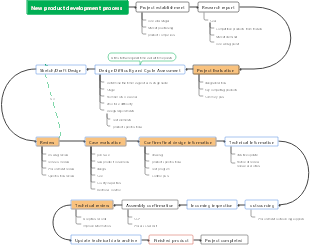
MindMap Gallery New product development process plan display
This mind map shows the new product development process plan, explaining the new product development process from the aspects of product level, strategic level, organizational identification, etc.
Edited at 2022-04-24 17:36:04This article discusses the Easter eggs and homages in Zootopia 2 that you may have discovered. The main content includes: character and archetype Easter eggs, cinematic universe crossover Easter eggs, animal ecology and behavior references, symbol and metaphor Easter eggs, social satire and brand allusions, and emotional storylines and sequel foreshadowing.

[Zootopia Character Relationship Chart] The idealistic rabbit police officer Judy and the cynical fox conman Nick form a charmingly contrasting duo, rising from street hustlers to become Zootopia police officers!
This is a mind map about Deep Analysis of Character Relationships in Zootopia 2, Main content: 1、 Multi-layer network of relationships: interweaving of main lines, branch lines, and hidden interactions, 2、 Motivation for Character Behavior: Active Promoter and Hidden Intendant, 3、 Key points of interaction: logic of conflict, collaboration, and covert support, 4、 Fun Easter eggs: metaphorical details hidden in interactions.
This article discusses the Easter eggs and homages in Zootopia 2 that you may have discovered. The main content includes: character and archetype Easter eggs, cinematic universe crossover Easter eggs, animal ecology and behavior references, symbol and metaphor Easter eggs, social satire and brand allusions, and emotional storylines and sequel foreshadowing.
[Zootopia Character Relationship Chart] The idealistic rabbit police officer Judy and the cynical fox conman Nick form a charmingly contrasting duo, rising from street hustlers to become Zootopia police officers!
This is a mind map about Deep Analysis of Character Relationships in Zootopia 2, Main content: 1、 Multi-layer network of relationships: interweaving of main lines, branch lines, and hidden interactions, 2、 Motivation for Character Behavior: Active Promoter and Hidden Intendant, 3、 Key points of interaction: logic of conflict, collaboration, and covert support, 4、 Fun Easter eggs: metaphorical details hidden in interactions.
New product development process plan display
Provide context, goals and direction for product development and ongoing product management
What is strategy?
Define and communicate an organization's unique positioning and illustrate how organizational resources, skills, and capabilities can be integrated to achieve competitive advantage. -- Porter, 2008
The action plan formulated by an enterprise to achieve long-term goals based on its own industry positioning, opportunities and resource conditions. -- Kotler, 2012
It is the core of an organization's survival and growth, laying the foundation and providing a framework for all functions and activities of the organization.
Organizational identification/identity
Clearly define and understand what the organization stands for? Why do organizations exist? and answer “Who are we as an organization?”
Organizational identity is the basis for defining the organization’s vision, mission, and values
Three key attributes
Centrality/Coreness
persistence
unique
mission, vision, values
Vision Vision
An act of imagination based on foresight and insight that reveals possibilities as well as practical constraints and describes an organization's most desired future state.
What is it going to look like?
Mission Mission
An explanation of the company's beliefs, philosophy, purpose, operating principles, or corporate beliefs. The purpose is to focus the organization's capabilities and resources.
Why do it? doing what?
Value Value
Any code that a person or organization emotionally chooses to adhere to
levels of strategy
company strategy
Overall strategy for a diverse organization
answer two questions
1. In what areas does the company compete?
2. How do different business units collaborate and improve the company's overall competitive advantage?
business strategy
Choose a set of actions to provide a unique value combination. This unique value combination refers to the products and services that the company provides to a specific market.
Steps to develop business strategy
1. Determine operational/business goals
Product categories and markets, and growth targets in both areas
2. Determine the role of product development in achieving this goal
3. Determine the focus of product innovation strategy. This is often called a "plan of attack"
4.New product planning
Includes individual project screening, portfolio management and resource allocation
product development environment
1. Company environment
Technology, Marketing, Finance, Production
2. Industrial environment
Industrial structure, industry scale, industry scale, technology level, competition, market, resources, government support
3. Overall (macro) environment
Economy, politics, culture, society, technology, resources, law, natural environment
PESTLE
Political
Economical
Social
Technological
Legal
Environmental
SWOT
Strengths
Weakness
Opportunities
Threats
innovation strategy
Must provide a basis for cross-functional collaboration, prioritization, and trade-off assessments
Innovation strategic framework
Porter Porter
Enterprise advantages ultimately boil down to two points
Cost advantage
Differentiation
There are three general strategies for using these two strengths
Segmentation
Market scope is small and focused
Differentiation
Target a broad range of products and markets
Cost Leadership Cost Leadership
Increase corporate market share by attracting cost-sensitive customers
Miles&Snow
Explorer Prospector
Analyzer
Defender
Focus on narrow but stable markets and product categories; risk averse
Focus on core competencies and product improvements
In specialized fields, we have a full range of products
Reactor
Continuous innovation and disruptive innovation
Continuous innovation
Develop new value for existing markets or networks
Focus on continuous product improvement: product aesthetics, performance, cost
Disruptive innovation
Create a new market or value network
Disruptive innovation is usually a business model, not a technology
Innovation Map/Canvas
two dimensions
business model
technology
Four types of innovation
Routine Innovation Routine
Development of functional improvements, new versions, and new models
Disruptive innovation
new business model
Breakthrough Innovation Radical
new technology
Architectural Innovation Architectural
New business models New technologies
Strategies to support innovation
Platform strategy
A series of subsystems and their interfaces, thereby establishing a common architecture and then efficiently developing and manufacturing other extended products.
technology strategy
A plan for the maintenance and development of technologies that can support the organization's future development and contribute to the achievement of the organization's strategic goals
technology life cycle
Germination/introduction period
growth period
mature stage
Intellectual Property Strategy
Types of intellectual property
1. Patent
2. Copyright Copyright
3. Trademark
4. New plant variety rights Plant Variety
5. TradeSecret
Intellectual property can be sold, licensed, exchanged or given away
The role of intellectual property rights: obtaining benefits and establishing barriers
Intellectual property management methods
Response/Passive Reactive
Proactive
Strategy Strategic
Optimized
marketing strategy
levels of marketing strategy
1. Start with business goals
Included in the organization’s vision and mission
2. Develop a marketing strategy
3. Develop a marketing mix
Products, Prices, Promotions, Locations
Promotion should emphasize the core benefits, tangible features and additional features of the product
4. Develop a marketing plan
specific tasks and activities
Questions answered by marketing strategy
Who: Who is the target customer? Including market boundaries and market segments served
What: What products are provided? Including determining product line width and depth
How:Channel
Why: Why should customers choose our products instead of our competitors’ products? Point out unique attributes that customers like
Value Proposition Value Proposition
Definition: A short, clear, and simple statement about the dimensions and how a product concept delivers value to potential customers.
The nature of value: the trade-off between the benefits users receive from a new product and the price paid
BCG Matrix
product roadmap
A plan that matches short-term and long-term business goals with product-specific innovative solutions to achieve those goals
Purpose: Communicate project direction and progress to internal and external teams or stakeholders
capability strategy
Focus on internal capabilities
Rely partly or completely on external capabilities
Combine internal and external capabilities
open innovation
Generate ideas and expand markets
functional strategy
product level
core interests
The true value of the product, non-tangible physical attributes
core benefit or service
tangible characteristics
Experienced and touchable physical properties
Packaging, brand, quality, style, features
Additional features
Additional benefits available, optional benefits at additional cost
Installation, after-sales service, warranty, delivery & credit services
Conceive a complete product around core benefits