 Wondershare EdrawMind
MindMap Gallery System Integration Project Management Engineer 3rd EditionChapter 7 Software and Hardware System Integration
- 27
System Integration Project Management Engineer 3rd EditionChapter 7 Software and Hardware System Integration
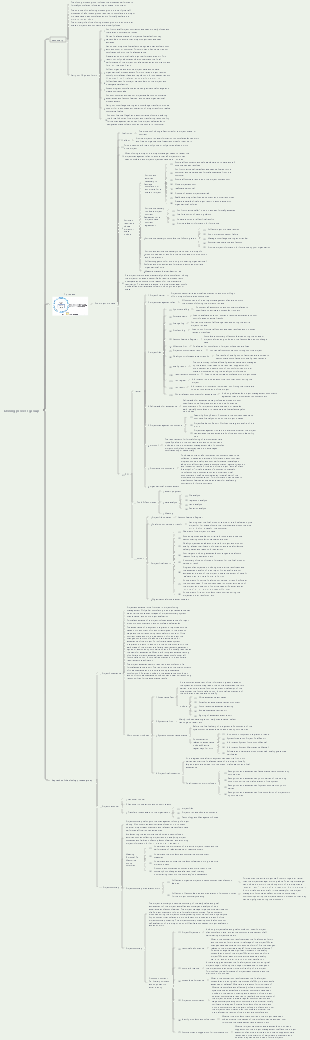
System Integration Project Management Engineer 3rd Edition/Chapter 7 Software and Hardware System Integration. Computer software and hardware system integration is based on the scenario-based needs of organizational governance, management, business, services, etc., optimizing various information technologies and products, etc., and separating each "Information islands" are connected to form a complete, reliable, economical and effective whole, allowing them to coordinate with each other, exert overall effectiveness, and achieve overall optimization.
Edited at 2024-03-19 18:09:52
- New Employee First - week Onboarding Plan
Mappa mentale per il piano di inserimento dei nuovi dipendenti nella prima settimana. Strutturata per giorni: Giorno 1 – benvenuto, configurazione strumenti, presentazione team. Secondo giorno – formazione su policy aziendali e obiettivi del ruolo. Terzo giorno – affiancamento e primi task guidati. Il quarto giorno – riunioni con dipartimenti chiave e feedback intermedio. Il quinto giorno – revisione settimanale, definizione obiettivi a breve termine e integrazione culturale.
- Analisi del campo di allenamento inglese
Mappa mentale per l’analisi della formazione francese ai Mondiali 2026. Punti chiave: attacco stellare guidato da Mbappé, con triplice minaccia (profondità, taglio, sponda). Criticità: centrocampo poco creativo – la costruzione offensiva dipende dagli attaccanti che arretrano. Difesa solida (Upamecano, Saliba, Koundé). Portiere Maignan. Variabili: gestione infortuni e condizione fisica dei big. Ideale per scout, giornalisti e tifosi.
- Analisi della lineup francese
Mappa mentale per l’analisi della formazione francese ai Mondiali 2026. Punti chiave: attacco stellare guidato da Mbappé, con triplice minaccia (profondità, taglio, sponda). Criticità: centrocampo poco creativo – la costruzione offensiva dipende dagli attaccanti che arretrano. Difesa solida (Upamecano, Saliba, Koundé). Portiere Maignan. Variabili: gestione infortuni e condizione fisica dei big. Ideale per scout, giornalisti e tifosi.
System Integration Project Management Engineer 3rd EditionChapter 7 Software and Hardware System Integration
- New Employee First - week Onboarding Plan
Mappa mentale per il piano di inserimento dei nuovi dipendenti nella prima settimana. Strutturata per giorni: Giorno 1 – benvenuto, configurazione strumenti, presentazione team. Secondo giorno – formazione su policy aziendali e obiettivi del ruolo. Terzo giorno – affiancamento e primi task guidati. Il quarto giorno – riunioni con dipartimenti chiave e feedback intermedio. Il quinto giorno – revisione settimanale, definizione obiettivi a breve termine e integrazione culturale.
- Analisi del campo di allenamento inglese
Mappa mentale per l’analisi della formazione francese ai Mondiali 2026. Punti chiave: attacco stellare guidato da Mbappé, con triplice minaccia (profondità, taglio, sponda). Criticità: centrocampo poco creativo – la costruzione offensiva dipende dagli attaccanti che arretrano. Difesa solida (Upamecano, Saliba, Koundé). Portiere Maignan. Variabili: gestione infortuni e condizione fisica dei big. Ideale per scout, giornalisti e tifosi.
- Analisi della lineup francese
Mappa mentale per l’analisi della formazione francese ai Mondiali 2026. Punti chiave: attacco stellare guidato da Mbappé, con triplice minaccia (profondità, taglio, sponda). Criticità: centrocampo poco creativo – la costruzione offensiva dipende dagli attaccanti che arretrano. Difesa solida (Upamecano, Saliba, Koundé). Portiere Maignan. Variabili: gestione infortuni e condizione fisica dei big. Ideale per scout, giornalisti e tifosi.
- Recommended to you
- Outline

System Integration Project Management Engineer 3rd EditionSoft Test SuccessChapter 2 Information Technology Development
- 29

System Integration Project Management Engineer 3rd EditionSoft Test Midterm Chapter 13 Monitoring Process Group
- 35
System Integration Project Management Engineer 3rd EditionSoft Test MidtermChapter 14 Closing Process Group
- 35

Systems Integration Project Management Engineer 3rd EditionChapter 4 Information Systems Architecture
- 39
Software and hardware system integration
一、 summary
Computer software and hardware system integration is based on the scenario-based needs of organizational governance, management, business, services, etc., optimizing various information technologies and products, etc., to connect various separated "information islands" into a complete, reliable, economical and effective whole. And enable them to coordinate with each other to exert overall effectiveness and achieve overall optimization.
System integration can generally be divided into software integration, hardware integration, network integration, data integration and business application integration. Usually, system integration means integrating computer software, hardware, network communications, information security, business applications, data management and other technologies and products into an information system that can meet specific needs. The system's software and hardware integration activities are also a series of integration activities across the boundaries of components such as devices and systems. It is necessary to break through the "security trust" mechanism within these system components and achieve new and dynamic "security" across components through technical means. "Trust" relationship, which often requires the in-depth application of commercial passwords.
二、 System integration basics
I. Understanding of system integration concepts
System integration is to propose a systematic and overall solution under the guidance of the scientific method of system engineering and based on the analysis of demand scenarios and technical specifications for computer software and hardware development, and at the same time integrate the hardware, software, network, business, etc. that make up the solution. Data, personnel, etc. are organically combined to achieve a complete system that meets the needs of the scenario.
Software and hardware system integration is a systematic thought and method with engineering thinking. Although it involves technical issues such as software and hardware, it is by no means just a technical issue.
Software and hardware system integration takes the integration of information as the goal, the integration of functions as the structure, the integration of platforms as the basis, and the integration of personnel as the guarantee.
II. System integration project characteristics
1. The integrated delivery team is large and often not very continuous;
2. Involves numerous contractors or service organizations and is generally dispersed across multiple geographies;
3. It is usually necessary to develop or develop a certain amount of software and hardware systems, especially the adaptation and systematization of Xinchuang products and Xinchuang systems;
4. Often employing a large number of new, cutting-edge, and even disruptive technologies;
5. Integration results are becoming more and more user-friendly, and integration implementation and operation and maintenance tend to become more complex.
III. Xinchuang and system integration development
i. The definition of “critical information infrastructure industry” (referred to as “critical information infrastructure industry”) refers to important industries and fields such as public communications and information services, energy, transportation, water conservancy, finance, public services, e-government, and national defense technology, as well as other once-in-a-lifetime industries and fields. Information facilities that are damaged, lose their functions or have data leaked, which may seriously endanger national security, national economy and people's livelihood, and public interests.
ii. Basic areas such as communications, energy, transportation, finance, and e-government must accelerate the advancement of industry information creation.
iii. Compared with traditional system integration, Xinchuang's related integration needs to pay attention to the following aspects:
1. Since there are many innovative or original technologies and products, each technology and product is at a different maturity level. This requires integrated service providers to fully grasp the selection of technologies and products on the one hand, and on the other hand, based on the life cycle of technologies and products. situation, and match and integrate with the corresponding application scenarios;
2. Xinchuang technology products often have a relatively fast iteration cycle and will also cause problems with standardization. This requires the integration service organization to fully understand and recognize this problem. Based on the different degree and level of scenario requirements, reasonable use is in a rapid iteration period. Xinchuang technology and products;
3. Because Xinchuang's technology and products have strong independent controllability, in scenario-oriented applications, technology and product manufacturers can be fully mobilized to carry out scenario-based technology and product innovation, thereby obtaining better economic and social benefits, and Further drive the development of Xinchuang technology and products.
三、 Infrastructure integration
I. summary
Information system infrastructure usually includes communication network infrastructure represented by LAN, Internet, 5G, Internet of Things, Industrial Internet and Satellite Internet, new technology infrastructure represented by artificial intelligence, cloud computing and blockchain, as well as Computing infrastructure represented by data centers and supercomputing centers.
Information system infrastructure has different division methods from different dimensions, such as weak current systems, network systems, data centers, etc.
II. Weak current engineering
i. Weak current generally refers to electricity consumption below AC 220V and 50Hz. It is a way of classifying power applications according to the strength of the power transmission power.
ii. Weak current projects involved in information systems include a variety of application scenarios:
1. Telephone communication system
Used to implement telephone (including three types of fax machines, video phones, etc.) communication functions
Usually a star topology is used, using Category 3 (or above) unshielded twisted pairs, and the frequency of the transmitted signal is within the audio range.
2. Computer LAN system
Network foundation used to implement various data transmissions
According to different usage scenarios, it can be divided into office network, production network, industrial control network, confidentiality network, R&D network, etc.
Usually a star topology is used, using Category 5 or above unshielded twisted pairs to transmit digital signals, and the transmission rate can reach more than 100 Mb/s.
3. Music/Broadcasting System
Through speakers, radios, etc. installed at the scene (such as shopping malls, stations, corridors, office areas, etc.), music playback or voice broadcasting can be performed on the scene.
Usually a multi-channel bus structure is used, using copper-core insulated wires to transmit the constant-voltage audio signal output by the power amplifier to drive the on-site speaker to produce sound.
4. Cable TV signal distribution system
Evenly distribute cable TV signals to each user point in the building (group)
Branches and distributors are usually used for signal distribution. In order to reduce signal distortion and attenuation and ensure that the signal quality at each user point meets the requirements stipulated in the specification, the wiring usually adopts a tree structure and uses 75Ω RF coaxial cable to transmit multiple RF signals. , and varies with the form of the building and the distribution of user points.
5. video surveillance system
Through cameras, anti-theft detectors and other equipment installed on-site (such as data centers, shopping malls, stations, communities, etc.), various entrances and exits of the building and some important places are monitored, and abnormal situations can be alarmed.
The transmission of video signals usually adopts a star structure, using video coaxial cables or optical fibers, and the transmission of control signals adopts a bus structure, using copper core insulated cables.
With the widespread popularization of network technology and equipment, traditional closed-circuit video surveillance systems are gradually replaced by network video surveillance systems. Network video surveillance systems usually refer to network surveillance systems used for specific applications in the fields of security surveillance and remote monitoring. It enables users to achieve video surveillance, video image recording and related alarm management through IP networks.
6. Fire alarm system
The fire alarm system consists of fire alarm, fire linkage system, fire broadcast system, fire intercom telephone system and other parts.
For the transmission of linkage control signals of important fire protection equipment (such as fire pumps, sprinkler pumps, positive pressure fans, smoke exhaust fans, etc.), a star structure is sometimes used, and copper core insulated cables are used for signal transmission (some products require the use of twisted pair).
Fire broadcasting systems usually adopt a multi-channel bus structure, and copper core insulated wires are used for signal transmission (this system can be used in conjunction with music/broadcasting systems).
Fire alarm intercom telephone systems usually adopt two structures: star and bus, and shielded wires are used for signal transmission.
7. Entrance and exit control system/all-in-one card system
Use computers, smart card door locks, card readers and other equipment to set, monitor, control and record the status of each entrance and exit, to achieve unified management of each entrance and exit of the building and ensure the safety of the building
Its topology and transmission media vary depending on product or scenario requirements.
8. Parking fee management system
Through the induction coil installed under the ground of the vehicle entrance and exit, the entry and exit of the vehicle is sensed, and the manual/semi-automatic/fully-automatic toll management system is used to collect tolls and control the opening and closing of the electric railings.
The system wiring is limited to the entrances and exits of the parking lot. Each entrance and exit is controlled by a controller. The controller can work independently or be networked with the upper management computer. Its wiring structure and transmission media vary depending on the product or scene requirements.
9. Building automation system
Through various detection and execution devices connected to the on-site controller, various environmental parameters inside and outside the building and the working status of various equipment in the building (such as air conditioning, water supply and drainage, lighting, power supply and distribution, elevators, etc.) are detected , monitor and control, and connect various on-site controllers through the computer network to reasonably allocate and manage the resources and equipment in the building to achieve the goals of comfort, convenience, savings and reliability.
The communication protocols used by products of different manufacturers of building automation systems are different, and the topologies and transmission media of their field buses and control buses are also different.
10. Intelligent system
It refers to an intelligent collection that is composed of modern communication and information technology, computer network technology, industry technology, and intelligent control technology, and is applied in a certain field or scenario.
Smart residential communities, smart hospitals, smart buildings, etc. are all developed based on smart buildings. The intelligent systems we usually mention refer to intelligent building systems.
iii. Weak current projects also include video conferencing systems, screen display systems, sound reinforcement systems, patrol systems, building intercom systems, Three-meter (water, electricity, gas meter) automatic meter reading system, etc.
iv. Designers usually start from line integration (sharing), network integration, function integration and software interface Integration and other aspects should be considered to consider the integrated application between various weak current systems.
III. network integration
i. summary
Network system integration is in network engineering, based on the needs of scenario-based applications, using technology, management and other means to integrate network infrastructure, network equipment, network system software, network basic service systems, computer hardware equipment, software systems, application software, etc. The whole process of integrating organizations into a complete, reliable, economical, safe and efficient computer network system.
From a technical perspective, network system integration is a comprehensive technology that comprehensively applies computer technology, network technology, control technology, communication technology, application system development technology, building decoration and other technologies to network engineering.
Network integration projects generally include pre-project plans, line and weak current construction, network equipment erection, various system erection and network post-maintenance and other project construction and information technology service work.
From a technical perspective, network integration not only involves network equipment and management software from different manufacturers, but also involves the interconnection of heterogeneous and heterogeneous network systems. From a management perspective, the management methods and management ideas of each organization vary widely, and the transformation to network management will face many human factors.
The general system framework of computer network integration usually includes network transmission subsystem, switching subsystem, network management subsystem and security subsystem.
ii. Transmission subsystem
Transmission is the core of the network and the "highway" and "blood vessel" of network information. The bandwidth of the transmission line not only reflects the communication capabilities of the network, but also reflects the modernization level of the network.
At present, the main transmission media are divided into two categories:
(1) Wireless transmission media mainly include radio waves, microwaves, infrared, etc.
(2) Wired transmission media mainly include twisted pairs, coaxial cables, optical fibers, etc.
iii. switching subsystem
Networks can be divided into local area networks, metropolitan area networks and wide area networks according to the areas they cover.
Network switching can also be divided into
(1) LAN switching technology
1||| Shared LAN
Usually shared high-speed transmission media, such as Ethernet (including Fast Ethernet and Gigabit Ethernet, etc.), Token Ring, FDDI, etc.
2||| switched LAN
It refers to the switching equipment composed of hardware switching circuits with frames or smaller data units (called cells) of the data link layer as the switching unit.
The switched network has good scalability and high information forwarding speed, and can adapt to the needs of growing network applications.
(2) MAN switching technology
A metropolitan area network is a computer communication network established within a city.
Due to the use of LAN technology with active switching elements, the transmission delay in the network is small, and its transmission medium is mainly optical cable.
A typical application of the metropolitan area network is the broadband metropolitan area network, which is a high-bandwidth, multi-functional, multi-functional network within the city that integrates data, voice and video services based on IP and ATM telecommunications technology and using optical fiber as the transmission medium. Multimedia communication network with multi-service access.
(3) WAN switching technology
A wide area network is a remote network that connects computers in local area networks or metropolitan area networks in different areas for communication.
It usually spans a large physical range, covering a range from dozens of kilometers to thousands of kilometers. It can connect multiple regions, cities and countries, or span several continents, and can provide long-distance communications, forming an international remote network.
WAN is not the same as the Internet. The Internet generally refers to a public wide area network.
The main technologies of WAN are:
1||| circuit switching
It refers to the data exchange between two devices through a dedicated communication line established by an intermediate node.
For example, the telephone network uses circuit switching technology.
The advantage of circuit switching is that once a communication line is established, both communicating parties can transmit data at a constant transmission rate with small delay; its disadvantage is that the utilization rate of the communication line is low.
2||| message exchange
It means that the communicating parties do not have dedicated lines, but exchange data in units of messages, and the sender's message is transmitted to the destination through multiple "store and forward" operations by the node.
The advantage of message switching is that the utilization rate of communication lines is high, but the disadvantage is that the message transmission delay is large.
3||| packet switching
It refers to dividing the data into fixed-length packets (the length is much smaller than the message), and then performing "store and forward" to achieve higher communication line utilization, shorter transmission delay and lower communication cost.
4||| mixed exchange
Mainly refers to the simultaneous use of circuit switching technology and packet switching technology.
A typical application is ATM switching technology.
iv. security subsystem
Main areas of concern include:
1. Use firewall technology to prevent external intrusions. Firewall technologies mainly include packet filtering technology, proxy servers and application gateways.
2. Use data encryption technology to prevent anyone from stealing information from communication channels. Currently, the main encryption technologies include symmetric encryption algorithms (such as DES) and asymmetric encryption algorithms (such as RSA).
3. Access control mainly protects network resources by setting passwords, passwords and access rights.
v. Network management subsystem
For any network management subsystem, the key task is to ensure that the network operates well.
As the network scale increases, network "bottleneck" problems often occur, slowing down the system. The network administrator's job is to identify bottlenecks and resolve them.
vi. Service subsystem
Network services are the core issue of network applications.
No matter how high the bandwidth of the network is, if there is no good network service, the benefits of the network cannot be exerted.
Network services mainly include Internet services, multimedia information retrieval, information on demand, information broadcast, remote computing and transaction processing, and other information services.
IV. Data center integration
i. summary
Data center integration usually includes integrated environments such as data center infrastructure, communication rooms, computing centers, data processing centers, distributed computing, telecommunications equipment, network and security equipment.
In the integrated construction of the data center, the construction or renovation of the computer room is the basic project. The construction or renovation of the computer room includes the construction, transformation and decoration of the network center computer room, high-performance computer room and related auxiliary computer rooms. In addition, it also includes the UPS power supply, air conditioning and grounding of the computer room. And lightning protection projects and other supporting facilities (such as weak current projects), etc.
ii. Cabinet integration
Before installing the cabinet, the project staff first planned the available space in the computer room, considered the heat dissipation and maintenance of the equipment, and clarified the cabinet installation process.
Specific cabinet integrated installation work includes preparation work before installation, construction according to the cabinet installation process, and debugging after cabinet installation.
iii. Server integration
The server is a key device in system integration.
The role of the server is to provide resources and services such as processors, memory, disks, printers, software data, etc. to workstations, and is responsible for coordinating and managing these resources. Server integration work is to install server equipment into the cabinet according to the project implementation plan and its installation sequence, and debug the server operating system based on the server system design in the project implementation plan or system design plan.
Before implementing server integration, you need to be familiar with the server design plan in the project implementation plan, including network topology, server application design, server resource division, server operation requirements, etc.
For network servers, since the network server must serve all users on the network at the same time, the network server is required to have higher performance, including faster processing speed, larger memory, larger disk capacity and high reliability.
Consider the following factors when choosing a web server:
① The speed and number of CPUs;
②Memory capacity and performance;
③Bus structure and type;
④Disk capacity and performance;
⑤Fault tolerance performance;
⑥Network interface performance;
⑦Server software, etc.
iv. Storage integration
Storage integration implementation usually complements server integration. The following factors should be considered when integrating storage devices:
①Disk array space and type;
②Configure the number of hard drives;
③RAID controller structure;
④Support RAID 0, RAID 1, RAID5 or more types;
⑤IOPS reading and writing performance and data transmission capability;
⑥Meet high reliability, equipped with redundant hot-swappable power supplies, fans, etc.
Cloud-integrated storage typically refers to cloud-based storage technology that tiers and/or hides data.
v. Network device integration
Network equipment integration work is usually based on network planning and design in software and hardware integration projects, equipment installation and connection, and network testing.
Network planning and design content includes topology planning, equipment installation and deployment design, network planning, etc.
Among them, network planning usually includes WAN planning, LAN planning, IP address planning, routing planning, wireless planning, network management planning, service planning and security planning.
Network equipment usually includes core switches, aggregation switches, access switches, routers, repeaters, hubs, gateways, bridges, etc.
vi. Security device integration
Security equipment integration work mainly focuses on network security construction planning solutions, including firewall systems, network intrusion prevention systems, network intrusion detection systems, virus filtering gateways, vulnerability scanning, host monitoring and auditing, network security audits, database audits, log audit systems, Web application protection, web page anti-tampering, security management platform, bastion host and VPN system and other security systems and equipment are integrated, implemented, installed, deployed and tested.
四、 Software integration
I. Basic software integration
i. Operating systems, databases, middleware and other key components that drive computer operation are the focus of information system integration.
ii. operating system
1. Operating System (OS) is the most basic and important basic system software in a computer system. It is a group of systems that supervises and controls computer operations, uses and runs hardware and software resources, and provides public services to organize user interaction. Interrelated system software programs.
2. Classification and function
There are many types of operating systems. According to the operating environment, operating systems can be divided into desktop operating systems, server operating systems, mobile operating systems, embedded operating systems, etc.
From a functional perspective, there are
(1) Batch operating system
It is one of the earliest types of operating systems. Its main function is to execute a series of pre-written jobs in batches. The user submits the job to the operating system, and the system executes it in sequence and outputs the results;
(2) real-time operating system
It is mainly used in time-sensitive systems, such as aerospace, industrial automation and other fields, and can be divided into hard real-time systems and soft real-time systems;
(3) time-sharing operating system
It is an operating system designed for multi-users and multi-tasking. It can provide services to multiple users at the same time. Each user's tasks are executed alternately in time, giving users a feeling of monopolizing the computer at the same time;
(4) network operating system
It is an operating system designed for network environments. It provides a set of functions for managing network resources and services, allowing multiple computers to work together and share resources;
(5) Distributed operating system
It is an operating system in which multiple computers work together. It distributes computing and storage tasks to multiple computers to improve the performance and reliability of the entire system.
At present, my country's independently developed operating systems mainly include Winning Kirin, Galaxy Kirin, Deepin, Huawei Hongmeng, etc. Various organizations are deeply involved in the development, adaptation and application of operating systems, further stimulating and prospering my country's development in this field.
Operating system integration is to carry out installation, deployment and performance optimization around its main functions. The operating system functions mainly include the following aspects:
Process management
Its main job is process scheduling. In the case of a single user and a single task, the processor is only exclusive to one task of one user, and the process management work is very simple. However, in the case of multi-programming or multi-user, when organizing multiple jobs or tasks, it is necessary to solve the problems of processor scheduling, allocation and recycling.
Storage management
It is divided into functions such as storage allocation, storage sharing, storage protection, and storage expansion.
Device management
It has functions such as equipment allocation, equipment transmission control, and equipment independence.
File management
It has functions such as file storage space management, directory management, file operation management, and file protection.
Job management
Responsible for processing any requests submitted by users.
3. network operating system
A network operating system is a software program that can replace a general operating system. It is the heart and soul of the network environment and a special operating system that provides services to network computers.
Information systems transfer data and various messages to each other through the network. The structure can be divided into
1||| server
The main function is to manage the sharing of various resources and network equipment on the server and network, integrate and control traffic, and avoid paralysis;
2||| client
It has the function of receiving and applying the data passed by the server, so that the client can clearly search for the required resources.
The main task of the network operating system is to schedule and manage network resources and provide network users with a unified and transparent way to use network resources.
Network resources mainly include network servers, workstations, printers, bridges, routers, switches, gateways, sharing software and application software, etc.
The basic functions of a network operating system include:
1||| data sharing
Data is the most important resource of the network, and data sharing is the core function of the network operating system.
2||| Device sharing
Network users share relatively expensive equipment such as laser printers, large-screen monitors, plotters, large-capacity disks, etc.
3||| File management
Manage network users to read/write server files, and coordinate and control access operation permissions.
4||| name service
Network user registration management is usually completed by a domain name server.
5||| cyber security
Prevent illegal users from operating, stealing, modifying and destroying network resources.
6||| network management
Including network operation management and network performance monitoring.
7||| System fault tolerance
To prevent host system failures from affecting the normal operation of the network, technical measures such as UPS power monitoring and protection, dual-machine hot backup, disk mirroring, and hot-plugging are usually adopted.
8||| Internet connection
Connect different networks together to achieve communication and resource sharing between them.
9||| application
Supports various network applications such as email, database, and file services.
4. Distributed operating system
A distributed operating system is an operating system configured for distributed computing systems.
Some resources, such as files with multiple copies, must also consider consistency, etc. The so-called consistency means that the data read by several users at the same time from the same file is consistent. In order to ensure consistency, the operating system must control the reading, writing, and operation of files, so that multiple users can read a file at the same time, and only one user can modify the file at any time.
The structure of the distributed operating system is also different from other operating systems. It is distributed on each computer in the system, can handle various user needs in parallel, and has strong fault tolerance.
5. Virtualization and security
Operating system virtualization, as the core technology of containers, has received widespread attention from researchers.
Operating system virtualization technology allows multiple applications to run in isolation in an environment that shares the same host operating system (Host OS) kernel. The host operating system provides applications with isolated operating environments, that is, container instances.
The operating system virtualization technology architecture can be divided into container instance layer, container management layer and kernel resource layer.
The most essential difference between operating system virtualization and traditional virtualization is that traditional virtualization requires the installation of a guest operating system (Guest OS) to execute applications, while operating system virtualization replaces the guest operating system with a shared host operating system. .
Providing operating system security reinforcement and optimization services is a key link in achieving information system security.
Currently, the main threats to operating system security include system vulnerabilities, fragile login authentication methods, access control issues, computer viruses, Trojans, system backdoors, covert channels, malicious programs and code infections, etc.
At present, under the rapid development trend of the Xinchuang industry, the Xinchuang operating system will rise rapidly.
The integration work of the operating system is mainly based on the project implementation plan (system deployment plan), focusing on project tasks such as operating system installation, resource allocation, system management, etc., to carry out integration implementation and delivery work, as well as the adaptation of operating system applications based on the Xinchuang environment , testing, verification and performance tuning.
iii. database
A database is a warehouse that organizes, stores, and manages data according to a data structure. It is a collection of large amounts of data that is stored in a computer for a long time, is organized, shareable, and unified management.
A database management system is a computer software system designed for managing databases. It generally has basic functions such as storage, interception, security, and backup. Therefore, the database management system is the core component of the database system. It mainly completes the operation and management functions of the database, realizes the creation of database objects, as well as query, add, modify and delete operations of database stored data, and user management and permission management of the database. wait.
Distributed database is a combination of database technology and distributed technology. Distributed database technology refers to a database technology that combines various database nodes that are geographically dispersed, but logically belong to the same system in the computer system. Distributed database systems do not focus on centralized control of the system, but focus on the autonomy of each database node.
Database integration work is mainly based on the project implementation plan (including database construction plan or database design), and carries out integration implementation and delivery work around project tasks such as database system installation, database creation, database migration, database backup and recovery, and database management, and Adaptation, testing, verification and performance tuning of database applications based on Xinchuang environment.
iv. middleware
Middleware is a major category of basic software and belongs to the category of reusable software. Middleware is located between the operating system software and the user's application software. That is, the middleware is above the operating system, network and database, and is the lower layer of the application software. Its overall function is to provide an operating and development environment for the application software on its upper layer. , helping users develop and integrate complex application software flexibly and efficiently.
Middleware functions
Middleware is an independent system-level software that connects the operating system layer and the application layer, standardizes the application interfaces provided by different operating systems, unifies the protocols, and shields the details of specific operations.
Middleware generally provides functions
1. Communication support
Middleware provides a platform-based operating environment for the application software it supports. This environment shields the interface differences between underlying communications and enables interoperability. Therefore, communication support is the most basic function of middleware.
The main communication methods for early applications to interact with distributed middleware were remote calls and messages.
In the communication module, remote calls communicate through the network and support data conversion and communication services, thus shielding different operating systems and network protocols. Remote calling provides process-based service access and only provides a very simple programming interface or process call model for the upper-layer system.
Messages provide a mechanism for asynchronous interaction.
2. Application support
The purpose of middleware is to serve upper-layer applications and provide an interoperability mechanism between different services in the application layer.
Middleware provides a unified platform and operating environment for upper-layer application development, encapsulates the API interfaces provided by different operating systems, and provides a unified standard interface to the application system, making the development and operation of the application system independent of the operating system and achieving its independence.
The loosely coupled structure of middleware, standard encapsulated services and interfaces, and effective interoperability mechanisms all provide strong support for application structuring and development methods.
3. Public Service
Public services are the extraction of common functions or constraints in application software. Classify and implement these common functions or constraints, support reuse, and provide them to applications as public services.
By providing standard and unified public services, it can reduce the development workload of upper-layer applications, shorten application development time, and help improve the development efficiency and quality of application software.
Classification of middleware
The development of middleware technology has gone through multiple stages such as process-oriented distributed computing technology, object-oriented distributed computing technology, and agent-oriented distributed computing technology.
Middleware products are usually divided into
(1) transactional middleware
Also known as transaction processing management program, it is one of the most widely used middleware currently. Its main function is to provide communication, concurrent access control, transaction control, resource management, security management, load balancing, and fault recovery required for online transaction processing. and other necessary services.
Transactional middleware supports concurrent access by a large number of client processes and has strong scalability. Because transactional middleware has the characteristics of high reliability and strong scalability, it is mainly used in industries and fields with a large number of customers such as finance, telecommunications, e-commerce, and e-government.
(2) procedural middleware
Also known as remote procedure call middleware.
Procedural middleware is generally divided logically into two parts: client and server. Client and server are a logical concept and can run on the same computer or on different computers. Even the underlying operating systems of the client and server can be different.
Communication between the client and server can use synchronous communication or threaded asynchronous calls. Therefore, procedural middleware has better heterogeneous support capabilities and is simple and easy to use. However, due to the access connection used between the client and the server, there are certain limitations in terms of ease of tailoring and fault tolerance.
(3) Message-oriented middleware
Referred to as message middleware, it is a type of middleware that uses messages as a carrier to communicate. It uses an efficient and reliable message mechanism to realize a large amount of data exchange between different applications.
According to different communication models, there are two types of communication models for message middleware: message queue and message passing.
(4) object-oriented middleware
Also known as distributed object middleware, it is a combination of the development of distributed computing technology and object-oriented technology, referred to as object middleware. The distributed object model is a natural extension of the object-oriented model in a distributed heterogeneous environment.
Object-oriented middleware provides various forms of communication services to the application layer. Through these services, upper-layer applications can more easily handle transaction processing, distributed data access, object management, etc.
(5) Transaction middleware
It is a software designed specifically for online transaction processing systems.
Online transaction processing systems need to handle a large number of concurrent processes, and processing concurrent processes will inevitably involve various basic software and application software such as operating systems, file systems, compiled languages, and database systems. It is a quite complex task, but this type of high difficulty The work can be simplified by using transaction middleware.
Using transaction middleware can significantly reduce the programming effort required to develop an online transaction processing system.
(6) Web application server
It is the product of the combination of Web server and application server.
Application server middleware can be said to be the infrastructure of software. It uses componentization technology to integrate application software into a certain collaborative working environment, and provides a variety of communication mechanisms, transaction processing capabilities, and application development and management functions.
Because it directly supports the development of three-tier or multi-tier application systems, application servers are a hot spot in the middleware market, and J2EE architecture is the mainstream standard for application servers.
The integration work of middleware is mainly based on the project implementation plan (server deployment and middleware deployment plan), focusing on project tasks such as middleware installation, application deployment, middleware management, etc., to carry out integration implementation and delivery work, as well as middleware based on Xinchuang environment. Adaptation, testing, verification and performance tuning of software applications.
v. Office Software
Office software usually refers to software that can perform word processing, table production, slide production, graphics and image processing, simple database processing, etc.
The current integration work of office software mainly involves
1. streaming software
Software that processes streaming documents is streaming software, and its specialty is editing documents in a WYSIWYG format.
Kingsoft's WPS Office software is a typical streaming software, and the documents saved are streaming files. Streaming files support editing, and their content is flowing. Typing new content in the middle will cause the subsequent content to "flow" to the next line or page. The display effect of streaming files will change in different software and hardware environments. For example, the same Word document will have different display effects in different versions of Office software or on computers with different resolutions. That is the "running version" phenomenon.
2. Layout software
The software that processes layout documents is layout software. Its specialty lies in displaying, printing, and sharing the original file contents intact without any changes or editing.
For layout software, there are currently two layout standards in the industry: one is the international version of PDF; the other is the national standard. OFD. Simply put, OFD is the national standard format, which is generally used in official documents, documents and other services in the field of government affairs. Currently, various PDF readers and editors are typical layout software, and the saved PDF documents are layout files. After the format file is formed, the text cannot be edited or tampered with, and only information such as annotations, seals, etc. can be added to it. Therefore, layout documents are very suitable as carriers of highly serious and highly precise documents, such as electronic official documents, electronic certificates, electronic certificates, etc. Compared with streaming files, layout documents will not "run out", and the display and printing effects on any device are highly accurate and consistent.
The integration work of office software is mainly based on the installation, management and application of office software products in the Xinchuang environment. Especially the adaptation, testing, verification and performance tuning of office software based on Xinchuang Environment.
II. Application software integration
i. Common methods of application software system integration include calling each other through interfaces between software systems, fully integrating software system functions into one system, using single sign-on between software systems, etc., and are recognized by the industry as the best solution for application integration. The way is SOA.
ii. The functions of application software system integration usually include interface integration, function integration, interface integration and system corresponding data integration.
iii. In the context of software integration, representative software component standards have emerged
1. Common Object Request Broker Architecture (CORBA)
The Object Management Group (OMG) is the developer of the CORBA specification. It is an international organization composed of more than 800 information system suppliers, software developers and users. It was established in 1989.
The purpose of OMG is to integrate object and distributed system technologies into an interoperable unified structure that supports both existing platforms and future platform integrations.
Based on CORBA and using JINI technology, various electronic products can be combined to become service resources on the network, allowing application integration to move toward broader application fields. At the same time, Object Web brings CORBA technology into the Internet world. CORBA is the basis for OMG's standardized distributed object computing.
CORBA automatically matches many common network tasks, such as object registration, positioning, activation, multi-channel requests, framing and error control, parameter orchestration and de-arrangement, operation distribution, etc.
CORBA has the following features:
1||| Object Request Broker (ORB)
In CORBA, the interaction between various modules is completed through the object request proxy. The function of the ORB is to pass the user's request to the target object and return the execution result of the target object to the user who made the request. Therefore, ORB is a framework that implements application interoperability in the form of object requests. It provides transparency of interactions between users and target objects. It is the basis for people to effectively use object-oriented methods to develop distributed applications, and ORB is the entire reference model. Core.
2||| object service
CORBA Object Services extend the basic CORBA architecture. Its object service represents a set of pre-implemented distributed objects that are commonly required by software developers. Its interface has nothing to do with specific application fields and can be used by all distributed object programs.
Currently, CORBA has standardized and defined a total of 15 types of services, such as Naming Service, Event Service, Life Cycle Service, Relationship Service, Transaction Service, etc.
3||| Common Facility
Public functions are similar to the basic functions of object services, except that public functions are end-user-oriented applications. For example, the distributed document component function (OpenDoc-based component document common function) is an example of a public function.
4||| Domain Interface
Provides similar interfaces to object services and public functions, but these interfaces are application domain-specific. These areas include manufacturing, telecommunications, medicine and finance, among others.
5||| Application Interface
Provides interfaces for application development.
2. COM
An object in COM is a binary code object whose code form is DLL or EXE execution code. Objects in COM are directly registered in the Windows system library. Therefore, the objects in COM are no longer objects supported by a specific programming language and its programming environment, but are objects directly supported by the system platform.
The basic goal of COM technology is: even if the objects are implemented by different developers using different programming languages, objects that already exist in other existing software systems can still be effectively used when developing software systems. At the same time, It is also necessary to make the currently developed objects easy to reuse when developing other software systems in the future.
In order to achieve independence from programming languages, the COM object is made into binary executable code, and then the unified method of this standard interface is used at the binary code layer to provide a standard interoperability interface for the object, and the system platform directly processes the COM object Provide support for management and use.
COM has many features required for software integration, including
1||| object-oriented
COM is developed on the basis of object-oriented.
2||| client/server
COM is based on the client/server (C/S) model and has very good flexibility
3||| language independence
The definition of the COM specification does not depend on a specific language. Therefore, the language used to write component objects and the language used to write user programs can be different, as long as they can both generate executable code that conforms to the COM specification.
4||| process transparency
COM provides three types of component object service programs, namely in-process service programs, local service programs and remote service programs.
5||| reusability
Reusability is the goal of any object model. Especially for large software systems, reusability is very important. It simplifies complex systems into some simple object models and embodies the object-oriented idea.
COM uses two mechanisms (containment and aggregation) to achieve object reuse. For the user program of a COM object, it only uses the services provided by the object through the interface and does not need to care about the internal implementation process of the object.
3. DCOM and COM
(1) DCOM
As an extension of COM, DCOM not only inherits the advantages of COM, but also provides some new features for distributed environments, such as location transparency, network security, cross-platform calling, etc.
DCOM is actually an improvement for users to call out-of-process services. Through the RPC protocol, users can transparently call remote services on remote machines through the network.
During the calling process, the user does not directly call the remote service on the remote machine, but first establishes a remote service agent on the local machine, calls the stub on the remote service machine through the RPC protocol, and the stub parses it. User calls are mapped to methods or properties of the remote service.
(2) COM
COM is a new development of COM or a higher-level application of COM. Its underlying structure is still based on COM and contains almost all the contents of COM.
COM advocates a new concept, which elevates COM component software to the application layer instead of the underlying software structure. Through various supports from the operating system, the component object model is built on the application layer, and the underlying components of all components are The details are left to the operating system. Therefore, COM is more closely integrated with the operating system.
Key features of COM include:
1||| True asynchronous communication
The underlying layer of COM provides queue component services, which makes it possible for users and components to Working together at a point in time, COM applications can obtain such features without adding code.
2||| event service
The new event mechanism makes event sources and event receivers more flexible in implementing event functions, using system services The service simplifies the event model and avoids the trivial details of the COM connectable object mechanism.
3||| Scalability
COM's scalability comes from many aspects. Dynamic load balancing and system services such as in-memory databases and object pools all provide the technical foundation for COM's scalability.
The scalability of COM is in principle consistent with the scalability characteristics of multi-layer structures.
4||| Inherited and developed the characteristics of MTS
From COM to MTS is a conceptual leap, but the implementation is still lacking. MTS is mature, and COM has perfected and implemented many concepts and features of MTS.
5||| Manageability and configurability
Management and configuration are actions after the development of the application system is completed. The cost of software maintenance continues to increase. Today's increase in COM applications will help software vendors and users reduce investment in this area.
6||| Easy to develop
The complexity and difficulty of COM application development will determine the success of COM. Although the COM development model is simpler than previous COM component development, truly improving development efficiency still requires the help of some excellent development tools.
COM marks that component technology has reached a new height. It is no longer limited to the desktop system on one machine, but targets a broader organizational intranet and even the Internet.
4. .NET
.NET is a series of products, technologies and services based on a set of open Internet protocols.
The .NET development framework provides developers with a complete basic class library, database access technology and network development technology based on a common language running environment. Developers can quickly build network applications using multiple languages.
1||| Common Language Runtime (Common Language Runtime, CLR)
It is at the bottom of the .NET development framework and is the foundation of the framework. It provides a unified running environment and a unified programming model for multiple languages of the .NET development framework, which greatly simplifies the release and upgrade of applications. Interaction between languages, automatic management of memory and resources, etc.
2||| Base Class Library (BCL)
It provides developers with a unified, object-oriented, hierarchical, and extensible programming interface, allowing developers to efficiently and quickly build applications based on the next generation Internet.
3||| ADO.NET technology
Used to access the database, it provides a set of class libraries for connecting to the database, running commands, and returning record sets. ADO.NET provides powerful support for XML, providing the basis for XML to become a unified format for data exchange in .NET.
4||| ASP.NET
It is a network programming structure in .NET that can easily and efficiently build, run and publish network applications. ASP.NET also supports Web Services. In .NET, ASP.NET applications are no longer interpreted scripts, but compiled and run, coupled with flexible buffering technology, which fundamentally improves performance.
5. J2EE application architecture
The J2EE architecture is a de facto industry standard for developing organizational-level applications using Java technology. It is the product of Java technology's continuous adaptation and promotion of organizational-level applications.
J2EE provides a good mechanism for building an organizational system with scalability, flexibility, and ease of maintenance.
The architecture of J2EE can be divided into
1||| client layer
This layer is responsible for direct interaction with users. J2EE supports multiple clients, so the client can be either a Web browser or a dedicated Java client.
2||| Server-side component layer
This layer serves Web-based applications. It uses JSP and Java Servlet technology in J2EE to respond to client requests and provide backward access to components encapsulated with business logic.
3||| EJB layer
This layer mainly encapsulates business logic, completes enterprise computing, and provides various basic services such as transaction processing, load balancing, security, and resource connection. When writing EJB, the program can not care about these basic services and focus on the business logic. accomplish.
4||| information system layer
Including the organization's existing systems (including database systems, file systems), J2EE Various technologies are provided to access these systems, such as JDBC to access DBMS.
In the J2EE specification, the J2EE platform includes a complete set of services, application programming interfaces and protocols, which can be used to develop general multi-tier applications and Web-based multi-tier applications. It is the core and foundation of J2EE. It also provides comprehensive support for EJB, Java Servlets API, JSP and XML technologies.
III. Other software integration
Other software integration usually includes integrated adaptation and optimization of external device drivers, integrated deployment and management of security software, integrated deployment and management of information system monitoring software, and integrated deployment and management of operation and maintenance software.
五、 Business application integration
I. summary
If a business application system supports the exchange of information between various components located at the same level, then the system is said to support interoperability.
From an open systems perspective, interoperability refers to the ability to effectively exchange information at a peer-to-peer level.
An open system is also said to support interoperability if it provides a mechanism for exchanging information between system components.
A subsystem (component or part) is said to be portable if it can be transplanted from one environment to another. Therefore, portability is determined by characteristics of both the system and its environment.
Integration is concerned with the consistency of various human/machine interfaces between all hardware and software of individuals and systems.
Business application integration or organizational application integration (EAI) refers to connecting independent software applications to achieve collaborative work.
The technical requirements for business application integration are roughly as follows:
1. Have interoperability between applications
2. Portability of applications in distributed environments
3. Have transparency of application distribution in the system
II. The advantages of business application integration mainly include
1. share information
2. Improve agility and efficiency
3. Simplify software use
4. Reduce IT investments and costs
5. Optimize business processes
III. The development history of business application integration
In the 1980s, organizations began using technology to connect local business applications, and subsequently, the need to integrate disparate business applications emerged.
In the 21st century, cloud-based Software as a Service (SaaS) applications have emerged, and organizations have become increasingly aware that people need to adopt different integration methods to optimize the interaction between new cloud applications and existing local applications. communication.
Since then, business application integration technology has rapidly evolved, allowing organizations to achieve this new hybrid integration, supporting communication and collaboration between cloud and on-premises applications.
With the emergence of APIs, organizations can easily integrate data through the Internet, break down organizational silos, and gain deeper and richer insights using data from more data sources.
IV. Business application integration can help coordinate the components that connect various business applications, including
1. Application Programming Interface (API)
APIs are programs and rules that define how different software interacts, allowing applications to communicate with each other.
APIs utilize specific data structures to help developers quickly access other application functions.
2. event-driven operations
When a trigger (i.e. event) starts a program or a set of operations, the system performs Software driven operation.
3. data mapping
Data mapping refers to mapping data from one system to another. It can define how data is exchanged, thereby simplifying subsequent data export, grouping, or analysis.