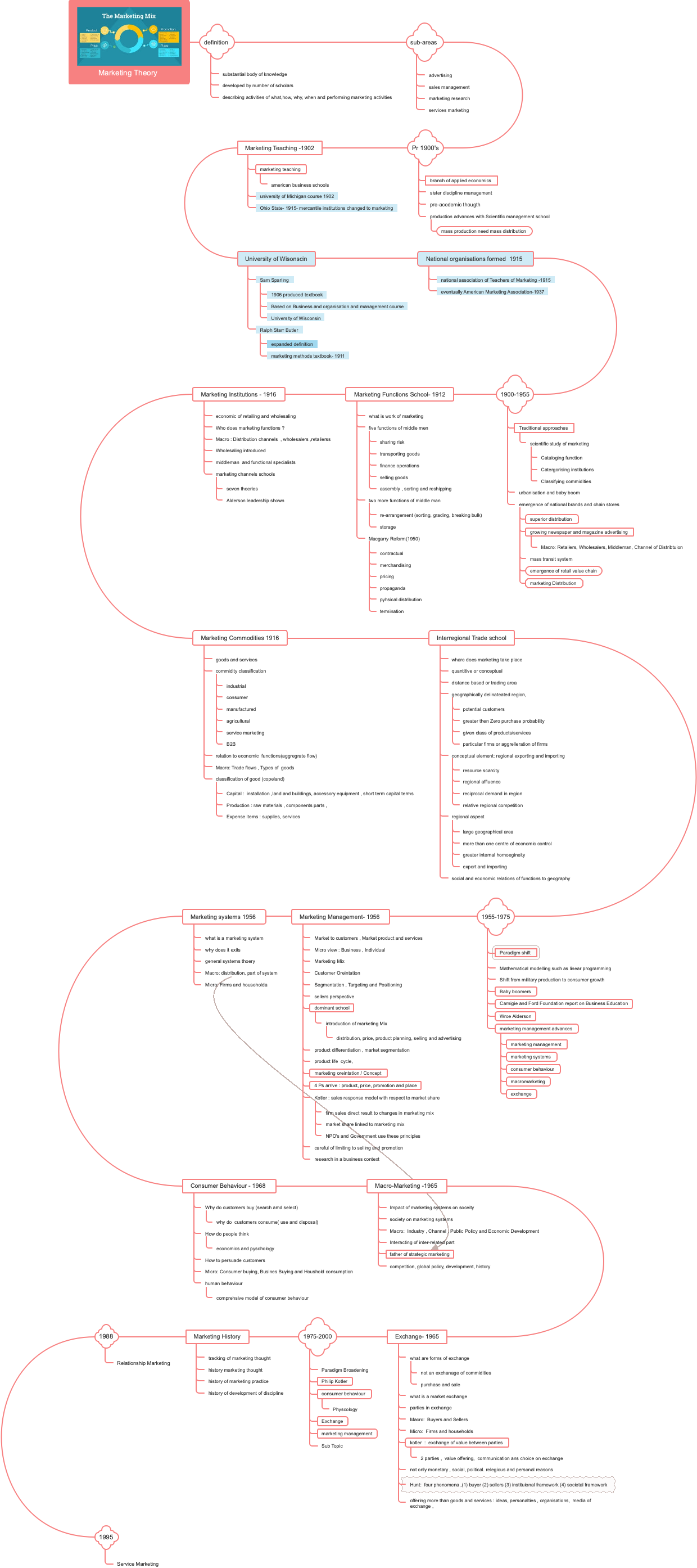
MindMap Gallery marketing theory
This is a mind map about marketing theory, telling stories related to marketing theory. If you are interested in the story of marketing theory, you are welcome to collect and like this mind map~
Edited at 2020-10-11 07:43:34This Valentine's Day brand marketing handbook provides businesses with five practical models, covering everything from creating offline experiences to driving online engagement. Whether you're a shopping mall, restaurant, or online brand, you'll find a suitable strategy: each model includes clear objectives and industry-specific guidelines, helping brands transform traffic into real sales and lasting emotional connections during this romantic season.

This Valentine's Day map illustrates love through 30 romantic possibilities, from the vintage charm of "handwritten love letters" to the urban landscape of "rooftop sunsets," from the tactile experience of a "pottery workshop" to the leisurely moments of "wine tasting at a vineyard"—offering a unique sense of occasion for every couple. Whether it's cozy, experiential, or luxurious, love always finds the most fitting expression. May you all find the perfect atmosphere for your love story.
The ice hockey schedule for the Milano Cortina 2026 Winter Olympics, featuring preliminary rounds, quarterfinals, and medal matches for both men's and women's tournaments from February 5–22. All game times are listed in Eastern Standard Time (EST).
This Valentine's Day brand marketing handbook provides businesses with five practical models, covering everything from creating offline experiences to driving online engagement. Whether you're a shopping mall, restaurant, or online brand, you'll find a suitable strategy: each model includes clear objectives and industry-specific guidelines, helping brands transform traffic into real sales and lasting emotional connections during this romantic season.
This Valentine's Day map illustrates love through 30 romantic possibilities, from the vintage charm of "handwritten love letters" to the urban landscape of "rooftop sunsets," from the tactile experience of a "pottery workshop" to the leisurely moments of "wine tasting at a vineyard"—offering a unique sense of occasion for every couple. Whether it's cozy, experiential, or luxurious, love always finds the most fitting expression. May you all find the perfect atmosphere for your love story.
The ice hockey schedule for the Milano Cortina 2026 Winter Olympics, featuring preliminary rounds, quarterfinals, and medal matches for both men's and women's tournaments from February 5–22. All game times are listed in Eastern Standard Time (EST).
marketing theory
Marketing Overview
Definition and Objectives
Marketing is the process of managing products and services by satisfying customer needs and achieving organizational goals.
Goals include acquiring more customers, increasing sales and enhancing brand awareness.
marketing environment
Internal environment: includes the organization’s resources, capabilities, and culture.
External environment: including competition, economic conditions, policies and regulations, etc.
marketing strategy
Positioning and target market selection: Based on market segmentation, select the target market with the most potential.
Market positioning: Determine the positioning and differentiation of products or services in the target market.
Marketing mix (4Ps): the integration of product, price, promotion and channel strategies.
Consumer Behavior
Decision-making process
Demand identification: Consumers’ perception and understanding of demand for a certain product or service.
Information search: Get information about a product or service.
Evaluate and compare: Evaluate and compare different options.
Purchasing behavior: the final selection and purchase of a product or service.
Subsequent behaviors: post-purchase satisfaction, loyalty, word-of-mouth, etc.
Influencing factors
Personal characteristics: personal needs, preferences, values, etc.
Social factors: the influence of family, friends, culture, etc. on consumer behavior.
Psychological factors: the impact of perception, cognition, attitude, etc. on consumer behavior.
Market segmentation and positioning
market segmentation
Basic market segmentation: Divide the market according to characteristics such as geography and population.
Behavioral market segmentation: Divide the market based on consumer purchasing behavior.
Psychographic market segmentation: Divide the market according to consumer needs and psychological characteristics.
Market positioning
Different market positioning strategies: differentiated positioning, centralized positioning, diversified positioning, etc.
Market positioning assessment: Determine whether the market positioning is successful and make adjustments and optimizations.
Product and brand management
product development
Product strategy: Determine the core functions, features and differentiating advantages of the product.
Product life cycle management: includes management of product introduction, growth, maturity and decline stages.
Brand management
Brand positioning: Determine the brand’s core values and differentiated features.
Brand communication: Increase brand awareness through advertising, public relations, social media and other means.
Brand value assessment: Evaluate the value and influence of the brand.
Price Strategy
Pricing method
Cost-based pricing: Product prices are determined based on cost plus.
Market-oriented pricing: determine product prices based on market demand and competition.
Value-based pricing: determine the price based on the value and benefits of the product.
Pricing Strategy
Pricing elasticity strategy: Adjust pricing based on product price elasticity.
Channel pricing strategy: determine prices based on differences among different channels.
Promotional pricing strategy: adjust product prices through promotions.
Channel management
Channel selection
Direct sales channel: selling products or services directly to consumers.
Indirect sales channels: products are sold indirectly through distributors, retailers, etc.
Channel cooperation
Channel Management: Manage and motivate channel partners to ensure smooth product flow.
Channel conflict resolution: handle conflicts of interest and disagreements in channel cooperation.
Promotional strategy
Advertising and publicity
Advertising media selection: Select appropriate advertising media based on target audience and budget.
Creative design: Designing attractive advertising content and formats.
sales promotion
Promotional activity selection: Choose appropriate promotional methods and activities.
Promotional effectiveness evaluation: Evaluate the effectiveness of promotional activities on sales and brand impact.
Market research and analysis
data collection
Questionnaire survey: Obtain consumer opinions and feedback through questionnaires.
Market observation: observe the market and competition and collect relevant data.
data analysis
Qualitative analysis: subjective analysis of opinions, psychological feelings, etc.
Quantitative analysis: Perform statistical and quantitative analysis on data.
Grade
sales performance review
Sales: Evaluate sales growth and market share gains.
Customer satisfaction: Evaluate customer satisfaction through surveys and other methods.
Brand performance assessment
Brand value: Evaluate the market position and reputation of the brand, etc.
Brand loyalty: Evaluate consumers’ loyalty to brands through surveys and other methods.