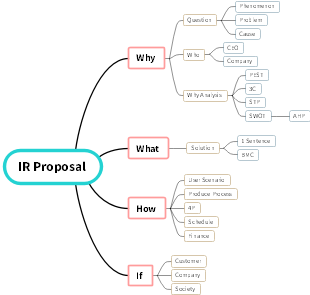
MindMap Gallery UE model-Business model in the eyes of investors
This picture is an introduction to the UE model about the business model in the eyes of investors. It analyzes the business model in the eyes of investors and can promote friends to learn related content.
Edited at 2021-12-15 00:39:17This is a mind map about bacteria, and its main contents include: overview, morphology, types, structure, reproduction, distribution, application, and expansion. The summary is comprehensive and meticulous, suitable as review materials.

This is a mind map about plant asexual reproduction, and its main contents include: concept, spore reproduction, vegetative reproduction, tissue culture, and buds. The summary is comprehensive and meticulous, suitable as review materials.
This is a mind map about the reproductive development of animals, and its main contents include: insects, frogs, birds, sexual reproduction, and asexual reproduction. The summary is comprehensive and meticulous, suitable as review materials.
This is a mind map about bacteria, and its main contents include: overview, morphology, types, structure, reproduction, distribution, application, and expansion. The summary is comprehensive and meticulous, suitable as review materials.
This is a mind map about plant asexual reproduction, and its main contents include: concept, spore reproduction, vegetative reproduction, tissue culture, and buds. The summary is comprehensive and meticulous, suitable as review materials.
This is a mind map about the reproductive development of animals, and its main contents include: insects, frogs, birds, sexual reproduction, and asexual reproduction. The summary is comprehensive and meticulous, suitable as review materials.
Management/Entrepreneurship
business plan Business Plan
It is usually a PPT of less than 20 pages, which the founder uses to express his entrepreneurial ideas in a nearly two-dimensional way, containing a small amount of data and more stories.
financial model Financial Model
According to the development of the storyline in BP, the dimension of continuous time change was added on the basis of Unit Economics (of course there are many other complex factors), and it became a four-dimensional data file composed of multiple tables. With this Model, everyone can see the company's overall development expectations in a certain market.
unit economic benefit Unit Economics
It is usually a page of table data. The founder can use it to clarify the operation of a certain minimum operating unit under the business model. It embodies the logic of the entire business in a three-dimensional way.
definition
Core purpose: In a business model, the smallest operating unit that can reflect the relationship between revenue and cost
"an express shipment" "A box of cosmetics" "One kilometer fare" “One hour manicure”
step
1. Determine and select the "minimum operating unit" in a certain business model. Peel away the cocoons of the business model and see through the essence and crux.
2. Determine the revenue and cost components surrounding this unit (calculate the independent situation of revenue and costs directly linked to each business)
What we usually call Total Cost
Variable Cost
This part of the cost increases proportionally as the number of units sold increases.
Fixed Cost
3. Analyze each component of the equation separately to see under what circumstances the income will be greater than the cost, and how likely this extreme situation is to occur.
4. Specific application to online mode
The first thing to look at is whether each transaction can make money.
Let’s see if the money earned together can cover the customer acquisition cost (LTV>CAC)
Finally, calculate the conditions for the break-even point considering fixed costs, and analyze whether these conditions can be achieved and how to achieve them under what circumstances.
case
Door-to-door manicure service (O2O type)
Income per worker per hour
= average revenue per order * number of orders per worker per hour
Average revenue per order
(total revenue/total odd numbers) for (certain period of time)
Story: Although the current revenue per order is low, we will expand our business in the future or develop into high-end business. In short, we will try every means to increase the unit price per customer.
How many orders does each worker complete per hour?
Total number of orders completed per day / Total daily working hours of all workers
Story: When there are enough customers and the density is high enough, a lot of travel time can be saved, that is, the average number of orders that can be completed per hour is high (this is why many investors like to emphasize efficiency, service efficiency How high is the point that contributes the most to whether the business model is established)
Cost per worker per hour
Total daily wages of all workers / Total daily working hours of all workers
Story: Unmanned, mechanized
B2B e-commerce
Price per customer * Gross profit margin - Distribution cost per order - Warehousing cost per order - Sales commission per order = / > /< "0" (It should be considered here that the cost of the goods itself is relatively high, so it must be multiplied by the gross profit margin, while O2O door-to-door services generally only have service costs)
Notice
The above is the basic version (factory workers produce items), but O2O "where do orders come from"?
User acquisition cost CAC
LTV (user lifetime value)
subsidy or retention
Example
Spending 200 yuan to acquire a customer will result in a net profit of 10 yuan per transaction. However, on average each customer will be lost after using the service 15 times, so in the end you will still lose 50 yuan.
contribution margin
If a certain business model is calculated, each business is profitable, and the LTV is greater than the CAC, then at this time we can introduce a concept called Contribution Margin Ratio (margin contribution rate)
Contribution margin = (total revenue – total variable costs) / total revenue
break-even conditions
Goal: Calculation of break-even amount = total cost / contribution margin rate
Goal decomposition
A simplified funnel model of e-commerce conversion from browsing to purchase deduced in reverse
Example:
An online store can earn 100 yuan for each piece of clothing sold, but it needs to pay 75 yuan in purchasing costs and 5 yuan in packaging costs. The monthly platform entry fee for this online store is 30,000 yuan per month, and the fixed salary for staff is 10,000 yuan per month. Then the online store: Contribution margin = (100 yuan - 75 yuan - 5 yuan) / 100 yuan = 20%
The total revenue required when this business model reaches the break-even critical point is: total fixed cost / contribution margin = 40,000 yuan / 20% = 200,000 yuan
dismantle
Known 100 yuan per piece
Sell 2,000 pieces of clothing every month
Assume that the unit price of each customer in this store is 200 yuan (that is, each customer purchases an average of 2 items per month)
Attract 1,000 purchasing customers every month
1 out of every 10 customers who browse the online store will be converted into a purchasing customer
The platform brings 10,000 browsing customers to it every month
Three Unit Eco
Unit Eco generally reflects only static results at a certain point in time. In reality, the data in Unit Eco will change with the passage of time and company development. One is at the current point in time, one is at the break-even state, and the other is under the final ideal situation.