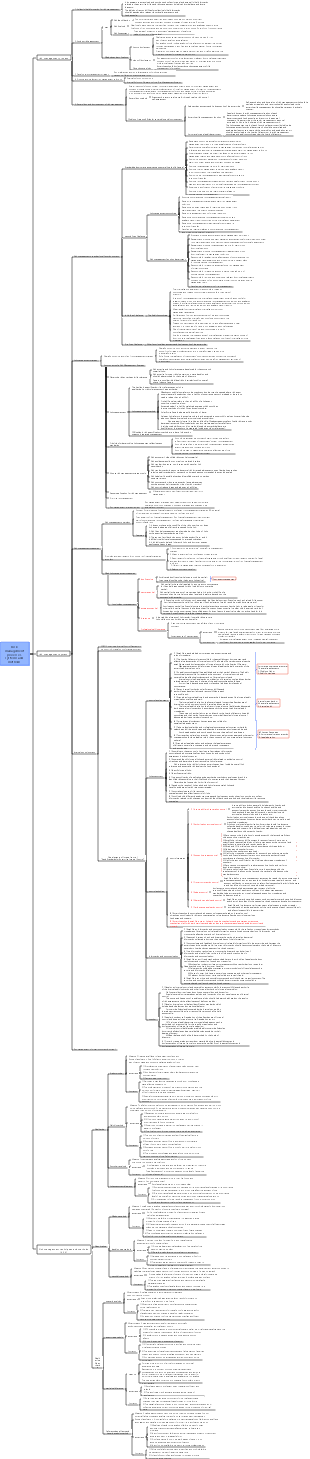
MindMap Gallery 06Overview of Risk and Risk Management
Chapter 6 of the 23-year Note on Strategic Management, the decision-making body of risk management is the risk management unit; the core of risk management is to reduce losses and strive to create value.
Edited at 2023-05-28 11:38:06This is a mind map about bacteria, and its main contents include: overview, morphology, types, structure, reproduction, distribution, application, and expansion. The summary is comprehensive and meticulous, suitable as review materials.

This is a mind map about plant asexual reproduction, and its main contents include: concept, spore reproduction, vegetative reproduction, tissue culture, and buds. The summary is comprehensive and meticulous, suitable as review materials.
This is a mind map about the reproductive development of animals, and its main contents include: insects, frogs, birds, sexual reproduction, and asexual reproduction. The summary is comprehensive and meticulous, suitable as review materials.
This is a mind map about bacteria, and its main contents include: overview, morphology, types, structure, reproduction, distribution, application, and expansion. The summary is comprehensive and meticulous, suitable as review materials.
This is a mind map about plant asexual reproduction, and its main contents include: concept, spore reproduction, vegetative reproduction, tissue culture, and buds. The summary is comprehensive and meticulous, suitable as review materials.
This is a mind map about the reproductive development of animals, and its main contents include: insects, frogs, birds, sexual reproduction, and asexual reproduction. The summary is comprehensive and meticulous, suitable as review materials.
Risks and Risk Management Overview
concept of risk and risk factors
concept
Early days: risk (uncertainty) = loss
Modern: Risk (uncertainty) = loss opportunity
Metric: Consequence Likelihood
1. Corporate risks are related to corporate strategy and performance;
2. Risk is a series of possible outcomes, not the most likely outcome;
3. Risks are both objective and subjective;
4. Risks often coexist with opportunities.
Components
risk factors
Tangible risk factors: refers to material risk factors that directly affect the physical functions of things. Also called material risk factors
Intangible risk factors: refer to non-material factors that affect the possibility and extent of material losses. It is further divided into moral risk factors and psychological risk factors.
Risk events (accidents): refer to accidental accidents that cause losses. is the direct cause of losses.
Loss: refers to the unintentional, unanticipated, and unplanned decrease in economic value. (direct loss indirect loss)
The three constitute a non-unity of risks; The three are interdependent and interact with each other.
The concept, characteristics, objectives and functions of risk management
risk management concept
The decision-making body of risk management is the risk management unit;
The core of risk management is to reduce losses and strive to create value;
The object of risk management can be pure risk or speculative risk;
The process of risk management is a process of decision-making and control.
feature
Objectivity: People can only change the conditions for the existence and occurrence of risks within a certain time and space, and reduce the frequency of risk occurrence and the degree of loss.
Strategic: Mainly used at the corporate strategic management level to manage corporate-level risks at the strategic level. Reducing the expected value of risk losses is the value of comprehensive risk management.
Feasibility: There is a substitution relationship between risk loss cost and risk management cost to a certain extent.
Systematic: Comprehensive risk management must have a systematic and standardized method and establish and improve a comprehensive risk management system. The specific manifestations of systematicity are: comprehensiveness, extensiveness, and all-membership.
Professionalism: Professional talents implement professional management.
Duality: The business mission of enterprise comprehensive risk management is: loss minimization management, uncertainty management, and performance optimization management.
Target
Principles for setting risk management goals: consistency principle, reality principle, clarity principle, and hierarchy principle
According to the level of goals, risk management goals can be divided into basic goals, direct goals, core goals, and supporting goals.
Function
Planning functions: Design risk management plans and develop implementation plans;
Organizational functions: assign and combine the activities of the risk management unit and its production factors;
Guidance functions: interpret and judge risk response plans, communicate plans, exchange information and direct activities;
Control functions: Inspect, supervise, analyze and evaluate the implementation of the plan, and take corrective measures.
The evolution of risk management theory and the development of risk management practice
slightly