 Wondershare EdrawMind
MindMap Gallery Operation management platform
- 29
Operation management platform
This is a mind map about the operation and management platform. The main contents include warehouse, PMC, production, quality, procurement, equipment, technology, and R
Edited at 2023-01-07 23:16:05
- bacteria
This is a mind map about bacteria, and its main contents include: overview, morphology, types, structure, reproduction, distribution, application, and expansion. The summary is comprehensive and meticulous, suitable as review materials.
- Plant asexual reproduction
This is a mind map about plant asexual reproduction, and its main contents include: concept, spore reproduction, vegetative reproduction, tissue culture, and buds. The summary is comprehensive and meticulous, suitable as review materials.
- Reproductive development of animals
This is a mind map about the reproductive development of animals, and its main contents include: insects, frogs, birds, sexual reproduction, and asexual reproduction. The summary is comprehensive and meticulous, suitable as review materials.
Operation management platform
- bacteria
This is a mind map about bacteria, and its main contents include: overview, morphology, types, structure, reproduction, distribution, application, and expansion. The summary is comprehensive and meticulous, suitable as review materials.
- Plant asexual reproduction
This is a mind map about plant asexual reproduction, and its main contents include: concept, spore reproduction, vegetative reproduction, tissue culture, and buds. The summary is comprehensive and meticulous, suitable as review materials.
- Reproductive development of animals
This is a mind map about the reproductive development of animals, and its main contents include: insects, frogs, birds, sexual reproduction, and asexual reproduction. The summary is comprehensive and meticulous, suitable as review materials.
- Recommended to you
- Outline
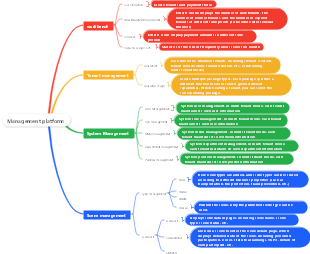
Operation management platform
storehouse
Warehouse hardware resources
How many warehouses are there? (The warehouse needs to be numbered according to the rules Convenient digital management)
Dangerous goods warehouse
Flammable and explosive
precursor
Ordinary warehouse
Environmentally controlled
environmental randomness
scrap warehouse
Hazardous waste warehouse
General scrap warehouse
Automation library
Three-dimensional library
Tank system
temporary warehouse
Warehouse capacity
design solvent
design area
Design height
Volume rate
height limit
Number of warehousing levels
Single layer flat warehouse
multi-story warehouse
Number of locations
Shelves
Warehouse location
Ground library
Can use motorized forklift
Can use manual forklift
Floor warehouse with elevator
Floor warehouse without elevator
underground library
Can use motorized forklift
Can use manual forklift
means of transportation
Motorized forklift
Manual forklift
electric drive
Artificial
Other forklifts
special transport
Warehouse software resources
human Resources
Number of warehouse personnel
Warehouse personnel academic qualifications
Male to female ratio of warehouse staff
Warehouse staff age group
Personnel and location matching
Knowledge requirements for storage locations
Gender requirements for storage locations
Storage location requirements for skills
Strength requirements for storage locations
Time requirements for storage locations
per capita load
Outbound quantity from storage location
Storage location transportation distance
Location document complexity
Storage location risk level
Location preparation time
warehouse management software
WMS
WCS
Other warehouse management software
Warehousing management rules
Matching rules for materials and locations
The same storage location allows those materials to be stored together
Which materials require temperature and humidity control, and what are the control rules?
Warehouse energy consumption standards
Implementation of national safety standards for dangerous goods warehouses
Warehouse inventory limit, load capacity
Incoming materials and warehousing
the arrival
Timeliness of arrival
time dimension
Incoming material time period
Are there materials coming in at the same time?
quantity dimension
Logistics service satisfaction evaluation
IQC inspection
Detection time control
IQC sampling inspection time? Are samples taken according to regulations? Is there a disconnect from warehouse inspection to IQC inspection? Is it real-time sampling or centralized sampling? What are the effects of different adoption regimes on efficiency?
Timeout?
Detection timeout warning
Timeout cause analysis
improvement measures
KPI evaluation
Warehouse inspection report
Inspection rules?
Inspection time?
Sampling control
Special storage and distribution of sampled products (that is, are there special regulations on the storage conditions of this batch of raw materials after unpacking and sampling? Once sampling is started, are there priority rights to issue to avoid raw material failure?
Detection and analysis
Dimensional analysis of qualification, return, and special purchase
Analysis of the above indicators by the same supplier
Analysis of the above indicators from different suppliers of the same material
Inspector dimension analysis
Staff utilization ratio? That is, are the testing supporting personnel currently configured reasonable? too much? not enough?
Dimensional analysis of testing equipment
Is the company’s testing hardware advanced? Benchmarking or equipment matching with suppliers? Equipment failure? Equipment test cycle or become a capability?
Supplier dimension analysis
What is the supply ratio of a single material from the same supplier, or multiple materials from the same supplier at the same time? Risk analysis for different companies but belonging to the same group or the same investor?
Correlation Analysis
For example: if a certain inspector detects defective materials from a certain supplier more frequently than other inspectors, we need special attention. Aspects that need attention may be: 1. For the materials provided by the supplier, the inspection ability of the inspection personnel is insufficient? 2. Is there any conflict between the function supplier and the inspector? 3. Is it a coincidence that the supplier's material inspection is always assigned to this inspector, resulting in data deviation?
Raw materials warehousing
Warehousing time monitoring
The interval from the end of IQC inspection to the completion of warehousing
Inbound location and inventory monitoring
Check whether materials are in the specified physical location
Check whether the inventory data changes following the entry into the warehouse. Is the data accurate? This data needs to be associated with financial
data analysis
Is the frequency of inbound and outbound shipments abnormal? Is the total amount in and out of the warehouse abnormal? Are the categories entering and leaving the warehouse unusual? Is the time period for entering and leaving the warehouse abnormal? Comparison of the efficiency of different warehouse management personnel?
Storage condition check
Temperature, humidity, storage time?
Supplier evaluation
Timely rate of incoming materials
Incoming material quantity accuracy
Incoming material inspection pass rate
Attitude and ability to respond to customer complaints
Material distribution
Preparing, picking and returning materials
punctuality
Accurate delivery rate
Operation efficiency
Delivery
data analysis
Optimize delivery specifications
Minimize returns or bulk packaging
Negotiate with suppliers to optimize packaging model
Abnormal picking
time
Picking materials beyond reasonable operating hours
Picking up materials during non-working hours
frequency
Factories often have multiple warehouses coexisting or one warehouse manager manages multiple warehouses at the same time. At this time, it is very important to specify the frequency of picking materials, otherwise personnel will waste a lot of time moving back and forth.
Example: 1. The system found that a certain material was picked too frequently, which led to an increase in warehouse management labor costs. It is necessary to analyze whether there is a situation where a material is returned after being taken out? Are the materials used in the same project collected at the same time or in multiple batches? The materials that need to be used within a day are not taken out all at once but multiple times? 2. The quantity or frequency of hardware withdrawals from a certain piece of equipment or a process is significantly higher than the historical data. Can it be shown from the side that the equipment in this process section has frequently experienced abnormalities recently? If there is no large-scale regular maintenance during this period and the equipment is generally stable, then what is the purpose of collecting these hardware?
Inventory management The most basic thing is the consistency of account, card and object
Storage compliance checks
Check the reasonableness of the standards
Check which types of materials are best stored in the same area
Is there any danger?
Review cycle check
Every material has a review cycle, and the warehouse manager needs to inventory the materials in each review cycle; if there is no inventory in the previous inventory cycle, then this inventory cycle must be inventoried, and there cannot be multiple inventory cycles without inventory. area and materials.
first in first out control
Warranty period and re-inspection cycle reminder
Material inventory age warning
Sluggish proportional control
Inventory quantity warning (safety stock limit)
Inventory amount warning
Prepare inventory in advance
Finished product delivery
OQC
Detection method
Random inspection
According to the sampling specifications, corresponding sampling ratio and sampling quantity
Full inspection
Continuously evaluate quality capabilities to reduce the frequency of full inspections
Pass rate
Changes in pass rate are linked to random inspection ratios
big data analysis
risk assessment
Modify rules
A full inspection is triggered when the pass rate falls below a certain threshold.
Ship
Inspection before shipment
Check contract quantity
Check the consignee
Check the packaging method
Order inventory locking and unlocking
Prevent a small number of shipments. For example: Sales A receives an order for 3000 PCS and the inventory shows that 5000 PCS of the product can meet the requirements. Then Sales B receives an order for 3000 PCS because the previous inventory is not locked. When checking the inventory, it will show that there are still 5000 PCS in stock. In fact, the actual inventory of that node should be 2000PCS, and some of them have not been shipped out but have been locked.
Timely delivery rate
time dimension
quantity dimension
Combined shipments to the same customers
Transportation Logistics
Optimal transportation plan for single batch shipment
Speed, price, delivery evaluation, delivery order reply, etc.
Feasibility of combined shipping (same area, close time period)
Route planning by region (similar to JD Logistics)
Appointment dispatch reminder
Vehicles and shipments are synchronized to reduce waiting
Prepare shipment consolidation in advance
Arrival timely rate
The time when the customer signs the receipt shall prevail.
The difference between the time when the goods arrive at the customer and the time when the customer receives the goods
Node control 1. Does the company deliver goods on time? Does it arrive at the client at a certain time? Does the customer sign the receipt on time? Does the company's delivery time have any advantages over its peers? Avoid sending out our goods every time because we don’t follow up in time.
Customer pick up goods
On-time delivery rate
Delay waiting time
Delivery date change frequency
Delivery ratio
Are the goods for each order picked up at once, or are they always picked up in batches or even partially not picked up at all?
PMC
Resource inventory
Hardware resources
Equipment capacity
Equipment production capacity needs to be distinguished according to different varieties or types, because the same equipment may produce different outputs for different products; or some equipment can only make certain products and is not versatile.
Tooling fixtures
Tooling jigs are divided into general jigs and special jigs. General jigs need to be used at the same time, and special jigs need to consider equipment matching and lifespan.
Auxiliary tools
For example, boxes and shelves used for turnover; vehicles used for internal transportation; pallets used for cargo transportation, etc.
Software resources
Supply chain readiness and redundancy
Raw material supply capacity
manufacturing human resources
Quality manpower
engineering manpower
production manpower
File support
MI
CP
BOM
Finished product inventory (general models, special models)
Order docking
Order expectations
Annual total order expectations
type
quantity
client
time frame
Monthly order expectations
type
quantity
client
time frame
Instant order review
Verify finished goods inventory
Direct shipment?
Verify semi-finished products and work-in-progress
Verify packaging material inventory
Confirm purchasing cycle
Confirm manufacturing cycle
Confirm logistics time
Confirm delivery date
Production Plan
order priority
Develop order scheduling principles
What type of orders take priority?
How to sort when they are all priority orders?
split order
Capacity
Evaluate whether production capacity is met
Includes hardware and software capacity and needs to be updated every month
Possibility of downtime waiting for materials
The arrival time of materials does not match the production scheduling time
Space beyond standard capacity (extra overtime)
Feasibility of outsourcing
Outsourcing coating
outsource pack
Purchased finished products
input-output rate
Historical model pass rate
Historical work order pass rate (the pass rate is related to the number of work orders)
The pass rate index for this production launch will generally be set lower for urgent orders; priority will be given to shipments.
Production cycle
Process time
Need to be updated based on process conditions and peer level
Turnaround time
It mainly assesses the ability of production management and whether it can achieve non-stop turnover between processes.
grace time
Whether it is design or manufacturing, there is always uncertainty, and space needs to be reserved for uncertainty.
Work order closed
Production is the end of the process, and only the completion of the work order can be regarded as the end of the order.
Compare the closed data with the planned data, find out the gaps, and correct the rules for scheduling the model.
Rework
Material planning
BOM material
Determine BOM accuracy
Output overall demand
Determine material inventory and in-transit
Actual demand is output by subtracting from overall demand
Confirm the sluggish digestion of materials
Apply for a digestion treatment plan for sluggish materials
Excipients
Determine excipient accuracy
Output auxiliary material requirements
Determine the inventory and in-transit of excipients
Output actual demand through deductions
stock control
Control upper inventory limits for materials
Control the matching of materials and orders
Clearance operation before material changeover
Matching inventory and purchasing cycle
Risk preparation for special periods
Sluggish control, amount control, turnaround time control
Initiate purchase plans in batches and follow up on when materials are in place
Execution monitoring
Received as planned
Put into production as planned
There are too many or too few key nodes
Qualified number and time of key nodes (PMC does not pay attention to the qualified rate of each process, as long as the production ensures that the quantity of good products arriving at the key nodes reaches the standard, and the key processes are completed according to the estimated time)
Major exceptions in the process
Stock products on schedule and in quantity
deliver
Delivery date
Early warning points need to be established before delivery
Absolute delivery time is more important than relative delivery time
Delivery quantity, manufacturing quantity, difference analysis
Poor delivery is a major vulnerability for companies to lose profits
logistics
Logistics company resources
Logistics distribution
Fees and Services
Customer signs and settles the bill
Customer signature is the only measure of delivery
Systems and documents
Work order management
planning control
people management
Logistics management
Production
Put into production as planned
Same production model
Same production time
Production quantity is consistent
The resources used are consistent
production performance
Achievement rate
Effective time management
Valid time in different periods
Effective time of different process sections
Validity time of different devices
Valid time for different personnel
Validity time of different varieties
Achievement rate comparison
different shifts
different teams
different environments
different seasons
different species
Achievement rate optimization
Find the optimal human-machine combination
Find the optimal device and model combination
Find the optimal combination of managers and process sections
Through rate
Total pass rate
Multiply the process pass rate
Input-output ratio
most effective data
Theoretical output to actual output ratio
The most reasonable data
Through rate of each process
Relationship between through rate and materials
Relationship between through rate and shifts
Relationship between through rate and variety
pass rate trends
Total pass rate trend
Process pass rate trend
Variety pass-through rate trend
Ten thousand yuan output value cost
Normal labor
Overtime labor
social Security
staff training
Employee Benefits
Safety and environmental protection
data analysis
Time dimension analysis
boot time
On-time start rate
The main concern is whether prenatal time is utilized in production management? Especially when it takes a long time to prepare For equipment, it is particularly important to start it up on time.
Boot preparation time
The start-up preparation time is mainly for the tooling and fixtures that are complicated and the equipment has complex factors that need to be confirmed repeatedly.
Equipment utilization rate
The ratio of equipment running time to total time reflects the adequacy of equipment utilization.
First time
Which operators of the same type and equipment have the shortest first-piece time? What is the average first-piece time? What is the impact on time of different first article methods? What is the ratio of first article production to confirmation time?
First article frequency
How long does it take on average to make the first piece?
Dimensional analysis of running speed
Whether the equipment operating speed is within a reasonable range
Is there any overspeeding?
Is the running speed too low?
Is the running speed uniform?
Equipment uniform speed
The speed of equipment operation affects product quality and output quantity
Which personnel operate the equipment at the most stable speed? How is the method of operation different from others?
Which types of products or materials are used when the equipment runs at the most stable speed and with the highest efficiency?
Production speed
Are the production speeds in the early and late stages of production consistent? Is there a period in a shift when the speed is particularly high or low? Or is there no obvious pattern in the entire production process?
Efficiency dimension analysis
Accurate identification of work efficiency
Identify effective working hours
Planned shift time
First time
The inherent time waste in the system such as changing reels, splicing tapes, handling exceptions, etc.
The relationship between products and validity time; for example, frequent model changes, small batch sizes, and small design margins?
Calculate production efficiency based on effective time
The effective time is generally the result of accurate calculation by IE.
Time period efficiency identification
Period efficiency analysis
Morning shift efficiency
Mid-shift efficiency
Impact of work breaks
Effect of workshop temperature
night shift efficiency
When is the best time to evaluate overtime?
Reasonably arrange the work content and intensity of different time periods based on the results of time period analysis
Overtime efficiency analysis
Evaluate optimal overtime hours
How much overtime is reasonable per day?
Evaluate optimal overtime periods
Which shift’s overtime is the most valuable? How long is the best time to take vacation each month? How often do you take vacations? How long is a vacation?
WIP
Process linkage coordination
The shift or daily output of each important node needs to be consistent with the PMC production schedule or within the tolerance range
Portrait (top, middle, bottom)
If an abnormality in the front process affects the next process, then the back process needs to be warned in advance to delay or support the front process.
Abnormalities in the back process lead to accumulation, so the front process needs to be warned to stop production and wait or support the next process.
Process capacity balance, the output capacity of vertical processes at the same time should be consistent taking the qualification rate into consideration
process bottleneck
When a certain process has a bottleneck due to hardware or software resources, it needs to be compensated through the time dimension.
Horizontal (left, center, right)
Parallel processes require matching production capacity. For example, the positive and negative poles must be consistent, otherwise there is no way to carry out the following processes.
The complete set of materials is the prerequisite for process arrangement. For example, there is no way to package batteries without aluminum-plastic film, and aluminum-plastic film needs to be punched before packaging.
Horizontal process bottlenecks can be eliminated by stocking up in advance or adding auxiliary hardware and software separately.
Line position
Inventory monitoring
Storage cycle warning
Are there any materials in the side warehouse that have exceeded the temporary storage time?
Storage quantity warning
Is the total inventory quantity on the lineside too high or too low? Have all materials along the line been inventoried?
Storage cost warning
Does the line warehouse store valuable raw materials and is of great value? Is this value reflected in PMC's accounts? Avoid off-book positions
Storage condition warning
Have the conditions of the warehouse changed due to production suspension or vacation at the line, focusing on temperature and humidity?
Exception handling
Abnormality in the previous process
Parallel process and auxiliary process startup temporary storage
Abnormality in this process
Start temporary storage of previous process materials
Abnormal auxiliary process
In addition to raw materials, the lineside warehouse stores semi-finished products more importantly.
Abnormal overproduction
As long as it is not the final process, overproduction is also an anomaly! Overproduction in the previous process will lead to insufficient raw materials for subsequent processes or parallel processes, or take up the production scheduling time of other orders.
For example: If the WIP of process A is to produce 3000PCS today, process B and process A are parallel processes, and process B only produces 2000PCS today, then the following plan needs to be initiated: 1. Does the output capacity of process B meet the requirements of 3000PCS production schedule? 2. Why only 2,000 were produced when the production capacity of process B was sufficient? 3. Is it necessary to reduce production in process A or to tilt resources (including overtime and adding people) to process B? 4. If there is corresponding inventory at the line, will it not affect the contingency of starting production and stocking at the line?
Auxiliary materials
Fixed auxiliary materials
The quantity of auxiliary materials used is not directly related to the output (it can also be called a guarantee). As long as the work starts, these auxiliary materials need to be used.
Floating auxiliary materials
The quantity of auxiliary materials used is directly related to the output
The quantity and variety of auxiliary materials used are directly related
Public auxiliary materials
Printing supplies
Testing auxiliary materials and reagents
Detect loss
Cost monitoring
The ratio of auxiliary materials to order value should be constant or show a certain curve relationship
Standards should be formulated in advance for the distribution of auxiliary materials, and production should be distributed and used in accordance with the standards, and indicators should be continuously optimized.
The focus of auxiliary material monitoring is not the quantity but the cost. In many cases, the cost is actually lower when using auxiliary materials with higher unit prices and better quality. Don’t fall into the misunderstanding of pursuing low unit price
defect
Linked early warning and processing of process defects
Before and after processes
Abnormalities in the front process can be covered by post-process adjustments; then the abnormalities in the front process need to be notified to the post-process as soon as possible. For example, if the positive electrode is too light in the previous process, then the pole pieces need to be weighed, identified and matched in the subsequent process.
If a subsequent process discovers a problem with a previous process, that is, the abnormality cannot be detected in time in the previous process, and the previous process must be notified as soon as possible to avoid the abnormality. For example, if you find any abnormality in the surface appearance of the pole piece after rolling, you need to notify the mixing and coating team as soon as possible.
Parallel process
The coated negative electrode is relatively light. If there is room in the capacity, the positive electrode needs to be informed to reduce the weight accordingly.
There is no problem with the coated positive and negative electrodes in this process, but if it is found during the winding process that the positive electrode cannot wrap the negative electrode or the ending position is different from the design, then the two parallel processes must be notified as soon as possible. At this time, is it the positive pole or the negative pole that should be adjusted? Or will both sides make adjustments simultaneously?
Defect warning
The number of defects exceeds the standard
New defects appear
Changes in the first 3 bad items
Defects tend to get worse
Defects are strongly correlated with time
Defects are strongly correlated with models
Statistical Analysis
Process dimension
Which process has the highest efficiency rate?
Which process is the most efficient?
Which process requires the least rework?
Device dimensions
Which device has the most abnormalities?
Which piece of equipment is the most efficient?
Which piece of equipment has the most stable utilization rate?
Dimensions of improvement measures
Which improvement measures are most effective?
We often have many different handling measures for the same exception, but which solution is more effective? We need to promote the most effective measures. At the same time, some improvement measures are difficult to distinguish in this process and need to be reflected in many subsequent processes to prevent this process from seemingly solving the problem but causing greater losses to subsequent processes.
Which measure is the most practical?
There are some improvement measures that are not the best, but are low-cost and easy to promote; then this solution may be the best solution.
Improvement direction
abnormal dimension
Which type of exceptions are most common?
Problem frequency
Which anomaly has the greatest impact?
Losses caused by problems
Problem impact
Is the abnormality caused by operation or hardware or design?
What is the relationship between anomaly and species or type?
Technological innovation incentives
Technical renovation bidding
Make full use of external resources
Make full use of cross-border resources
Technical transformation hero list
Encourage internal improvements
Encourage indirect department participation
5S
tidy
Rectify
clean
clean
discipline
quality
System operation
System operation planning
ISO9001:2015 quality management system
IATF16949: 2016 International Automotive Industry Technical Specifications
ISO14001 Environmental Management System
GB/T 31484 Battery Testing Standard for Electric Vehicles
GB/T 31241 Safety requirements for lithium-ion batteries and battery packs for portable electronic products
OHSAS18000 safety management system
GB/T 45001: 2020 Occupational Health and Safety Management System
UN38.3 Code of practice for rechargeable lithium batteries transported as non-dangerous goods
UL1642 lithium battery standard
IEC/TC21
JIS/CE/IEEE1625/KC62133
production and service processes
Identification traceability
Raw materials traceable
Operators can be traced
Operation equipment and parameters are traceable
Work time can be traced
Operation process and source traceable
Customer property management
Customer or external provider property shall be properly managed while it is in use. The organization shall identify, verify, protect and safeguard property provided by customers or external providers for use in or incorporated into products and services.
If customer or external provider property is lost, damaged, or found to be unfit for use, the organization shall report it to the customer or external provider and retain relevant documented information.
Note: Property of the customer and external providers may include materials, parts, tools and equipment, the customer’s premises, intellectual property and personal information.
protection
The organization shall safeguard output as necessary during production and service provision to ensure compliance with requirements. Note: Protection can be designed for identification, handling, contamination control, packaging, storage, delivery or transportation, and protection.
Requirements for post-delivery activities related to products and services
a. Legal and regulatory requirements
b. Potential adverse consequences associated with products and services
c.The nature, purpose and expected life cycle of its products and services
d.Customer feedback
Note: Post-delivery activities may include related activities under the terms of the warranty, such as contractual maintenance services, and additional services such as recycling or final end-of-life disposal.
Release of products and services
Non-conforming output is identified and controlled to prevent unintended use or delivery
The nature of the nonconformity and its impact on products and services. Take appropriate action.
Maintain documented information regarding release of products and services. Documented information should include:
a. Evidence of compliance with acceptance criteria
b. Traceability information of authorized release personnel
Control of unqualified output
Take appropriate action based on the nature of the nonconformity and its impact on products and services.
a.Correction
b. Quarantine, restrict, return or suspend the provision of products and services
c. Inform customers
d. Obtain authorization to receive concessions
NOTE: Correction of nonconforming output should be followed by verification of compliance with requirements.
2. The organization shall retain the following documented information:
a. Description of the non-conformity
b. Description of measures taken
c.Description of concessions obtained
d. Dispose of unqualified authorization marks
Voice of the customer
customer communication
a. Information about the products and services provided
b. Process inquiries, contracts or orders, including changes
c. Obtain customer feedback about products and services, including customer complaints
d. Disposal and control of customer property
e. Develop specific emergency measures when the stakes are high
Determination of product and service requirements
Product and service requirements are clarified, including
Applicable legal and regulatory requirements
Requirements deemed necessary by the organization
Provide products and services to customers that meet the company's stated requirements
Review of relevant requirements for products and services
Should ensure the ability to meet the requirements for providing products and services to customers
a. Customer-specified requirements, including requirements for delivery and post-delivery activities
b. Although not expressly stated by the customer, the requirements are necessary for the specified use or the known intended use.
c. Requirements specified by the organization
d. Legal and regulatory requirements applicable to products and services
e. Contract or order requirements that are different from those previously stated
The organization shall retain the following documented documents
a.Review results
b. New requirements for products and services
Changes to product and service requirements
Customer complaints
Delivery time complaints
Delivery quantity complaints
Delivery quality complaints
Delivery Protection Complaints
Abnormal use process
Customer review
product check
process audit
Quality management system audit
supply chain
Evaluation tools
Basic ability evaluation form
VDA6.3 review report
Packaging material supplier evaluation form
Supply chain business evaluation
willingness to cooperate
The importance of bosses and management
Attractiveness of potential cooperation opportunities to suppliers
Contribution of potential cooperation opportunities to supplier sales
Suppliers’ enthusiasm for quotations and technical exchanges
business risk
business risk
Company contingency plan
Internal risk assessment and upgrade mechanism
Are the customer base and product distribution uniform?
Compatibility of existing products with industry development
Financial risk
Three major statements in the company's annual report
Risks in the capital chain
Risk of bankruptcy and liquidation
Legal risks
Are there any examples of cases being filed?
Investigation of past legal disputes
Intellectual Property Investigation
Basic evaluation
System certificate
ISO9001
IATF16949
Environment, safety, occupational health, etc.
Quality system operation effectiveness evaluation
Personnel organization structure
Quality assurance staffing
Project manager configuration
Ratio of senior technical personnel
Technical and quality communication capabilities for existing cooperation projects
Direct labor and indirect labor ratio
Company management level
Corporate vision, mission, quality goals
Operational efficiency and effectiveness
Company employee sense of belonging and morale
Sales scale
sales within 3 years
sales trends
monthly quality report
Completeness of institutional provisions
Running frequency
Month, quarter, year?
Way
Internal meeting of quality department
Company-wide team meeting
Internal email notification
Internal leadership approval
subtopic
operational level
meeting organization
Metric tracking
Question closed
Continuous improvement
Case
system
Internal risk assessment and upgrade mechanism
strategic fit
Target positioning for supplier development
QCDTS multi-dimensional targeting
Comparison with existing suppliers
subtopic
Supplier’s position in the industry
Industry ranking
Regional industry status
Product industry status
mutual strategic fit
Whether each other is in the other's development direction
Supplier’s strategy and development direction
Transaction volume proportion and ranking of suppliers
Matching between company procurement and supplier procurement strategy
Delivery and capacity assessment
Capacity surplus
L/T rationality
Sample delivery time
Batch delivery
Compared with the level of peers
Supply system management
Staffing and Capabilities
ERP system
Emergency delivery management and response measures
transportation management
Own fleet
Express delivery and logistics
cost competition
Price/cost analysis, quotation comparison of existing projects
Cost ranking within existing supply system
cost structure
agent
Agency fees
Original manufacturer’s bargaining power
Ability to apply for other CP prices
manufacturer
Provide structured quotation form
Reasonable cost structure
Profit level
Returns and rectifications
Willingness to communicate about returns
Cooperation and time for returns
Ability to rectify abnormalities
Willingness to rectify abnormalities
Ability and willingness to compensate
Process monitoring
Document specification
System operation file
Run according to the process
Product manufacturing documents
Made to file
Process operating documents
1||| Operation by file
Record form file
record by file
Measuring instruments and equipment instruments
Measuring range
Accuracy
Matching
measurement method
Online/Offline
Manual / Auto
Incoming material inspection, first article inspection, process inspection, result inspection; record all inspection results
The destructive testing process requires CPK to ensure product stability and reliability, and process data SPC monitoring
Fool-proof operation/fool-proof design/fool-proof detection
Transfer between processes
Indicators determined
No ordering without confirmation
environmental control
temperature
humidity
dust
Personnel training and certification
Quality department operator
Production department operator
data analysis
Indicator library
consistency index
SPC
X-bar chart
P-chart
pass rate indicator
Process pass rate
First pass rate
Utilization
OEE indicators
Process capabilityCPK
Inspection pass rate index
knowledge base
Exception Handling Guide
Defect distribution map
PFMEA
QCFC
Comparative analysis
Comparative analysis between batches
Intra-batch comparative analysis
Comparative analysis between models
Quality defect aggregate analysis
Stability trend analysis
Instrument management
Measuring instrument management
Checklist
Calibration cycle reminder
maintenance
Operating Instructions
MSA
meaning
Measurement system analysis refers to statistical variation analysis and research on the various factors that constitute the measurement system through statistical analysis methods to obtain a conclusion on whether the measurement system is accurate and reliable.
Why is it called a measurement system rather than a measurement tool?
Because the factors that affect the measurement results include not only the instrument used, but also the measurement standard, the operator's usage method, reading error, clamp tightness, ambient temperature and other comprehensive factors.
Why do MSA?
In order to make a scientific and systematic analysis and evaluation of the measurement system used to ensure that the measured results are true and effective.
Prerequisites for MSA analysis
1. Choose the appropriate measuring tool: The measurement must have sufficient resolution and at least meet the 1/10 principle. The resolution is too low to detect variations in the process.
2. The measurement system is stable and controlled, that is, it cannot include special variations.
What situations require an MSA?
1. New measuring tools purchased
2. According to customer requirements or process requirements
3. In the process of continuous improvement, before measuring data;
4. According to the requirements of PPAP, all measuring tools mentioned in the CP need to be analyzed.
Classification
Quantitative analysis (range method, mean range method, etc.)
Count analysis (crossover method)
Destructive analysis (nested method)
Evaluation indicators
bias
Often referred to as "accuracy," it refers to the difference between the actual measured value and the true value. It is for the same feature on the same part.
Linear
The degree of variation in bias within the normal operating range of the gage.
stability
Also known as "drift", it is the total variation obtained by measuring the same characteristic on the same benchmark or part using the same test system. Focus on the change of offset over time.
Repeatability and reproducibility
Collectively known as R&R or GRR
Repeatability is the intra-evaluator variation, the degree of consistency of the values obtained by repeated measurements of the same or similar measured objects in the same measurement procedure, the same operator, the same measurement equipment, the same operating conditions and the same location in a short period of time.
Reproducibility is the variation between evaluators, the degree of consistency between the values obtained under repeated measurements of the same or similar measured objects in different locations, different operators, and different measuring equipment.
purchase
Supplier management
Supplier introduction
supplier option
Supplier profile
Supplier inspection
Assess qualifications
Production processes
Financial status
Manpower allocation
Transport capacity
Supplier evaluation and selection
Assess supplier capabilities
Create a supplier directory
Construction of supplier elimination mechanism
Mass production supplier evaluation
Quality Evaluation
Receiving quality
quality audit
Return status
Compensation performance
price evaluation
price level
historical price
Account period situation
payment method
Service evaluation
Supplier cooperation
Exception handling timeliness
Delivery evaluation
Delivery on time rate
Delivery quantity accuracy and reliability
Transportation method
Transportation punctuality
subtopic
development assessment
Supplier development capabilities
New material qualification rate
supplier level
Importance
strategic supplier
bottleneck supplier
regular supplier
Leverage Provider
Supply qualification
agent
Outsourcing
manufacturer
Rating level
excellent
good
qualified
disuse
Cooperation status
cooperate
Potential cooperation
blacklist
Purchase price management
price setting policy
price estimate
Cost Control
Price adjustment mechanism
Raw material price changes
Market
Labor cost changes
New technology application
supplier strategy
Supplier cost reduction strategy
Supplier supply ratio strategy
homemade supply
Supplier integration
Procurement process management
market survey
Quote Approval
Confirm supplier
signing the contract
Supplier qualification review
Determine contract terms
Contract approval
Contract archive
price fluncuation
accounts payable
Procurement data analysis
equipment
Equipment introduction
Equipment Purchase
Clear requirements (including products, production capacity, efficiency) and confirm the hardware conditions (space, energy) that the company can match
Collect more than 3 suppliers of equipment of the same level and type based on the company's budget
Confirm equipment technical specifications and peer application research
Finally identify 2~3 suppliers that meet the company's requirements and hand them over to the procurement for business negotiations and sign a procurement contract.
device installation
The neatness of the equipment on site
Check according to the contract list
Equipment arrival on time
Arrive according to contract time
Installation cycle control
Personnel quality
Safety and environmental protection
spare parts
Preparation of auxiliary facilities
Equipment debugging
Debug data logging
The data after debugging is compared with the contract requirements as the basis for judging the effectiveness of debugging.
Debugging data is an important parameter basis for subsequent batch operations.
Equipment debugging problem records
All debugging exceptions require a procedural solution, as these exceptions may reoccur at a later stage.
Equipment debugging exceptions are a reference for the SOP production process. Some exceptions need to be avoided through operation and maintenance.
Follow-up on rectification of unfinished matters (non-major abnormal items)
Equipment debugging costs
Personnel, materials
Energy consumption, management costs
Tooling jigs and auxiliary materials
Equipment debugging costs can be included in the financial value of the equipment to participate in depreciation. At the same time, equipment debugging costs must be within the control range of the early budget.
debug report
A complete equipment installation and commissioning report must be submitted before equipment debugging is completed and delivered to mass production. This report is the basis or part of the subsequent equipment acceptance.
Equipment acceptance
Equipment acceptance organization
What time point is the acceptance
Who will organize the acceptance
Participants in the acceptance?
What the acceptance report needs to contain
Equipment acceptance report
Machine hardware (brand and model consistency)
Software system (functions proposed in the contract, subsequent updates and maintenance)
Production efficiency (width, speed), product qualification rate, CPK
Energy consumption (starting energy consumption, running energy consumption)
Emissions (only involving solvent emissions)
spare parts
Operating Instructions, Equipment Description
Equipment hardened
After the equipment is inspected and accepted, the equipment will be converted into fixed assets of the company to participate in depreciation.
Equipment operation monitoring
Equipment inspection
Publish equipment inspection list (including daily inspection and periodic inspection)
Ensure the validity of inspection questions
Solutions to inspection problems, problem follow-up and processing procedures
Equipment parameter visualization
The key parameters of the equipment are clearly defined (including production parameters and support parameters)
Important parameters need to be visible, controllable, and numerical
Important parameters are collected online as much as possible and displayed in charts.
Equipment operation warning
Early warning of key parameter fluctuations (with thresholds, capable of alarming)
Suggestions on processing solutions for key parameter fluctuations
Equipment warning processing time monitoring
Equipment troubleshooting
Fault display, common fault list
Troubleshooting timeliness
How long does it take to respond? How long does it take to complete the process?
How to report fault handling timeout step by step
Different fault levels require different responders
Fault information transmission
Vertical (transmission between upper and lower production processes)
Horizontal (transfer between departments, transfer with friends, and between different bases)
Failure causes and solutions
Recommended troubleshooting methods
Recommend the previous effective methods for troubleshooting this type of fault to the person troubleshooting this time (that is, form a fixed list of troubleshooting methods)
When a new fault occurs, collect effective solutions and provide them for future reference.
When there is a more optimized way to handle the same fault, the list of processing solutions needs to be updated to improve the efficiency of resolving exceptions.
Troubleshooting expert guidance
When the fault cannot be solved internally, it is necessary to seek support from the supplier or other experts, and after the abnormality is resolved, the expert opinions will be converted into internal solutions.
Impact of faults on OEE
Equipment failure rate
Equipment failure time
Product economic losses caused by equipment failure
How to reduce equipment failure (the birthplace of technological transformation)
Wear parts monitoring
Create a detailed list of wearing parts
The list must include the brand, specification, and model Valuable wearing parts and ordinary wearing parts need to be treated differently
The list of wearing parts needs to be updated in a timely manner (new equipment, elimination, brand change of wearing parts, etc.)
Clarify the service life of each wearing part
The relationship between the service life of wearing parts and production capacity
Such as slitting tools
The relationship between the service life of wearing parts and operating speed
Such as the dispersion plate of the mixer
The relationship between the service life of wearing parts and the operator
Such as coating machine extrusion head, gravure
The relationship between wearing parts and operating environment
Such as the sealing ring of a mixer
The impact of abnormal operation on wearing parts
Such as the head of the packaging machine and the punching Teflon mold
Update and prediction of the lifespan of wearing parts (the lifespan of wearing parts is generally a reference value formulated through collected data after actual operation and combined with experience). It would be more efficient if the lifespan can be predicted through self-learning through data modeling. Reasonable
It is necessary to be able to give early warning when the service life of wearing parts reaches the end.
Clarify the procurement cycle and value of each wearing part
Equipment maintenance management
spare parts
Form a spare parts list (there is a difference between spare parts and wearing parts)
Spare parts safety inventory
Spare parts cost management
unit price
Frequency of use
replacement cost
Downtime cost
Inventory costs
subtopic
Repair plan rating
The focus of the rating is economy and product stability (the ratio of maintenance expenditure to service life and output qualification rate)
For every type of equipment and every type of maintenance, there can only be one optimal maintenance plan.
The unity and breakthrough of maintenance solutions coexist, that is, there is only one commonly used solution but at the same time, local innovations need to be continuously tried. When the new plan is better, you can mention the previous one, become the best plan and promote it.
Maintenance Personnel Rating
Who takes the shortest time to repair?
Who lasts the longest after repairs?
Whose equipment is the most stable after repair?
The optimized plan will be formed into personnel training SOP for subsequent training of equipment maintenance personnel.
devices care
Maintenance cycle planning and reminders
Maintenance effect evaluation
Has the maintenance effect been achieved?
Will it affect the product?
Are there any abnormalities between maintenance intervals?
Maintenance time optimization
A certain maintenance requirement is to be completed in 4 hours, but it actually takes 6 hours to complete?
Employee maintenance time continues to be less than 4 hours? Need to optimize maintenance time standards?
Are employees consistently above 4H? Have maintenance conditions changed? Are employee skills missing? Are the maintenance tools damaged?
Are individual employees higher than 4H? Strengthen the training and assessment of abnormal employees?
Are individual employees below 4H? Ways to promote this employee? Give performance incentives?
Equipment technical modification
Find out the direction of technological transformation
Develop technical improvement plan
Technical transformation cost, cycle, income
Equipment operation capability standards after technical renovation
Evaluation and incentives of technical innovation results
Equipment development
Develop new equipment based on process advancements
Develop new equipment to improve efficiency
Follow up on peer equipment progress and develop new equipment
Factory facilities
water supply
tap water
pure water
frozen water
Electricity supply
Power transformation and distribution
Reactive power compensation
Workshop power distribution
Fire power supply
gas supply
compressed air
air compressor station
natural gas
vacuum
Vacuum pumping station
Energy management
Electricity, gas, water bills
workshop environment
temperature
Workshop air conditioning and auxiliary heating
humidity
Dehumidifiers and humidifiers
dust
Medium efficiency and high efficiency filters
noise
Intake and exhaust balance
Disposal and collection
Craftsmanship
Project review
Drawing analysis
structural analysis
Material selection analysis
Specification requirements analysis
Export project review data
Process analysis
Organizational manufacturing feasibility analysis
Fully manual/semi-automatic/automatic
Do you need to add new equipment, fixtures, and tooling?
technological design
Design product manufacturing process
Clarify processing procedures based on product structure
Clarify the processing sequence according to product structure
Decompose each process and clarify the operation method
Evaluate work methods based on work requirements
Evaluate and clarify material design based on work methods, and evaluate fixture design
Initial single product processing cost assessment
Evaluate operating efficiency based on process flow, process design, and operating methods
Evaluate line demand for direct labor/auxiliary labor, output estimated per capita production capacity and processing costs
Output manufacturing feasibility report
Output process plan
Output process flow chart
Output SOP framework
Output FMEA
meaning:
Potential Failure Modes and Effects Analysis
Purpose:
Discover and evaluate potential failures and consequences in products/processes, and find measures to avoid or reduce the occurrence of potential failures.
Classification:
DFMEA
Design FMEA
Applicable stage:
It starts when or before a design concept is formed, and is continuously modified in various stages of product development when the design changes or other information is obtained, and ends before the drawing processing is completed.
Application objects:
The final product and each of its associated systems, subsystems and components
effect:
Contribute to the mutual trade-off between design requirements and design solutions
Initial design that helps reflect manufacturing and assembly requirements
Improve the consideration of potential failure modes and their impact on the system/product during the design/development process
Provide more information for the development of comprehensive and effective design test plans and development projects
Establish a priority control system for improved design and development testing
Provide a reference for future analysis and study of site conditions, evaluation of design changes, and development of more advanced designs.
PFMEA
Process FMEA
Applicable stage:
It should start before production tooling preparation, at or before the process feasibility analysis stage, and consider all manufacturing processes from individual parts to the assembly.
Application objects:
All new parts/processes, changed parts/processes, and existing parts/processes with changes in application or environment
content:
Determine potential product-related process failure modes
Evaluate the potential impact of failures on users
Determine the causes of potential manufacturing or assembly process failures and identify process control variables that reduce the occurrence of failures or identify failure conditions
Compile potential failure mode classification standards and establish an optimization system for corrective measures;
Document manufacturing or assembly processes
EFMEA
Equipment FMEA
Features:
1. Quoted and adapted from the quality tool FMEA
2. Can be combined with TPM or implemented independently
method:
RPN (risk priority) = S (failure severity) * O ( occurrence rate ) * D ( detectability)
Severity: Assess the impact of a failure mode on the device. 10 is the most serious, 1 is no impact
Frequency of occurrence: The probability that a specific cause of failure occurs. 10 means it will definitely happen, 1 means it will almost never happen.
Detectability: Evaluates the probability of an equipment failure detecting a failure mode. 10 means it cannot be detected, 1 means it can be effectively detected.
SFMEA
System FMEA
definition:
US version: still belongs to DFMEA
German version: connected with QMC-VDA, including product system and process system
Design & Verification of Tooling Fixtures
Design of tooling fixtures
Verification of tooling fixture structure and performance
Optimization of tooling fixtures
Output tooling fixture list
Trial production verification follow-up
Trial production process, operation methods, tooling and fixture verification and evaluation
Bottleneck station/process abnormality history & verification improvement suggestions
Trial production abnormal history record
Trial production yield data & analysis
Formulation and verification of repair plan
Preliminary measurement of standard working hours
Trial production summary
Trial production summary report
Contains analysis data, abnormal history, and control requirements
Trial Production Abnormal History Report
Abnormal history and problem points of each trial production
Standards document updates
Update process flow, PFMEA, QCFC, SOP according to trial production problem points & improvement plan
Fixture List & Acceptance Update
Convert to mass production
Standard file output
SOP
PFMEA
QCPC
Flow chart
Standard working hours
Repair plan
Analysis and improvement summary of abnormal history & problem points
Mass production project loss assessment
Mass production follow-up
Increased mass production yield
Summary and follow-up of mass production abnormality history
Mass production project improvement & process improvement
Mass production file update
Customer Complaint
Customer exception history
Major customer complaints expert improvement
Level development of major customer complaints & file update investigation
R&D
advanced technology
High specific energy technology
CTP
The first module-less battery technology, by simplifying the module structure, the battery pack volume utilization rate is increased by 15~20%, parts are reduced by 40%, and production efficiency is increased by 50%.
High nickel technology
The high-nickel 811 leading system, combined with the industry's nano-rivet technology, carries out structural reinforcement and protection at the cell level, greatly increasing the capacity density and effectively balancing high safety and reliability.
high voltage technology
Precise single-crystal particle design, combined with oxidation-resistant electrolyte, continuously broadens the upper voltage limit to extract more active lithium, thereby significantly increasing capacity density and achieving optimal cost performance.
Ultra-thin substrate technology
4.5μm ultra-thin foil, thinner than broken, thin without wrinkles, infinitely slimming and weight-reducing in priority space, single cell capacity has been increased by up to 5~10%
Long cycle life technology
Low lithium consumption anode
It can greatly reduce the consumption of active lithium during battery cell use, significantly improve the stability of the anode material surface and body structure, and meet the performance requirements of ultra-long life.
passivated cathode
The cathode FIC layer technology is used to construct a self-dormant passivation film on the pole piece, which reduces the activity during storage and is reactivated during use, greatly reducing losses like animal hibernation.
Biomimetic self-healing electrolyte
Automatically repair defects in the solid electrolyte membrane to ensure its integrity and stability, demonstrate adaptive protection characteristics, and improve the cycle and storage performance of the battery cell.
Pole piece microstructure design
Through precise design at the pole plate level, a "high-speed channel for ions and electrons" is constructed to reduce lithium ion diffusion resistance and slow down capacity fading.
Expansion adaptive management
Introducing flexible expansion force management technology to achieve adaptive management of cell expansion force, reduce lithium ion diffusion resistance, and slow down capacity fading.
life compensation
Carry out blood replenishment and detoxification at different stages according to life requirements, slow down capacity decay and extend battery life.
Super fast charging technology
Super Electronic Network
The fully nanometerized material surface builds an electronic network extending in all directions, which greatly improves the response speed of the cathode material to charging signals and the extraction speed of lithium ions.
fast ion ring
Modifying the surface of the anode material of the porous coating layer provides abundant active sites required for lithium ion exchange, greatly improving the lithium ion charge exchange speed and ion insertion rate.
Isotropic graphite
The introduction of various homogeneous technologies allows lithium ions to be embedded in graphite channels from 360 degrees, achieving a significant increase in charging speed.
superconducting electrolyte
The introduction of superconducting electrolyte with super transport capacity can greatly increase the transmission speed of lithium ions in the liquid phase and interface, and achieve a rapid increase in battery charging speed.
High porosity separator
The use of high-porosity separators can effectively reduce the average transmission distance of lithium ions, allowing lithium ions to come and go freely between the anode and cathode, greatly reducing the ion transmission resistance.
Multi-step pole pieces
By regulating the gradient distribution of the porous structure of the pole piece, a high porosity structure in the upper layer and a high compaction density structure in the lower layer are achieved, perfectly balancing high energy density and super fast charging.
Multi-pole ears
Multi-dimensional space pole technology greatly improves the current carrying capacity of the pole piece and breaks through the temperature rise bottleneck in the DC charging and discharging process.
Anode point monitoring
By monitoring the anode position, the charging current is adjusted in real time to ensure that the battery will not precipitate lithium metal during the maximum charging speed, thereby achieving the ultimate charging speed.
High security technology
Temperature resistant cathode
Conduct high-throughput screening of material gene libraries to lock in unique metal elements for doping with variable-price elements such as nickel and cobalt, which not only ensures capacity density but also increases the difficulty of oxygen release, and greatly improves the thermal stability of ternary materials. .
safety coating
The nano-scale coating forms a stable and dense solid electrolyte film on the surface of the pole piece, which greatly reduces the reactivity of the material and electrolyte and helps improve the thermodynamic stability of the battery core.
Safe electrolyte
By developing new multi-element electrolyte additives and improving the genes of the electrolyte, it can effectively reduce the reaction heat between the solid-liquid interface and significantly improve the heat-resistant temperature of the battery and the thermal safety of the battery.
Raw material evaluation
new material
silicon carbon
solid electrolyte
superconducting layer
alternative raw materials
supplier substitution
material substitution
Same raw materials, different specifications
Different combinations of raw materials
Economic evaluation of raw materials
product planning
Already have product planning
Own product analysis
Sales analysis of various products
Sales of different products
Proportion of total company sales
Main competitor sales
Profit analysis of various products
Profit from different products
The proportion of different products and the company’s total profit
Industry average profit margin analysis
Market share analysis of various products
Market share of each product
Product improvement paths
Major competitors’ product share
Main problems with current products
Missing feature list
Cost comparison list
Performance comparison list
Application scope missing list
Implement cost analysis
quality
Failure analysis
Fault classification
Troubleshooting costs
quality control cost
Production inspection cost
Quality inspection cost
Maintenance cost
User experience
Difficulty to master
Feedback
Industry evaluation
Comparison with some of the best in the industry
Main competitor analysis
Top three in sales and market share of similar products
Advantages
Features
Analysis of rising stars in similar products
Advantages
Features
Product disadvantages
Learn and absorb
Advantage learning
copy
transcend
Disadvantage avoidance
Customer and internal staff needs research
Existing product trend analysis
Description of current trends
Annual and quarterly sales trends of different products
Annual or quarterly and quarterly sales trends of different products
Annual or quarterly and quarterly average profit trends of different products
Cause Analysis
Increase or decrease reason description
Product advantages and disadvantages analysis
Analysis of advantages and disadvantages of similar products
Product development roadmap
Product roadmap development and review
Basis for formulation
Industry development trends
technical feasibility
economic feasibility
Roadmap adjustment and review
Adjustment basis
Adjustment plan
Adjust results
planning review
new product planning
Source of demand
Market source
Proposed by corporate customers
Benefit Analysis
promotion potential
Development potential
New project requirements
Benefit Analysis
promotion potential
Development potential
source of technology
Technology breakthrough guidance
Technology introduction
Technical cooperation
Market analysis
National policy analysis
Policy Guidance
Relevant department policies
Industrial policy guidance
Government-supported industries
Industry policy analysis
Access condition analysis
Market size analysis
Market size analysis in 3-5 years
Future market forecast
Market segment analysis
Customer group analysis
Who are the main customers?
Buying power
Problems you want to solve
What are you more concerned about? Price? Service? Ease of use?
competitor analysis
Key competitive analysis
Potential rivals catch up on time
Analysis of means to avoid catching up
The consequences and possible risks of being overtaken
Possible strategies of potential opponents
Responses
product analysis
Opponent's advantage analysis
Formulation of response measures
Opponent's Weakness Analysis
Development of countermeasures for utilization
Product form analysis
Sales model analysis
Advantages and disadvantages analysis
Pricing strategy analysis
Analysis of current operating conditions
Development direction analysis
Product life cycle analysis
Analysis of product future development direction
Analysis of technology development direction
Product strategy development
Product Positioning
Product segmentation and customer group strategies
Determine target market segments
Determine target customer groups
Product differentiation strategy formulation
Products should focus on such markets and customer groups, such as price? Serve? wait
What are the differentiated contents compared to competitors and analysis of specific advantages?
Sales model strategy formulation
Product series planning and pricing strategy formulation
technical feasibility
Feasibility of technical solutions
Development cycle
Developer input
Technology accumulation
Breakthroughs in key technical difficulties
Key technology preliminary research
Key technical solutions
Company resource analysis
Analysis of existing product advantages/disadvantages
sales price comparison
Performance analysis
Short board analysis
Technology accumulation and reserves
External borrowable resources
Resources to collaborate with
Risk Analysis
technology risk
time delay
Cause search
Progress Control
Increase manpower
Personnel adjustments
Technical Difficulties
Concentrate efforts to tackle key problems
Outsourcing breakthrough
Plan adjustment
personnel turnover risk
Staff addition
Incentives
Market change risk
Plan modification
Modification plan formulation
Modify plan review
termination
Unpredictable risks
risk control
risk assessment
termination
Product SWOT analysis
SWOT analysis
What is the innovation point?
Advantages
core value
What are the advantages
Value Analysis
Potential advantages
Disadvantages and deficiencies
improvement measures
Protective measures
Development options that capitalize on strengths and opportunities
Take advantage of opportunities and modify solutions to address weaknesses
Take advantage of opportunities and transform risk plans
Method Risks and Weaknesses Countermeasures
financial analysis
Product R&D Cost Estimation
R&D investment expenses
R&D personnel costs
R&D site investment
Investment in R&D equipment
Later R&D investment
Market access fees
Maintenance and improvement costs
Problem resolution fee
market fee
Sales license
advertising
expected market size
Product profit analysis
Product performance analysis within 3 years
Product roadmap established
Product line
product name
Targeted market
market strategy
product strategy
core selling point
value proposition
Improved or added features
implementation technology
value strategy
Development potential
The development potential of the product itself
Product future analysis
Capability for subsequent development or upgrades
Derived product capabilities
Customer and internal staff needs research
Product project approval
Preliminary feasibility analysis
Technology roadmap assessment
Preliminary evaluation is feasible
Review rejected
Market prospect analysis
Preliminary evaluation is feasible
Review rejected
Product manager selected
product specifications
Determine product specifications
Determine product functions and scope of use
basic skills
Follow-up functions
Set product performance goals
Product manual and instructions for use
Product development manager confirms
Organization team
Implementation process
Review
implement
test
submit
Develop technical route
Develop implementation plan
Real time and steps
Identify key nodes
Submit implementation plan
Program review
New product plan demonstration
Demonstration program
Plan demonstration report
Technical feasibility analysis
Technical feasibility review
Feasibility Analysis
Submit feasibility report
Internal company review
Jury
Passed the review
implement
examine
Correction
If the plan is not passed, modify the plan and review it again.
Review rejected
Product development
product design
Product design plan formulation
Establish product plan milestones
scope
need
Development stage established
Release established
Write product plan
time plan
manpower planning
training program
Software and hardware usage plan
communication plan
risk control plan
plan review
Similar product research
Functional research on similar products
Functional application scenarios of similar products
Advantages and reference analysis of similar products
Analysis of shortcomings of similar products
Product prototyping
Establish prototype style
Establish prototype layout
Prototyping
prototype review
Technical preliminary research
Technical architecture research
Implement technology research
Prepare technical preliminary research report
product development
product development plan
Understand the main business needs
Analyze and quantify past work with reference
Project plan development
Division of work among planning personnel
Discussion of first draft plan
Plan summary and integration
plan review
Plan revision
Plan countersign
Planned release
R&D needs analysis
Clarify the scope of business needs
Requirements document division of labor
Write the first draft of R&D requirements
Writing requirements process discussion
R&D needs review
Modification of R&D requirements
R&D requirements finalized
Design document writing
Writer’s introduction to design plan
Writing process discussion
Writing first draft review
Summary design document integration
Formal review of outline design documents
Send review email
Integrate review documents
Convene a review meeting
Review meeting discussion
Finalize outline design document
Product trial production
Material purchase and receipt
Make products according to design
Record the whole process data of trial production
Product finalization
Product Trial
sample delivery
test sample
Sample customer trial
Submit trial report
Confirm last request
Product acceptance
Review process documentation
Determine legacy impact
Confirm acceptance
Internal styling
Supporting document submission
Pre-sales documentation
Pre-sales PPT
FAQ
Technical solutions
specifications
Training Manual
Training questions
After-sales documentation
User manual
FAQ
Training Manual
Training questions
Submit supporting packaging
Hardware packaging
Hardware selection plan
Hardware appearance design
Hardware boxing
software packaging
software packaging
Supporting prints
Submit quotation plan
Product version management
version definition
Version management process definition
Product upgrade or change management
subtopic
Product marketing support
Marketing
product planning
Product promotion
Product packaging
Product sales plan
Product pre-sales plan
product marketing
pre-saling support
Pre-sales solution Q&A
Pre-sales program workload assessment
Customer communication support
Bidding support
Product training
Product sales training
Product target audience
Product main function introduction
Product advantages introduction
Product pricing strategy
Product pre-sales training
Product main function introduction
Introduction to solution features
Product target audience
Product advantages introduction
Product after-sales training
Assembly and use introduction
Daily maintenance skills training
product review
Evaluation strategy established
Evaluation document sorting
Evaluation system provides
Product on-site evaluation
Sorting and summarizing evaluation results
Product Marketing Analysis
Product usage customer group analysis
Product usage tracking
Usage tracking
Use issue tracking
Intellectual Property Management and Planning
Patent
Utility model patents
Appearance patent
international patent