 Wondershare EdrawMind
MindMap Gallery Basic structure of IELTS argumentative essay
- 17
Basic structure of IELTS argumentative essay
This is a mind map about the basic structure of an IELTS argumentative essay. The main contents include the first paragraph, argument paragraph, report type, concluding paragraph, and refutation paragraph.
Edited at 2022-12-25 22:19:13
- bacteria
This is a mind map about bacteria, and its main contents include: overview, morphology, types, structure, reproduction, distribution, application, and expansion. The summary is comprehensive and meticulous, suitable as review materials.
- Plant asexual reproduction
This is a mind map about plant asexual reproduction, and its main contents include: concept, spore reproduction, vegetative reproduction, tissue culture, and buds. The summary is comprehensive and meticulous, suitable as review materials.
- Reproductive development of animals
This is a mind map about the reproductive development of animals, and its main contents include: insects, frogs, birds, sexual reproduction, and asexual reproduction. The summary is comprehensive and meticulous, suitable as review materials.
Basic structure of IELTS argumentative essay
- bacteria
This is a mind map about bacteria, and its main contents include: overview, morphology, types, structure, reproduction, distribution, application, and expansion. The summary is comprehensive and meticulous, suitable as review materials.
- Plant asexual reproduction
This is a mind map about plant asexual reproduction, and its main contents include: concept, spore reproduction, vegetative reproduction, tissue culture, and buds. The summary is comprehensive and meticulous, suitable as review materials.
- Reproductive development of animals
This is a mind map about the reproductive development of animals, and its main contents include: insects, frogs, birds, sexual reproduction, and asexual reproduction. The summary is comprehensive and meticulous, suitable as review materials.
- Recommended to you
- Outline
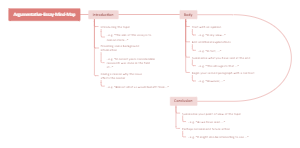

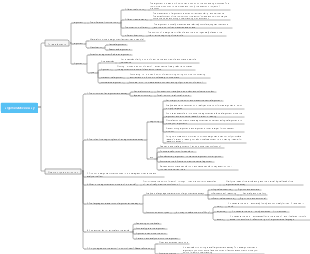
Basic structure of IELTS argumentative essay
first paragraph
40-50 words
Writing outline
background
Background introduction: 1.It is quite common these days for sb in many countries to do sth 2.A controversial(controversial) issue of modern societies is whether sentence A of B –A of B
Expand
Extensions: 1. Whether or not this is a good thing is a moot point(pending). 2. The other party’s point of view (Some people/individuals are in favor of (support) the view that the other party’s point of view)
own point of view
My own point of view: 1. In my opinion(As far as I am concerned), it is essential/necessary for sb to do sth. 2.My view is that (the advantages outweigh the disadvantages) 3. I agree/disagree with this view. (Mostly used for disagreement categories)
Example
example 1
Some people believe that children should be allowed to stay at home and play until they are six or seven years old. Others believe that it is important for young children to go to school as soon as possible. What’s your opinion. A…..B…..what is your opinion?
standing dock
A controversial issue of modern societies is whether children should stay at home before six or seven or go to school early.
The two whethers cannot be used together
Some people are in favor of the view that children should stay at home for a longer time.
Howerer, my view is that children should go to school as early as possible.
it is necessary for children to go to school early.
Example 2
In many countries, traditional foods are being replaced by international fast food. This is having a negative effect on both families and societies. To what extent do you agree or disagree?
It is quite common these days for people in many countries to eat international fast food rather than traditional food.
Whether or not this is a good thing is a moot point. I agree with this view that this trend has negative effects on both families and societies.
Some people are in favor of the view that this trend has negative effects on both families and scoieties. I agree with this view.
Example 3
As countries develop, more and more people buy and use their cars. Do you think the advantages of this trend for individuals outweigh its disadvantages for environment?
It is quite common these days for people in many countries to buy and use their cars.
Whether or not this is a good thing is a moot point.
My view is that the benefits for people outweigh the disaster for environment.
Argument paragraph
110-120 words
argument
The first way of writing
Core sentence expansion
There are two main reasons why sb should do sth….. .
Firstly, point 1 is expanded.
Secondly, point 2 is expanded.
The second way of writing
An obvious argument in favor of (support) sb doing sth/doing sth is that sub-argument 1 extension.
Moreover, sub-point 2 is extended.
How to find points for arguments
People (generally refers to participants)
Environment (the environment in which the general participants are located)
Separate situations (when A and B belonging to different things appear in the question)
Example
example 1
Some people think the police should carry guns, while others think the police with guns will lead to serious crimes. Discuss both views and give your own opinion?
1. Be nice to the police 2. Good to society
Example 2
Some people believe that children should be allowed to stay at home and play until they are six or seven years old. Others believe that it is important for young children to go to school as soon as possible. What’s your opinion. A…..B…..what is your opinion?
Writing method 1
There are two main reasons why children should attend school early. Firstly, this phenomenon can positively affect these kids. Expand
Secondly, there are some benefits for their parents if they send their children to school at an early age. Extension
Writing method 2
An obvious argument in favor of children going to school early is that this has positive effects on them. Extension
Sentence pattern
sth have positive effects on sb or sth can positively affect sb
This is beneficial for sb.
be conductive to=be beneficial for
be harmful to=be detrimental to
There are benefits for A if B do sth.
benefit=advantage
drawback=disadvantage
Expand
Writing method
explain
Write from direct causes/effects to indirect causes/effects to find the direct cause.
Just think of a little more and ask yourself why
For example: children can learn knowledge early if they go to school early
The school has experienced teachers who can teach various subjects, learn knowledge, develop intelligence and broaden their horizons, be smart and achieve good results.
Because the school has experienced teachers who can teach a variety of subjects, students can learn a lot of knowledge, which helps them develop their intelligence and broaden their horizons. Therefore, they can become smarter and achieve good academic results. Besides that, there are many peers in school so they can make friends and get along with each other, which improves their social skills.
transform: Students can acquire much knowledge in school because there are many professional techers who can teach various subjects. This can help them to develop their intelligence and broaden their horizons. Therefore, they can become clever and get a good score. Besides, there many children of the same age so that they can make friends and get along with each other, which can improve their social ability.
Argument to the contrary
by contrast, if...not
Example
By contrast,
for example
such as noun, phrase For example, sentence
Main points
Try not to use celebrities as examples
Try not to use your own examples
Examples are placed after the general term
Incorrect example: I have many friends who like to play games with me, such as Xiaohong and Xiaoming
Correction 1: I have many friends, such as Xiaohong and Xiaoming, and they like to play games with me, such as hide and seek.
Correction 2: I have many friends who like to play games with me. For example, Xiao Hong and Xiao Ming like to play hide and seek with me.
Example
(Continuing from the example explained above) For example,
Extension mode
explain
Explanation Contrast
explain give example
Explain, give examples, contrast
Report class
question type
A...What are the reasons and how to solve?
A...What problems will it cause and how to solve? Result Solution
example
A common problem of modern society is that college graduates find it difficult to get a job. What are the reasons and how to solve?
Some people think a rise in standard of living in a country only seems to benefit cities more than rural areas. What problems may those differences cause? How to reduce these problems?
Problem-solving ideas
first paragraph
Reason 1
Reason 2
solution
first paragraph
Result 1
Result 2
solution
Report article structure
reason
First paragraph: Ask why
It seems to be an increasingly widespread problem that...I think that two main reasons are responsible for this, and several methods could be taken to tackle it.
Second paragraph: Reason (personal)
One possible reason why sentence ….may be that sentence. Extension (explanation, examples)
Paragraph 3: Reason (group: family, company, school, society)
Another important factor contributing to this phenomenon is that sentence expansion. (Extension method: explain, give examples)
Paragraph 4: Solution (can be written in two paragraphs)
In order to solve this issue, personally. In addition, groups. What’s more, what should society (government) do?
result
First paragraph: Ask about the result
It seems to be an increasingly widespread problem/concern that...I think that this issue/trend/phenomenon would lead to two results, and several methods could be taken to tackle it.
Second paragraph: Result 1 (individual)
One possible result may be that sentence. Expansion (explanation, examples)
Paragraph 3: Result 2 (Group: family, company, school, society)
Another possible consequence may be that sentence expansion (explanation, example)
Paragraph 4: Solution (can be written in two paragraphs)
In order to solve this issue, personally. In addition, groups. What’s more, what should society (government) do?
Common solutions
internationality: Strengthen cooperation, reach consensus, and set international standards (strengthen the cooperation; reach the agreement, set international standards) domestic: government: Enact laws and regulations to intervene and guide/punish (enact laws and regulations to intervene and guide/punish) offer education to raise the awareness of the general public Promulgate preferential policies and invest money/funds in solving the problem (carry out some preferential policies and invest money/funds in solving the problem) Increase taxes (High-tax penalties/punishments should be imposed on sth/ Governments can put taxes on sth)
concluding paragraph
30-40 words
reiterate one's point of view
In conclusion, my view is that sb should be encouraged to do sth …… That is the best way for them to ……
In conclusion, although sb think the other party's point of view, my view is that my own point of view a summary of my own reasons.
refutation paragraph
80-90 words
Paragraph content
the other person's point of view
Review the topic again and write down the other party’s point of view
the other party’s reasons
No less than 30 words
refute
Writing method
However, there are some individuals who claim that (it is understandable that some individuals claim that) the other side's perspective. This is because of the other party's reasons. But they are oversimplifying the situation. As a matter of fact, rebuttal
Refute logically (support the other party’s reasons in reverse) This is less likely as support
Solve positive and negative reasons
Take steps to solve the problem This issue can be solved by various methods.
Address negative reasons
Example: However, there are some people who think that children should stay at home before six or seven years old. This is because if they stay at home for a longer time, their parents can accompany and take good care of them. This means that children can receive high-quality family education and get a good sense of security, which is conducive to their physical and mental health. But they are oversimplifying the situation. As a matter of fact, this is less likely as/because parents are always busy with their daily jobs.
short essay
Category: 5 2
Data type: graph/chart
Non-data type: diagram
Problem solving steps
Line graph
First paragraph: (introduction) = paraphrase (rewrite the title)
The line graph shows (describes, demonstrates, illustrates, gives information about, indicates) Data Form Description Object Location Time
Data format: the number of countable noun=the figure for the amount of uncountable noun=the quantity of the proportion/percentage of noun=the figure for birth rate graduate rate crime rate the consumption of meat=the amount of meat consumed per person Describing objects is generally rewritten with attributive clauses
Time: 1960-1990 from 1960 to 1990 between 1960 and 1990 During/over/throughout the period from 1960 to 1990 in 1992=in the year of 1992 in month on some day at time point In the USA=in America In the UK=in Britain
Writing sentence patterns in the middle paragraph
Describe the object as the subject
The number of teachers quickly decreased from 5 million in 1960 to 3 million in 1962.
The number of teachers saw/showed a dramatic downward trend from 5 million in 1960 to 3 million in 1962.
rising, falling and flat as subject
A sharp increase could be seen in the number of teachers from 3 million in 1962 to 6 million in 1964.
There be sentence pattern
noun
There was a slight/slow decline in the number of teachers from 6 million in 1964 to 5 million in 1966.
Vocabulary summary
trend
rise: Verb: increase, go up, grow, rise, soar (rising rapidly) Noun: increase, growth, rise, upward trend/tendency (trend) decline: Verb: decrease, go down, decline, fall Noun: decrease, fall, decline, downward trend/tendency Ups and downs: Verb: fluctuate, vary Noun: fluctuation, variation constant: Verb: stabilize, remain/keep stable/constant/steady Noun: stable trend, a period of stability
Two major characteristics
Extreme point
Highest: the top=the peak=the highest point lowest: the bottom=the lowest point Reach the peak at…=peak at…
About: about, approximately, just over, just below, around
The degree of rise and fall
To a large extent: sharp(-ly), quick(-ly), substantial(-ly), significant(-ly), dramatic(ally) To a small extent: slow(-ly), slight(-ly), gradual(-ly), minor(ly) Moderate: modest(-ly), moderate(-ly)
conjunction
Turning point: but, however, while, on the other hand, by contrast
Express the passage of time: then, since then, thereafter, after (after...)/before (before...)
sentence, which was followed by noun
example
The graph below shows radio and television audiences throughout the day in 1992 in the UK.
Rewrite the first paragraph
The line graph gives information about the proportions of audiences who listened to radio and watched TV throughout the day in 1992 in Britain.
Middle section 1
As can be seen from the line chart, the proportions of television and radio audiences both increased first and then decreased.Specifically, the proportion of television audiences increased dramatically from 2% at 6.00 am to the top at just below 50% at 8.00pm, overtaking that of radio audiences at about 2.00 pm. Since then, the figure saw/showed a sharp decrease to 3% at 3.00 pm on the next day, which was followed by a stable trend until 6.00 am.
middle section 2
In terms of radio audiences, the proportion increased…..
Closing Paragraph: Summary/Comparison
To conclude, before 2.00 pm, the radio was more popular with audiences, while there were more people who chose to watch TV after that.
pie chart
First Paragraph: Three Elements
middle section
Write the peak value first (maximum, minimum)
Other data are grouped and described according to the relationship between data (similarity/multiple)
end
Sentence pattern
1.The percentage of sth is the highest/maximum, with 33%./accounting for 33%/(33%). The percentage of working and sleeping time was 65%, with/accounting for 33% and 32% respectively(respectively) 2. sth account for=occupy=constitute(occupy) the minimum proportion/share, with only 2%. The time which was spent in traveling to work accounted for the minimum share, with only 2%. 3. The numerical value is the subject: 65% of time was spent on working and sleeping, with 33% and 32% respectively. 18% of time was spent on relaxing at home 4.There was 33% of time which was spent on working .(there be) 5. People or countries are the subject working adults spent 32% of time on sleeping.
resemblance: 1.A is similar to B/A is the same as B 2. A, B and C account for(occupy=constitute) similar proportions, with 4%, 5% and 6% respectively(=separately). 3. There be: There is a slight difference/gap in A and B, accounting for 3% and 4%.(3% and 4% respectively) There are some slight differences in A, B and C. 4. People or countries are the subject
multiple: 1.A double/triple/quadruple B 2.A is twice as much/many as B three times-four times
example
The chart shows the percentages of time working adults spent on different activities in a certain country in 1958.
The pie chart shows that there are four main causes of farmland becoming degraded in the world today. Globally, 65% of degradation is caused by too much animal grazing and tree clearance, constituting 35% and 30% respectively. A further 28% of global Degradation is due to over-cultivation of crops. Other causes account for only 7% collectively.
These causes affected different regions differently in the 1990s, with Europe having as much as 9.8% of degradation due to deforestation, while the impact of this on Oceania and North America was minimal, with only 1.7% and 0.2% of land affected respectively. Europe , with the highest overall percentage of land degraded(23%), also suffered from over-cultivation(7.7%) and over-grazing (5.5%). In contrast, Oceania had 13% of degraded farmland and this was mainly due to over -grazing(11.3%). North America had a lower proportion of degraded land at only 5%, and the main causes of this were over-cultivation(3.3%) and, to a lesser extent, over-grazing(1.5%).
Overall, it is clear that Europe suffered more from farmland degradation than the other regions, and the main causes there were deforestation and over-cultivation.
Static image: table
example
The table gives information about the proportions of consumer expenditure which was spent on different items in Ireland, Italy, Spain, Sweden and Turkey in 2002.
As can be seen from the table, food/drinks/tobacco were the most important daily items for all the five countries, while consumers paid the least money for leisure and education. Specifically, Turkey spent the most money on food, drinks and tobacco, with 32.14%. Ireland ranked the second, spending 28.91% of money. The rest three countries spent relatively less money on these items, with around/approximately 15%, 16% and 18% respectively.
In terms of footwear and clothing, the proportion of money which was spent was the most in Italy (9%), while only 5% of money was spent on these items in Sweden. The expenditure spent in Ireland, Spain and Turkey accounted for similar proportions, with about 6%.
All consumers in five countries spent the least proportion of money on leisure and education, fluctuating from 1.98% to 4.35%.
Overall, the five countries spent different proportions of money on different items.