MindMap Gallery 5PMP-Project Scope Management Summary
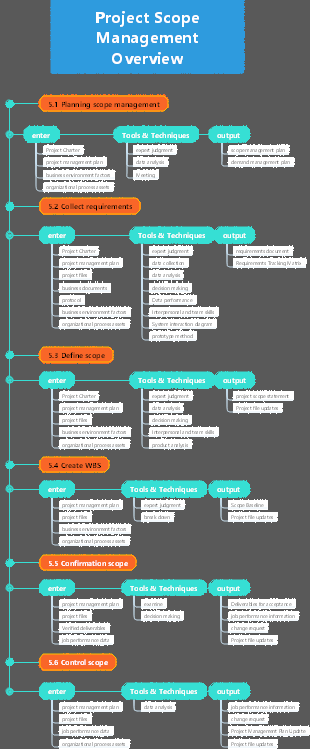
This is a mind map about 5PMP-project scope management summary. Project scope management includes a series of processes required to successfully complete a project to ensure that the project contains and only contains the work that must be completed for the project.
Edited at 2021-05-31 17:18:04This is a mind map about bacteria, and its main contents include: overview, morphology, types, structure, reproduction, distribution, application, and expansion. The summary is comprehensive and meticulous, suitable as review materials.

This is a mind map about plant asexual reproduction, and its main contents include: concept, spore reproduction, vegetative reproduction, tissue culture, and buds. The summary is comprehensive and meticulous, suitable as review materials.
This is a mind map about the reproductive development of animals, and its main contents include: insects, frogs, birds, sexual reproduction, and asexual reproduction. The summary is comprehensive and meticulous, suitable as review materials.
This is a mind map about bacteria, and its main contents include: overview, morphology, types, structure, reproduction, distribution, application, and expansion. The summary is comprehensive and meticulous, suitable as review materials.
This is a mind map about plant asexual reproduction, and its main contents include: concept, spore reproduction, vegetative reproduction, tissue culture, and buds. The summary is comprehensive and meticulous, suitable as review materials.
This is a mind map about the reproductive development of animals, and its main contents include: insects, frogs, birds, sexual reproduction, and asexual reproduction. The summary is comprehensive and meticulous, suitable as review materials.
PMP-Project Scope Management
planning scope management
ITTO
enter
1. Project Charter
2. Project management plan
quality management plan
Project life cycle description
development method
3. Business environment factors
4. Organizational process assets
Tools & Techniques
expert judgment
data analysis
Alternatives Analysis
Meeting
output
scope management plan
Role: Provide guidance and direction on how to manage scope
Description: How to define, develop, monitor, control and confirm project scope
Purpose: Reduce the risk of scope creep
demand management plan
Description: How to analyze, document, and manage project and product requirements
Scope is the end of demand. Demand does not have to be done, but scope must be done.
Gather requirements
ITTO
enter
1. Project Charter
2. Project management plan
scope management plan
demand management plan
Stakeholder Engagement Plan
3.Project files
Hypothetical log
Lessons Learned Register
Interested Party Register
4. Business documents (business case)
5. Agreement
6. Business environment factors
7. Organizational process assets
Tools & Techniques
1. Expert judgment
Delphi method (experts, anonymity, multiple rounds, voting, eliminating the influence of influential stakeholders)
2. Data collection
Brainstorming (brainstorming ideas)
Interview (one-to-one, one-to-many, informal conversation)
Focus group (professional moderator guides experts to discuss "focus issues", focusing on interactive discussions)
Nominal group (screening the results of the brainstorming session, focusing on the screening of the results)
Surveys (quickly collect information from many respondents)
Benchmark comparison (cottage)
3.Data analysis
File analysis
4.Decision making
vote
unanimously agreed
most principles
relatively many principles
autocratic decision making
Multi-criteria decision analysis (evaluate and rank many ideas)
5.Data performance
Affinity diagram (categorizing ideas generated during brainstorming)
Mind map (use a picture to connect the ideas obtained during brainstorming to reflect commonalities and differences)
6.Interpersonal and team skills
Nominal group technology: keyword voting (screening the results of brainstorming sessions, focusing on the screening of results, relevant parties have their own agendas, voting to sort the most useful ideas)
observe/talk
guide
Joint Application Design or Development (JAD) (bringing business experts and development teams together to gather requirements and improve the software development process)
Quality Function Deployment (QFD) (used by the manufacturing industry to help determine the key features of new products, from effect to cause, and from school bus safety results to cause)
User stories (short text description of required functionality, requirements workshop)
subtopic
7. System interaction method (visio)
8. Prototype method (CAD, DEMO): Create prototypes, use them without experience
output
1.Requirements document
Requirement Category
Business needs
Stakeholder needs
Solution requirements
excessive demand
Project requirements
quality requirements
2. Requirements Traceability Matrix: Reflecting Requirements and Deliverables
is an enhanced requirements document
Pay attention to the past and present of needs
Deliverable ownership
Define scope
ITTO
enter
1. Project Charter
2. Project management plan
scope management plan
3.Project files
Hypothetical log
requirements document
risk register
4. Business environment factors
5. Organizational process assets
Tools & Techniques
1. Expert judgment
2. Data analysis (alternative analysis)
3. Decision-making (multi-criteria decision analysis)
4.Interpersonal and team skills (guidance)
5. Product analysis
product breakdown
demand analysis
system analysis
Systems Engineering
Value Analysis
Value Engineering
output
1. Project Scope Statement
Product range description
Product acceptance criteria
Project deliverables
Project Exclusions
Project constraints
Project Assumptions
2. Project file update
Hypothetical log
requirements document
Requirements Tracking Matrix
Interested Party Register
Create work breakdown structure WBS
ITTO
enter
1. Project management plan
scope management plan
2.Project files
project scope statement
requirements document
3. Business environment factors
4. Organizational process assets
Tools & Techniques
1. Expert judgment
2. Decompose
Divide scope and deliverables into smaller, more manageable component technologies
Each stage of the life cycle is the second level of decomposition
Products and deliverables are placed on the third layer
Put major deliverables on the second tier
in principle
100% principle: WBS includes all products and project work
Rolling Planning: Deliverables to be completed in the future that may not be decomposable currently
WBS control layer 4-6
8-80 principle: The size of the work package requires at least 8 hours, and the total completion time should not be greater than 80 hours.
output
1. Scope benchmark
project scope statement
Work breakdown structure WBS
milestone
Control account: management node
Planning package: content is known, detailed progress activities are not yet available
work package
Corresponding WBS dictionary (work package annotations)
Work packages and planning packages are both in the WBS dictionary
Keywords: job description, detailed description, evaluation progress, etc. If you want to determine which document description to use in the question, look for the "WBS Dictionary"
2. Project file update
Hypothetical log
requirements document
Confirm scope
ITTO
enter
1. Project management plan
scope management plan
demand management plan
Scope Baseline
2.Project files
Lessons Learned Register
quality report
requirements document
Requirements Tracking Matrix
3. Verified deliverables
4. Job performance data
Tools & Techniques
1. Check
2. Decision-making (voting)
output
1. Acceptable deliverables
2. Job performance information
3. Change request
4. Project file update
Lessons Learned Register
requirements document
Requirements Tracking Matrix
Control range
ITTO
enter
1. Project management plan
scope management plan
demand management plan
change management plan
configuration management plan
Scope Baseline
performance measurement benchmarks
2.Project files
Lessons Learned Register
requirements document
Requirements Tracking Matrix
3. Job performance data
4. Organizational process assets
Tools & Techniques
1.Data analysis
Deviation analysis
Compare benchmarks to actual results,
trend analysis
Review performance over time to determine whether performance is improving or deteriorating
output
1. Job performance information
2. Change request
3. Project management plan update
scope management plan
Scope Baseline
progress baseline
cost basis
performance measurement benchmarks
4. Project file update
Lessons Learned Boarding Book
requirements document
Requirements Tracking Matrix
Key words
Scope supervision and scope changes are all about controlling the scope.
Keywords: Develop new functions - Missing functions - Missing requirements, first locate the control scope process
Question stem description: The scope of team members’ assumptions, etc.