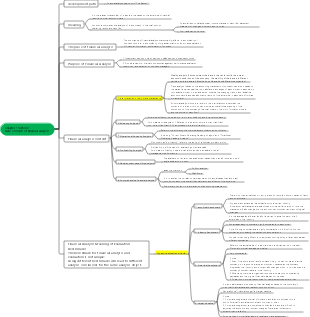
MindMap Gallery Accounting Chapter 1, Section 3 Financial Analysis Procedures and Methods
Higher education self-study exam, financial statement analysis notes, including financial analysis procedures, Basic methods of financial analysis and other contents.
Edited at 2024-03-14 20:56:55This is a mind map about bacteria, and its main contents include: overview, morphology, types, structure, reproduction, distribution, application, and expansion. The summary is comprehensive and meticulous, suitable as review materials.

This is a mind map about plant asexual reproduction, and its main contents include: concept, spore reproduction, vegetative reproduction, tissue culture, and buds. The summary is comprehensive and meticulous, suitable as review materials.
This is a mind map about the reproductive development of animals, and its main contents include: insects, frogs, birds, sexual reproduction, and asexual reproduction. The summary is comprehensive and meticulous, suitable as review materials.
This is a mind map about bacteria, and its main contents include: overview, morphology, types, structure, reproduction, distribution, application, and expansion. The summary is comprehensive and meticulous, suitable as review materials.
This is a mind map about plant asexual reproduction, and its main contents include: concept, spore reproduction, vegetative reproduction, tissue culture, and buds. The summary is comprehensive and meticulous, suitable as review materials.
This is a mind map about the reproductive development of animals, and its main contents include: insects, frogs, birds, sexual reproduction, and asexual reproduction. The summary is comprehensive and meticulous, suitable as review materials.
Chapter 1 Section 3 Financial analysis procedures and methods
financial analysis program
1. Establish analysis goals and clarify analysis content
2. Collect and analyze data
3. Determine the baseline for analysis
4. Select analysis method
5. Make analytical conclusions and make relevant suggestions
Basic methods of financial analysis
1. comparative analysis
It is the most common method in financial analysis
comparative form classification
absolute number comparison
Common forms: Compare financial statements, present two/multi-period financial statements side by side, compare and observe the increase or decrease in project data, and analyze the economic meaning of the changes.
Disadvantage: It is difficult to reflect the differences between analysis objects of different scales
Percent change comparison (relative number)
Formula: Change percentage = (Analysis item amount - Analysis base amount) / Analysis base amount * 100%
If the base amount is a negative number, the change percentage is negative and is reflected as a decrease in percentage. If the base amount is "0", the calculation of the change percentage is meaningless If the benchmark amount is a small positive number, a small change in the absolute number will lead to a large change, distorting the economic significance of the indicator change.
baseline classification
Compare to target baseline
Compare to historical benchmarks
Compare to industry benchmarks
Not suitable for financial analysis of monopolistic enterprises
shortcoming: Differences can be found, but it is difficult to explain the reasons for the differences and what factors affect them.
Solution: Use "factor analysis"
2. ratio analysis
The most common analysis method A method of examining, measuring and evaluating by calculating ratios using the interrelationships between indicators
composition ratio analysis
Formula: composition ratio = certain indicator value/overall value*100%
Example: Common ratio financial statements, calculate the ratio of each item in the report to a certain same item (Ratio of current assets to total assets, ratio of fixed assets to total assets)
Use this to observe whether the overall financial indicator structure of the company is reasonable and whether the source of profit has changed.
Chain analysis: the current value compared with the previous year *100%
Related Ratio Analysis
Compare two indicators that are different but related in nature and find the ratio
Note: The two indicators of numerator and denominator should have an economic relationship and should not be used casually. When one of the two indicators comes from the balance sheet (point-in-time statement) and the other comes from the income statement or cash flow statement (period statement), the balance sheet data should be averaged during the period.
shortcoming: After calculating the relevant ratio, the corresponding economic significance cannot be directly explained. It must be compared with certain evaluation benchmarks. Therefore, "ratio analysis" is often used in conjunction with "comparative analysis"
3. factor analysis
By sequentially changing the number of each factor, we can calculate the impact of changes in each factor on the overall current indicators.
four steps
Determine the analysis object Use comparative analysis dust to compare the analysis indicators with the selected benchmark and find the difference number
Determine the influencing factors of the analysis object
Determine the quantitative relationship between the analysis object and its influencing factors, and establish a functional relationship
Replace each factor variable at a time in a certain order and calculate the degree of influence of each factor on the analysis target indicator.
a, b, c, d Replace one by one x=a*b x1=c*b x2=c*d
See book P24 for details
4. trend analysis
Based on the company's financial reports for several consecutive periods, taking the first year or a certain year as the base period, calculate the trend percentage of the same item in each period to the base period.
For comparison of financial indicators in different periods, different base periods are used.
Fixed ratio dynamic ratio
Compared to the fixed base period You can observe the overall change trend of enterprise indicators
Period-on-month dynamic ratio
Compared with the previous period Possibility to clarify the rate of change of the indicator
question: When using the "trend analysis method" to analyze the cash flow statement, if the opening item is zero, the processing method may include: A. Eliminate the item C. Analyze item by item based on the comparative cash flow statement.