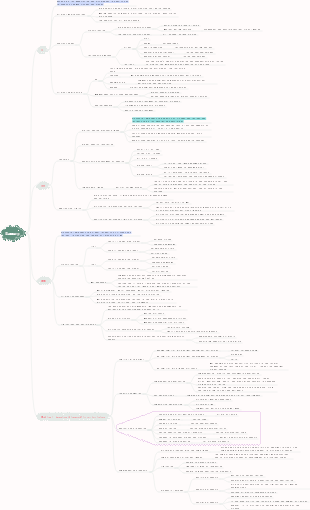
MindMap Gallery Diagnostic Imaging Pleural Lesions
An article about diagnostic imaging: a mind map of pleural lesions, including pleural effusion, pneumothorax and hydropneumothorax, pleural hypertrophy, adhesions and calcifications, pleural masses, etc.
Edited at 2024-03-17 09:22:06This is a mind map about bacteria, and its main contents include: overview, morphology, types, structure, reproduction, distribution, application, and expansion. The summary is comprehensive and meticulous, suitable as review materials.

This is a mind map about plant asexual reproduction, and its main contents include: concept, spore reproduction, vegetative reproduction, tissue culture, and buds. The summary is comprehensive and meticulous, suitable as review materials.
This is a mind map about the reproductive development of animals, and its main contents include: insects, frogs, birds, sexual reproduction, and asexual reproduction. The summary is comprehensive and meticulous, suitable as review materials.
This is a mind map about bacteria, and its main contents include: overview, morphology, types, structure, reproduction, distribution, application, and expansion. The summary is comprehensive and meticulous, suitable as review materials.
This is a mind map about plant asexual reproduction, and its main contents include: concept, spore reproduction, vegetative reproduction, tissue culture, and buds. The summary is comprehensive and meticulous, suitable as review materials.
This is a mind map about the reproductive development of animals, and its main contents include: insects, frogs, birds, sexual reproduction, and asexual reproduction. The summary is comprehensive and meticulous, suitable as review materials.
Pleural lesions
pleural effusion
X-ray
free pleural effusion
small amount of effusion
When standing, only the posterior costophrenic angle becomes blunt.
The effusion volume reaches 250 mL, and the lateral costophrenic angle becomes blunt and shallow.
It continues to increase, the lateral costophrenic angle disappears, the effusion covers the top of the diaphragm, the outside is high and the inside is low, arc-shaped dense shadow, the lower edge of the front end of the 4th rib on the upper edge
Moderate effusion
The upper limit exceeds the lower edge of the front end of the 4th rib and is below the plane of the lower edge of the front end of the 2nd rib.
The upper edge is curved and concave, and the middle and lower lung fields on the affected side are uniformly dense.
Massive effusion
The upper edge of the curved concave surface exceeds the lower edge of the front end of the 2nd rib
The lung field on the affected side is uniformly dense, the intercostal space is widened, the transverse septum is descended, and the mediastinum is shifted to the healthy side.
localized pleural effusion
encapsulated effusion
Adhesion of the visceral and parietal pleura causes fluid accumulation to be localized in a certain part of the pleural cavity
It is more common in pleurisy, which is more common in the lower chest and posterior chest wall.
Tangent slice: It manifests as a semicircular or mound-shaped uniform dense shadow protruding from the chest wall to the lung field, with clear edges, and the upper and lower edges intersect with the chest wall at an obtuse angle.
interleaf effusion
Fluid accumulation limited to horizontal and oblique fissures
Oblique fissures: interleaf fissures with even spindle shapes and clear edges.
Free effusion enters the interlobular fissure: it is mostly limited to the lower part of the oblique fissure, with the tip of the tip posteriorly and upward as a triangular shadow of increased density (lateral radiograph)
Fluid at the base of the lungs
Fluid is located between the bottom of the lungs and the diaphragm, more common on the right side
The effusion pushes the diaphragm upward, the highest point of the dome is in the outer 1/3, and the costophrenic angle is deep and sharp. (Different from elevated diaphragm)
CT
Small to moderate effusion
Narrow arc-shaped, crescent-shaped liquid density shadow under the posterior chest wall with smooth edges
Fluid moves under the anterior chest wall in the prone position
Massive effusion
There is a fluid-like density shadow in the entire pleural cavity, the lungs are compressed to the hilum and appear as soft tissue shadows, and the mediastinum is shifted to the opposite side.
encapsulated effusion
A convex mirror-shaped liquid density shadow protruding from the chest wall to the lung field, with a wide base and close to the chest wall, an obtuse angle with the chest wall, and smooth edges. There is often thickening of the adjacent pleura, and the pleural tail sign
interleaf effusion
Band-shaped, fusiform, and spherical liquid density shadows in interleaf fissures
The location and course are consistent with the interlobar fissures, liquid-like density, enhanced but not enhanced
Pneumothorax and hydropneumothorax
Rupture of the visceral or parietal pleura allowing air to enter the chest
The simultaneous presence of liquid and gas is called hydropneumothorax
X-ray
No lung texture and gas density in the pneumothorax area
A small amount: Linear or band-like textureless areas, which appear more clearly during exhalation
Large quantities: It occupies the outer zone in the middle of the lung field, and the inner zone is the compressed lung, showing a soft tissue-like shadow of uniform density. The ipsilateral intercostal space is widened, the diaphragm is descended, and the mediastinum is shifted to the healthy side.
Hydropneumothorax: The air-fluid level can be seen on upright chest X-ray. In severe cases, the air-fluid level can traverse the entire chest cavity on the affected side.
Visceral and parietal pleural adhesions may form localized or multilocular pneumothorax or hydropneumothorax
CT
pneumothorax: A band-like extremely low-density area without lung markings on the lateral side of the lung; The medial arc-shaped visceral pleura shows a thin linear soft tissue density shadow, parallel to the chest wall; The lung tissue is compressed to varying degrees, the mediastinum shifts to the opposite side, and the diaphragm descends
Hydropneumothorax: Fluid distribution dorsally, well-defined air-fluid level, collapsed lung margins
Pleural hypertrophy, adhesions and calcification
Cause: Pleuritic fibrinous exudation, granulation tissue hyperplasia, trauma and bleeding organization can be
Pleural hypertrophy and adhesions often coexist
Mild localized pleural hypertrophy and adhesions mostly occur in the costophrenic angle area
Pleural calcification is more common in tuberculous pleurisy, hemorrhagic organizing, and pneumoconiosis
X-ray
Localized pleural hypertrophy and adhesions: the costophrenic angle becomes shallow and flat; Extensive pleural hypertrophy and adhesions, collapse of the thorax on the affected side, narrowing of the intercostal space, increased lung field density, nearly right-angled costophrenic angle, elevated diaphragm, flattening of the top, and mediastinal shift to the affected side
Pleural calcification: flaky, irregular dot-like, and strip-like high-density shadows at the edge of the lung field; Encapsulated pleurisy: calcification is curved and irregular
CT
Pleural hypertrophy: a band-like soft tissue shadow along the chest wall with uneven thickness and uneven surface. Small adhesion shadows are often seen at the interface with the lungs; When the thickness reaches more than 2cm, it is mostly malignant.
Pleural calcification: punctate, band-like, massive high-density shadow, CT value close to bone
Pleural mass
Primary: mostly pleural mesothelioma, rarely connective tissue fibroma, leiomyoma, neurofibroma
Pleural tumors: localized, diffuse (malignant); Masses combined with pleural effusion are mostly malignant
X-ray
Hemispherical, convex mirror-shaped, irregular dense shadow, uniform density, clear edge, intersecting with the chest wall at an obtuse angle
Metastases may cause rib destruction
CT
A mass of soft tissue density connected to the chest wall
The periphery of the mass continues with the pleura to form the pleural tail sign
Enhancement: Many tumors are enhanced