MindMap Gallery Conservation quantities and conservation laws of motion
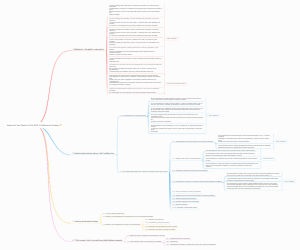
This is a mind map about the conserved quantities and conservation laws of motion. A system composed of N particles - the research object is called a particle system. The interaction force between the particles within the internal force system.
Edited at 2021-06-16 17:51:21This is a mind map about bacteria, and its main contents include: overview, morphology, types, structure, reproduction, distribution, application, and expansion. The summary is comprehensive and meticulous, suitable as review materials.
This is a mind map about plant asexual reproduction, and its main contents include: concept, spore reproduction, vegetative reproduction, tissue culture, and buds. The summary is comprehensive and meticulous, suitable as review materials.
This is a mind map about the reproductive development of animals, and its main contents include: insects, frogs, birds, sexual reproduction, and asexual reproduction. The summary is comprehensive and meticulous, suitable as review materials.
This is a mind map about bacteria, and its main contents include: overview, morphology, types, structure, reproduction, distribution, application, and expansion. The summary is comprehensive and meticulous, suitable as review materials.
This is a mind map about plant asexual reproduction, and its main contents include: concept, spore reproduction, vegetative reproduction, tissue culture, and buds. The summary is comprehensive and meticulous, suitable as review materials.
This is a mind map about the reproductive development of animals, and its main contents include: insects, frogs, birds, sexual reproduction, and asexual reproduction. The summary is comprehensive and meticulous, suitable as review materials.
Conservation quantities and conservation laws of motion
Internal and external forces of the mass point system, center of mass, center of mass motion theorem
1. Internal and external forces of the particle system
Internal force: the interaction force between the particles inside the system.
Conclusion: The sum of the internal forces of the particle system is zero
External force: The force exerted by the outside of the system on the internal particles of the system of particles.
sum of external forces
sum of internal forces
2. Center of mass
The center of mass of the mass point system is referred to as the center of mass. A dimension with length that describes the position of a certain point in space related to the system of particles.
(2) The position vector of the center of mass is related to the choice of the coordinate system, but the relative position of each particle in the relative particle system remains unchanged and is a specific position.
(5) A uniform object with symmetrical shape and its center of mass is located at the center of its geometric symmetry.
(6) The difference between the center of gravity and the center of mass: The center of mass and the center of mass are different. When the size of the object is not very large, the positions of the center of mass and the center of mass coincide.
The motion of the center of mass reflects the overall motion trend of the particle system.
3. Theorem of motion of center of mass
Momentum Theorem Law of Conservation of Momentum
The integral on the left represents the accumulation of force over time, called impulse.
This is the momentum theorem of a particle: the impulse of the net external force experienced by an object during motion is equal to the increment of the momentum of the object.
For problems such as collision and impact, the average impulse can be estimated based on the effect.
2. Law of Conservation of Momentum
(1) Momentum theorem of particle system
The impulse of the total external force of a mechanical system composed of n particles is equal to the increment of the total momentum of the system - the momentum theorem of the particle system.
(2) Law of conservation of momentum
The angular momentum theorem of particle and the law of conservation of angular momentum
Direction: Right-hand spiral rule.
(1) Angular momentum must be specified for which fixed point.
----Particle angular momentum theorem
The net external moment on a particle is equal to the rate of change of its angular momentum with respect to time.
3. Law of Conservation of Angular Momentum
work kinetic energy kinetic energy theorem
1. Gong
① Work is a scalar quantity, which can be positive or negative. ② Work is a process quantity, and work only exists when the position of an object changes.
Constant force work
The power of changing force
2. Kinetic energy theorem of particle
(1) Ek is the state quantity (2) Ek is a scalar quantity (3) Ek is always positive
2. The kinetic energy theorem of a particle - the effect of work
The kinetic energy theorem of objects studies the law between work done by external forces and changes in the motion state of objects
The work done by the combined external force = the increment of the kinetic energy of the particle
Symmetry and conservation laws
collision
1. Elastic collision
The deformation of the object after the collision can be fully restored, and the total mechanical energy of the system before and after the collision is conserved.
2. Completely inelastic collision
The deformation of the object during the collision is completely irreversible, so that the two objects merge into one and move together. There is a mechanical energy loss in the system.
Negative sign?——Mechanical energy loss
3. Inelastic collision
The deformation of the object after the collision is only partially restored, and the system suffers a partial loss of mechanical energy.
Collision law: The separation speed of the two balls after the collision (v2- v1) is directly proportional to the approaching speed of the two balls before the collision (v10-v20).
Functional principles of the particle system Law of conservation of mechanical energy
1. The kinetic energy theorem of a system of particles
The work done by all external forces in a mechanical system + the work done by all internal forces = the increment of the total kinetic energy of the system
Note: The work done by internal force is generally not 0.
2. Functional principles
For a mechanical system, according to the particle group kinetic energy theorem
Functional principle of the system: When the system changes from state 1 to state 2, the increment of its mechanical energy is equal to the sum of the work of the external force and the work of the non-conservative internal force. This conclusion is called the functional principle of the system.
Conservative force Work of pairs of forces Potential energy
1. Conservative power
It can be seen that the work done by gravity is only related to the starting and ending positions of the object, but has nothing to do with the path that the moving object takes.
It shows that when an object moves along any closed path in a gravity field, the work done by gravity is zero.
2. Work of elastic force
It can be seen that the work done by elastic force is only related to the starting and ending positions of the particle, and has nothing to do with the specific path.
3. Work of gravity
It can be seen that the work done by gravity is only related to the starting and ending positions of the particle, and has nothing to do with the specific path.
Universal definition of conservative force: In any reference system, the work of a pair of conservative forces only depends on the relative positions of the interacting particles at the beginning and end, and has nothing to do with the motion path of each particle.
2. Work of paired forces
It can be seen that the total work done by the pair of action force and reaction force is only related to the action force and relative displacement, and has nothing to do with the respective motion of each particle.
It shows that the total work of any pair of interacting forces is independent of the reference frame. Depends only on the relative displacement of the two objects.
3. Potential energy
This energy is only related to position and is called potential energy (also called potential energy). It is a kind of potential energy, which is different from kinetic energy.
The work done by a pair of conservative forces is equal to the reduction in potential energy of the system (the negative of the potential energy increment).
4. Potential energy curve
Power: the work done by a force per unit time
Power reflects the speed of work done by force. The greater the power, the less time it takes to do the same work.