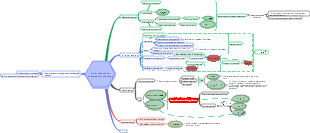
MindMap Gallery law of conservation of mechanical energy
The law of conservation of mechanical energy refers to the mutual conversion of kinetic energy and potential energy (including gravitational potential energy and elastic potential energy) of the object system in an object system where only gravity or elastic force does work (or is not affected by other external forces), but the total energy of mechanical energy constant.
Edited at 2021-05-03 18:08:34This is a mind map about bacteria, and its main contents include: overview, morphology, types, structure, reproduction, distribution, application, and expansion. The summary is comprehensive and meticulous, suitable as review materials.

This is a mind map about plant asexual reproduction, and its main contents include: concept, spore reproduction, vegetative reproduction, tissue culture, and buds. The summary is comprehensive and meticulous, suitable as review materials.
This is a mind map about the reproductive development of animals, and its main contents include: insects, frogs, birds, sexual reproduction, and asexual reproduction. The summary is comprehensive and meticulous, suitable as review materials.
This is a mind map about bacteria, and its main contents include: overview, morphology, types, structure, reproduction, distribution, application, and expansion. The summary is comprehensive and meticulous, suitable as review materials.
This is a mind map about plant asexual reproduction, and its main contents include: concept, spore reproduction, vegetative reproduction, tissue culture, and buds. The summary is comprehensive and meticulous, suitable as review materials.
This is a mind map about the reproductive development of animals, and its main contents include: insects, frogs, birds, sexual reproduction, and asexual reproduction. The summary is comprehensive and meticulous, suitable as review materials.
law of conservation of mechanical energy
gravitational potential energy
Work done by gravity and its characteristics
WG=mgh
It only depends on the height difference between the beginning and the end of the position
Gravitational potential energy and its characteristics
definition
The energy an object has due to being lifted high
formula
Ep=mgh
unit
Joule(J) 1J=1kg.m².1/s²
Features
Systematic
relativity
arbitrariness
Reference plane selection
Absoluteness
absolute change
Relationship to work done by gravity
WG=Ep1-Ep2=-ΔEp
elastic potential energy
definition
The parts of an object undergoing elastic deformation also have potential energy due to elastic interactions.
Features
Systematic
relativity
Kinetic energy and kinetic energy theorem
Kinetic energy and its change
kinetic energy
expression
Ek=1/2mv²
unit
Joule(J) 1J=1kg.m².1/s²
nature
Status quantity
scalar
relativity
Kinetic energy change
△Ek=1/2mv2²-1/2mv1²
△Ek>0
Increased kinetic energy
△Ek<0
Kinetic energy decreases
Kinetic energy theorem
Content expression
The total work done by an external force on an object is equal to the change in kinetic energy of the object
expression
W=Ek2-Ek1
W=1/2mv²2-1/2mv²1
law of conservation of mechanical energy
content
In a system of objects where only gravity or elastic force does work, kinetic energy and potential energy can be converted into each other, while the total mechanical energy remains unchanged.
condition
Only the gravity or elastic force in the system does work, and other forces do no work or the algebraic sum of the work done is zero.
Common expressions
conservation
Ek Ep=Ek' Ep'
Convert
△Ek=-△Ep
transfer
△E increases = △E decreases
Mutual conversion of kinetic energy and potential energy
Gravitational potential energy and kinetic energy
Elastic potential energy and kinetic energy
Mechanical energy
Gravitational potential energy, elastic potential General term for energy and kinetic energy
E=EkEp
work and power
achievement
definition
An object is acted upon by a force and undergoes a displacement in the direction of the force
necessary factors
force
Displacement occurs in the direction of the force
size
formula
W=Flcosa
unit
Joule(J) 1J=1kg.m².1/s²
scalar
Positive and negative work
Zhenggong
0≤a<π/2
No work done
a=π/2
negative work
π/2<a≤π
Calculation of total work
Each component of force acts on the object respectively algebraic sum of work done by a body
The resultant pair of several forces work done by an object
Change force to do work
Micro-element method
average force method
image method
power
definition
The ratio of work done to the time it takes to complete the work
significance
Reflects the speed of work
formula
P=W/t
scalar
unit
Watt(W) 1W=1kg.m².1/s³
Average power and instantaneous power
average power
P=W/Δt
Instantaneous power
P=Fvcosa
Rated power and actual power
rated power
Maximum power under long-term operation
actual power
Actual working power
Power and speed
The relationship between W, F and v
F and v are in the same direction P=Fv
The angle between F and v is α P=Fvcosα
Average power and instantaneous power
Average power: the average power within time t
Instantaneous power: the instantaneous value of power at a certain moment
Locomotive starting problem
constant power start
Constant acceleration start