MindMap Gallery Inorganic Chemistry - Gases
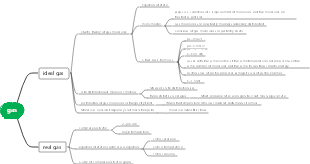
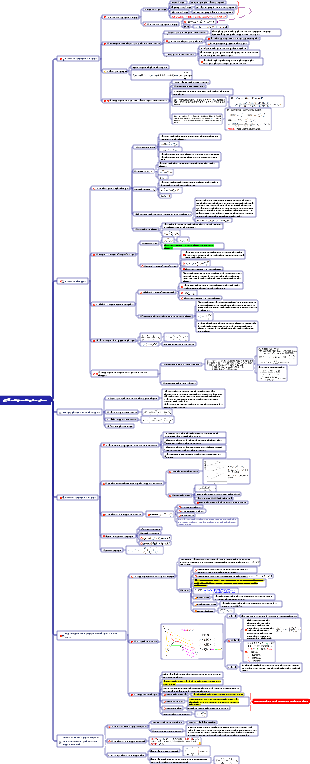
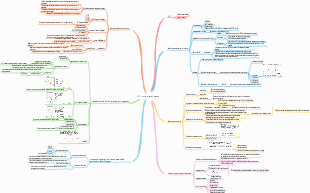
Gas mind map of inorganic chemistry, the main contents include: ideal gas equation of state, partial pressure law, partial volume law, and real gases.
Edited at 2022-01-03 20:50:56This is a mind map about bacteria, and its main contents include: overview, morphology, types, structure, reproduction, distribution, application, and expansion. The summary is comprehensive and meticulous, suitable as review materials.

This is a mind map about plant asexual reproduction, and its main contents include: concept, spore reproduction, vegetative reproduction, tissue culture, and buds. The summary is comprehensive and meticulous, suitable as review materials.
This is a mind map about the reproductive development of animals, and its main contents include: insects, frogs, birds, sexual reproduction, and asexual reproduction. The summary is comprehensive and meticulous, suitable as review materials.
This is a mind map about bacteria, and its main contents include: overview, morphology, types, structure, reproduction, distribution, application, and expansion. The summary is comprehensive and meticulous, suitable as review materials.
This is a mind map about plant asexual reproduction, and its main contents include: concept, spore reproduction, vegetative reproduction, tissue culture, and buds. The summary is comprehensive and meticulous, suitable as review materials.
This is a mind map about the reproductive development of animals, and its main contents include: insects, frogs, birds, sexual reproduction, and asexual reproduction. The summary is comprehensive and meticulous, suitable as review materials.
Inorganic Chemistry - Gases
ideal gas equation of state
The ideal gas equation of state can be expressed by pV=nRT, where: p is the pressure (Pa), V is the gas volume (m³), T is the temperature (K), n is the amount of gas (mol), and R is the mole of gas. Constant (also called universal gas constant) (J/(mol*K)).
If the gas is an ideal gas with a mass of M and a molar mass of J/(mol·K). This equation reflects the relationship between three state parameters of a certain mass of gas in the same state.
A gas that strictly obeys the experimental gas laws under any circumstances can be regarded as an ideal gas. At the same time, the experimental laws of gases are obtained under conditions where the pressure is not too high (compared to atmospheric pressure) and the temperature is not too low (compared to room temperature). Therefore, as long as under these conditions, general gases can be approximately regarded as ideal gases.
law of partial pressure
The pressure exerted by a certain component gas on the wall of the mixed gas is called the partial pressure of the component gas. For an ideal gas, the partial pressure of a certain component gas is equal to the pressure produced when the component gas alone occupies the same volume as the mixed gas at the same temperature.
When the temperature and volume are constant, the sum of the partial pressures of the gas components in the mixed gas is equal to the total pressure of the mixed gas. Mathematical expression: P total =P1 P2 ··· Pi Assume that a certain amount of mixed gas is filled into a container with a volume V. At temperature T, its total pressure is Ptotal. Obviously, the amount n of the total substance of the mixed gas is always the amount ni of the component gas position. According to the ideal gas law: P total V = n total RT PiV = niRT Expand P total V = n total RT P total=n total RT/V=(n1 n2 ··· ni)RT/V=n1RT/V n2RT/V ··· ni=P1 P2 ··· Pi
The partial pressure of a gas is equal to the total pressure multiplied by the gas mole fraction or volume fraction. P total = P1 P2 ··· Pi , divide P total on both sides of the right-hand equation. 1=P1/P total P2/P total ··· Pi/P total=x1 x2 ··· xi The ratio of the partial pressure Pi of each component gas to the total pressure P is called the pressure fraction. Obviously, the sum of the pressure fractions Pi/P is always equal to 1. Because n total=n1 n2 ···ni Similarly, 1=n1/n total n2/n total ··· ni/n total=x1 x2 ··· xi ni/n is collectively called the mole fraction. From the law of partial volumes: 1=V1/Vtotal V2/Vtotal ··· Vi/Vtotal It can be obtained that xi=Pi/Ptotal=ni/ntotal=Vi/Vtotal, that is, for the same state, the gas pressure fraction is equal to the mole fraction and the volume fraction. Transform the above formula: Pi=P total·Vi/V total=P total·ni/n total
law of partial volumes
The total volume of a mixed gas is equal to the sum of the volumes occupied by each component gas in the mixed gas when it exists alone under the same temperature and pressure conditions as the mixed gas. This is Armager's law of partial volumes.
The ratio of the partial volume of component B in the gas mixture to the total volume can be derived from the ideal gas equation of state VB/V=(nB RT/p)/(nRT/p)=nB/n=yB, that is, VB=yBV. In the formula, yB - the amount fraction of component B. This formula shows that the partial volume of any component in the mixed gas is equal to the product of the amount fraction of the component and the total volume.
real gas
The gas molecules themselves occupy a volume, and the actual gases where there are interactions between molecules are called real gases. Real gases do not obey the ideal gas law. Natural gas is a real gas.
Real gases at lower pressures and higher temperatures can be approximated by the ideal gas equation of state. In other cases, the ideal gas equation of state cannot be used directly and the ideal gas equation of state must be modified.
Van der Waals gas equation of state: (p a·n^2/V^2) (V-nb)=nRT. The pressure term is corrected to take into account the influence of molecules on the pressure, and also corrects the deviation of the free volume caused by the molecules themselves under high pressure. For an ideal gas, a and b are zero