MindMap Gallery base station antenna
The role and introduction of base station antennas, such as antenna gain is a very important parameter, which reflects the degree of concentration and enhancement of the transmitted signal in a certain direction.
Edited at 2023-07-28 15:50:23This is a mind map about bacteria, and its main contents include: overview, morphology, types, structure, reproduction, distribution, application, and expansion. The summary is comprehensive and meticulous, suitable as review materials.
This is a mind map about plant asexual reproduction, and its main contents include: concept, spore reproduction, vegetative reproduction, tissue culture, and buds. The summary is comprehensive and meticulous, suitable as review materials.
This is a mind map about the reproductive development of animals, and its main contents include: insects, frogs, birds, sexual reproduction, and asexual reproduction. The summary is comprehensive and meticulous, suitable as review materials.
This is a mind map about bacteria, and its main contents include: overview, morphology, types, structure, reproduction, distribution, application, and expansion. The summary is comprehensive and meticulous, suitable as review materials.
This is a mind map about plant asexual reproduction, and its main contents include: concept, spore reproduction, vegetative reproduction, tissue culture, and buds. The summary is comprehensive and meticulous, suitable as review materials.
This is a mind map about the reproductive development of animals, and its main contents include: insects, frogs, birds, sexual reproduction, and asexual reproduction. The summary is comprehensive and meticulous, suitable as review materials.
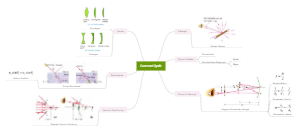
base station antenna
Function: Acts as an "amplifier" of the signal
One is to convert the electrical signal at the input end into electromagnetic waves and launch them into space.
The second is to collect and receive electromagnetic waves from space and convert them into electrical signals for output.
Antennas are mostly passive, 5G
How does the antenna emit electromagnetic waves?
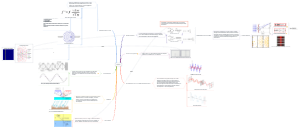
The oscillator of the base station antenna is two straight wires. When alternating current passes through the wires, electromagnetic induction will occur. First, the wires generate a horizontal electric field, and a magnetic field is induced around the electric field. The magnetic field in turn induces an electric field. By analogy, electromagnetic waves Just keep spreading it.
During the propagation of electromagnetic waves, the electric field and the magnetic field are perpendicular to each other. The regular change in the vibration direction of the electric field is the polarization of the electromagnetic wave. Polarization refers to how the electric field vibrates. Vibrations perpendicular to the ground are called vertical polarization. Vibrations parallel to the ground are called horizontal polarization.
The radiation ability of electromagnetic waves is related to the size and shape of the oscillator. When L=in/2, the radio induced on the conductor reaches the resonance state, so the signal strength of the electromagnetic wave is the highest. The size of the conductor is equal to half the wavelength, which is called a half-wave oscillator. In = v/f, the length of the oscillator L = v/2f. Conclusion: The length of the oscillator is inversely proportional to the frequency of electromagnetic waves. For antennas with the same specifications, the higher the frequency band, the smaller the size.
Influence of the shape of the oscillator: As the opening angle of the oscillator becomes larger, the electromagnetic wave radiation ability gradually becomes larger. When the two oscillators are in a line, the radiation ability is the strongest. The electromagnetic waves emitted by the omnidirectional antenna are like a round cake, emitted 360 degrees in the horizontal direction, and emitted all around when looking down.
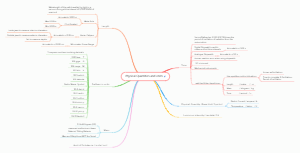
Antenna gain
Is a very important parameter, which reflects the degree of concentration and enhancement of the transmitted signal in a certain direction.
Two units: dBi and dBd, differences caused by different oscillators, point oscillators and symmetrical oscillators. 9dBd 2.15=11.15dBi
How to implement: Assume that the signal line delivers 30dBm of energy to the antenna, and the antenna gain is 5dBm, then the signal energy that the antenna can emit becomes 35dBm, which is an increase of 5dBm compared to the input signal energy.