MindMap Gallery surgery anesthesia
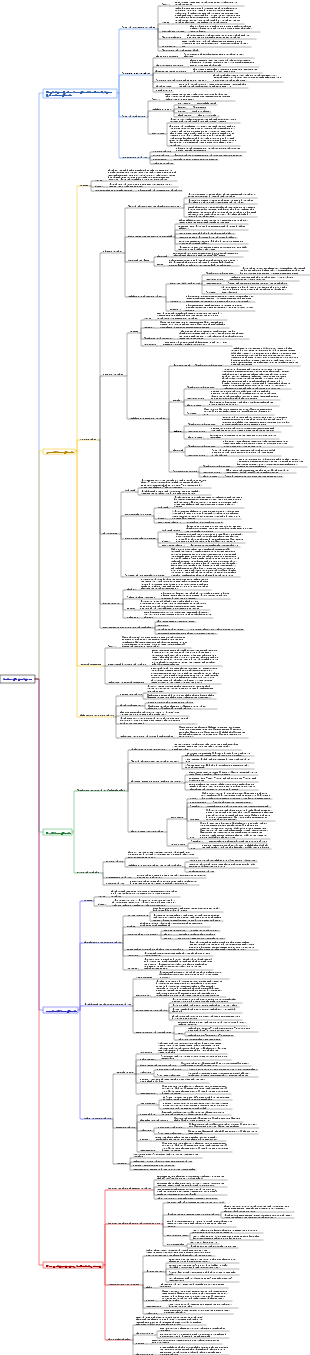
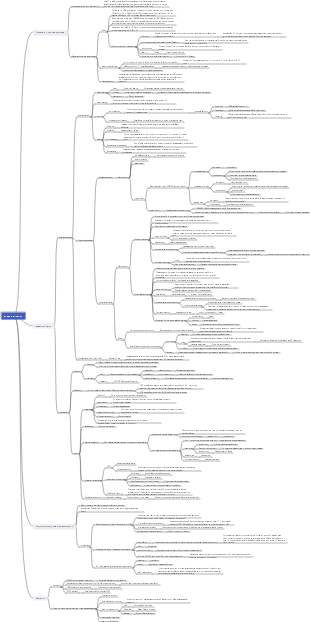
The word anesthesia comes from the Greek word, and its original meaning is loss of sensation, which refers to the use of drugs or other methods to make the patient temporarily lose all or part of the sensation, thereby eliminating the pain during surgery. The main contents include: pre-anesthesia preparation and pre-anesthesia medication, general anesthesia, local anesthesia, and spinal anesthesia.
Edited at 2022-04-30 13:35:21This is a mind map about bacteria, and its main contents include: overview, morphology, types, structure, reproduction, distribution, application, and expansion. The summary is comprehensive and meticulous, suitable as review materials.
This is a mind map about plant asexual reproduction, and its main contents include: concept, spore reproduction, vegetative reproduction, tissue culture, and buds. The summary is comprehensive and meticulous, suitable as review materials.
This is a mind map about the reproductive development of animals, and its main contents include: insects, frogs, birds, sexual reproduction, and asexual reproduction. The summary is comprehensive and meticulous, suitable as review materials.
This is a mind map about bacteria, and its main contents include: overview, morphology, types, structure, reproduction, distribution, application, and expansion. The summary is comprehensive and meticulous, suitable as review materials.
This is a mind map about plant asexual reproduction, and its main contents include: concept, spore reproduction, vegetative reproduction, tissue culture, and buds. The summary is comprehensive and meticulous, suitable as review materials.
This is a mind map about the reproductive development of animals, and its main contents include: insects, frogs, birds, sexual reproduction, and asexual reproduction. The summary is comprehensive and meticulous, suitable as review materials.
anaesthetization
Preparation before anesthesia and medication before anesthesia
patient preparation
condition assessment
Preparing the patient's body
Pre-anesthetic medication
Purpose of pre-anesthetic medication
①Sedation and hypnosis: eliminate the patient's tension, anxiety and fear; enhance the effect of general anesthetics and reduce the side effects of general anesthetics; can produce amnesia for adverse stimuli. ②Analgesia: Raise the patient's pain threshold, alleviate (or) relieve the pain caused by the original disease or invasive procedures before anesthesia. ③ Inhibit gland secretion: Inhibit the secretion function of respiratory glands and reduce saliva secretion to prevent aspiration. ④ Suppress adverse reflexes: Eliminate adverse reflexes caused by surgery or anesthesia, especially vagal reflexes, and inhibit sympathetic nerve excitement to maintain hemodynamic stability.
Commonly used drugs before anesthesia
general anesthesia
definition
¤Refers to the method in which anesthetics enter the human body through respiratory inhalation or intravenous or intramuscular injection, causing depression of the central nervous system. ¤Clinical manifestations include loss of consciousness, general loss of pain sensation, amnesia, reflex inhibition and a certain degree of muscle relaxation.
general anesthesia
inhalation anesthesia
definition
Refers to drugs that enter the human body through respiratory inhalation and produce general anesthesia. Can be used for the induction and maintenance of general anesthesia.
Commonly used drugs
intravenous anesthesia
definition
Refers to drugs that are injected into the body through intravenous injection and act on the central nervous system through blood circulation to produce general anesthesia. Its advantages include rapid induction, no irritation to the respiratory tract, and no environmental pollution.
Commonly used drugs
Muscle relaxants (muscle relaxants)
Features of muscle relaxants
① It can block the nerve-muscle transmission function and cause skeletal muscle relaxation. ② It can only paralyze skeletal muscles, but has no obvious effect on myocardium and smooth muscle. It has no effect on the function of the central nervous system and usually has no obvious interference on the physiological functions of the body. ③ It does not produce anesthesia and cannot make the patient's consciousness and feeling (pain) disappear. ④ Does not produce amnesia.
Application Notes
①An artificial airway (such as endotracheal intubation) should be established and assisted or controlled breathing should be implemented. ② Muscle relaxants have no sedative or source-locking effects. It cannot be used alone and should be used under the influence of all others. ③The application of succinylcholine can cause a temporary increase in serum potassium, intraocular pressure and intracranial pressure. Therefore, it is contraindicated in patients with severe trauma, burns, paraplegia, glaucoma, and elevated intracranial pressure. ④ Hypothermia can prolong the action time of muscle relaxants; inhaled anesthetics, certain antibiotics (such as streptomycin, gentamicin, polymyxin) and magnesium sulfate can enhance the effect of non-depolarizing muscle relaxants. effect. ⑤ Patients with neuromuscular junction diseases, such as myasthenia gravis, are contraindicated in using non-depolarizing muscle relaxants. ⑥Some muscle relaxants have a histamine-releasing effect, and should be used with caution by those with a history of asthma or allergies.
Pharmacological mechanism
It mainly acts on the motor end plates of skeletal muscles, interfering with the normal transmission of impulses between neuromuscles, causing skeletal muscles to temporarily lose contractility and relax.
endotracheal intubation
Purpose
① During anesthesia, keep the patient's respiratory tract open to prevent foreign matter from entering the respiratory tract and facilitate timely suction of tracheal secretions or blood. ② Carry out effective artificial or mechanical ventilation to prevent patients from hypoxia and CO accumulation. ③Facilitates the application of inhaled general anesthetics.
Indications
① During general anesthesia, it is difficult to ensure the patient's airway is unobstructed (such as intracranial surgery, thoracotomy surgery, prone position surgery, etc.). ②Those who have difficulty keeping the respiratory tract open due to disease (such as tumors compressing the trachea). ③ General anesthesia significantly inhibits breathing or muscle relaxants are used. ④ Endotracheal intubation must be performed in cases of respiratory failure requiring mechanical ventilation (such as rescuing critically ill patients), cardiopulmonary resuscitation, drug poisoning, and severe neonatal asphyxia.
complication
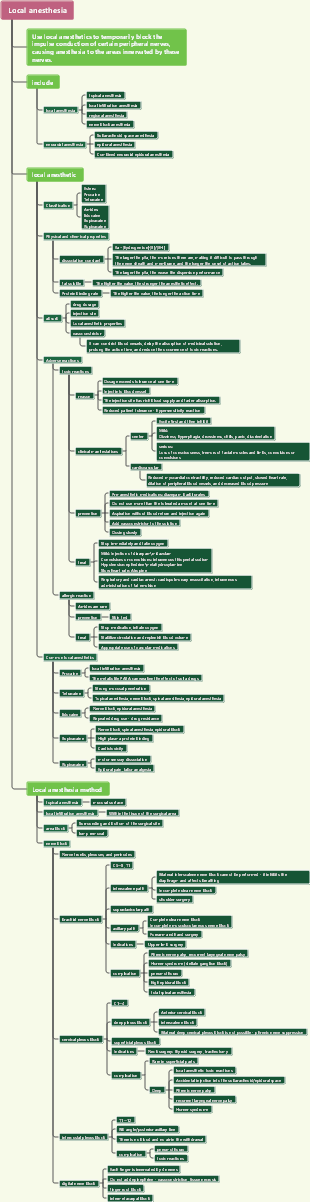
Local anesthesia
Commonly used local anesthetics
Commonly used anesthesia methods
Precautions for local infiltration anesthesia
¤The medicinal liquid injected into the human tissue must have a certain volume so that the medicinal liquid has extensive contact with nerve endings to enhance the anesthetic effect. ¤To avoid exceeding the one-time limit of medication, the concentration of the medicinal solution should be reduced. ¤The medicine must be withdrawn before each injection to avoid injecting into the blood vessels. ¤Substantial organs and brain tissue have no pain, so no injection of medicine is required. ¤The concentration of epinephrine in the medicinal solution can slow down the absorption of local anesthetics and prolong the action time.
nerve block
Injecting local anesthetic around nerve trunks, plexuses, and nodes to block impulse conduction and produce anesthesia in the area controlled is called nerve block.
brachial plexus block
¤The brachial plexus is mainly composed of the anterior branches of the C5-8 and T1 spinal nerves and controls the sensation and movement of the upper limbs. ¤Brachial plexus block can be performed at three locations: interscalene, supraclavicular, and axilla, which are called interscalene, supraclavicular, and axillary pathways respectively.
Digital (or toe) nerve block
¤Digital nerve blocks can be performed at the base of the fingers or at the metacarpal bones. For digital nerve block, please refer to the digital nerve block method. ¤When using local anesthetics on fingers, toes, penis, etc., it is contraindicated to add epinephrine, and the amount of injection should not be too much to avoid vasoconstriction or compression, which may cause tissue ischemia and necrosis.
neuraxial anesthesia
Applied anatomy within the spinal canal
¤The spinal canal contains the spinal cord and three layers of spinal cord capsule. ¤The spinal cord is composed of pia mater, arachnoid mater and dura mater from the inside to the outside. The space between the pia mater and the arachnoid membrane is called the subarachnoid space. Its upper end communicates with the brain's subarachnoid space, and its lower end ends at the S2 level and contains cerebrospinal fluid. ¤The space between the dura mater and the inner wall of the spinal canal is the epidural space, which contains fat, loose connective tissue, blood vessels and lymphatic vessels. There is a potential space between the dura mater and the arachnoid mater, called the subdural space.
Classification of neuraxial anesthesia
Depending on the cavity into which the local anesthetic is injected
Subarachnoid space block (referred to as spinal anesthesia)
epidural space block
Combined spinal anesthesia-epidural space block
Spinal nerves and block sequence
¤Spinal nerves and block sequence There are 31 pairs of spinal nerves, including 8 pairs of cervical nerves (C), 12 pairs of thoracic nerves (T), 5 pairs of lumbar nerves (L), 5 pairs of sacral nerves (S) and 1 pair of coccygeal nerves (Co ). ¤Local anesthetics block both the anterior and posterior roots of spinal nerves. However, due to the different thicknesses of various nerve fibers and their different functions of conducting nerve impulses, the effect, speed and effectiveness of local anesthetics of the same concentration in blocking different nerve fibers are also different. Are not the same. ¤The order in which different nerve fibers are blocked is: sympathetic nerve (first to be blocked) → cold sense → warm sense (disappeared) → temperature recognition sense → dull pain sense → sharp pain sense → touch → motor nerve (muscle relaxation) → Pressure sensation (diminished) → proprioception (finally blocked), the order of block resolution is opposite to that of block.
complication
intraoperative complications
blood pressure drops
Vasodilation occurs in the area of nerve block and is related to the level of anesthesia.
heart rate slows down
Plane>T4 cardiac accelerating nerve is blocked and vagus nerve is hyperactive
Respiratory depression
Intercostal muscle paralysis; excessive elevation of the plane inhibits the respiratory center.
feel sick and vomit
¤ Hypotension and respiratory depression cause cerebral ischemia and hypoxia, which stimulates the vomiting center. ¤ Vagus nerve hyperactivity, gastrointestinal peristalsis enhancement; abdominal viscera traction. ¤Sensitive to auxiliary drugs used in intraoperative anesthesia, such as the emetic effect of pethidine.
Postoperative complications
Headache after spinal anesthesia
Related to puncture needle and puncture technique; outflow of cerebrospinal fluid causes low intracranial pressure.
urinary retention
The parasympathetic nerves that control the bladder are easily blocked and recovery is slow; pain.
purulent meningitis
Anesthesia surgery for patients with skin infection and sepsis.
cranial nerve palsy
Cerebrospinal fluid leakage; the abducens nerve is most vulnerable to damage, causing strabismus and diplopia.
adhesive arachnoiditis
Chronic proliferative inflammatory reaction of pial membrane and arachnoid membrane; sensory impairment and paralysis.
cauda equina syndrome
Sensorimotor disturbances in the perineal area and distal lower limbs; urinary retention; urinary incontinence.
Headache after spinal anesthesia
What happens
The incidence rate is 3% to 30%. It is common 2 to 7 days after anesthesia and is more common in young women. About half of patients' symptoms disappear within 4 days, usually no more than a week.
Clinical features
The headache worsens when raising the head or sitting up, and decreases or disappears after lying down (cerebrospinal fluid leakage increases and decreases when standing and lying down respectively).
The mechanism
The blood supply of the dura mater and arachnoid mater is poor, and the puncture hole is not easy to heal. Most headaches after spinal anesthesia are related to the loss of cerebrospinal fluid leakage, which leads to a decrease in intracranial pressure (low-pressure headache).
Influencing factors
The occurrence of headaches is related to the thickness of the puncture needle or repeated punctures. Fine puncture needles can significantly reduce cerebrospinal fluid leakage and reduce the incidence of headaches.
Precaution
A conical non-cutting fine puncture needle (26G) should be used. The bevel of the puncture needle should be parallel to the long axis of the spinal cord (note: not perpendicular) to avoid repeated punctures. Adequate fluid administration during the perioperative period to prevent dehydration.
Treatment measures
¤You should lie down and rest. You can take analgesics or tranquilizers, acupuncture, or tie the abdomen with an abdominal belt. ¤For severe headaches, normal saline (or glucose solution or dextran) can be injected into the epidural space, which has better effects. Epidural autologous blood filling therapy can be used when necessary.
Complications of epidural anesthesia
The mechanism
A phenomenon in which most or all of the local anesthetic used for epidural anesthesia is accidentally injected into the subarachnoid space, causing all spinal nerves to be blocked.
clinical manifestations
The patient may develop difficulty breathing, drop in blood pressure, become confused or disappear within a few minutes after injection, and then stop breathing.
Treatment measures
¤Immediately provide oxygen with mask pressure and perform emergency endotracheal intubation for artificial respiration, accelerate infusion, and use vasopressors to maintain circulation stability (i.e., artificial respiration and circulation support). ¤If handled promptly and correctly, serious consequences can be avoided, otherwise it may lead to cardiac arrest.
sacral block
definition
Injecting local anesthetic into the lumen of the lick canal through the sacral hiatus to block the spinal nerve is called sacral canal block, which is a type of epidural block.
Indications
Suitable for rectal, anal and perineal surgeries.
Commonly used drugs
Commonly used local anesthetics include 1.5% lidocaine or 0.5% bupivacaine.
complication
¤There is a rich venous plexus in the sacral canal. If the blood vessels are damaged during puncture, the absorption of local anesthetic will be accelerated and toxic reactions may occur. ¤If the puncture needle is inserted too deep into the dural sac, the medicinal solution can be directly injected into the subarachnoid space to cause total spinal anesthesia. Postoperative urinary retention is more common.