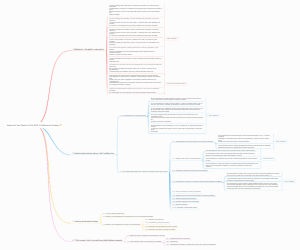
MindMap Gallery Polymer Chemistry and Physics Chapter 9 Mechanical Properties of Polymer Solids Mind Map
A mind map on the mechanical properties of polymer solids in Chapter 9 of Polymer Chemistry and Physics, including the mechanical properties of glassy and crystalline polymers, the yield of polymers, etc.
Edited at 2023-12-02 15:47:09This is a mind map about bacteria, and its main contents include: overview, morphology, types, structure, reproduction, distribution, application, and expansion. The summary is comprehensive and meticulous, suitable as review materials.
This is a mind map about plant asexual reproduction, and its main contents include: concept, spore reproduction, vegetative reproduction, tissue culture, and buds. The summary is comprehensive and meticulous, suitable as review materials.
This is a mind map about the reproductive development of animals, and its main contents include: insects, frogs, birds, sexual reproduction, and asexual reproduction. The summary is comprehensive and meticulous, suitable as review materials.
This is a mind map about bacteria, and its main contents include: overview, morphology, types, structure, reproduction, distribution, application, and expansion. The summary is comprehensive and meticulous, suitable as review materials.
This is a mind map about plant asexual reproduction, and its main contents include: concept, spore reproduction, vegetative reproduction, tissue culture, and buds. The summary is comprehensive and meticulous, suitable as review materials.
This is a mind map about the reproductive development of animals, and its main contents include: insects, frogs, birds, sexual reproduction, and asexual reproduction. The summary is comprehensive and meticulous, suitable as review materials.
Mechanical properties of polymer solids
Mechanical properties of glassy and crystalline polymers
Basic physical quantities that characterize the mechanical properties of materials
Force mode
simple stretching
The external force is perpendicular to the cross section
simple cut
The external force F is parallel to the interface, equal in magnitude and opposite in direction.
hydrostatic compression
The material receives confining pressure
simple stretching
Tensile stress σ
Ratio of force to initial cross-sectional area
Tensile strain ε
Ratio of length change to initial length
Young's modulus E
The ratio of stress to strain reflects the material's ability to resist deformation. The greater the modulus, the greater the material's stiffness.
Poisson's ratio ν
Ratio of transverse contraction to axial elongation
simple cut
shear strain
Ratio of shear force to shear area
shear modulus
Ratio of shear force to shear strain
hydrostatic compression
Compressive strain
Compression modulus
Stress-strain curve of polymer materials
Stress-deformation curve of amorphous polymers
0-A is elastic deformation, obeying Hooke's law of elasticity, A-B is forced high elastic deformation, passing through the yield point Y in the middle, and the motion unit is a chain segment
Stress-deformation curve of crystalline polymers
0-A is elastic deformation, obeying Hooke's law, the motion unit is bond length and bond angle, and εA is the elastic elongation limit. A-B is forced high elastic deformation, and the motion unit is a chain segment. After reaching the yield point Y, a thin neck is formed, and the interface becomes uneven. After Y, it enters the thin neck development stage, and the elongation continues to increase while the stress remains almost unchanged or changes little. The cross-sectional areas of the thin neck and non-thin neck parts remain unchanged respectively, while the thin neck part continues to expand and the non-thin neck part continues to shorten until the entire sample becomes completely thin. Finally, the necked polymer sample is stretched evenly, and the stress increases with the stretching until the sample breaks.
Different temperatures affect the stress-deformation curve of polymers
Yielding of Polymers
Characteristics of Yield Point
thin neck phenomenon
The basis for judging the yield point
The first derivative of true stress with respect to elongation ratio is equal to its ratio
On the image: The point passing through the origin and tangent to the true stress-stretch ratio curve is the yield point.
No yield point - cannot form thin necks
1 yield point - capable of necking, but unstable
Multiple yield points - can form stable thin necks
Silver streak yields
During the use and storage of polymer materials, micro-cracks are produced on the surface of the material due to tensile stress or environmental effects.
Cavitation stripe deformation zone, silver streak is the precursor of fracture
The difference between craze and cracks
The volume fraction of polymer in the silver striae is 40-60%, and in the cracks it is 0
Silver streaks are reversible. When annealed under pressure or above Tg, silver streaks can shrink and disappear, but cracks cannot.
shear yield
When the tough polymer is stretched, a shear slip deformation band that is inclined at an angle of approximately 45 degrees to the stretching direction will appear during the recovery process. Due to the large shear strain present in the shear zone. When shear bands occur, the material yields
The difference between craze yield and shear yield
Shear yielding without significant volume change
Shear yielding can be caused under applied shear stress, tensile stress, and compressive stress, while craze yielding only occurs under tensile stress.
Fracture and strength of polymers
Brittle fracture and ductile fracture
Inner willfulness - absorbs large amounts of energy before breaking
Brittleness: The stress-deformation curve is linear, the fracture energy is small, and the fracture surface is smooth.
Toughness: The stress-deformation curve is nonlinear, the fracture energy is large, and the fracture surface is rough.
Brittleness and toughness depend on experimental conditions, temperature and test rate
At a constant strain rate, the low-temperature brittle form transforms into a high-temperature ductile form.
At constant temperature, when the strain rate increases, the brittle form appears; when the strain rate decreases, the ductile form appears.
Theoretical strength and actual strength of polymers
fracture theory
crack theory
Fracture requires the formation of a new surface, which requires a certain surface energy. The surface energy required for fracture to produce a new surface is obtained by reducing the elastic energy storage within the material.
The distribution of elastic energy storage in the material is uneven. There is more elastic energy storage at the cracks to supply the surface energy required to create a new surface, causing the material to break first at the cracks.
molecular theory of fragmentation
Fracture is a relaxation process. Macroscopic fracture is a thermal activation process of breaking microscopic chemical bonds.
When random thermal fluctuations in the thermal motion of atoms exceed the comfort energy barrier, chemical bonds dissociate and break.
Factors affecting the tensile strength of polymers
polymer structure
polymer chain structure
The upper limit of the strength of polymer materials is determined by the chemical construction of the main chain and the interaction between molecular chains. Increasing polarity or forming hydrogen bonds can improve the strength.
When the main chain or side chain contains aromatic heterocycles, the strength and modulus are higher.
The degree of branching increases, the distance between molecules increases, the force decreases, and the strength decreases.
Cross-linking can reduce deformation and increase strength. Excessive cross-linking will make the material hard and brittle, and the material strength will decrease.
molecular weight
Crystallization and Orientation
The crystallinity is increased, and the tensile strength, flexural strength and elastic modulus are increased.
After orientation, the strength of the material can be increased several times or dozens of times. Orientation is an indispensable measure to improve the strength of synthetic fibers. After orientation, when fractures occur along the orientation direction, the proportion of broken primary valence bonds increases.
stress concentrator
Stress concentrators are cracks, voids, chips, crazes and impurities in materials. When stressed, the stress in the vicinity of these defects increases sharply, reaching tens to hundreds of times the average stress value, leading to material damage.
cause
Uneven mixing, insufficient plasticization, air inclusions
Mixed with impurities
Different cooling rates produce internal stress
Plasticizer
external conditions
Stretch speed
Tensile strength and yield strength increase with the increase of tensile speed.
As a viscoelastic material, the destruction process of polymer is a relaxation process. When the stretching speed increases, the chain segment movement cannot keep up with the external force, and more force is needed to make the material yield.
temperature
Reduce temperature and increase intensity
Boltzmann superposition principle
time-temperature equivalence principle
In order for the polymer chain segment to generate sufficient mobility to exhibit high elastic deformation, a certain relaxation time is required. If the entire polymer chain can move and exhibit viscous flow, a certain relaxation time is also required.
When the temperature increases, the motion of the chain segments accelerates, so the same mechanical behavior can be seen at a higher temperature and in a shorter time, and the same mechanical behavior can also be seen at a lower temperature and in a shorter time. In most cases, increasing the temperature is equivalent to the singing observation time. For the case of alternating forces, lower the doe wait and extend the observation time
With the help of conversion silver, the mechanical data measured at a certain temperature can be converted into mechanical data at another temperature. This is the principle of time-temperature equivalence.
viscoelastic model
Maxwell model
Made of a spring and a sticky pot connected in series
The stress is the same and the strain is the sum of the two elements
Maxwell model equation of motion
Kelvin model
Spring and sticky pot are connected in parallel
The strains are the same and the stress is the sum of the two elements
The Maxwell model cannot reflect relaxation behavior under constant stress conditions
Kelvin model cannot reflect stress relaxation under constant strain conditions
four-component model
Maxwell and Kelvin in tandem
Mechanical properties of polymer elastomers
High elasticity characteristics
Thermodynamic analysis of high elasticity in equilibrium state
High elastic deformation can be divided into two types: equilibrium deformation and non-equilibrium deformation.
Can be analyzed using the first and second laws of thermodynamics
Rubber service temperature
When stretching, entropy decreases, ds is negative, and heat is released during the stretching process.
When an ideal elastomer is stretched, it only causes an entropy change, or in other words, only the change in entropy contributes to the elasticity of the ideal elastomer. This elasticity is also called entropic elasticity.
stress relaxation
For a linear viscoelastic body, when the strain remains constant, the stress gradually decays with time. This phenomenon is called stress relaxation.
Stress relaxation and creep are all aspects of a problem, reflecting three types of motion of molecules within polymers.
T>>Tg chain segments are easy to move, and the internal friction received is very small. The molecules quickly adjust in the direction of the external force, and the internal stress disappears quickly.
T<<Tg Although the chain segment receives a lot of stress, due to the large internal friction and the small movement ability of the chain segment, the stress relaxes very slowly and is still not easy to detect.
T is close to Tg and stress relaxation can be clearly detected.
hysteresis
The phenomenon that the deformation of polymer lags behind the stress change under the action of alternating force.
When the chain segment is moving, it is subject to the effect of internal friction. When the external force changes, the movement of the chain segment cannot keep up with the change of the external force. The deformation lags behind the stress. There is a phase difference. The larger it is, the more difficult it is for the chain segment to move. The harder it is to keep up with changes in external forces,
The hysteresis phenomenon of polymers is related to their own chemical structures. Generally, the hysteresis phenomenon of rigid molecules is small, the hysteresis phenomenon of flexible molecules is serious, and the hysteresis phenomenon of flexible molecules is serious.
The hysteresis phenomenon is also affected by external conditions.
Frequency of external force: low frequency and small hysteresis
Temperature: high temperature, fast chain segment movement, small hysteresis
Viscoelasticity
Mechanical relaxation phenomenon of polymers
Creep, stress relaxation, hysteresis, mechanical loss
Creep
Under the action of a certain temperature and constant external force, the deformation of the material gradually increases with time.
Ordinary elastic deformation
The bond length and bond angle will change immediately after receiving the external force, and the deformation amount is very small. After the external force is removed, the elastic deformation will be completely restored immediately, regardless of time.
High elastic deformation
In the process of molecular chain gradually stretching through chain segment motion, the deformation amount is much larger than that of ordinary elastic deformation. The deformation has an exponential relationship with time. The high elastic deformation gradually recovers after the external force is removed.
viscous flow
Linear polymers without cross-linking between molecules will produce relative slip between molecules, which has a linear relationship with practice. After the external force is removed, the viscous deformation cannot be restored, and it is an irreversible deformation.
When the polymer is acted upon by an external force, three deformations occur together. The relative proportions of the three deformations vary according to different specific conditions.
T<Tg Normal elastic deformation dominates
T>Tg common elastic deformation and high elastic deformation
T>>Tg All three are significant
Different types of polymers have different creep behaviors
Linear amorphous polymer
Cross-linked polymer creep
Creep of crystalline polymers
Mechanical loss