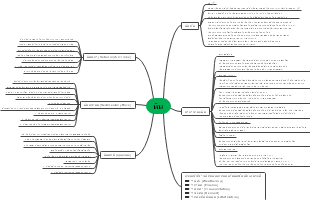
MindMap Gallery Geology-Mind map of external geological effects
This is a mind map about geology - external geological effects, including rivers, lakes, swamps, groundwater, etc. Friends in need hurry up and collect it!
Edited at 2023-11-23 23:06:29This is a mind map about bacteria, and its main contents include: overview, morphology, types, structure, reproduction, distribution, application, and expansion. The summary is comprehensive and meticulous, suitable as review materials.

This is a mind map about plant asexual reproduction, and its main contents include: concept, spore reproduction, vegetative reproduction, tissue culture, and buds. The summary is comprehensive and meticulous, suitable as review materials.
This is a mind map about the reproductive development of animals, and its main contents include: insects, frogs, birds, sexual reproduction, and asexual reproduction. The summary is comprehensive and meticulous, suitable as review materials.
This is a mind map about bacteria, and its main contents include: overview, morphology, types, structure, reproduction, distribution, application, and expansion. The summary is comprehensive and meticulous, suitable as review materials.
This is a mind map about plant asexual reproduction, and its main contents include: concept, spore reproduction, vegetative reproduction, tissue culture, and buds. The summary is comprehensive and meticulous, suitable as review materials.
This is a mind map about the reproductive development of animals, and its main contents include: insects, frogs, birds, sexual reproduction, and asexual reproduction. The summary is comprehensive and meticulous, suitable as review materials.
External geological action
river
Erosion: The process by which a river eats away at the rocks and sediments it flows through
downward eclipse
side eclipse
traceable erosion
The essence of these three are water erosion, but the way to distinguish them is to look at their trends, which is the so-called different erosion directions.
Transport function: the transport function of rivers on materials
Bottom transport (large particles): refers to the transportation of coarser materials such as sand and gravel in the river bed along the bottom of the river bed by rolling, sliding, dragging, and jumping.
Suspended transportation (small particles): refers to fine particles such as clay dust, which are transported in a suspended state due to the turbulence of flowing water.
Solution transportation: refers to the dissolution of soluble rocks and minerals in rivers and transportation in an ionic state.
All three belong to the transport function, but they show different ways due to the different sizes of transported materials.
Sedimentation: Suspended materials sediment when the flow velocity decreases, the flow decreases, and the river bottom is flat.
These three are the external forces acting on the river, and they each perform their own duties.
lake
Movement in lakes is smaller than movement in seawater and rivers
Denudation: Mainly caused by wave motion, mainly occurs in the lakeshore zone
Mechanical erosion (mainly)
abrasion
Chemical erosion
Transport function: Debris is transported toward the center of the lake by lake currents, shore currents, receding currents and other forces, and is deposited in appropriate locations.
Sedimentation
Mechanical sedimentation: Coarse gravel forms accumulation terrain along the coast, and finer silt clay is transported to the center of the lake to form accumulation.
chemical deposition
Classified by climate
1 humid climate zone
2Arid climate zones
Carbonate deposition stage (bottom of outer zone)
Sulfate deposition stage (middle of the middle zone)
Chloride deposition stage (upper inner band)
The drying up of salt lakes and the burial of salt layers
The above all belong to his sedimentation process, but different sedimentation processes are formed due to different climate and closing conditions.
swamp
Sedimentation (because swamps only have relatively static small-scale water bodies, the essence of their geological processes is sedimentation, and it is mainly biological sedimentation.
groundwater
Denudation (underlying erosion)
wash away
Dissolution
Karst (affected by climate, geological structure, tectonic movement, lithology, water)
Transportation function: Except for cave water, which has strong mechanical transportation ability, other groundwater is mainly transported in two ways: true solution and colloidal solution, and the transportation ability is weak.
Sedimentation
According to deposition method
mechanical deposition
Chemical Deposition (Major)
According to the location of chemical deposition
Pore deposition (formation of colloidal masses)
fissure deposits
cave deposits
hot spring deposits
ocean
Waves, tides, turbidity currents, and ocean currents have become the basic pathways for seawater geological movement
Sedimentation
Coastal sediments (are coastal waters with strong wave and tidal movements)
shallow sea sediments
Semi-deep sea sediments
Deep sea sedimentation (calm water, low sediment supply and slow speed)
Ooze (Bio Ooze. Red Clay)
Turbidity current deposits and contour current deposits
Metal mud and manganese nodules (only found in deep sea)
glacier
Denudation
excavation
Abrasion
Transport function (poor sorting)
Sedimentation (mainly accumulated by melting glaciers)
wind
Denudation
Blow (blow)
abrasion
Both are closely related to particle size and wind speed.
transport function
Suspension handling
Jump transfer
creeping transport
The transport effect is mainly related to particle size and wind speed.
Sedimentation (reduced wind force, accumulation when encountering obstacles, deposition caused by moist and cold airflow and the intersection of two airflows)
The same point: they all have sedimentation, and the sedimentation conditions are mostly calm places. They each perform their duties
Differences: Each geological action has different intensity, action objects, action locations, and different action times.