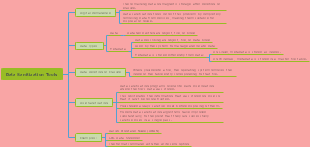
MindMap Gallery Biochemistry-Carbohydrate Mind Map
This is a mind map about biochemistry - carbohydrates, with a detailed introduction and comprehensive description. I hope it can help interested friends learn.
Edited at 2023-11-20 12:59:46This is a mind map about bacteria, and its main contents include: overview, morphology, types, structure, reproduction, distribution, application, and expansion. The summary is comprehensive and meticulous, suitable as review materials.
This is a mind map about plant asexual reproduction, and its main contents include: concept, spore reproduction, vegetative reproduction, tissue culture, and buds. The summary is comprehensive and meticulous, suitable as review materials.
This is a mind map about the reproductive development of animals, and its main contents include: insects, frogs, birds, sexual reproduction, and asexual reproduction. The summary is comprehensive and meticulous, suitable as review materials.
This is a mind map about bacteria, and its main contents include: overview, morphology, types, structure, reproduction, distribution, application, and expansion. The summary is comprehensive and meticulous, suitable as review materials.
This is a mind map about plant asexual reproduction, and its main contents include: concept, spore reproduction, vegetative reproduction, tissue culture, and buds. The summary is comprehensive and meticulous, suitable as review materials.
This is a mind map about the reproductive development of animals, and its main contents include: insects, frogs, birds, sexual reproduction, and asexual reproduction. The summary is comprehensive and meticulous, suitable as review materials.
carbohydrate
Overview
Polyhydroxy aldehydes/polyhydroxy ketones
aldose
three carbon sugar
Glyceraldehyde
four carbon sugar
Erythrose
five carbon sugar
Ribose, arabinose, xylose
six carbon sugar
Glucose, mannose, galactose
Ketose
three carbon sugar
Dihydroxyacetone
four carbon sugar
Erythrulose
five carbon sugar
Ribulose, xylulose
six carbon sugar
fructose
Function
Oxidation can produce ATP
store energy
Serves as a precursor for the synthesis of other biomolecules and as a structural component of cells
Participate in molecular recognition and signal transduction between cells
Monosaccharide
Divided into triose, tetose, pentose, several sugars, heptose
structure
Chirality-related special sugars
Dihydroxyacetone is achiral and has no optical activity
Ketobutose has only one chiral C atom (other chiral monosaccharides have at least 2 chiral C atoms)
D/L configuration judgment
The highest numbered chiral C (farthest from the carbonyl group) compared to glyceraldehyde
D type (right)
L type (left)
Most monosaccharides are of the D type
isomer
Enantiomers
mirror relationship
D-fructose and L-fructose
Diastereomers
A pair of optical isomers has one or more chiral Cs with opposite configurations, but they are not mirror images.
D-mannose and D-galactose
epimer
A pair of optical isomers differs only in the configuration of one chiral C
D-mannose and D-glucose, D-galactose and D-glucose
Number of isomers
(n is the number of chiral C)
Properties of monosaccharides
Optical activity
All except dihydroxyacetone are optically active
Reactivity of carbonyl and hydroxyl groups
ring
The nucleophilic attack of the alcoholic hydroxyl group on the carbonyl group forms hemiacetal or hemiketal
Glucose cyclizes into six-membered ring pyranose
Fructose, ribose and deoxyribose are cyclized into five-membered ring furanose
α,β isomers
Anomer C (conversion of the attacked aldehyde carbonyl or ketone carbonyl C)
alpha anomer
The hemiacetal or hemiketal hydroxyl group is below the ring and has the same orientation as the hydroxyl group on the original highest numbered chiral C
beta anomer
The hemiacetal or hemiketal hydroxyl group is above the ring and has a different orientation than the hydroxyl group on the original highest numbered chiral C
stability
The chair conformation is more stable than the boat conformation
β configuration is more stable than α configuration
mutraotation
Glossary
A phenomenon in which two anomers of a sugar compound undergo interconversion in an aqueous solution and reach equilibrium, resulting in a change in optical rotation. (Open a ring, form a chain and then form a ring again)
special case
If a ring structure cannot be formed, there will be no mutarotation phenomenon, such as glyceraldehyde
condition
Ring structure, the presence of hemiacetal or hemiketal hydroxyl groups enables ring opening
Heterogeneous
Under alkaline conditions, aldose interconverts to 2-ketose through an enediol intermediate.
The enediol intermediates of D-glucose, D-mannose, and D-fructose are the same (the configurations on C3, C4, and C5 are the same)
adult
condition
Reducing sugars with hemiacetal or hemiketal hydroxyl groups present
C1 and C2 of reducing sugar can react with phenylhydrazine to form glycosides (yellow crystals)
use
Identify reducing sugars
Glycoside
condition
Presence of hemiacetal or hemiketal hydroxyl group
Glossary
The hydroxyl group of hemiacetal or hemiketal reacts with other compounds with hydroxyl or amino groups, and dehydration produces acetal or ketal compounds, which are glycosides.
involving nouns
Glycosyl, ligand, glycosidic bond
Glycosidic bonds are divided into α-glycosidic bonds and β-glycosidic bonds (mainly). Glycosides are afraid of acid but not alkali.
Nucleosides in nucleic acid molecules are β-glycosides formed between bases and ribose or deoxyribose.
Features (glycosides without hemiacetal or hemiketal hydroxyl groups)
It has optical rotation, no mutarotation, cannot be oxidized by Fehling's reagent or Benedict's reagent, and cannot form reagents.
color reaction
Molisch reaction
Can distinguish sugars from non-sugars (identify sugars)
First α-naphthol/ethanol and then concentrated sulfuric acid. Purple-red ring at the junction of liquid levels
Seliwanoff reaction
Differentiate between ketose and aldose
Concentrated acid first and then resorcinol. Ketose is bright red, aldose is light red
Phloroglucinol reaction
Identify pentose sugars
Pentose and phloroglucinol/concentrated hydrochloric acid produce a vermilion substance, and other monosaccharides produce a yellow substance
Fehling's reagent or Benedict's reagent (weak oxidizing agent)
Identify reducing sugars, monosaccharides are all reducing sugars
Several important simple sugars
D-glyceraldehyde and dihydroxyacetone
intermediates of glycolysis
D-Glucose
Energy substance, especially important for nerve cells, composed of blood sugar
D-galactose (brain sugar)
Composition of glycoproteins in brain and nervous tissue
D-Fructose
The sweetest natural sugar
D-ribose and 2-deoxy-D-ribose
are the components of RNA and DNA respectively.
Oligosaccharides
2-10 monosaccharides are condensed and connected by glycosidic bonds
Reduction end and non-reduction end
Restore end
The hemiacetal hydroxyl group on anomer C exists in free form
non-reduction end
Anomer C participates in forming one end of the glycosidic bond
write
The non-reducing end is written on the left and the reducing end is written on the right.
disaccharide
Features
The linking C of one monosaccharide is always C1, and the position of the linking C of the other monosaccharide can vary. Derived from reducing sugars and non-reducing sugars
Classification
reducing sugar
Features
There are free hemiacetal hydroxyl groups, which are reducing and can react with Fehling's reagent or Benedict's reagent, and there is a mutarotation phenomenon.
Example
Lactose (galactose-β-1,4-glucose), maltose (glucose-α-1,4-glucose), isomaltose (glucose-α-1,6-glucose), cellobiose (glucose-β- 1,4-glucose),)
non-reducing sugar
Features
Two monosaccharide molecules are each produced by dehydration using a hemiacetal or hemiketal hydroxyl group. It has optical activity but no mutarotation phenomenon. It cannot be oxidized by Fehling's reagent or Benedict's reagent and cannot form reagents.
Example
Sucrose (glucose-α-1,2-fructose), α,α-trehalose
polysaccharide
Features
More than 10 monosaccharide molecules are condensed through glycosidic bonds
The type of glycosidic bond is related to mechanical strength and solubility properties
Polysaccharides linked by α-1,4-glucosidic bonds are relatively soft and have certain solubility in water, such as starch and glycogen.
Polysaccharides linked by β-1,4-glucosidic bonds are relatively hard and difficult to dissolve in water, such as cellulose and chitin.
Reducing side and non-reducing side
One end with the free hemiacetal hydroxyl group is the reducing end, and the other end is the non-reducing end.
No definite relative molecular mass
No mutarotation and reducibility
The proportion of the recovery end is too small
Classification
Classification according to composition
Homopolysaccharide
The same monosaccharide molecules
heteropolysaccharides
Composition of different monosaccharide units
Classified by function
energy storage polysaccharide
starch
Amylose
α-1,4-glucosidic bonds are connected and unbranched. The repeating monosaccharide unit is glucose and the repeating disaccharide unit is maltose.
Turns blue when exposed to iodine
Amylopectin
α-1,4-glycosidic bond and α-1,6-glycosidic bond (reason for branching). Branched, the repeating monosaccharide units are glucose and the repeating disaccharide units are maltose and isomaltose
Turns purple when exposed to iodine
category
Homopolysaccharide (glucose)
glycogen
Liver glycogen (main form), muscle glycogen, renal glycogen. short term energy reserves
Function
(Liver glycogen) stores energy for the entire body, especially nerve cells, and is helpful in maintaining the stability of blood sugar concentration under starvation.
(muscle glycogen) stores energy only for muscle cells
(Kidney glycogen) stores energy for the entire body, but only in a limited proportion
Short-term energy reserves. The highly branched structure facilitates its rapid mobilization or resynthesis in the body.
category
Homopolysaccharide (glucose)
The reason why polysaccharides are used to store energy instead of simple sugars
The polysaccharide form reduces the osmotic pressure on cells, which depends only on the number of molecules
structural polysaccharide
Cellulose
Features
A linear, unbranched molecule connected by β-1,4-glycosidic bonds. The repeating monosaccharide unit is glucose and the repeating disaccharide unit is cellobiose.
The fully extended ribbon conformation has intra-bond, inter-chain, and inter-lamellar hydrogen bonds, which gives cellulose a certain strength.
Most animals have difficulty utilizing β-1,4-glycosidic bonds because the hydrolases in their digestive tract cannot recognize them; archaea or bacteria in the digestive tracts of ruminants and termites can secrete β-glycosidase to hydrolyze cellulose.
category
Homopolysaccharide (glucose)
Arrangement of slices
Parallel arrangement (the reducing ends of the lamellar chains are on one side, and the non-reducing ends are on the other side)
Chitin
Features
Linear unbranched, extended ribbon conformation. Found in insect skeletal muscles and fungal cell walls
Connection method
β-1,4-glycosidic bond
category
Homopolysaccharide (N-acetylglucosamine: NAG)
Arrangement of slices
Full parallel arrangement, full anti-parallel arrangement, mixed arrangement
The world's only cationic edible animal fiber
xylan
use
The main component of hemicellulose in plant cell walls
Connection method
β-1,4-glycosidic bond
category
Homopolysaccharide (xylose)
Glycosaminoglycans (GAGs) (mucopolysaccharides)
category
Heteropolysaccharides with repeating disaccharide units hexuronic acid and hexosamine (except keratin)
Hyaluronic acid (hyaluronic acid)
The only glycosaminoglycan that does not contain sulfate groups and is highly hydrophilic
Keratan sulfate
Chondroitin sulfate
Dermatan sulfate
heparin
Contains sulfate groups, which can covalently bond with core proteins to form proteoglycans
agarose
category
heteropolysaccharides
Glycoconjugates
A complex of sugars and non-sugar substances linked by covalent bonds
glycoproteins and proteoglycans
How glycopeptide bonds are connected
O type
The hemiacetal hydroxyl group of the α-GalNAc residue at the reducing end condenses with the hydroxyl group of the Ser/Thr residue of the polypeptide chain.
N type
The hemiacetal hydroxyl group of the β-GlcNAc residue at the reducing end condenses with the amide group of Asn in the polypeptide chain.
glycoprotein
Generally, they are secreted proteins and cell membrane proteins. Protein is the center of structure and function, and sugar plays the role of embellishment and foil.
oligosaccharide chain
Affects protein stability and solubility. Involved in a variety of biological functions such as molecular recognition, signal transduction, polypeptide chain folding, post-translational sorting and orientation of proteins
Proteoglycans
Sugar is the center of structure and function, and protein plays the role of embellishment and foil.
Peptidoglycan (Mucopeptide)
Main component of bacterial cell wall.
Main ingredients
N-acetylglucosamine (NAG), N-acetylmuramic acid (NAM), short peptides
Short peptides are not synthesized in ribosomes and contain D-type amino acids, which can prevent their degradation by proteases in the host body.
NAG and NAM are linked by β-1,4-glycosidic bonds
Lysozyme can hydrolyze the glycosidic bond between NAG and NAM; penicillin and cephalosporin can interfere with the connection between short peptide chains
Glycolipids and lipopolysaccharides
Glycolipids
The focus is on lipids, amphoteric, hydrophobic lipids on the membrane, and hydrophilic sugars exposed on the cell surface
Lipopolysaccharide (LPS)
Hermaphroditism, emphasis on sugars, Gram-negative bacteria, endotoxins
composition
O-antigen, core sugar chain, lipid A (toxic component)