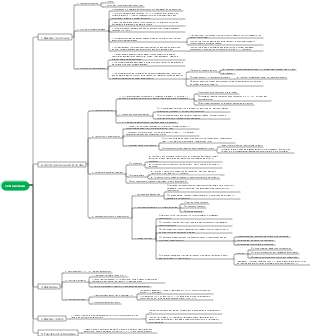
MindMap Gallery Medicine-Cell Nucleus Final Edition
An article about the mind map of the cell nucleus in Chapter 8 of the Sixth Edition of Medical Cell Biology, including chromatin, chromosomes, nuclear membrane, etc.
Edited at 2023-11-19 21:48:28This is a mind map about bacteria, and its main contents include: overview, morphology, types, structure, reproduction, distribution, application, and expansion. The summary is comprehensive and meticulous, suitable as review materials.

This is a mind map about plant asexual reproduction, and its main contents include: concept, spore reproduction, vegetative reproduction, tissue culture, and buds. The summary is comprehensive and meticulous, suitable as review materials.
This is a mind map about the reproductive development of animals, and its main contents include: insects, frogs, birds, sexual reproduction, and asexual reproduction. The summary is comprehensive and meticulous, suitable as review materials.
This is a mind map about bacteria, and its main contents include: overview, morphology, types, structure, reproduction, distribution, application, and expansion. The summary is comprehensive and meticulous, suitable as review materials.
This is a mind map about plant asexual reproduction, and its main contents include: concept, spore reproduction, vegetative reproduction, tissue culture, and buds. The summary is comprehensive and meticulous, suitable as review materials.
This is a mind map about the reproductive development of animals, and its main contents include: insects, frogs, birds, sexual reproduction, and asexual reproduction. The summary is comprehensive and meticulous, suitable as review materials.
cell nucleus
4. Nuclear matrix
(1) Composition and morphological structure Main components: protein and a small amount of RNA (function: maintain the integrity of the three-dimensional grid structure of the nuclear skeleton) Classification: Nuclear matrix protein: It is a protein component common to all types of cells; Nuclear matrix binding protein: Composition is related to cell type differentiation status, physiological and pathological conditions
(2) Functions: 1. Participate in DNA replication; 2. Participate in gene transcription and processing; 3. Participate in chromosome construction; 4. Related to cell differentiation.
5. Function of cell nucleus
(1) Storage and replication of genetic information The DNA in the cell nucleus is the carrier of the genetic information of the organism and determines the genetic traits and biological behavior of the organism. The cell nucleus wraps the original article in the nucleus, ensuring the stability of the cell 2 .DNA replication is discontinuous replication
(2) Transcription of genetic information The essence of transcription is to transfer genetic information from DNA to RNA. RNA transcription and processing occurs in the nucleus. The 5' end of the mRNA is capped and the 3' end is tailed to remove introns
6. Cell Nucleus and Disease
(1) Nuclear structural abnormalities and basics 1. Tumor cell nuclear abnormalities; 2. Lamin abnormalities and premature aging
(2) Nuclear transport abnormalities and diseases
(3) Telomere abnormalities and diseases
3. Nucleolus, the most obvious structure in the nucleus of eukaryotic cells during interphase, shows periodic disappearance and reconstruction during cell division.
(1) Main ingredients: protein 80%, DNA 8% and RNA 10%
(2) Structure 1. The fiber center of the nucleolus is the chromatin region where rRNA genes are distributed (for transcription) 2. The dense fiber component of the nucleolus contains rRNA molecules at different stages of transcription. 3. The granular component of the nucleolus is composed of rRNA and protein being processed.
(3) Function 1. It is the place where rRNA groups are transcribed and processed; 2. The nucleolus is the place where ribosome subunits are assembled.
2. Chromatin and chromosomes
Overview
Chromatin is a nucleoprotein complex composed of nucleic acids and proteins. The main components are DNA, histones, non-histone proteins and a small amount of RNA. Chromatin stretches loosely and becomes filament-like
Chromosomes refer to the strip or rod-shaped structures formed by the condensation of chromatin during mitosis or meiosis of cells.
1. Composition
(1) DNA is the carrier of genetic information
1AGCT; 2 Each unreplicated chromatin in eukaryotic cells is composed of a linear DNA molecule; 3 The entire genetic information contained in the haploid chromosome set of a eukaryotic cell is called the genome
1. Single sequence: There is generally only a single copy or a few copies in the genome, and it generally has a coding function. 2. Moderately repeated sequences: The number of repetitions is between 10 and 100,000, and most do not code for proteins, forming intragenic genes. The spacer sequence between them plays an important role in gene regulation. Coding genes include: rRNA genes, tRNA genes, histone genes, ribosome genes, etc.; 3. Highly repetitive sequences: the number of repeated copies exceeds 100,000, constituting the intervals of structural genes, distributed in the telomeres and centromeric regions of chromosomes .
There are three types of functional sequences of chromatin DNA: 1. Replication source sequence: it is the starting point for DNA replication in cells; 2: Centromere sequence: it is the connection site of the two sister chromatids that have been replicated, and it is with the spindle during metaphase. The connection allows the replicated chromosomes to be evenly distributed into the two daughter cells; 3. Telomere sequence: maintains the high degree of conservation at both ends of the DNA molecule and maintains the stability of the chromosomes
(2) Histones are the basic structural proteins in eukaryotic cell chromatin
1. Characteristics of histones: (1) The basic structural protein of eukaryotic chromosomes; (2) Rich in positively charged basic amino acids such as Arg, it is a basic protein and can bind tightly to acidic DNA.
2. Classification (1) Nucleosomal histones (H2A, H2B, H3 and H4): non-species and tissue specific, highly conserved in evolution, assisting DNA to curl into a stable structure of nucleosomes. (2) Connecting histones (H1) are species and tissue specific and connect nucleosomes
(3) Non-histone proteins can affect the structure and function of chromatin in many ways
1. Concept: a general term for chromatin-binding proteins other than histones. 2. Characteristics: A type of negatively charged acidic protein; smaller in number but more diverse, including chromosome skeleton proteins, regulatory proteins and related enzymes involved in nucleic acid metabolism and chemical modification of chromatin.
2. Euchromatin and heterochromatin
(1) Euchromatin is a functionally active and stretched chromatin fiber. Definition: It is a chromatin filament that is lightly colored, has a low degree of spiralization, is in a stretched state, and contains genes when stained with basic dyes in the interphase nucleus. Transcriptionally active sites. Often distributed in the center of the nucleus, partially in the middle of heterochromatin.
(2) Heterochromatin is a functionally inert and condensed chromatin fiber. Definition: The part of chromatin in the interphase nucleus that is in a condensed state, has no transcriptional activity, and is darker when stained with basic dyes. Distributed on the edge of the nucleus or around the nucleolus.
Composition: Constitutive chromatin (constant, all in a condensed state) and facultative chromatin (sometimes converted into euchromatin)
3. Chromatin is assembled into chromosomes
(1) Nucleosome - the primary structure of chromatin (basic structural unit) Definition: a disc-shaped particle composed of about 200 bp of DNA and a histone octamer. Assembly: 1. Two molecules each of nucleosome histones form an octamer; 2. 146bp DNA coils around 1.75 turns of the histone octamer to form a nucleosome; 3. Two adjacent nucleosomes are connected by connecting DNA , typical length is 60bp; the formation of nucleosome beads compresses the DNA molecule about 7 times
(2) Solenoid - the secondary structure of chromatin Concept: A solenoid is a hollow structure formed by a nucleosome bead structure spiraling with the help of histone H1. Assembly: There are 6 nucleosomes per ring, with an outer diameter of 30 nm and an inner diameter of 10 nm. Histone H1 is located inside the solenoid. The nucleosome bead structure is compressed 6-fold during the formation of the solenoid.
(3) Further packaging of solenoid
Multilevel spiralization model
Chromosome skeleton-radial ring model
(4) Morphological structure of chromosomes. In the metaphase of mitosis, chromatin is highly condensed and the morphological and structural characteristics of chromosomes are obvious.
Centromere 1. Primary constriction: refers to the junction of the two sister chromatids of the metaphase chromosome, which is a lightly colored constriction that is concave inwards. 2. Centromere: The main constricted chromatin part, composed of highly repetitive heterochromatin.
Centromere-kinetochore complexes mediate spindle chromosome association
Secondary constriction is not present on all chromosomes
The satellite is a globular structure located at the end of the chromosome. The nucleolar organization area is the chromosomal region containing the rRNA gene. This part of the rRNA gene is actively transcribed, and the chromatin condensation is low and appears as lightly stained secondary scars. It is related to nucleolus formation; it is the chromosome one of the signs
Telomeres are specialized parts of the ends of chromosomes
(5). Karyotype and banding type. Banding staining can accurately identify each chromosome.
1. Nuclear membrane
chemical composition of nuclear membrane
1. Composed of proteins and lipids, as well as small amounts of sugars, DNA and RNA
structure of nuclear membrane
1. Composed of inner and outer nuclear membranes, perinuclear space, nuclear pore complex and nuclear lamina
(1) Outer nuclear membrane
1 Connected to rough endoplasmic reticulum, with ribosomes attached to the surface
2. The cytoplasmic surface of the outer nuclear membrane is attached with cytoskeletal components such as intermediate fiber nuclear microtubules, which are related to the positioning of the nucleus, fixation of the nucleus and maintenance of nuclear morphology.
binary inner membrane
Arranged parallel to the outer nuclear membrane, with a smooth surface
The nuclear lamina fiber structure is attached to the nucleoplasmic surface of the inner nuclear membrane, which supports the nuclear membrane.
trinuclear gap
1Definition: The space between the inner and outer nuclear membranes
2 Connected to rough endoplasmic reticulum
Four nuclear pore complexes
1 is the annular opening formed by the fusion of the inner and outer nuclear membranes
2. A protein molecular complex composed of multiple protein particles arranged in a specific way.
Five nuclear lamina
Structure: A layer of network sheet structure composed of high-electron-density fiber proteins located between the outside of the inner nuclear membrane and chromatin.
Composition: Composed of lamin A, lamin B, and lamin C
Function: 1 acts as a scaffold in the nucleus; 2 is closely related to the disintegration and reconstruction of the nuclear membrane; 3 is related to the condensation of chromatin into chromosomes; 4 is involved in the replication of DNA
functions of nuclear membrane
(1) Provides a spatiotemporal isolation barrier for gene expression
Make DNA replication, RNA transcription and protein translation proceed at different times and spaces; maintain a relatively stable internal environment of the cell nucleus
(2) Participate in protein synthesis
(3) Nuclear pore complex mediates material exchange between nucleoplasm and nucleoplasm
1 Import of nucleophilic proteins
Nucleophilic protein: a protein synthesized on free ribosomes in the cytoplasm and transported into the nucleus through the nuclear pore to play a role
2. Nuclear export of RNA and ribosomal subunits. Export proteins are receptors that recognize transported RNA.
Basic overview
It is the place where genetic information is stored, replicated and transcribed. Genetic information guides protein synthesis, thereby regulating cell proliferation, growth, differentiation, aging and death. Therefore, the cell nucleus is the command and control center of cell life activities.
Number: Each cell usually has only one nucleus, but some cells are dual or even multinucleated
Size: The diameter of the nucleus of higher animal cells is usually 5 to 10 microns. Strongly growing cells have larger nuclei