MindMap Gallery Systemic Anatomy-Reproductive System Mind Map
This is a mind map about systemic anatomy-reproductive system, including male reproductive system, female reproductive system, etc. Hope this helps!
Edited at 2023-11-14 11:12:38This is a mind map about bacteria, and its main contents include: overview, morphology, types, structure, reproduction, distribution, application, and expansion. The summary is comprehensive and meticulous, suitable as review materials.

This is a mind map about plant asexual reproduction, and its main contents include: concept, spore reproduction, vegetative reproduction, tissue culture, and buds. The summary is comprehensive and meticulous, suitable as review materials.
This is a mind map about the reproductive development of animals, and its main contents include: insects, frogs, birds, sexual reproduction, and asexual reproduction. The summary is comprehensive and meticulous, suitable as review materials.
This is a mind map about bacteria, and its main contents include: overview, morphology, types, structure, reproduction, distribution, application, and expansion. The summary is comprehensive and meticulous, suitable as review materials.
This is a mind map about plant asexual reproduction, and its main contents include: concept, spore reproduction, vegetative reproduction, tissue culture, and buds. The summary is comprehensive and meticulous, suitable as review materials.
This is a mind map about the reproductive development of animals, and its main contents include: insects, frogs, birds, sexual reproduction, and asexual reproduction. The summary is comprehensive and meticulous, suitable as review materials.
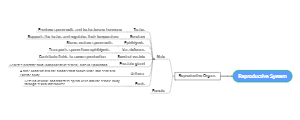
reproductive system
male reproductive system
male internal genitalia
Testicles: Located in the scrotum, one on each side, they are the organs that produce sperm and secrete male hormones. It is slightly flattened and oval, divided into front and rear edges, upper and lower ends and inner and outer sides. The anterior edge is free; the posterior edge has blood vessels, nerves and lymphatic vessels entering and exiting, and is connected to the epididymis
vas deferens tube
Epididymis: Crescent-shaped, close to the upper end and posterior edge of the testicles. The upper end is the caput epididymis, the middle part is the body of the epididymis, and the lower end is the cauda epididymis. The epididymis is an organ that temporarily stores sperm and secretes epididymal fluid for sperm nutrition. Promote further maturation of sperm. The epididymis is a common site for tuberculosis.
Vas deferens: It is the direct continuation of the epididymal duct, about 50cm in length, with thicker wall, more developed muscle layer and small lumen. When touched in vivo, it appears as a solid round cord. The vas deferens starts from the end of the epididymis and enters through the inguinal canal along with the spermatic cord. In the pelvic cavity, behind the bladder floor and in front of the rectum, the vas deferens on both sides gradually approach and expand into the ampulla of the vas deferens.
Ejaculatory duct: The end of the ampulla of the vas deferens tapers and merges with the efferent duct of the seminal vesicle to form the ejaculatory duct. The ejaculatory duct opens into the prostate part of the urethra
Spermatic cord: It is a soft round cord-like structure that passes from the abdominal ring of the inguinal canal through the inguinal canal, exits the subcutaneous ring and extends to the upper end of the testis. The ligated part of the vas deferens is the spermatic cord
accessory glands
Seminal vesicle: It is an oblong sac-like organ located behind the base of the bladder and on the lower outside of the ampulla of the vas deferens, one on each side.
Prostate: An unpaired solid organ located between the bladder and urogenital diaphragm. The secretion of the prostate is the main component of semen and contains prostaglandins.
The bulbourethral glands are a pair of pea-sized spherical glands located in the deep transverse muscles of the perineum. The efferent duct of the gland opens into the bulb of the urethra
male external genitalia
Penis: divided into three parts: head, body and root. It consists of two corpora cavernosa of penis and one corpora cavernosa of urethra. The posterior end of the corpus cavernosum is attached to the inferior pubic and ischial ramus. The corpus cavernosum is located on the ventral side of the corpus cavernosum of the penis, and the urethra runs through it. The front end of the urethra cavernous body expands into the glans penis, and the rear end expands into the bulb urethra.
Scrotum: It is a pouch-like structure located behind and below the penis. The scrotal wall is composed of skin and fleshy membranes. The skin of the scrotum is thin and soft, with a small amount of pubic hair and obvious pigmentation.
Male urethra: It has the functions of both urination and semen. It starts from the internal urethral opening of the bladder and ends at the external urethral opening of the glans penis. The male urethra can be divided into prostatic, membranous and cavernous parts. The prostatic and membranous parts of the urethra are called the posterior urethra
The urethra has three strictures, three dilations and two curvatures ① Three strictures: located in the internal orifice of the urethra, the membranous part of the urethra and the external orifice of the urethra, with the external orifice being the narrowest. Urethral stones are often lodged in these narrow areas ②Three enlargements: located in the prostatic part of the urethra, the bulbar part of the urethra, and the navicular fossa. ③Two curves: the inferior curvature of the pubic bone, which is convex downward and backward, and the anterior curvature of the pubic bone, which is convex upward and forward.
female reproductive system
female internal genitalia
Ovary: an organ that produces eggs and secretes estrogen and is located in the ovarian fossa sandwiched between the internal and external iliac arteries. The ovary is flat and oval, divided into inner and outer sides, front and back edges, and upper and lower ends. The anterior edge of the ovary is connected to the broad ligament of the uterus by the mesentery. There are blood vessels, nerves, etc. coming out from the middle of the front edge, which is called the ovarian portal.
Fallopian tubes (carry eggs, one on each side, connected to both sides of the fundus of the uterus)
Cervix: The section located within the uterine wall, with the smallest diameter, connecting the fallopian tube to the uterine cavity.
Isthmus: short and straight, where fallopian tube ligation is often performed
Ampulla: Thick and long, with rich blood supply, accounting for about 2/3 of the total length of the fallopian tube. Most eggs are fertilized in the ampulla.
Infundibulum: The enlarged part at the end of the fallopian tube. Around the abdominal opening of the fallopian tube, many slender finger-like protrusions called fallopian tube fimbria are formed on the edge of the end of the fallopian tube, covering the surface of the ovary. One of the larger protrusions connected to the ovary is called the ovarian fimbriae
Uterus (muscular organ with thick walls and small cavity)
Location: Located in the center of the small pelvis, between the bladder and rectum and connected to the vagina at the lower end
Shape: The uterus of an unpregnant adult is slightly flattened from front to back and inverted pear shape. The uterus is divided into three parts: fundus, body, and neck. The fundus of the uterus is the part above the level of the uterine opening of the fallopian tube, wide and round. The cervix is a narrow cylindrical part at the lower end, which is a common site for cancer tumors. Between the fundus of the uterus and the cervix is the body of the uterus. The upper part of both sides of the uterus that communicates with the fallopian tube is called the uterine horn. The narrower part where the body of the uterus connects with the upper end of the cervix and vagina is called the uterine isthmus.
Fixtures
Broad ligament of uterus: restricts the uterus from tilting to both sides
Round ligament of uterus: maintains the anteversion of the uterus
Cardinal ligament of uterus: maintains the normal position of the cervix and prevents it from prolapse downwards
Uterosacral ligament: pulls the cervix backward and upward, and together with the round ligament of the uterus, maintains the anteversion and flexion of the uterus.
Vagina (female genital organ): It is composed of mucous membrane, muscular layer and adventitia, and is highly stretchable. The upper end of the vagina is broad and surrounds the cervix and vagina, forming an annular depression called the vaginal vault. The vaginal vault is divided into interconnected anterior, posterior and lateral parts. The posterior part of the vaginal vault is the deepest, and above and behind it is the recto-uterine depression. The two are separated only by the posterior part of the vagina and the peritoneum covering it. Clinically, posterior vaginal puncture can be used to drain the fluid and blood in the recto-uterine depression for diagnosis and treatment.
Female external genitalia (i.e. vulva)
mons pubis
labia majora
labia minora
clitoris
Vaginal vestibule: The rhombus-shaped area located between the labia minora on both sides. It has 4 openings, namely the external urethral opening in the front, the vaginal opening in the rear, the junction of the middle and posterior 1/3 of the labia minora, and a Bartholin gland on the left and right. opening of duct