MindMap Gallery Voltammetry mind map
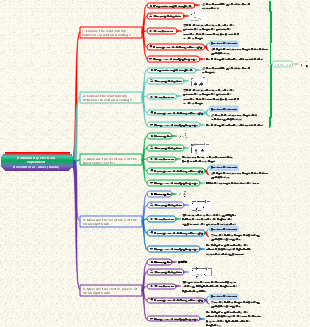
"Instrumental Analysis Tutorial", Peking University Press, Chapter 13 includes cyclic voltammetry, polarography, electrode reaction, stripping voltammetry, working electrode classification, etc.
Edited at 2023-11-12 21:42:57This is a mind map about bacteria, and its main contents include: overview, morphology, types, structure, reproduction, distribution, application, and expansion. The summary is comprehensive and meticulous, suitable as review materials.

This is a mind map about plant asexual reproduction, and its main contents include: concept, spore reproduction, vegetative reproduction, tissue culture, and buds. The summary is comprehensive and meticulous, suitable as review materials.
This is a mind map about the reproductive development of animals, and its main contents include: insects, frogs, birds, sexual reproduction, and asexual reproduction. The summary is comprehensive and meticulous, suitable as review materials.
This is a mind map about bacteria, and its main contents include: overview, morphology, types, structure, reproduction, distribution, application, and expansion. The summary is comprehensive and meticulous, suitable as review materials.
This is a mind map about plant asexual reproduction, and its main contents include: concept, spore reproduction, vegetative reproduction, tissue culture, and buds. The summary is comprehensive and meticulous, suitable as review materials.
This is a mind map about the reproductive development of animals, and its main contents include: insects, frogs, birds, sexual reproduction, and asexual reproduction. The summary is comprehensive and meticulous, suitable as review materials.
Voltammetry
stripping voltammetry
An electrochemical analysis method that combines electrolytic enrichment and dissolution assays
Higher sensitivity than polarography
electrolytic enrichment
The working electrode is fixed at a potential that generates a limiting current for electrolysis, and the substance to be measured is concentrated on the electrode.
Dissolution assay
After a certain period of enrichment, stop stirring and reversely change the potential. The resulting current-potential curve is the dissolution curve, which is in the shape of a peak.
anodic stripping voltammetry
Reduction and enrichment, oxidation and dissolution
cathodic stripping voltammetry
Oxidation and enrichment, reduction and dissolution
Cyclic voltammetry
Voltage scanning mode: triangle wave
After one triangular wave scan, the i-E curve obtained is the cyclic voltammogram.
In addition to being a quantitative analysis method, cyclic voltammetry is mainly used as an electrochemical research method. It can be used to study the nature, mechanism and electrode process kinetic parameters of electrode reactions.
Square wave and pulse voltammetry
square wave polarogram
principle
Change the superimposed AC sine wave into a square wave, use a special time switch, and take advantage of the characteristic that the charging current decays quickly with time, and record the AC polarization current signal in the later period after the square wave appears.
Peak current
scanning method
A square wave voltage with an amplitude of 10~30mV and a frequency of 225~250Hz (pulse width of several ms) is superimposed on the linear scanning voltage, and the electrolytic current is recorded at the moment when the square wave voltage changes direction.
Square wave polarographic current curve
At the moment when the voltage changes direction, the capacitor current decays the most. At this time, the electrolytic current also attenuates, but the attenuation speed is faster than that of the capacitor. The current decays slowly. At this time, recording the electrolysis current can Overcome the influence of capacitive current, thereby improving sensitivity.
Precautions
Square wave polarography does not need to add surfactant to suppress the polarogram. On the contrary, surfactant will cause the electrode to react It should be blocked and change the electric double layer capacitance of the electrode and solution surface, thus affecting the measurement.
The reversibility of the electrode reaction has a great influence on the sensitivity of the assay. In the square wave polarogram, due to the relatively large superposition High-frequency voltage, that is, the speed of adding polarization voltage is quite fast, so the electrode reaction speed is relatively fast. For slow substances, the peak height obtained will be greatly reduced.
In order to effectively eliminate the capacitive current, the RC value of the electrolytic cell circuit should be made much smaller than the half-cycle value of the square wave. For a square wave frequency of 225Hz, the half period is 0.002s, and the R value is generally required to be no greater than 50Ω.
Capillary noise. Noise due to capillary tubes. This noise is several times higher than the noise of the entire instrument.
pulse polarography
principle
At the end of the growth period of the dropping mercury electrode, superimpose a given DC voltage or a linearly increasing DC voltage. The curve obtained by gradually increasing the amplitude or equal amplitude of the pulse voltage and recording the electrolytic current at the end of each pulse.
conventional pulse polarography
Voltage scanning method
Polarographic curve
The sensitivity of conventional pulse polarography is 7 times that of DC polarography.
differential pulse polarography
Voltage scanning method
Polarographic curve
Why is pulse polarographic sensitivity higher than square wave polarographic sensitivity? Since the pulse duration in pulse polarography is 40-80ms, it is longer than several ms in square wave polarography. When the current is measured in the latter part of the pulse, the capillary noise current iN and the charging current ic at this time are almost attenuated to 0, and the electrolysis current is mainly measured, thereby improving the sensitivity of the pulse polarogram.
Electrode reaction
Pre-reaction
subsequent reaction
parallel catalytic reactions
extreme spectrum
Device diagram
polarographic wave
Residual current part
When the applied voltage does not reach the decomposition voltage of metal ions, a tiny current flows through the electrolytic cell in the solution, which is called residual current. It is generated by the reduction of a small amount of impurities in the electrolyte and the trace oxygen that has not been removed on the electrode.
Current rising part
When the potential reaches the precipitation potential of metal ions, the metal precipitates and an electrolytic current is generated.
Limit diffusion current stage
The metal ions on the surface of the dropped mercury tend to zero, the concentration polarization reaches the limit, the diffusion current no longer increases with the external voltage, and the curve appears a plateau.
The potential of the mercury-dropping electrode when the diffusion current is half of the limiting diffusion current is called the half-wave potential E1/2
,
The particularity of the polarographic process
Special features of electrodes
The potential of the mercury-dropping electrode changes completely with the applied voltage, and it is a polarized electrode.
The electrode potential of the saturated calomel electrode can be considered unchanged and it is a depolarizing electrode.
The ions to be measured reach the electrode surface from the solution mainly by three mass transfer methods:
electrostatic attraction
To generate migration current, a large amount of supporting electrolyte can be added to eliminate
convection of solution
Produces convective currents, which can be eliminated by keeping the solution still
Concentration Diffusion
Diffusion current is generated, and only the diffusion current is proportional to the concentration of the substance to be measured
The particularity of electrolysis conditions
The concentration of the substance to be measured should be small, the solution is dilute, and the electrolysis current generated is small. Ensure that the calomel electrode is a depolarizing electrode and the dropping mercury electrode is a polarizing electrode.
Electrolysis is performed stationary, without stirring, and a large amount of supporting electrolyte is added to the solution
Types of polarographic waves
reversible wave
The electrode reacts quickly, and the reaction rate is much higher than the diffusion rate. It is shown that any point on the polarographic wave is controlled by the diffusion rate, and the Nernst formula is applicable.
irreversible wave
The rate of electrode reaction is slower than the diffusion rate. Polarographic waves are controlled by both the diffusion rate and the electrode reaction rate. Due to the existence of overpotential, the Nernst formula is not applicable and the waveform is poor.
Polarographic waves of simple metal ions
Half-wave potential and metal ion concentration are matte and can be used for qualitative analysis
Quantitative analysis methods
Interference current and its elimination method
Residual current
Electrolysis current, caused by trace impurities, very small
The charging current is caused by the charging process of the double electric layer at the interface between the mercury-dropping electrode and the solution.
The main components of residual current and the main factors affecting the detection limit of polarographic analysis
Elimination method
Drawing method to subtract residual current
New polarography technology overcomes the influence of charging current
Square wave polarogram, pulse polarogram
migration current
There is no quantitative relationship with the concentration of the measured substance
Elimination method
Add a large amount of supporting electrolytes such as KCl, potassium nitrate, etc. The added electrolyte does not react with the electrode, and its concentration is 50-100 times greater than the concentration of the substance being measured.
oxygen wave
Dissolved oxygen is reduced at the dropping mercury electrode, producing two polarographic waves that interfere with the measurement.
Elimination method
High purity nitrogen gas is passed through the solution
extremely extreme
The diffusion current rapidly increases to a maximum value as the potential of the mercury-dropping electrode decreases, and then decreases and stabilizes at the normal limit diffusion current value. This prominent current peak is called "polarographic maximum"
cause
The surface tension of each part of the drop of mercury is different, resulting in tangential movement.
Elimination method
A small amount of surface active substances can be added to make the surface tension of each part of the mercury droplets uniform, which is called a maximum inhibitor.
Disadvantages of Polarography
High sensitivity, low detection limit, high accuracy, good reproducibility, fast analysis speed, easy automation, and wide application range
The amount and time of mercury used, the rate of applying DC current is slow, time-consuming and mercury-consuming
Low sensitivity
Try to reduce the charging current or increase the electrolysis current to improve the signal-to-noise ratio and improve the sensitivity of the measurement.
low resolution
iRdrop
iR drop can be overcome using a three-electrode system
Working electrode classification
mercury electrode
Dropping mercury electrode
Polarography
solid electrode
rotating disk electrode