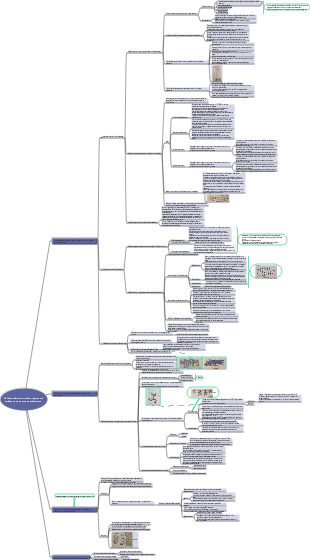
MindMap Gallery Cell membrane and transport of substances across membranes
This is a mind map about cell membranes and the transmembrane transport of substances, including the chemical composition and biological characteristics of cell membranes, the transmembrane transport of small molecule substances and ions, etc.
Edited at 2023-11-11 16:37:47This is a mind map about bacteria, and its main contents include: overview, morphology, types, structure, reproduction, distribution, application, and expansion. The summary is comprehensive and meticulous, suitable as review materials.

This is a mind map about plant asexual reproduction, and its main contents include: concept, spore reproduction, vegetative reproduction, tissue culture, and buds. The summary is comprehensive and meticulous, suitable as review materials.
This is a mind map about the reproductive development of animals, and its main contents include: insects, frogs, birds, sexual reproduction, and asexual reproduction. The summary is comprehensive and meticulous, suitable as review materials.
This is a mind map about bacteria, and its main contents include: overview, morphology, types, structure, reproduction, distribution, application, and expansion. The summary is comprehensive and meticulous, suitable as review materials.
This is a mind map about plant asexual reproduction, and its main contents include: concept, spore reproduction, vegetative reproduction, tissue culture, and buds. The summary is comprehensive and meticulous, suitable as review materials.
This is a mind map about the reproductive development of animals, and its main contents include: insects, frogs, birds, sexual reproduction, and asexual reproduction. The summary is comprehensive and meticulous, suitable as review materials.
Cell membrane and transport of substances across membranes
Chemical composition and biological properties of cell membrane
chemical composition of cell membrane
Membrane lipids form the structural skeleton of cell membranes (lipids on cell membranes are called membrane lipids)
Phospholipids are the main components of membrane lipids
Glycerophospholipid
Mainly include phosphatidylcholine (lecithin), phosphatidylethanolamine (cephalin) and phosphatidylserine
Sphingomyelin
The only phospholipid on the cell membrane that does not use glycerol as its skeleton is less abundant in the membrane, but more abundant in the neuron cell membrane. It is mainly synthesized in the Golgi complex.
Cholesterol stabilizes cell membranes and regulates membrane fluidity
Another important type of lipid in the cell membrane, the molecule is relatively small, dispersed among phospholipid molecules
Glycolipids are mainly located on the non-cytoplasmic side of the plasma membrane
It is composed of hydrophilic lipid molecules, lipids and oligosaccharides. Glycolipids are commonly found on the surface of prokaryotic and eukaryotic cell membranes, accounting for less than 5% of the total membrane lipids. More than 40 types of glycolipids have been discovered so far, and their main difference lies in their different polar heads. The simplest glycolipid is cerebroside) which has only one galactose or glucose residue in its polar head group and is the major glycolipid in myelin. In all cells, glycolipids are located in the non-cytoplasmic monolayer of the lipid bilayer, and the sugar groups are exposed on the cell surface.
Membrane lipids are amphipathic molecules
Lipid bilayer has characteristics as an ideal junction for biological membranes
1. Form a barrier that separates two water bathing environments. 2. The lipid bilayer is continuous and has the tendency to fuse with itself to form a closed chamber. No free boundaries are found within the cell, forming an extensive continuous membrane network. 3. The lipid bilayer is flexible and deformable
Membrane proteins associate with lipid bilayers in multiple ways
intrinsic membrane protein
Also known as penetrating membrane proteins, they account for 70% to 80% of the total membrane proteins and are also amphiphilic molecules. Can be separated with detergent
external membrane protein
Also known as peripheral proteins, they account for 20% to 30% of the total membrane proteins. It is a type of protein that is loosely bound to the cell membrane and is not inserted into the lipid bilayer. It is distributed on the cytoplasmic side or extracellular side of the plasma membrane.
lipid anchored protein
Also known as adiponectin. Such membrane proteins can be located on both sides of the membrane, much like peripheral proteins, but differ in that lipid-anchored proteins are covalently bound to lipid molecules within the lipid bilayer. Lipid-anchored proteins covalently bind to lipid molecules in two ways. One is located on the cytoplasmic side of the plasma membrane. Some intracellular signaling proteins directly form covalent bonds with certain fatty acid chains (such as myristic acid, palmitic acid or isoprenyl) in the lipid bilayer and are anchored in the lipid bilayer. double layer
Membrane sugars cover the surface of the cell membrane
Depending on the species and cell type, carbohydrates account for approximately 2%e~10% of the weight of the plasma membrane. 93% of the sugars in membrane sugars are covalently bound to membrane proteins in the form of oligosaccharide or polysaccharide chains to form glycoproteins. There is a carbohydrate-rich peripheral zone on the surface of most eukaryotic cells, called the cell coat or glycocalyx.
biological properties of cell membranes
Membrane asymmetry determines the directionality of membrane function
Membrane lipid asymmetry
Differences in the distribution of membrane lipid components give intracellular biological membranes different characteristics and functions. Some lipid molecules (such as phosphatidylinositol) in the lipid bilayer can provide binding sites for specific proteins and play an important role in maintaining the correct positioning and polarity of membrane proteins in the lipid bilayer. In addition, the asymmetric distribution of membrane lipids causes different fluidities between the inner and outer layers of the lipid bilayer.
Membrane protein asymmetry
Membrane protein distribution is absolutely asymmetric
Membrane sugar asymmetry
The distribution of membrane sugars is significantly asymmetric
Significance: The asymmetry of the distribution of membrane lipids, membrane proteins and membrane sugars is closely related to the asymmetry and directionality of membrane function, and has important biological significance. The asymmetry of membrane structure ensures the directionality of membrane function. and a high degree of orderliness in life activities
Membrane fluidity is the guarantee of membrane functional activity
concept
Membrane fluidity is one of the basic characteristics of cell membranes and a necessary condition for cells to carry out life activities. The membrane is a dynamic structure, and its fluidity mainly refers to the fluidity of membrane lipids and the mobility of membrane proteins.
The lipid bilayer is a liquid crystalline two-dimensional fluid
As the main body of biological membrane, the lipid bilayer has both the orderly arrangement of solid molecules and the fluidity of liquid. These two characteristics are in a state between the crystalline state and the liquid state, that is, liquid. Quality is an extremely important property of cell membranes. The water environment inside and outside the cell prevents membrane lipid molecules from escaping from the lipid bilayer. At mild temperatures (37°C), membrane lipid molecules can move back and forth, left and right, and exchange positions with each other in the plane of the lipid monolayer. Lipids It exists in a relative flow state, but the long axes of the molecules are basically parallel and the arrangement maintains a certain direction. The film at this time can be regarded as a two-dimensional fluid.
How membrane lipid molecules move
lateral diffusion
It means that within the monolayer of a lipid bilayer, lipid molecules quickly exchange positions with adjacent molecules laterally along the membrane plane, with an exchange frequency of about 102 times/s. Lateral diffusion is the main movement mode of membrane lipid molecules
flipping motion
Refers to the movement of membrane lipid molecules from one monolayer to another in the lipid bilayer. Generally, it rarely happens, because when a flipping movement occurs, the hydrophilic head group of the phospholipid will pass through the hydrophobic layer inside the membrane and overcome the resistance of the hydrophobic area to reach another level. This is thermodynamically very unfavorable. of
rotational motion
Refers to the spin motion of membrane lipid molecules around an axis perpendicular to the plane of the membrane
bending motion
The hydrocarbon chains of membrane lipid molecules are tough and bendable. The tail end of the molecule bends and swings to a large extent, while the bending and swinging range close to the polar head is small.
Factors affecting membrane lipid fluidity
Degree of saturation of fatty acid chain
The phase transition temperature and fluidity depend on the vertical density of lipid molecules. Van der Waals forces and hydrophobic interactions between the hydrophobic tails of phospholipid molecules are known to cause them to aggregate with each other. The long saturated fatty acid chains of phospholipid molecules are linear and have the greatest aggregation tendency and are tightly arranged into a gel state; the unsaturated fatty acid chains are bent at the double bonds and become curved, interfering with the interaction of van der Waals forces between lipid molecules. , so the arrangement is relatively loose, thereby increasing the fluidity of the membrane
Fatty acid chain length
The length of the fatty acid chain is related to the fluidity of the membrane. The short fatty acid chain has a low phase transition temperature and good fluidity. big
Dual regulatory effects of cholesterol
When the temperature is above the phase transition temperature, cholesterol stabilizes the plasma membrane and increases order. When the temperature is below the phase transition temperature, cholesterol in animal cell membranes can effectively prevent the sudden decrease in membrane fluidity at low temperatures.
Lecithin to sphingomyelin ratio
At 37°C, both lecithin and sphingomyelin are in a fluid state, but the viscosity of sphingomyelin is 6 times greater than that of lecithin. Therefore, the higher the sphingomyelin content, the lower the fluidity. During the process of cell aging, the ratio of lecithin to sphingomyelin in the cell membrane gradually decreases, and its fluidity also decreases.
Effect of membrane proteins
Membrane lipids have a direct impact on membrane fluidity after binding to membrane proteins. After the membrane protein is embedded in the hydrophobic region of the membrane lipid, the surrounding lipid molecules cannot move alone and form an interface lipid (formed by the combination of the embedded protein and the surrounding lipid molecules). The more embedded proteins, the more interface lipids, and the concentration of membrane lipids The fluidity is smaller, but the binding of membrane lipids to certain intrinsic proteins is reversible.
other
The polar groups of membrane lipids, ambient temperature, pH, ionic strength, etc. can all have a certain impact on the fluidity of membrane lipids.
Membrane protein motility
lateral diffusion
rotational motion
Or called rotational diffusion, membrane proteins can rotate around an axis perpendicular to the membrane plane, but the speed of rotation is slower than lateral diffusion. The rotation rates of different membrane proteins also vary greatly, which is related to their molecular structures and the different microenvironments they live in.
Molecular structure model of cell membrane
Transport of small molecules and ions across membranes
Selective permeability and simple diffusion of membranes
The permeability of a substance transporting across a membrane depends on the inherent lipid solubility of the plasma membrane and the characteristics of the substance itself.
Simple diffusion, also called passive diffusion, is the simplest way of transporting small molecules across membranes. Thermal motion of small molecules allows molecules to diffuse freely from one side of the membrane to the other, but two conditions must be met: first, the solute must maintain a certain concentration difference on both sides of the membrane, and second, the solute must be permeable. Pass membrane. The higher the temperature of the solution in which the substance is located, the larger the effective area of the membrane, and the higher the transport speed.
Transmembrane transport mediated by membrane transport proteins
Membrane transport proteins are divided into two categories: one is the carrier protein, also known as the transporter, and the other is the channel protein
Facilitated diffusion is passive transport mediated by carrier proteins
concept
Some non-lipid-soluble (or hydrophilic) substances cannot pass through the cell membrane by simple diffusion, but they can follow the substance concentration gradient or electrochemical gradient mediated by certain carrier proteins without consuming the metabolic energy of the cell. Carry out transport, this method is called facilitated diffusion or helped diffusion. Since facilitated diffusion does not consume cellular metabolism, this is the same as simple diffusion, both of which are passive transport.
Features
structure specificity
saturation phenomenon
competitive inhibition
Active transport is the energy-consuming transport of carrier proteins against a concentration gradient.
ATP driven pump
P-type ion pump, Na+-K pump, Ga pump, V-type proton pump, F-type proton pump, ABC transporter
co-transportation
Co-transport and counter-transport
Ion channel type
Ligand-gated channels
voltage gated channel
stress activated channels
Transmembrane transport of macromolecules and particulate matter (relying on vesicle transport)
endocytosis
Phagocytosis
Drinking function
receptor mediated
exocytosis
Continuous secretion is unregulated continuous secretion by cells
Regulated secretion is selective secretion regulated by extracellular signals
Cell membrane abnormalities and diseases
Carrier protein abnormalities and disease
cystinuria
renal glycosuria
ABC transporter protein abnormalities and diseases
cystic fibrosis
Membrane receptor abnormalities and diseases
familial hypercholesterolemia