 Wondershare EdrawMind
MindMap Gallery digestive system
- 103
digestive system
Systemic Anatomy - The digestive system is composed of two major parts: the digestive tract and the digestive glands. The basic physiological function is the process of ingesting, transporting, digesting food, absorbing nutrients, and excreting waste.
Edited at 2023-10-31 19:55:39
- bacteria
This is a mind map about bacteria, and its main contents include: overview, morphology, types, structure, reproduction, distribution, application, and expansion. The summary is comprehensive and meticulous, suitable as review materials.
- Plant asexual reproduction
This is a mind map about plant asexual reproduction, and its main contents include: concept, spore reproduction, vegetative reproduction, tissue culture, and buds. The summary is comprehensive and meticulous, suitable as review materials.
- Reproductive development of animals
This is a mind map about the reproductive development of animals, and its main contents include: insects, frogs, birds, sexual reproduction, and asexual reproduction. The summary is comprehensive and meticulous, suitable as review materials.
digestive system
- bacteria
This is a mind map about bacteria, and its main contents include: overview, morphology, types, structure, reproduction, distribution, application, and expansion. The summary is comprehensive and meticulous, suitable as review materials.
- Plant asexual reproduction
This is a mind map about plant asexual reproduction, and its main contents include: concept, spore reproduction, vegetative reproduction, tissue culture, and buds. The summary is comprehensive and meticulous, suitable as review materials.
- Reproductive development of animals
This is a mind map about the reproductive development of animals, and its main contents include: insects, frogs, birds, sexual reproduction, and asexual reproduction. The summary is comprehensive and meticulous, suitable as review materials.
- Recommended to you
- Outline
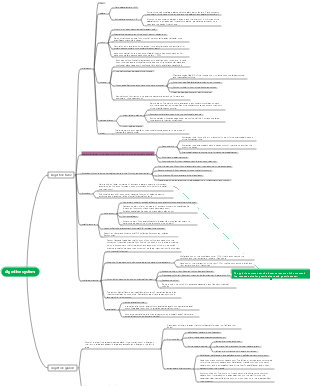
digestive system
Digestive tube
Upper gastrointestinal
oral cavity
walls of oral cavity
Lip: divided into upper lip and lower lip
Cheeks: are the two side walls of the mouth. There is a parotid duct papilla on the buccal mucosa opposite the crown of the maxillary second molar, and there is an opening of the parotid duct on it.
Palate: It is the upper wall of the mouth that separates the nasal cavity and the oral cavity. The palate is divided into two parts: hard palate and soft palate
tooth
Function: It is the hardest organ in the human body and has functions such as chewing food and assisting in pronunciation.
Types and arrangement of teeth: They are divided into two categories: deciduous teeth and permanent teeth. Generally, deciduous teeth begin to erupt six months after birth. After the age of six, deciduous teeth begin to fall out and are gradually replaced by permanent teeth. All permanent teeth emerge, a total of 32 teeth. 16 in each lower jaw According to the shape and function of the teeth, deciduous teeth and permanent teeth can be divided into three types: incisors, canines and molars, but permanent teeth are divided into molars and premolars. It is divided into 4 areas with the "+" mark, and the deciduous teeth are represented by Roman numerals I to V, and the permanent teeth are represented by Arabic numerals 1 to 8.
Tongue mucosa: There are many small protrusions on the surface called lingual papillae
Filamentous papillae (no taste function): white, largest in number, smallest in size, distributed in the front 2/3 of the back of the tongue
Fungiform papillae: red in color, less in number, more common on the tip and sides of the tongue
Foliated papillae: located at the back of the lingual border
Contoured Nipples: Maximum Volume
Salivary glands (see below for digestive glands)
pharynx
Shape and location: It is a funnel-shaped muscular duct that is wide at the top and narrow at the bottom, slightly flattened front and back, about 12cm long, and its inner cavity is called the pharyngeal cavity. The upper end of the pharynx originates from the base of the skull, and the lower end migrates into the esophagus at about the lower edge of the sixth cervical vertebra or the height of the cricoid cartilage.
Division: three parts: nasopharynx, oropharynx and hypopharynx. The oropharynx and hypopharynx of the pharyngeal cavity are the common passages between the digestive tract and respiratory tract.
esophagus
Location and divisions: The muscular duct that is flattened front and back is the narrowest part of the digestive tract, about 25cm long. The upper end is connected to the pharynx at the lower edge of the sixth cervical vertebra, and the lower end is approximately at the level of the 11th thoracic vertebra, and is connected to the cardiac cardia of the stomach. It can be divided into the neck, chest and abdomen.
Stricture parts (the three strictures are easy to retain foreign bodies in the esophagus and are prone to esophageal cancer)
The first stenosis: is the beginning of the esophagus, equivalent to the level of the lower edge of the sixth cervical vertebra, about 15cm from the central incisor.
The second stenosis is the intersection of the esophagus behind the left main bronchus, equivalent to the level between the 4th and 5th thoracic vertebrae, about 25cm from the central incisor.
Third stenosis: It is the esophageal hiatus where the esophagus passes through the diaphragm, equivalent to the level of the 10th thoracic vertebra, about 40cm from the central incisor.
Stomach (connected to the esophagus at the top and duodenum at the bottom)
Location and shape: When the stomach is moderately full, most of it is located in the left rib area, and a small part is located in the upper abdominal area. The stomach is divided into anterior and posterior walls, large and small curvatures, entrance and exit. The lesser curvature of the stomach is concave to the upper right, and the lowest point of the curvature is called the angular notch. Most of the greater curvature of the stomach is convex to the lower left. The junction between the proximal end of the stomach and the esophagus is the entrance to the stomach, called the cardia. The left side of the cardia, the acute angle formed by the left edge of the end of the esophagus and the fundus of the stomach, is called the cardiac notch. The distal end of the stomach is connected to the duodenum and is the outlet of the stomach, called the pylorus
Function: accommodate food and secrete gastric juice, as well as endocrine function
branch
Cardia: the part near the cardia
Fundus of stomach: the part that bulges from the cardia to the upper left
Body of stomach: most of the middle part from the fundus down to the angular notch
Pylorus: the part between the lower boundary of the stomach and the pylorus
Small intestine (the longest section of the digestive tube, 5 to 7 meters long in adults, is an important organ for digestion and absorption)
Duodenum (between the stomach and jejunum, about 25cm in total length)
Upper part: About 5cm long, starting from the pylorus of the stomach, the duodenal bulb is a common site for duodenal ulcers and perforations.
Descending part: The mucosa forms a well-developed annular fold. There is a longitudinal fold on the posterior medial wall of the part called the duodenal fold. The round bulge at its lower end is called the duodenal papilla. It is about 75cm away from the central incisor. The opening of the hepatopancreatic ampulla
Horizontal part: Across the third lumbar vertebra to the left
Ascending part: obliquely to the upper left, turns downward to the left side of the second lumbar vertebra, and transitions into the jejunum. The suspensory ligament of the duodenum is an important landmark in determining the origin of the jejunum
lower gastrointestinal tract
small intestine
Jejunum and ileum: The upper end originates from the duodenum and jejunum, and the lower end continues from the cecum. The jejunum and ileum are suspended from the posterior abdominal wall by the mesentery and are collectively called the mesenteric small intestine. Generally, the proximal 2/5 of the mesenteric small intestine is called the jejunum, and the distal 3/5 is called the ileum.
Large intestine (the lower section of the digestive tube, 1.5m in total, surrounding the emptiness and ileum)
Cecum: The beginning of the large intestine, its lower end is the blind end, continues upward from the ascending colon, and is connected to the ileum on the left side. The opening from the end of the ileum to the cecum is called the ileocecal opening. The circular muscles in the intestinal wall here are thickened and covered with mucosa to form two upper and lower half-moon-shaped folds called the ileocecal valve. This valve can prevent the contents of the small intestine from flowing too quickly. Flow into large intestine
Appendix: A section of intestinal tube attached to the cecum, shaped like an earthworm, also called lumbrical process. Located in the right iliac fossa, the artery that feeds it is the superior mesenteric artery. The root of the appendix is where the three colon bands gather. The position of the appendix root is relatively fixed, and its projection point is usually at the intersection of the middle and outer 1/3 of the line connecting the right anterior superior iliac spine and the umbilicus, which is called McFarland's point. Diagnosis of appendicitis: There is a localized tenderness point in the right lower abdomen
Colon: A section of the large intestine between the cecum and the rectum. The overall shape is "M" and is divided into the ascending colon, transverse colon, descending colon and sigmoid colon.
Rectum: It is a section of the digestive tube located in the lower part of the pelvic cavity, with a total length of 10~14cm. It connects to the sigmoid colon above and penetrates the pelvic diaphragm below to transform into the anal canal. There are three rectal transverse folds on the inner surface of the rectum. The middle rectal transverse fold is large and obvious, with a constant position. It is usually located on the right front wall of the rectum slightly above the ampulla of the rectum, about 7cm from the anus. It can be used as a positioning mark during proctoscopy.
Anal canal: There are 6 to 10 longitudinal mucosal folds inside the anal canal, called anal columns. The lower ends of each anal column are connected to each other by semi-moon-shaped mucosal folds. These folds are called anal valves. A recess with an upward opening is formed between each anal valve and the lower ends of the two adjacent anal columns called anal sinuses. The zigzag-shaped circular line connecting the lower end of each anal column and each anal valve is called the dentate line, which is the dividing line between the skin and mucosa.
The colon and cecum have three characteristic structures, namely the colonic band, the colonic pouch and the intestinal fat flap. ①The colon has three strips, converging at the root of the appendix ② The colon pouch is a sac-like protrusion that bulges outward on the intestinal wall separated by transverse grooves. It is formed by the shrinkage of the intestinal tube due to the colon band being shorter than the length of the intestinal tube. Intestinal fat tags are many small protrusions distributed along both sides of the colonic band, formed by the serosa and the fatty tissue it contains.
digestive glands
large digestive gland
major salivary glands
Parotid gland (largest): Opens into the papilla of the parotid duct on the mucosa sandwiched by the crown of the maxillary second molar.
Submandibular gland: opens into the sublingual caruncle
Sublingual gland: its ducts are of two sizes. The large duct and the submandibular gland duct open at the sublingual caruncle, and the small duct opens at the mucosal surface of the sublingual fold.
Liver (the largest gland in the human body and the largest solid organ in the body)
The location and shape of the liver: It is brown-red in color, soft and fragile in texture, and can easily rupture due to external impact, thus causing massive intra-abdominal bleeding. Most of the liver is located in the right rib area and epigastric area, and a small part is located in the left rib area. The liver is divided into upper and lower sides, with four edges on the front, back, left and right. There are three slightly "H"-shaped grooves in the middle of the visceral surface of the liver. The transverse groove is called the porta hepatis, which contains the left and right hepatic ducts, the left and right branches of the proper hepatic artery, the left and right branches of the hepatic portal vein, and the entrance and exit of nerves and lymphatic vessels. It is also called the first porta hepatis. The liver is divided into four lobes by an "H"-shaped hook on the visceral surface: the left lobe is located on the left side of the left longitudinal groove, the right lobe is located on the right side of the right longitudinal groove, the square lobe is located in front of the liver portal, and the caudate lobe is located on the right side of the right longitudinal groove. behind liver portal
extrahepatic biliary system
Gallbladder: A sac-like organ that stores and concentrates bile, with a capacity of 40 to 60 ml. The gallbladder is located in the gallbladder fossa below the liver. The gallbladder is divided into four parts: base, body, neck, and tube. The surface projection position of the gallbladder floor is at the right midclavicular line or near the intersection of the outer edge of the right rectus abdominis and the right costal arch. When the gallbladder is inflamed, there may be tenderness there. The cystic duct joins the common hepatic duct on the left side within the hepatoduodenal ligament and continues as the common bile duct
Biliary duct: The left and right hepatic ducts merge into the common hepatic duct after exiting the porta hepatis, and the common hepatic duct merges with the cystic duct to form the common bile duct. The common bile duct merges with the pancreatic duct in the descending part of the duodenum to form a slightly enlarged common duct called the hepatopancreatic ampulla, which opens into the great duodenal papilla. The hepatopancreatic ampulla is surrounded by the hepatopancreatic ampulla sphincter. The triangular area formed by the cystic duct, common hepatic duct and the visceral surface of the liver is called the gallbladder triangle. The cystic artery often passes through the triangle, so it is a sign to find the cystic artery during gallbladder surgery.
Pancreas (the second largest digestive gland in the human body, a long and narrow gland located on the posterior wall of the abdomen)
Exocrine department (glandular cells): can secrete pancreatic juice and contains a variety of digestive enzymes
Endocrine department (islets of pancreas): secretes insulin and regulates blood sugar concentration
The pancreas is located transversely in the upper abdominal area and left rib area, flat against the 1st to 2nd lumbar vertebrae. Can be divided into 4 parts: head, neck, body and tail
Small digestive glands: labial glands, buccal glands, lingual glands, gastric glands
Body surface projection position: Root of the appendix - the middle and outer 1/3 of the line connecting the right anterior superior iliac spine and the umbilicus Gallbladder floor—the intersection of the right midclavicular line and the right costal arch Lung apex - 2~3cm above the inner 1/3 of the clavicle Apex of the heart - 0.5~1cm medial to the midclavicular line in the left fifth intercostal space Inferior pleural boundary – intersection of scapula and 11th rib
The pharyngeal isthmus is the boundary between oral speech and speech, and is bounded by the palatal velum, the free edge of the velum palatine, the palatoglossal arch and the base of the tongue.