 Wondershare EdrawMind
MindMap Gallery A review of foreign ancient architectural history textbooks
- 38
A review of foreign ancient architectural history textbooks
This is a mind map about sorting out foreign ancient architectural history textbooks, including architecture in ancient Egypt, the Mesopotamia and the Iranian Plateau, and architecture in the "classical era" in Europe.
Edited at 2024-03-03 09:47:21
- bacteria
This is a mind map about bacteria, and its main contents include: overview, morphology, types, structure, reproduction, distribution, application, and expansion. The summary is comprehensive and meticulous, suitable as review materials.
- Plant asexual reproduction
This is a mind map about plant asexual reproduction, and its main contents include: concept, spore reproduction, vegetative reproduction, tissue culture, and buds. The summary is comprehensive and meticulous, suitable as review materials.
- Reproductive development of animals
This is a mind map about the reproductive development of animals, and its main contents include: insects, frogs, birds, sexual reproduction, and asexual reproduction. The summary is comprehensive and meticulous, suitable as review materials.
A review of foreign ancient architectural history textbooks
- bacteria
This is a mind map about bacteria, and its main contents include: overview, morphology, types, structure, reproduction, distribution, application, and expansion. The summary is comprehensive and meticulous, suitable as review materials.
- Plant asexual reproduction
This is a mind map about plant asexual reproduction, and its main contents include: concept, spore reproduction, vegetative reproduction, tissue culture, and buds. The summary is comprehensive and meticulous, suitable as review materials.
- Reproductive development of animals
This is a mind map about the reproductive development of animals, and its main contents include: insects, frogs, birds, sexual reproduction, and asexual reproduction. The summary is comprehensive and meticulous, suitable as review materials.
- Recommended to you
- Outline
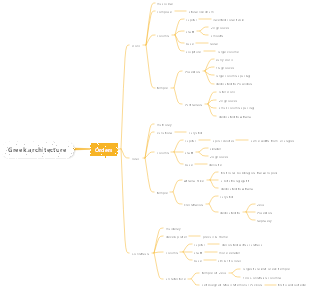
History of foreign ancient architecture
Chapter 1 Architecture in Ancient Egypt, Mesopotamia and the Iranian Plateau
Ways that monumental buildings enhance their commemoration (3 points)
Chapter 1 Architecture of Ancient Egypt
What conditions did the Nile River provide for the development of ancient Egypt (4 points)
Historical periods and architectural features of ancient Egypt (4 points)
1.1 Skilled craftsmen of stone buildings
Huge style building (3 points)
obelisk
carvings on stone
Mainly convex relief
Stigma size - the ratio of column length to column height is 1:5
Contrast between ruling class and working class
Imhotep
1.2 Residences and palaces
There were two types of primitive dwellings in ancient Egypt
A kind of wall with wood as the base, a wooden frame on top, and reed bundles as the wall, with mud or no mud on the outside (Lower Egypt)
The other type uses pebbles as the wall base, adobe walls, densely packed logs as the roof, and then a layer of soil, which looks like a rectangular earth platform with side legs. (Upper Egypt)
Mansion
cajon city
palace
The palaces of Amarna
Have a clear vertical axis and depth layout
1.3 The evolution of the pyramid
cause
It reflects the awareness that people in the purely agricultural era gained from the cycle of seasons and the cycle of life and death of crops. The ancient Egyptians were superstitious that after death, the soul is immortal. As long as the body is protected, they will be resurrected in the Paradise of Elysium three thousand years later for eternal life.
What's included
It includes a tomb chamber and a sacrificial hall. In addition to the spacious underground tomb, a sacrificial hall was also built with bricks on the ground. It was modeled after the popular residences in Upper Egypt, like a slightly tapered rectangular platform, with an entrance at one end (called the Ma'an). Staba)
Upper Egypt and Lower Egypt
Mausoleum of Menet in Negal
The improvements between the Pyramid of Zhaoser and the Tomb of Nepotka (2 points)
Giza Pyramids
They are all precise square cones with extremely simple forms. The towers are very tall. They are the Pyramid of Kufu, the Pyramid of Khafra and the Pyramid of Menkaure.
Figure - Cross-section of Kufu Pyramid
The evolution of the pyramid
1. Mastaba - the prototype of the pyramid
2. The tomb of Nebotka, the first dynasty emperor, at Saqqara
3. The first stone pyramid was the Pyramid of Zhaoser at Saqqara.
4. Giza Pyramids
1.4 Mausoleum in the canyon
During the Middle Kingdom, the capital moved to Thebes in Upper Egypt.
1. Changes in geographical environment: The widest canyon in the middle reaches is only about 15 kilometers, and the cliffs on both sides are hundreds of meters high. In such an environment, the artistic conception of the pyramid has completely lost its expressiveness.
2. The political situation changed: the emperor's status declined, and the local nobles became domineering. The local nobles dug tombs into caves on the cliffs. The emperor, who was held hostage by the nobles, also followed the tomb mechanism at that time.
The new layout of the emperor’s tomb
Digging a tomb into a cave
Tomb of Manduhotep III
pattern
pyramid
colonnade
effect
Balanced facade; integrated with the environment
axis
Expand the levels in the walk, see the big levels from the small, and gradually open up and close the levels, brewing the awe of the worshipers.
Tomb of Hatshepasu
Pillars of Osiris
1.5 Temple of the Sun
Cause (3 points)
How do temples embody the drama of religion? (2 points) How to reflect the mystery of the dark majesty of the hall? (4 o'clock)
Chapter 2 Architecture in Mesopotamia and the Iranian Plateau
The architecture in the two river basins can be roughly divided into two types: those on the lower reaches of the Euphrates and Tigris rivers and those on the upper reaches.
2.1 Main building types and shapes
Characteristics of housing in the Mesopotamia (4 points)
1. The walls are thick and the bays are narrow, so the indoor space is long and linear.
2. The river often overflowed, and it was rebuilt on the mounds several times, resulting in the form of high-rise buildings.
3. In order to strengthen the wall and delay its collapse. The outer walls of important buildings are separated by raised forts, forming a fixed shape of a pair of raised forts sandwiching the gate.
4. Delaying the soft collapse of adobe walls has led to many surface decoration techniques.
mountain terrace
2.2 Colorful finishing technology
Origin and evolution
Glazed bricks
2.3 Palace of Sagun II
Relics of Assyrian Civilization
2.4 Pasepolis
Part 2 Architecture of the European "Classical Age"
Chapter 3 Architecture of Aegean Culture
When the Ionians and Dorics established Greek culture, they largely inherited Aegean culture.
Crete
Palace of Knossos - what the ancient Greeks called the Labyrinth
Mycenae and Tyrone
There is a 3.5m wide and 3.5m high "Lion Gate" on the city wall of the Acropolis of Mycenae. There are stacks of coupons issued on it. The coupons are filled with a stone slab and a pair of lions standing facing each other are embossed in relief.
Chapter 4 Architecture in Ancient Greece
The Four Periods of Ancient Greece and Their Architectural Characteristics
4.1 The evolution of holy places and temples
In the process, two types of city-states were formed
1. In the city-states of Sicily, Italy and the Peloponnese Peninsula, agriculture was the mainstay. After the establishment of slavery, the clan tribes were not destroyed. The clan nobles enjoyed hereditary privileges and established an oligarchy. City-states are culturally backward and conservative
2. In Asia Minor, the Aegean Sea and Atiga, many civilians were engaged in handicrafts, commerce and navigation, and later established a republic.
Evolution of the Holy Land Complex
Characteristics of the Holy Land Complex
It does not seek to be flat and symmetrical, but is willing to adapt to and utilize various complex terrains to form a lively and changeable architectural scenery, with the temple taking over the overall situation.
The layout characteristics of oligarchic city-states
The acropolis was also the residential area for clan nobles. They are heavily guarded and have no close contact with the civilian population. Although a huge group of guardian temples were also built in the Acropolis, they adhered to the stipulation that the front faces east and were all arranged in parallel without prioritization. This was incompatible with the natural environment and created a heavy atmosphere.
The evolution of temple form
At first: "Main Room (Zhengwan)" (rectangular, with the narrower side facing forward, a door in the middle, and a pair of pillars in front of the door, forming a front porch)
Development: a place for public gatherings and an object of public appreciation
Final shape: Corridor-style temple, with two rows of pillars inside the sanctuary forming a central space and statues of gods.
The artistic function of the colonnade outside the temple (4 points)
After the 6th century BC, temples in important folk holy places generally adopted the form of corridors, but by this time they were already made of stone. (Picture - Typical 6-column corridor-style temple plan)
4.2 Evolution of column type
Transition from wooden architecture to stone architecture
Wood-Ceramic-Stone
What role did the terracotta material play in the development of column style? (3 points)
Two types of columns
Column type: refers to the specific methods of each element of the stone beam and column structure and their combination, from details to the whole.
The beauty of the human body and the harmony of numbers
The Ionic order of the democratic republic city-state
It is relatively beautiful and gorgeous, with light proportions and wide openings, reflecting the artistic taste of civilians engaged in handicrafts and commerce.
The Doric Order of an Oligarchic City-State
Heavy and clumsy, it reflects the artistic taste of oligarchic aristocrats in agricultural areas.
Corinthian order
The stigma is like a vigorous honeysuckle
As a symbol of tenacious vitality
4.3 Acropolis
Acropolis: originally meant to be the residence of slave owners and rulers
Acropolis
The Greek name is "Acropolis", which originally means "city on high places", "city-state on high hills"
In the 5th century BC, it became the center of national religious activities. After the Persian War, it became the national symbol.
Artistic achievements of the Acropolis (3 points)
Historical reasons for the prosperity of Athens (4 points)
The focus of construction is the Acropolis, the main purpose of construction (4 points)
Acropolis layout
The Acropolis is located on a small isolated hill in the center of Athens. The limestone on the top of the mountain is exposed and roughly flat, 70-80m higher than the surrounding plains. It is about 280m long from east to west and about 130m at its widest point from north to south. The mountain is so steep that there is only one tunnel at the west end that can be climbed. (Picture - General plan of the Acropolis)
Three aspects of the core of the Acropolis
Acropolis Gate
In order to give a more complete and imposing image to the foot of the mountain, it protrudes from the west end of the top of the mountain. And the ground is not leveled, but the western half is 1.43m lower than the eastern half. The roof is also disconnected
Use of Ionic columns in Doric buildings
Temple of Victory
Designer-Cary Crater
The artistic characteristics of the columns in the front and rear corridors (3 points)
Parthenon
The main designer was Ictinus, Callicrates participated in the design, and the sculpture was created by Fedi and his disciples.
As the center of the complex, it stands out from several aspects (4 points)
Vision Correction (4 points)
The artistic characteristics of carving
Column type
Erechtheion
Purpose: To commemorate the legendary ancestor of the Athenians
Shape: Ionic
Architect: Pytheos
Comparing the Parthenon and the Erechtheion (6 points)
4.4 Exploring new areas
Theaters and synagogues
Early days
Minoan Palace in Crete
Hellenistic period
subtopic
Summarize
From the perspective of theaters and auditoriums, the functions of public buildings during this period have been more in-depth, and architectural acoustics has also been initially understood. The internal spaces of the auditoriums are relatively developed. These are very meaningful improvements.
centralized monumental building
Represented by the Trophy Pavilion in Athens and the Mausoleum of Mosoleum at Haliknasu in Asia Minor
Trophy Pavilion Composition Techniques (3 points)
market gallery and stacked columns
Two-story open corridor with stacked columns
Chapter 5 Architecture of Ancient Rome
Historical development of ancient Rome (7 points)
The separation of powers in ancient Rome
Consul, Senate, Assembly of Citizens
Contribution to ancient Roman architecture (3 points)
"Glory to Greece, greatness to Rome"
5.1 Glorious arch technology
concrete
The main ingredient is an active volcanic ash, plus lime and gravel
Conditions for rapid development (3 points)
1. The mining and transportation of raw materials are cheaper and more convenient than stone.
2. You can use gravel as aggregate to save stone materials, and use pumice or other lightweight stones as aggregate to reduce the weight of the structure.
3. Except for a few skilled craftsmen, it can use a large number of unskilled slaves, while building arches with stones requires specialized craftsmen.
Innovations in concrete technology (4 points)
Get rid of load-bearing walls
Cross Arch Advantages (2 points)
1. The cross arch covers the square space and only requires pillars at the four corners instead of continuous load-bearing walls. The internal space of the building is liberated.
2. The cross arch is also convenient for opening side windows, which is very beneficial to the lighting inside large buildings.
vault system
most commonly used method
ribbed arch
The method of building a vault is to first build a series of arches, and then set up ribbed arches of stone slabs on top of them. The basic principle is to divide a vault into a load-bearing part and an enclosure part.
5.2 Development and finalization of column type
Tuscan column type
Conflicts to be resolved (3 points)
Column type: Decorative columns are affixed to the wall or piers, from the column base to the cornice, and the coupon holes are set in the column bays. Both the coupon feet and the coupon surface are decorated with column-like moldings to achieve consistent details and coordinate the style. The columns, eaves, etc. maintain the original proportions, but the bays are enlarged. The columns protrude from the wall approximately 3/4 of the column diameter.
Continuous coupons: Place the coupon feet directly on the pillars, with a small section of eaves in the middle.
Disadvantages of ancient Roman column style (3 points)
1. The columns are overly decorated and lose the elegance and dignity of the Greek columns.
2. It is no longer a structural component but a decoration.
3. Column introduction is formulaic and too rigid.
5.3 Vitruvius and the Ten Books on Architecture
Four Achievements in "Ten Books on Architecture"
1. It established the basic system of European architectural science
2. A very systematic summary of the practical experience of Greek and early Roman architecture
3. Vitruvius quite comprehensively established the basic principles of urban planning and architectural design, as well as the design principles of various types of buildings.
4. In accordance with the tradition of ancient Greece, Vitruvius combined rational principles with intuitive feelings, combined idealized beauty with beauty in real life, and discussed some basic principles of architectural art.
Disadvantages of "Ten Books on Architecture"
5.4 Contradictions in Ancient Roman Architecture
The shape of public buildings is divided into two categories according to their functions.
The first category, serving the invasion of military empires
The second category is those who serve the most decadent and barbaric life of slave owners.
sharp contradiction
The contradiction between production relations and productivity in slavery society (3 points)
5.5 The evolution of the square
The Square during the Republic (509 BC - 30 BC)
Romanum Square
Forum during the Imperial Period (30 BC - 395 BC)
caesar plaza
The first new form of a closed, axially symmetrical square with a temple as its main body
Announced the end of the Roman Republic and the advent of the Empire
Augustus Square
Trajan's Square
At the bottom of the square lies the Urbia basilica of the Trajan family.
basilica
The plane is rectangular, with colonnades on both sides, and a semicircular niche can be set up at the end. The roof is supported by several column structures. The central hall is high and open, while the side corridors on both sides are slightly lower. It is a large-scale building model, mostly used as hall buildings for courts, exchanges and conference venues. Although it looks simple from the outside, it is extremely beautiful inside.
Ji Gongzhu
Central idea: Praise the empire's military exploits and promote the authority of force
From the Forum of Romanum to the Forum of Trajan, the evolution of form clearly reflects the transition from republic to empire, and then the step-by-step strengthening of imperial power to deification.
5.6 Theater and Colosseum
5.7 Temples
Pantheon
A centralized form covered by a dome
Construction technology of domes (2 points)
Treatment of exterior walls
5.8 Public baths
Major achievements of the Baths of Diocletium (3 points)
Baths of Caracalla
General map rules
Rich worldly life
Main function
Axis, symmetrical layout
structural design
Rich vault system
heating
Hollow bricks for warmth
5.9 Residences and Palaces
See the importance of arch structure in Roman architectural achievements from the Colosseum, Pantheon and Baths of Caracalla (3 points)
The great influence of arch structure on ancient Roman architecture (3 points)
1. The maturity of arch structure technology has fundamentally changed some ancient architectural forms and arts that relied on beam and column structures.
2. The arch structure brings a new artistic image to ancient Roman architecture (arch arches, domes, niches, columns)
3. The arch structure also transformed urban construction (water canals)
Part Three European Medieval Architecture
Chapter 6 Byzantine Architecture
6.1 Domes and centralized forms
Sail arch and its diagram
Dome, drum base, sail arch
balance of dome
greek cross
6.3 Hagia Sophia
Comparison of the interior spaces of the Pantheon and Hagia Sophia
Chapter 7 Medieval Architecture in Western Europe
style division
5th century-10th century
early christian style
10th century-12th century
Romance style
12th century-15th century
gothic style
7.1 From abbey church to city church
latin cross basilica
St. John's Church
St. Paul's Church
monasteries and their churches
Reasons for the rise of monasteries and their areas of existence (3 points)
Changes in the form of the monastery (4 points)
7.2 Gothic churches centered in France
From Romanesque to Gothic
1. Different beliefs
2. The relationship between the church and citizens
3. Different sources of funds
4.Builder
5. Internal space
Gothic churches, marked by structural methods, were first formed in the Saint-Denis church of the royal family in the North District of Paris. They were formed in conjunction with the Cathedral of Chartres. The mature representative is Notre Dame de Paris. The works of the most prosperous period include Hans Cathedral. Church, Amiens Cathedral
Gothic cathedral shape
Basically Latin cross
Gothic church interior treatment
Internal Contradiction (3 points)
Part 4 Architecture in the period of the budding capitalism and absolute military power in Europe
Chapter 8 Italian Renaissance Architecture
The core content of the development of the Renaissance
Theoretical basis for struggle (2 points)
Causes of Decline (2 points)
1. The new culture will of course be counterattacked by medieval traditions.
2. On the one hand, the new culture of the bourgeoisie is opposed to feudal culture; on the other hand, it is also divorced from the masses of the citizens.
8.1 Spring News = Florence Cathedral
The beginning of the history of Italian Renaissance architecture
The main church was built as a monument to the republic after the merchant and craft guilds of Florence seized power from the nobility at the end of the 13th century.
In the early 15th century, Brunelleschi designed the dome
historical meaning
First, the Catholic Church regarded centralized planes and domes as the characteristics of heretical temples and strictly rejected them, but the craftsmen actually ignored the precepts of the church. Although the power of the Catholic Church was very weak in Florence at that time, it still required a lot of courage and a high level of consciousness to do this. It is therefore a sign of a breakthrough in architecture from the spiritual tyranny of the Church
Second, the domes of ancient Rome and the large domes of Byzantium are half-exposed and half-covered in appearance, and they are not used as an important modeling method. But this one in Florence draws on the techniques of small Byzantine churches and uses a drum base to express the entire dome. Including the lighting pavilion, it has a total height of 107 meters, becoming the center of the entire city's outline. This was unprecedented in Western Europe and, as such, was a sign of Renaissance ingenuity.
Third, both in terms of structure and construction, this dome is extremely original. , which marked the general progress of science and technology during the Renaissance
8.2 A tortuous journey
Nursery
Brunelleschi design
Basi Chapel
Brunelleschi design
New characteristics of early Renaissance architecture-citizen culture (4 points)
new high
Performance (4 points)
Tambierto
A typical representative of the monumental style of High Renaissance architecture is the Tempietto in Rome.
Designer: Bramonte
Two tendencies of formalism
One tendency is to adhere to the past and worship the past dogmatically
Another tendency is to pursue novelty and ingenuity
"Mannerism"
It was used by the reactionary Catholic Church in the 17th century and developed into "Baroque" architecture; the dogmatic column style was absorbed by academic classical architecture in the 17th century and used by the autocratic monarchy.
Basilica of Weijinzhai
“Palladian Motif” Facade Design
manor house
The most famous of the manor houses designed by Palladio is the Garden Hall Villa
8.4 Plaza Building Group
Piazza San Marco and floor plan
8.7 St. Peter’s Basilica and its construction
The greatest monument of the Italian Renaissance is St. Peter's Basilica in Rome
What form does the church take? (2:00)
Bramante's plan
Conceive
repeated several times
Raphael
Paruzzi
little sangalo
Michelangelo's designs
damage
8.8 Baroque Architecture in Italy
Main features of Baroque architecture (3 points)
Overview of Baroque: The original meaning is a deformed pearl. In the 16th and 17th centuries, the derived meaning was clumsy, hypocritical, artificial or despicable style, and illiterate.
church
The church has a new form (5 points)
Jesuit ancestral hall
The first masterpiece of Baroque architecture
Church of San Carlo with Four Fountains in Rome
Borromini
Representative works of late baroque churches
St. Andrew's Church
Bernini
Art synthesis
Characteristics of murals (4 points)
Characteristics of engraving (5 points)
Architectural nature of frescoes and sculptures
Town square
Piazza Navona
spanish steps
Chapter 9 French Classical Architecture
9.1 Initial changes
champagne store
9.3 Monument to absolute military power
Design competition for the east facade of the Louvre Palace
The composition reflects the hierarchical social order centered on the monarch and embodies the blend of French classicism and Italian Baroque.
Palace of Versailles
The largest single palace building in the world
Place Vendôme
9.4 Decline of monarchy and Rococo
The principle of Rococo art is pleasure
rococo decoration
Characteristics of Rococo (3 points)
Representative work: The living room of the House of Soubis in Paris
Nancy Square Group
Harmony Square
Chapter 5 Architecture of the European and American Bourgeois Revolutionary Period
Chapter 11 Architecture during the British Bourgeois Revolution
11.1 Before death
parish chapel
Christopher Lun
basic composition
Main lessons in bell tower composition (3 points)
11.2 Battle for the Monument – St. Paul’s Cathedral
Christopher Lun
monument
St. Paul's Cathedral becomes a monument to the British bourgeois revolution
Chapter 12 Architecture during the French Bourgeois Revolution
12.1 The great liberation of thought
enlightenment thought
The difference between the "rationality" of the Enlightenment and the "rationality" of 17th century rationalism
There are mainly two aspects
12.3 The triumphal song of the big bourgeoisie - imperialism
Military merit temple
Arch of Lions
Europe's largest triumphal arch
Star Plaza