MindMap Gallery corn
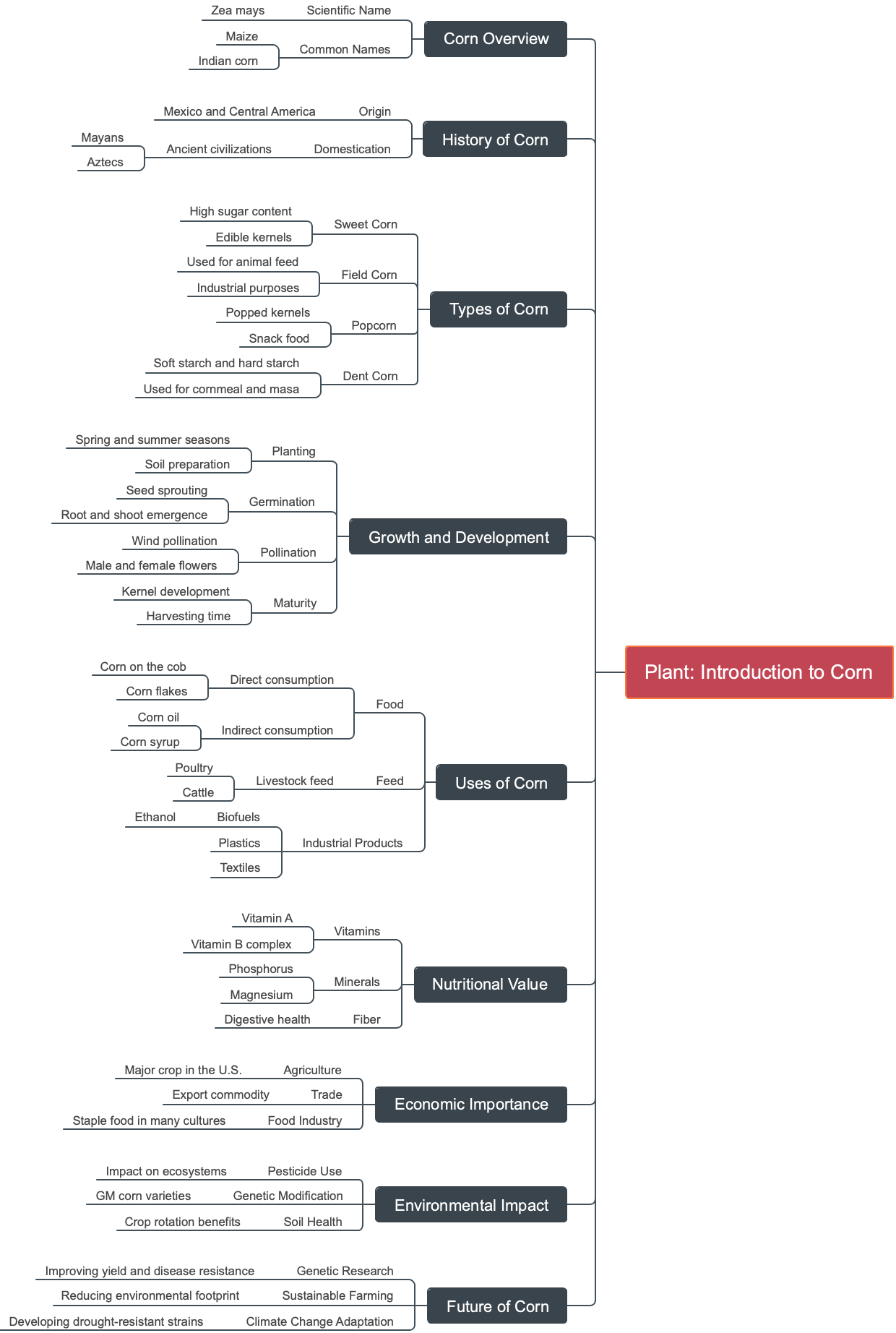
This is a mind map about corn, summarizing its uses, storage method, Quality Index, Factors affecting price, planting time, Domestic planting distribution, etc.
Edited at 2024-01-19 10:44:28This is a mind map about bacteria, and its main contents include: overview, morphology, types, structure, reproduction, distribution, application, and expansion. The summary is comprehensive and meticulous, suitable as review materials.

This is a mind map about plant asexual reproduction, and its main contents include: concept, spore reproduction, vegetative reproduction, tissue culture, and buds. The summary is comprehensive and meticulous, suitable as review materials.
This is a mind map about the reproductive development of animals, and its main contents include: insects, frogs, birds, sexual reproduction, and asexual reproduction. The summary is comprehensive and meticulous, suitable as review materials.
This is a mind map about bacteria, and its main contents include: overview, morphology, types, structure, reproduction, distribution, application, and expansion. The summary is comprehensive and meticulous, suitable as review materials.
This is a mind map about plant asexual reproduction, and its main contents include: concept, spore reproduction, vegetative reproduction, tissue culture, and buds. The summary is comprehensive and meticulous, suitable as review materials.
This is a mind map about the reproductive development of animals, and its main contents include: insects, frogs, birds, sexual reproduction, and asexual reproduction. The summary is comprehensive and meticulous, suitable as review materials.
corn
planting time
spring corn
Early April to late August
summer corn
Mid-to-late May to mid-September
Domestic planting distribution
Spring sowing corn areas in the north: three northeastern provinces, Inner Mongolia, and Ningxia
Summer corn sowing areas in the Huang-Huai-Hai Plain: mainly Shandong and Henan
Element
Starch: accounting for more than 60% of the total mass of corn
protein
Dietary fiber
vitamins
Minerals and other nutrients
use
subtopic
1. Eat directly
2. Feed
3. Processed products:
①Food processing
②Production of amylase: glucose, maltose, maltose syrup, fructose, etc.
③Production of lysine, monosodium glutamate, amino acids, citric acid, etc.
④Pharmaceutical industry: Starch is the most important raw material for the antibiotic industry. Almost all antibiotics are produced by starch fermentation.
⑤Papermaking industry: Among papermaking fine chemicals, starch and its derivatives are the most important chemical additives
⑥Petroleum processing: Corn can be used to produce anhydrous ethanol with a purity of more than 99.5%, which will be mixed with gasoline in an appropriate proportion to fully burn the gasoline and reduce pollutant emissions.
storage method
Low temperature airtight: According to the storage characteristics of corn, it is suitable for low temperature and dry storage. One is dry airtight, and the other is low temperature freezing airtight.
Corn ear storage: The corn is not threshed, the porosity in the ear pile is high, the ventilation conditions are good, and it is suitable for the low temperature season.
Quality Index
Corn test weight: ① First class test weight: > or = 720g/l, ② Second class test weight: > or = 685g/l < 720g/l, ③ Third class test weight: > or = 650g/l < 685g/l, ④ Fourth class Bulk weight: > or = 620g/l < 650g/l, ⑤ Fifth-grade bulk density: > or = 590g/l < 620g/l, ⑥ Bulk density lower than 590g/l is not a first-class product.
Moisture: Generally, the safe moisture content of corn in Northeast China is 14.0%
Price factors
weather factors
Market demand
policy factors
production factors
Global supply and demand changes
Supply worldwide
①North America: U.S. corn production accounts for more than 40% of global corn production
② Asia: China’s corn production accounts for about 20% of global corn, followed by India and the Philippines
③Europe: Ukraine, France, Italy
④South America: Brazil, Argentina (planting cycle: October to March of the following year)
need
Main consumer countries: United States, China, European Union, Brazil, Mexico
Consumer demand: rations account for about 20%, feed accounts for about 70%, and industrial processing
import and export
Imports: Domestic imports are currently dominated by Brazilian corn.
Exporting countries: United States, Brazil, Argentina, Ukraine
Related alternatives
The price ratio of wheat and corn: 0.9:1.0. The amount of corn replacement should be controlled below 2/3. In the feed for young livestock and poultry, the proportion should be reduced to 1/5.