MindMap Gallery Engineering Chemistry
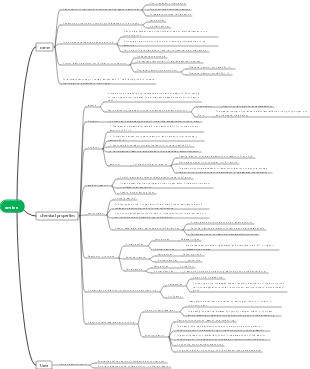
This is a mind map about engineering chemistry of NPU, which mainly includes the chemical composition and aggregation state of substances, material structure, electrochemistry, chemical principles, etc.
Edited at 2024-01-16 16:17:53This is a mind map about bacteria, and its main contents include: overview, morphology, types, structure, reproduction, distribution, application, and expansion. The summary is comprehensive and meticulous, suitable as review materials.

This is a mind map about plant asexual reproduction, and its main contents include: concept, spore reproduction, vegetative reproduction, tissue culture, and buds. The summary is comprehensive and meticulous, suitable as review materials.
This is a mind map about the reproductive development of animals, and its main contents include: insects, frogs, birds, sexual reproduction, and asexual reproduction. The summary is comprehensive and meticulous, suitable as review materials.
This is a mind map about bacteria, and its main contents include: overview, morphology, types, structure, reproduction, distribution, application, and expansion. The summary is comprehensive and meticulous, suitable as review materials.
This is a mind map about plant asexual reproduction, and its main contents include: concept, spore reproduction, vegetative reproduction, tissue culture, and buds. The summary is comprehensive and meticulous, suitable as review materials.
This is a mind map about the reproductive development of animals, and its main contents include: insects, frogs, birds, sexual reproduction, and asexual reproduction. The summary is comprehensive and meticulous, suitable as review materials.
Engineering Chemistry
chemical composition and aggregation state of matter
Aggregation status
gas
Gas introduction
No fixed shape, diffuseable, compressible
type
Single element composition
Compound composition
Various gases
ideal gas
basic properties
The volume of gas molecules is zero
The interaction force between gas molecules is zero
Gas molecules are not adsorbed
ideal gas equation of state
pV=nRT
Dalton's law of partial pressures
p=p1 p2 ……pn
liquid
Basic properties
subtopic
density
ρ=M/V
solution
Mass fraction (ω)
Ratio of mass of solute in solution to mass of solution
mole fraction (x)
Ratio of mass of solute in solution to mass of solution
Volume fraction (φ)
Ratio of mass of solute in solution to mass of solution
Mass-volume concentration (ρ)
The mass of a component per unit volume of a mixture is called the mass concentration of that component
Amount concentration of substance (C)
The volume of solute (liquid) as a percentage of the total solution volume
Molarity (mB)
The amount of a solute in a solution divided by the mass of the solvent
solid
crystal
characteristic
Long-range order, fixed melting point, and anisotropy
type
Ionic crystal: composed of anions and cations combined by ionic bonds
Metal crystal: composed of metal ions bound by metallic bonds
Atomic crystal: composed of atoms held together by covalent bonds
Molecular crystal: molecules are combined by weak forces such as hydrogen bonds or van der Waals forces.
Amorphous
Other forms
Liquid crystal, supercritical state
Changes in physical state
three phase diagram
Vaporize, liquefy
material structure
Atomic structure
Hydrogen atomic spectrum
v=c/λ=R (1/n1 squared 1/n2 squared)
bohr theory
Quantization of energy and light quantum E=hv
stationary orbit
Electronic transition and atomic spectrum: v=(E2-E1)/h
multi-electron atomic structure
Wave-particle duality: λ=h/P=h/mv
Quantum numbers
Principal quantum number (n): number of energy layers and electron layers
Angular quantum number (l): orbitals at all levels (0-s, 1-p...)
Magnetic quantum number (m): from -l to l, the number is equal to the number of orbitals
Spin quantum number (ms): electron spin state ±1/2
Orbital and electron cloud distribution
Orbital graphics: s-ball, p-dumbbell shape, d-petal shape·
Orbital energy level: E=-13.6*Z square/n square
If n is the same, the energy level will be higher if l is larger; if l is the same, the energy level will be higher if n is larger.
Distribution rules of electrons outside the core in the ground state
Pauli Exclusion (Pauli): For the same orbit (n, l, m are the same) the ms must be different and the spin direction must be opposite.
The principle of minimum energy: the larger the atom (n 0.7l), the higher the energy level; the larger the ion (n 0.4l), the higher the energy level.
Notation
atomic real representation
rearrange
electron loss sequence
Hundt's rule
The distribution on equivalent orbits always occupies different orbits as much as possible, and the spins are parallel
Special case: half full and full
periodic law of elements
Structure
Ionization energy
electron affinity
electronegativity
chemical bond
subtopic
Molecular Structure
subtopic
chemical principles
heat of reaction
Basic principles of chemical reactions
Solution and Ion Equilibrium
electrochemistry
Primary battery
Cell
metal corrosion