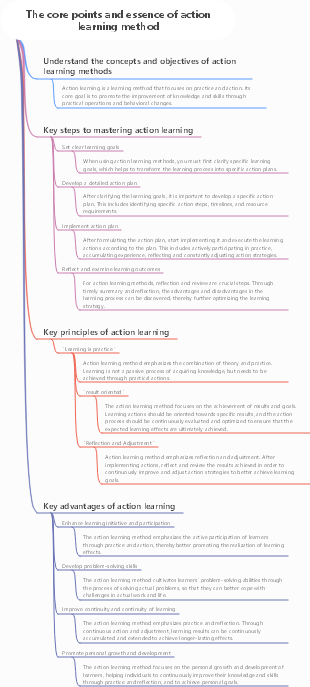
MindMap Gallery The core points and essence of action learning method
This is a mind map about the core points and essence of action learning method. It tells stories about the core points and essence of action learning method. If you are interested in the story of the core points and essence of action learning method, you are welcome to read this Mind map collection and likes~
Edited at 2022-09-19 07:19:54This is a mind map about bacteria, and its main contents include: overview, morphology, types, structure, reproduction, distribution, application, and expansion. The summary is comprehensive and meticulous, suitable as review materials.

This is a mind map about plant asexual reproduction, and its main contents include: concept, spore reproduction, vegetative reproduction, tissue culture, and buds. The summary is comprehensive and meticulous, suitable as review materials.
This is a mind map about the reproductive development of animals, and its main contents include: insects, frogs, birds, sexual reproduction, and asexual reproduction. The summary is comprehensive and meticulous, suitable as review materials.
This is a mind map about bacteria, and its main contents include: overview, morphology, types, structure, reproduction, distribution, application, and expansion. The summary is comprehensive and meticulous, suitable as review materials.
This is a mind map about plant asexual reproduction, and its main contents include: concept, spore reproduction, vegetative reproduction, tissue culture, and buds. The summary is comprehensive and meticulous, suitable as review materials.
This is a mind map about the reproductive development of animals, and its main contents include: insects, frogs, birds, sexual reproduction, and asexual reproduction. The summary is comprehensive and meticulous, suitable as review materials.
The core points and essence of action learning method
Definition: Action learning is a learning method of continuous improvement through practice, reflection and adjustment, aiming to improve the learning capabilities and performance of individuals and organizations.
Example: Action learning is a learning method that allows people to discover and solve problems through practical actions, and to continuously improve through reflection and adjustment.
immersive learning
Example: Immersive learning refers to learning and experiencing in-depth practice through full immersion and participation.
Example: For example, when learning a new language, learning can be enhanced by having conversations with native speakers and participating in a real language environment.
Example: Another example: when learning a musical instrument, you can practice and experience the beauty of music by repeatedly practicing different pieces of music to deepen your understanding of music techniques and theory.
Reflection and Summary
Example: Reflection and summary are important parts of the action learning method. Through reviewing and thinking about actions, problems can be discovered, lessons learned, and adjustments made.
Example: After completing a project, you can reflect on the problems you encountered during the project, the methods you used to solve them, and the results you achieved, and summarize the lessons learned so that you can better deal with similar situations in future actions.
Example: Similarly, in daily work, individuals can regularly conduct self-reflection and think about their career development direction, work efficiency and skill improvement, etc., so as to continuously optimize and improve their performance.
keep improve
Example: Continuous improvement is a core value of the action learning method, which means constantly introducing changes and innovations to adapt to changing circumstances and requirements.
Example: At the organizational level, continuous improvement can be the introduction of new work processes, the adoption of new technologies, or cultivating employees' learning capabilities and innovation awareness to continuously improve the organization's performance and competitiveness.
Example: On an individual level, continuous improvement can be the continuous learning of new knowledge and skills, and engaging in new projects and challenges to continuously improve personal abilities and achievements.
Practice and Application
Example: The essence of action learning lies in practice and application. Only by applying the learned knowledge and skills to actual situations can its value and effect be truly realized.
Example: For example, when learning management theory, only by applying the learned management principles to specific management practices can management effects and organizational goals be effectively improved.
Example: Another example: when learning programming, only by writing actual code and solving actual problems can you improve your programming skills and create software products of practical value.