MindMap Gallery What is action learning
This is a mind map about what action learning is, and tells the story about what action learning is. If you are interested in the story about what action learning is, please feel free to collect and like this mind map~
Edited at 2022-09-22 12:34:09This is a mind map about bacteria, and its main contents include: overview, morphology, types, structure, reproduction, distribution, application, and expansion. The summary is comprehensive and meticulous, suitable as review materials.

This is a mind map about plant asexual reproduction, and its main contents include: concept, spore reproduction, vegetative reproduction, tissue culture, and buds. The summary is comprehensive and meticulous, suitable as review materials.
This is a mind map about the reproductive development of animals, and its main contents include: insects, frogs, birds, sexual reproduction, and asexual reproduction. The summary is comprehensive and meticulous, suitable as review materials.
This is a mind map about bacteria, and its main contents include: overview, morphology, types, structure, reproduction, distribution, application, and expansion. The summary is comprehensive and meticulous, suitable as review materials.
This is a mind map about plant asexual reproduction, and its main contents include: concept, spore reproduction, vegetative reproduction, tissue culture, and buds. The summary is comprehensive and meticulous, suitable as review materials.
This is a mind map about the reproductive development of animals, and its main contents include: insects, frogs, birds, sexual reproduction, and asexual reproduction. The summary is comprehensive and meticulous, suitable as review materials.
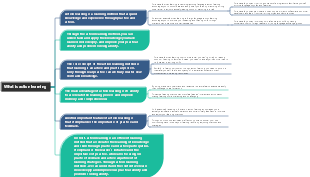
What is action learning
Action learning is a learning method based on practice and experience that continuously improves and improves through reflection and adjustment of actions.
For example, a person wants to learn how to ride a bicycle.
He can start trying to ride, reflecting on his movements and sense of balance when he falls.
He may find that he is not keeping his balance and try to correct his posture and maintain balance.
He may also find that he is not pushing hard enough on the pedals and learn to pedal with just enough force.
He can also observe how others ride their bikes and try to imitate their actions.
For example, a project manager wants to improve team communication.
He can observe how team members react by trying different communication methods.
He may find that some members prefer email communication, while others prefer face-to-face communication.
He may also find a lack of clarity in communication and learn to express himself more accurately.
He can also learn about the communication strategies of other project managers and consider borrowing their methods.
Action learning emphasizes the combination of practice and reflection, gaining experience and knowledge by constantly trying new actions, and discovering and solving problems through reflection, thereby achieving the growth and progress of individuals and teams.
For example, a salesperson wants to improve his sales skills.
He can get feedback by continually practicing the sales process and recording the results of each sale.
He may find that certain sales tactics are more popular with customers and decide to emphasize those tactics in his next sale.
He may also find that some customers object to certain sales methods and decide to adjust his sales methods.
He can also attend sales training courses to learn from the successes of other salespeople and apply them to his own sales process.
For example, a team wants to optimize processes and increase efficiency.
They can find the best way to work by continually experimenting and adapting their processes.
They may find that certain steps can be combined or simplified, saving time and resources.
They may also discover bottlenecks in certain areas and decide to add resources or adjust work allocation.
They can also borrow workflows from other teams and make appropriate modifications and customizations.
Action learning is a flexible, practice-oriented learning method that can be applied in various fields and levels to continuously optimize and improve the performance and capabilities of individuals, teams, and organizations.