MindMap Gallery Scope management mind map
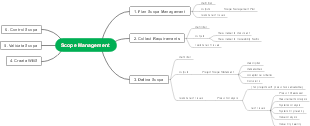
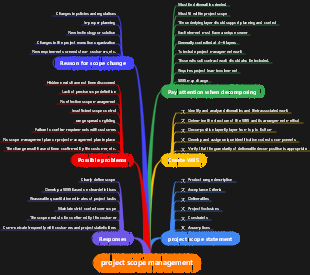
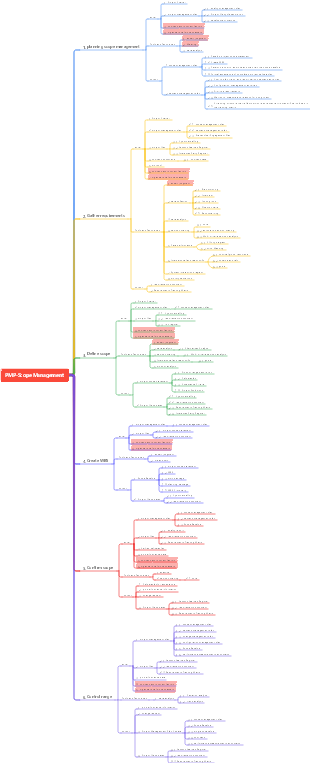
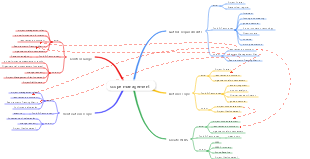
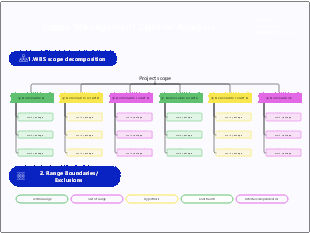
Project scope management includes procedures that ensure that the overall work requirements and individual work requirements covered by the project are completed successfully. The following figure summarizes the overview of scope management, planning scope management, gathering requirements, defining scope, controlling scope, confirming scope, and creating work breakdown structure.
Edited at 2021-07-20 15:33:52This is a mind map about bacteria, and its main contents include: overview, morphology, types, structure, reproduction, distribution, application, and expansion. The summary is comprehensive and meticulous, suitable as review materials.

This is a mind map about plant asexual reproduction, and its main contents include: concept, spore reproduction, vegetative reproduction, tissue culture, and buds. The summary is comprehensive and meticulous, suitable as review materials.
This is a mind map about the reproductive development of animals, and its main contents include: insects, frogs, birds, sexual reproduction, and asexual reproduction. The summary is comprehensive and meticulous, suitable as review materials.
This is a mind map about bacteria, and its main contents include: overview, morphology, types, structure, reproduction, distribution, application, and expansion. The summary is comprehensive and meticulous, suitable as review materials.
This is a mind map about plant asexual reproduction, and its main contents include: concept, spore reproduction, vegetative reproduction, tissue culture, and buds. The summary is comprehensive and meticulous, suitable as review materials.
This is a mind map about the reproductive development of animals, and its main contents include: insects, frogs, birds, sexual reproduction, and asexual reproduction. The summary is comprehensive and meticulous, suitable as review materials.
scope management Scope Management
Overview
The main work
Clarify project boundaries
Monitor project execution
Prevent project scope creep
the difference
Product Range
Functions included in the product (technical main line)
is the basis of the project scope
Whether it is completed or not depends on the product description.
Product scope description is an important component of the project scope statement. Changes in product scope first affect the project scope.
Project scope
The work required to deliver the product (management main line)
Project Scope Baseline
Approved project scope statement, WBS, WBS dictionary
This is a measure of whether the project scope is complete
scope management process
Each process
Input and output tool technology
planning scope management
scope management plan
It can be included in the project management plan or as a separate item. It can be detailed, general, formal or informal.
content
How to create a project scope statement
Scope definition
How to create a WBS from a scope statement
How to maintain and approve a WBS
Create, maintain, and approve WBS
range baseline
How to confirm and formally accept completed project deliverables
scope confirmation
How to handle project scope changes
scope control
demand management plan
content
How to plan, track, and report various demand activities
Resources needed for demand management
training program
Strategies for project stakeholders to participate in requirements management
Criteria and corrective procedures for determining inconsistencies between project scope and requirements
Configuration management activities
Gather requirements
Requirements classification
Business needs
high level requirements
Stakeholder needs
excessive demand
quality requirements
QFD quality function deployment
basic needs
expected demand
Other needs
Comparing textbook 1.41 needs analysis
User needs
system requirement
Tool technology
Interview
focus group
Moderator-led interactive discussion with selected stakeholders and subject matter experts
Stakeholders are generally not cross-functional
guided seminar
Invite major cross-functional stakeholders to participate in discussions to quickly define functional requirements and coordinate differences among stakeholders.
Emphasis on reaching consensus
Group innovation technology
Brainstorming
nominal group
Voting is an in-depth application of brainstorming
Delphi
Chat with each expert privately, formulate a summary of opinions and feed them back to each expert, and repeatedly form the opinions of the expert group
Concept/Mind Map
Connect brainstorming ideas with pictures
Affinity diagram (KJ method)
Use diagrams to summarize the problems in order to find the reasons. The core is brainstorming, and find the reasons based on the results.
Multi-criteria decision analysis
With the help of decision matrix, multiple criteria of risk level, uncertainty, value and return are established
group decision making techniques
unanimously agreed
most principles
relative majority rule
dictatorship
prototype method
Benchmarking
Planned (actual) practices are compared with those of similar organizations
System interaction diagram
Shows the system's inputs and input providers, outputs and output providers
File analysis
requirements document
Business needs
Stakeholder needs
Solution requirements
Project requirements
Service levels, performance, safety, compliance
excessive demand
Demand-related assumptions, dependencies, and constraints
Requirements tracking
content
understand
Forward tracking, reverse tracking, traceback, backtracking
The arrow represents the requirements tracing capability contact chain
The fifth type of contact chain is used to deal with the logical correlation between various types of requirements.
Requirements Tracking Matrix
The relevant attributes of each requirement should be recorded, including requirement description, owner, source, priority, current status (in progress, canceled, postponed, newly added, approved, assigned, completed, etc.)
Define scope
Specify the process of describing the project (product) in detail and clarify the product boundaries
Tools and techniques
expert judgment
product analysis
Ask and answer questions about products to form a description of product uses and features
Alternative generation
Specify as many potential alternatives as possible
guided seminar
project scope statement
Include project scope and product scope
Content (back)
Product range description
Acceptance Criteria
Conditions that need to be met before the deliverables pass acceptance, and the acceptance process
Deliverables
Project Exclusions
What is excluded from the project helps manage stakeholder expectations
Constraints
Assumptions
Control range
definition
Supervise scope status and manage scope baseline changes
reason
government policy
Poor project scope planning
New technologies, new means, new solutions
Changes in the project execution organization itself
Customer needs change
The main work
Influence the factors that cause scope changes and move them in a favorable direction
Determine whether the scope has changed
Change management should ensure that all requested changes are processed in accordance with the overall change control process of the project
Confirm scope
Phased acceptance should be carried out throughout the project Formal acceptance of completed deliverables
Tool technology
examine
Also known as: review, review, audit, walk-through, inspection, testing, etc.
group decision making
Confirmation steps
Determine when scope validation is required
Identify what inputs are needed for scoping validation
Confirm the formally accepted criteria and elements of the scope
Determine the organizational steps for a scoping meeting
Organization scope confirmation meeting
Stakeholder concerns
Management
progress, funds, resources
client
Product range
project management staff
Whether the deliverables are sufficient and must be completed, and whether time, funds, and resources are sufficient
project team members
Elements of own participation and responsibility
terminology comparison
and verify products
Verify product
Validation by the customer at the end of the project or phase, emphasizing the integrity of the product
Confirm scope
There is customer validation at the end of the phase, mainly for the deliverables
and quality control
QC
Emphasize the correctness of deliverables
Generally before or at the same time as confirming the scope
Belongs to internal inspection
Confirm scope
Emphasis on delivering results to gain customer acceptance
Usually at the end of the stage
Inspection by external stakeholders
Create work breakdown structure WBS
All project team members, users, Stakeholders jointly complete and unanimously confirm
WBS level
milestone
Important checkpoints are milestones, important milestones are baselines
work package
The lowest level deliverables of WBS
Need to be very specific in order to take on tasks that make sense of themselves
Work package size should follow the 8/80 principle
control account
A work package or an element above a work package
A control account can contain multiple work packages, and a work package can only belong to one control account.
planning package
WBS elements below control accounts and above work packages
The work content is known, but detailed progress activity WBS elements are still lacking.
WBS Dictionary
Documentation used to explain encoding identifiers in WBS
break down
Main work (back)
Identify and analyze deliverables and related work
What to decompose
Determine the structure and arrangement of the WBS
How to decompose
Top-down, layer-by-layer refinement
break down
Develop and assign identification codes to WBS components
coding
Verify that the level of decomposition of deliverables is appropriate
Check
in principle
functional or technical principles
organizational structure
system or subsystem
Way
Treat each life cycle stage as a second layer
Main deliverables as second layer
Subprojects (sourced externally) as second layer
form
tree shape
The hierarchy is clear, intuitive and structural, but not easy to modify. Not suitable for large, complex projects
Table type
Less intuitive, but can reflect all work elements, suitable for large projects
Fishbone shape
uncommonly used
Precautions
WBS is deliverable oriented
The WBS must be consistent with the project scope
The underlying layer of the WBS should support planning and control
There must be one and only one person responsible for the elements of the WBS
WBS guidance
WBS should be controlled at 4 to 6 levels. Large projects with more than six levels can be divided into several sub-projects to do WBS.
A work unit can only belong to a certain upper-level unit to avoid cross-subordination.
The WBS should include project management work and subcontracted work.
WBS preparation requires the participation of all (main) stakeholders and project team members
The WBS is not static. After the WBS is established, the WBS may need to be modified. The so-called rolling decomposition principle
WBS function
Describe project scope
Define project boundaries
Assign personnel to each independent unit and specify personnel responsibilities
For independent units, estimate time, cost, and resource requirements to improve estimation accuracy
Baseline project progress and control
Link project work to financial accounts
Determine work content and work sequence
Prevent demand from spreading