 Wondershare EdrawMind
MindMap Gallery Earth
- 69
- 1
Earth
The earth is our common home. The knowledge about the earth is too extensive. The earth is a complex and unique planet that breeds life and provides an environment suitable for human habitation. As science develops, our understanding of the earth will continue to deepen.
Edited at 2024-10-13 23:18:53
- 把時間當作朋友
這是一篇關於把時間當作朋友的心智圖,《把時間當作朋友》是一本關於時間管理和個人成長的實用指南。作者李笑來透過豐富的故事和生動的例子,教導讀者如何克服拖延、提高效率、規劃未來等實用技巧。這本書不僅適合正在為未來奮鬥的年輕人,也適合所有希望更好地管理時間、實現個人成長的人。
- Treat time as a friend
This is a mind map about treating time as a friend. "Treating Time as a Friend" is a practical guide on time management and personal growth. Author Li Xiaolai teaches readers practical skills on how to overcome procrastination, improve efficiency, and plan for the future through rich stories and vivid examples. This book is not only suitable for young people who are struggling for the future, but also for everyone who wants to better manage time and achieve personal growth.
- 高效能人士的七個習慣
這七個習慣相輔相成,共同構成了高效能人士的核心特質。透過培養這些習慣,人們可以提升自己的領導力、溝通能力、團隊協作能力和自我管理能力,從而在工作和生活中取得更大的成功。
Earth
- 把時間當作朋友
這是一篇關於把時間當作朋友的心智圖,《把時間當作朋友》是一本關於時間管理和個人成長的實用指南。作者李笑來透過豐富的故事和生動的例子,教導讀者如何克服拖延、提高效率、規劃未來等實用技巧。這本書不僅適合正在為未來奮鬥的年輕人,也適合所有希望更好地管理時間、實現個人成長的人。
- Treat time as a friend
This is a mind map about treating time as a friend. "Treating Time as a Friend" is a practical guide on time management and personal growth. Author Li Xiaolai teaches readers practical skills on how to overcome procrastination, improve efficiency, and plan for the future through rich stories and vivid examples. This book is not only suitable for young people who are struggling for the future, but also for everyone who wants to better manage time and achieve personal growth.
- 高效能人士的七個習慣
這七個習慣相輔相成,共同構成了高效能人士的核心特質。透過培養這些習慣,人們可以提升自己的領導力、溝通能力、團隊協作能力和自我管理能力,從而在工作和生活中取得更大的成功。
- Recommended to you
- Outline




Earth
Overview
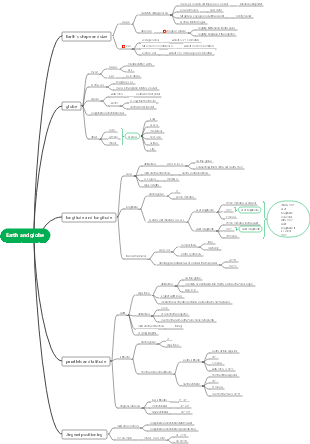
The Earth is the third planet located 150 million kilometers from the sun. The total area of the earth is about 510.1 million square kilometers, of which about 29.2% (148.94 million square kilometers) is land composed of continents and islands, and the remaining 70.8% (361.132 million square kilometers) is mostly covered by oceans, bays and other salty areas. Covered by water bodies, it is also covered by lakes, glaciers, rivers and other fresh water bodies, especially glaciers, which together form the hydrosphere. Most of Earth's polar regions are covered in ice.
Earth's atmosphere is mainly composed of nitrogen and oxygen. The tropics receive more solar energy than the polar regions, and it is redistributed through atmospheric and ocean circulation. Greenhouse gases also play an important role in regulating surface temperatures. The climate of a region is determined not only by latitude, but also by factors such as altitude and proximity to the area and the ocean.
Earth's gravity interacts with other objects in space, especially the Moon, Earth's only natural satellite. The Earth's axis of rotation is tilted relative to the plane of its orbit, creating seasons on Earth. Gravitational interactions between the Earth and the Moon cause tides that stabilize the Earth's orientation on its axis and gradually slow its rotation.
The World Earth Day is celebrated on April 22 every year. It is a holiday specially established for world environmental protection.
revolution and rotation
revolution
The average distance between the Earth and the sun in its orbit around the sun is about 150 million kilometers (93 million miles). It makes one revolution every 365.2564 mean solar days (365 days, 6 hours, 9 minutes and 10 seconds), which is called a sidereal year. The revolution causes the sun to have an apparent movement of about 1° eastward relative to the star every day, and the movement every 12 hours is equivalent to the apparent diameter of the sun or the moon. Due to this movement, it takes the Earth an average of 24 hours, or one solar day, to complete one rotation on its axis and allow the Sun to pass through the Midheaven again. The average speed of the Earth's revolution is about 29.8 km/s (107,000 km/h). It can travel 12,742 km (7,918 mi) in 7 minutes, which is equivalent to the diameter of the Earth; it can travel about 384,000 kilometers in about 3.5 hours. Earth-moon distance.
rotation
The average rotation period of the earth relative to the sun is called a mean solar day, which is defined as mean solar time of 86,400 seconds. Because of the tidal deceleration, the current Earth's solar day is slightly longer than it was in the 19th century, 0 to 2 SI ms longer per day. The rotation period of the earth relative to the sun is called a sidereal day. According to the measurement of IERS, 1 sidereal day is equal to 86,164.098903691 seconds of mean solar time (UT1), which is 23 hours, 56 minutes and 4.098903691 seconds.
satellite
The moon is a natural satellite of the earth. Because it can provide a certain lighting function at night in ancient times, it is often called the "moon". The diameter of the moon is about a quarter of the diameter of the earth, and its structure is similar to that of terrestrial planets. The Moon is the satellite with the largest satellite-planet volume ratio in the solar system.
The gravitational force between the moon and the earth is the main cause of the earth's tidal phenomenon, and the moon is tidally locked by the earth. Therefore, the moon's rotation period is equal to the revolution period around the earth, so that the same side of the moon always faces the earth. The change in the side of the moon that is illuminated by the sun and faces the earth causes the moon's phases to change, with the dark and bright parts separated by the line between light and dark.
feature
form
The shape of the Earth is roughly ellipsoidal. The effect of the Earth's rotation causes it to be slightly flattened along its axis running through the poles, and slightly bulged near the equator. From the Earth's center, the Earth's equatorial radius is 43 kilometers (27 miles) higher than its polar radius. Therefore, the farthest point on the Earth's surface from the Earth's center of mass is not Mount Everest, the highest altitude, but the top of Mount Chimborazo in Ecuador, which is located on the equator.
The land is mainly in the northern hemisphere, with five continents: Eurasia, Africa, America, Australia and Antarctica, as well as many islands. The oceans include the five oceans of the Pacific, Atlantic, Indian Ocean, Arctic Ocean and Southern Ocean and their affiliated sea areas. The total coastline is 356,000 kilometers.
chemical composition
The total mass of the earth is about 5.97237*10 to the 24th power kg, which is about 60 trillion tons. The main chemical elements that make up the earth are iron (32.1%), oxygen (30.1%), silicon (15.1%), magnesium (13.9%), sulfur (2.9%), nickel (1.8%), calcium (1.5%), aluminum (1.4%); the remaining 1.2% is other trace elements, such as tungsten, gold, mercury, fluorine, boron, xenon, etc.
Internal structure
The Earth's interior is divided into layers based on chemical or physical (rheological) properties. The Earth's inner core and outer core have obvious differences, which is a feature that other terrestrial planets do not have. The outer layer of the Earth is a crust composed of silicate minerals, and underneath there is a mantle composed of viscous solids. The boundary between the mantle and crust is the Moho discontinuity. The thickness of the Earth's crust varies with location, ranging from 6 kilometers at the bottom of the ocean to 30 to 50 kilometers on land. The crust and the cooler, harder upper layers of the mantle are collectively called the lithosphere, and this is where plates form.
Magnetic field and magnetosphere
There is a static magnetic field inside the earth and in the surrounding space. According to the multi-pole expansion of the static magnetic field, if the earth is approximately regarded as a magnetic dipole, its magnetic moment is 7.91 × 10¹⁵ T m3. The direction of the geomagnetic axis approximately coincides with the rotation axis but there is a slight deviation. The angle between the two is called geomagnetic declination.
According to the dynamo hypothesis, geomagnetism mainly comes from the movement of conductive fluids composed of iron and nickel in the earth's core. In the outer core of the Earth's core, hot conductive fluids form eddy currents due to the geostrophic deflection force as they convect outward from the center, creating a magnetic field. The magnetic field generated by the eddy current will have a reaction on the flow of the fluid, making the movement of the fluid and even the magnetic field it generates approximately stable. However, because the convection motion itself is unstable, the direction of the geomagnetic axis will change slowly and irregularly, leading to geomagnetic reversal.
The area of geomagnetic influence in space is called the magnetosphere. The ions and electrons in the solar wind are deflected by the magnetosphere and therefore cannot directly hit the Earth. The pressure of the solar wind will compress the area of the magnetosphere close to the sun to 10 Earth radii, while the area far from the sun will extend into a long tail shape.
three circles
hydrosphere
In the solar system, one of the distinctive features that distinguishes the earth from other planets is that its surface is covered by a large area of water. This is where the earth's nickname "Blue Planet" comes from. The Earth's hydrosphere is mainly composed of oceans, with land, seas, lakes, rivers, and groundwater that can be as deep as 2,000 meters also accounting for a certain proportion. The Challenger Deep, located in the Mariana Trench in the Pacific Ocean, is 10,911.4 meters deep and is the deepest point in the ocean.
About 97.5% of the water on the earth is sea water and 2.5% is fresh water. Of this 2.5%, 68.7% of fresh water exists in the form of ice caps or glaciers. The average salinity of the Earth's oceans is about 3.5%, which means there are about 35 grams of salt per kilogram of seawater. Most of this salt is produced by volcanic action and cooling of igneous rocks. The ocean is also a reservoir of dissolved atmospheric gases, which are essential for the survival of many aquatic life forms. The ocean is a large thermal reservoir, and its seawater has a significant impact on global climate.
biosphere
Due to the existence of minerals in the earth's atmosphere, earth's hydrosphere and surface, a natural environment suitable for biological survival is formed under the suitable temperature conditions on the earth. What people usually call organisms refers to living objects, including plants, animals and microorganisms. It is estimated that there are currently about 400,000 species of plants, more than 1.1 million species of animals, and at least 100,000 species of microorganisms.
atmosphere
The average air pressure on the earth's surface is 101.325 kilopascals, and the atmospheric altitude is about 8.5 kilometers. The Earth's atmosphere is composed of 78% nitrogen, 21% oxygen, mixed with trace amounts of water vapor, carbon dioxide, and other gaseous molecules.
The Earth's biosphere has a significant impact on the Earth's atmosphere. Photosynthesis began to produce oxygen 2.7 billion years ago, eventually forming an atmosphere mainly composed of nitrogen and oxygen. This change allows aerobic organisms to reproduce, and oxygen in the atmosphere is subsequently converted into ozone, forming the ozone layer. The ozone layer blocks ultraviolet rays from solar radiation, allowing life on earth to survive. For life, the atmosphere also plays an important role in transporting water vapor, providing gases needed for life, allowing meteoroids to burn before they fall to the ground, and regulating temperature. Certain trace gas molecules in the atmosphere can absorb long-wave radiation emitted from the earth's surface, thereby raising the earth's average temperature, which is the greenhouse effect. The main greenhouse gases in the atmosphere are water vapor, carbon dioxide, methane and ozone. If the earth had no greenhouse effect, the average surface temperature would be only −18°C (currently 14°C), and life would probably not exist.
habitability
climate
Earth's atmosphere has no clear boundaries. The farther away from the earth's surface, the thinner the air becomes, eventually stopping in outer space. Three-quarters of the atmosphere's mass is concentrated in the troposphere, 11 kilometers above the surface. The energy from the sun heats the gas on the surface and in the troposphere above. The air expands due to heat, and its density decreases, causing it to rise. The surrounding cooler and denser gas fills in, forming an atmospheric circulation. This redistributes heat and creates various weather phenomena and climate conditions.
The main atmospheric circulation is the trade winds in the equatorial region below 30° latitude and the mid-latitude westerly winds between 30° and 60° latitude. An important factor in determining climate is also the ocean currents, especially the thermohaline circulation that carries heat from the equatorial seas to the polar regions. The earth's surface can be divided into several latitude zones with roughly similar climates. From the equator to the poles, there are tropical, subtropical, temperate and polar climates. The commonly used Köppen climate classification divides the global climate into five major categories: Type A tropical climate, Type B arid climate, Type C temperate climate, Type D cold temperate climate, and Type E polar climate and alpine climate.
Much of the precipitation flows through river systems to lower elevations, often returning to the ocean or collecting in lakes. This water cycle is an important reason why the earth can sustain life, and it is also a major factor in the erosion of surface structures over long geological periods.
temperature
The temperature on the earth's surface is affected by solar radiation. The global average surface temperature is about 15°C. Deep underground where there is no sunlight, the temperature is mainly affected by geothermal heat and increases with depth.
resource
The earth contains various natural resources for human beings to exploit and utilize. Many of these are non-renewable energy sources such as fossil fuels, which regenerate very slowly. Fossil fuels are mostly obtained from the earth's crust, such as coal, oil and natural gas. Humans mainly use these fossil fuels to obtain energy and raw materials for chemical production.
The earth's biosphere can produce many biological products that are beneficial to humans, including food, wood, medicines, etc., and can recycle many organic wastes. Terrestrial ecosystems are sustained by topsoil and freshwater, while marine ecosystems are sustained by dissolved nutrients washed from land.
Glossary
warp
Also known as the "meridian", it is a semicircle or arc line on the earth connecting the north and south poles, with a length of approximately 20,037 kilometers. Any two longitudes are equal in length and intersect at the north and south poles.
The starting point of longitude is the 0-degree longitude, also known as the "prime meridian". It starts from the North Pole and goes all the way through the United Kingdom, France, Spain, Algeria, Mali, Burkina Faso, Togo, Ghana, and then through Atlantic Ocean, all the way to Antarctica.
East of 0 degrees longitude is called "East Longitude", from 1 degree East Longitude to 180 degrees East Longitude; West of 0 degrees Longitude is called "West Longitude", from 0 degrees West Longitude to 180 degrees West Longitude, 180 degrees East Longitude and 180 degrees west longitude is the same line.
weft
Refers to the trajectory formed by a certain point on the earth's surface as the earth rotates. Each latitude line is a circle and two parallel lines, and the direction is east-west.
The area north of the equator is called "northern latitude", from 0 degrees of the equator to 90 degrees of north latitude, which is the North Pole; the area south of the equator is called "southern latitude", from 0 degrees of the equator to 90 degrees of south latitude, which is the South Pole. Lines of latitude are circles, with the exception of the North and South Pole. The circles get smaller as you go toward the poles. The simplest way to distinguish between longitude and latitude can be said to be horizontal and vertical.
The longest latitude is the middle latitude, also called the "equator", with latitude 0 degrees.
North Pole: Latitude 90 degrees N, located in the Northern Hemisphere.
South Pole: Latitude 90 degrees S, located in the Southern Hemisphere.
Tropic of Cancer: 23.5 degrees latitude, located in the Northern Hemisphere, is the dividing line between the tropical and temperate zones.
Tropic of Capricorn: -23.5 degrees latitude, located in the Southern Hemisphere, is the dividing line between the tropical and temperate zones.
Arctic Circle: 66.5 degrees latitude, located in the Northern Hemisphere, is the dividing line between the temperate zone and the cold zone.
Antarctic Circle: The latitude is -66.5 degrees, located in the Southern Hemisphere, and is the dividing line between the temperate zone and the frigid zone.
Eastern Hemisphere
Longitude range: All longitudes between 20 degrees west longitude and 160 degrees east longitude
Northern Hemisphere
North of the equator is the Northern Hemisphere
Southern Hemisphere
South of the equator is the Southern Hemisphere
Western Hemisphere
Longitude range: all longitudes west of 20 degrees west longitude to east of 160 degrees east longitude