MindMap Gallery nervous tissue
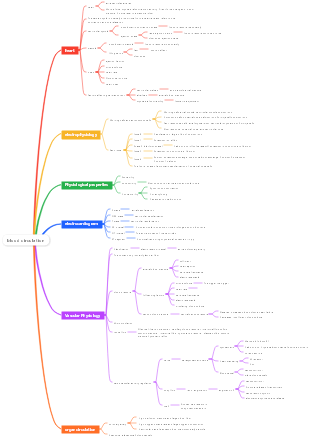
This is a mind map about neural tissue, which is composed of nerve cells and glial cells. Nerve cells, also known as neurons, are the structural and functional units of the nervous system and have the ability to receive stimuli, conduct impulses, and integrate information. Glial cells play a supportive, protective and nutritional role in nervous tissue.
Edited at 2024-11-12 20:28:52nervous tissue
nerve cells [neurons]
All have functions
accept stimulation
Integrate information
conduct impulse
structure
Cell body [center of neuronal nutrition and metabolism]
Location: Mainly located within the gray matter ganglia of the cerebral and cerebellar cortex, brainstem, and spinal cord
Shape: round, cone, fusiform, star, etc.
Nucleus: located in the center, large and round, with obvious nuclear envelope and more euchromatin, so it is lightly colored, and the nucleolus is large and round.
Cytoplasm【LM】
Nislsite
distributed
cell body
dendrites
Basophilic, evenly distributed
shape
Thick plaques (in large neurons such as spinal motor neurons)
Fine granular (in small neurons such as intraganglionic neurons)
EM
Well-developed rough endoplasmic reticulum and free ribosomes
Function
Synthesis of structural proteins required for renewal of organelles
Enzymes and neuromodulators required for the synthesis of neurotransmitters
neurofibrils
It cannot be distinguished in HE-stained sections, but appears as brown-black filaments in silver-stained sections.
arranged into a network and extending into dendrites and axons
EM
neurofilament
microtubules
Function
Cytoskeleton of neurons
Microtubules participate in material transport
Mitochondria, Golgi complex, lysosomes, etc.
The remnants of lysosomes - lipofuscin
Cell membrane [excitable membrane]
Function
accept stimulation
Process information
generate and conduct nerve impulses
dendrite [shape like branches]
one or more
dendritic spines
The structure of the cytoplasm is similar to that of the cell body
Function
accept stimulation
The ability of divine elements to receive and integrate information is closely related to the degree of branching of their dendrites and the number of dendritic spines.
axon
one (emanated from the cell body)
LM
Axial hillock: The part from the cell body that sends out axons under a light microscope is often conical in shape.
No Nissl bodies, light staining
Function
conduct nerve impulses
Classification
According to the number of protrusions
multilevel neurons
bipolar neurons
pseudounipolar neuron
by function
Sensory neurons (afferent neurons): carry information into the center
Motor neurons (efferent neurons): responsible for transmitting nerve impulses to muscle cells or gland cells
Interneurons: Mainly multi-level neurons, located between the first two types of neurons, playing the role of information processing and transmission
According to the length of neuron axon
Golgi type I neuron
Golgi II neurons
synapse
Definition: A structure that transmits information between neurons or between neurons and effector cells
type
axo-somatic synapse
Axo-dendritic synapse
axo-spine synapse
type
chemical synapse
electrical synapses (gap junctions)
EM
Presynaptic components (synaptosomes)
synaptic vesicles
Mitochondria
microfilament
microtubules
synaptic cleft
postsynaptic component
glial cells
All have functions
Support, protect, nourish and insulate neurons
Participate in the metabolism of neuronal substances and active substances
It has an important impact on the pathology and physiology of nervous tissue.
central nervous system glial cells
astrocytes
The largest, the cell body is star-shaped, the nucleus is round or oval, larger, lightly stained, and there are glial filaments in the cells.
Function
support and insulation
Footplate: involved in the formation of the gelatinous boundary membrane
Secretes neurotrophic factors and growth factors
When the brain and spinal cord are injured, they can proliferate and form glial scars.
oligodendrocytes
less
Function
Myelin-forming cells of the central nervous system
microglia
smallest
Function
When the nervous system is damaged, it can transform into macrophages and engulf dead cell debris.
ependymal cells
Function
Helps in the flow and production of cerebrospinal fluid
peripheral glial cells
Schwann cells
Myelin-forming cells of the peripheral nervous system
Secrete neurotrophic factors to promote the survival of damaged neurons and their axon regeneration
satellite cells
neural stem cells
nerve fibers and nerves
nerve fibers
myelinated nerve fibers
peripheral nervous system
Features
central nervous system
Features
unmyelinated nerve fibers
peripheral nervous system
central nervous system
nerve
nerve endings
sensory nerve endings
free nerve endings
Function: Involved in generating sensations of cold, heat, light touch and pain
tactile corpuscle
Function: Participate in the production of touch
toroidal body
Function: Involved in producing pressure and vibration sensations
muscle spindle
Belongs to proprioceptors and plays an important role in regulating skeletal muscle activity.
motor nerve endings
somatic motor nerve endings
motor end plate
visceral motor nerve endings
Degeneration and regeneration of nerve fibers