MindMap Gallery Electrochemistry Summary
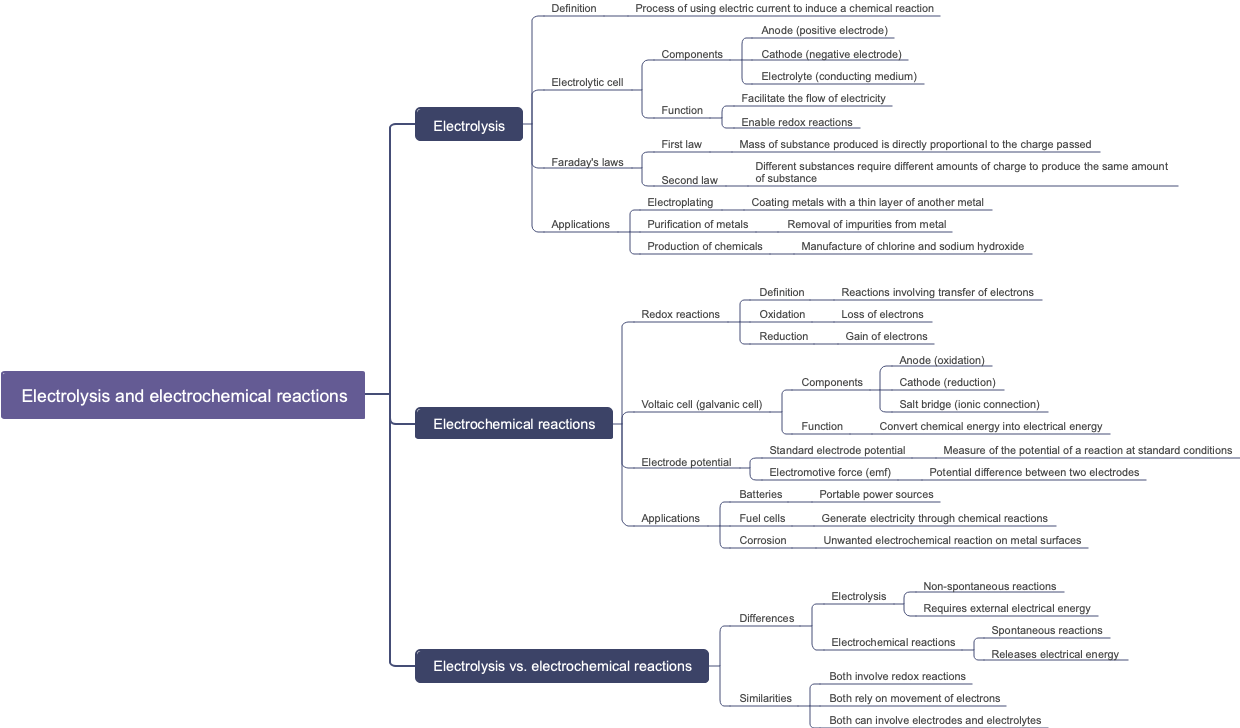
This summary of conductivity and electrolysis knowledge summarizes and organizes the knowledge points, covering all core contents, which is very convenient for everyone to learn. Suitable for exam review and preview to improve learning efficiency. Hurry up and collect it to learn together!
Edited at 2024-11-01 10:29:13This is a mind map about the annual work plan of the three pillars of human resources. The main contents include: strategic human resources planning, talent recruitment and allocation, employee performance management, employee training and development, employee relationships and communication, employee welfare and care, human resources information system construction, regulatory compliance and risk management, and organizational culture construction.
This is a mind map for the diagnosis and treatment of acute cerebral hemorrhage in patients with hemodialysis. The annual incidence of acute cerebral hemorrhage in patients with hemodialysis is (3.0~10.3)/1000, and the main cause is hypertension. Compared with non-dialysis patients, the most common bleeding site is the basal ganglia area, accounting for 50% to 80%; but the bleeding volume is large and the prognosis is poor, and the mortality rate is 27% to 83%. Especially for patients with hematoma >50ml, hematoma enlarged or ventricular hemorrhage on the second day after onset, the prognosis is very poor.
The logic is clear and the content is rich, covering many aspects of the information technology field. Provides a clear framework and guidance for learning and improving information technology capabilities.
This is a mind map about the annual work plan of the three pillars of human resources. The main contents include: strategic human resources planning, talent recruitment and allocation, employee performance management, employee training and development, employee relationships and communication, employee welfare and care, human resources information system construction, regulatory compliance and risk management, and organizational culture construction.
This is a mind map for the diagnosis and treatment of acute cerebral hemorrhage in patients with hemodialysis. The annual incidence of acute cerebral hemorrhage in patients with hemodialysis is (3.0~10.3)/1000, and the main cause is hypertension. Compared with non-dialysis patients, the most common bleeding site is the basal ganglia area, accounting for 50% to 80%; but the bleeding volume is large and the prognosis is poor, and the mortality rate is 27% to 83%. Especially for patients with hematoma >50ml, hematoma enlarged or ventricular hemorrhage on the second day after onset, the prognosis is very poor.
The logic is clear and the content is rich, covering many aspects of the information technology field. Provides a clear framework and guidance for learning and improving information technology capabilities.
Electrochemistry Summary
electrolyte solution
Electrical mobility and migration number of ions
Ion mobility (ion mobility): u r=u*dE/dl The positive ion hydrogen ion has the highest electrical mobility, and the negative ion hydroxide has the highest electrical mobility
Number of migrations t₁ t₁=I₁/I t1 t2=1
The relationship between migration number and electric mobility: t₁=u₁/u₂ u₁
Various ions: t₁=Q₁/Q=I₁/I ∑t₁ ∑t₂=1
Determination of ion migration number: ① Hittorf method (the apparent migration number or Hittorf migration number is measured), ② Interface movement method, ③ Electromotive force method
conductance of electrolyte solution
Conductance: The reciprocal of resistance is conductance R=1/G
Conductivity κ: G=κA/l A is the area, l is the length. Unit: S/m
Molar conductivity Λm: refers to the conductance of a solution containing 1 mol of electrolyte when it is placed between parallel electrodes of a conductivity cell spaced at unit distance Λm=κ/c Unit: S*m²/mol
Conductivity cell constant Kcell: Kcell=l(length)/A(area)=κ(conductivity)*R(resistance)
The relationship between conductivity and concentration
Within a certain concentration range, the conductivity of a strong electrolyte increases as the concentration increases, and then decreases as the concentration increases; the conductivity of a weak electrolyte does not change significantly with concentration, because the degree of dissociation decreases as the concentration increases.
Image: κ-c
Molar conductivity as a function of concentration
Strong electrolyte Λm = Λ∞m (1-β√c), that is, when the concentration is extremely dilute (below 0.001mol/L), the Λm of the strong electrolyte has a linear relationship with √c; the weak electrolyte has a linear relationship between Λm and √ under extremely dilute conditions. c is still not a linear relationship.
Image: Λm-√c
The law of independent movement of ions and the molar conductivity of ions
In an infinitely dilute solution, each ion moves independently, and the Λ∞m value of the electrolyte can be considered as the sum of the limiting molar conductivities of the two ions. 1-1 valence type electrolyte Λ∞m=Λ∞m ( ) Λ∞m (-); electrolytes of different valence types such as CaCl2, Λ∞m=Λ∞m (Ca2 ) 2Λ∞m (Cl-)
How to find the limit molar conductivity of weak electrolytes: Λ∞m (HAc) = Λ∞m (HCl) Λ∞m (NaAc) - Λ∞m (NaCl)
Type 1-1 strong electrolyte solution: t =Λm /Λm t∞ =Λ∞m /Λ∞m Λm=zuF (This formula applies to both the molar conductivity of positive and negative ions and the ultimate molar conductivity.
application
Test water purity
Calculate the degree of dissociation and dissociation constant of a weak electrolyte
Degree of dissociation α=Λm/Λ∞m Λm=α(u- u )F Λ∞m=(u- u )F
Measuring the solubility of sparingly soluble salts
κ (AgCl) = κ (solution) - κ (H₂O) Λm (AgCl) = κ (AgCl)/c (AgCl). Note that the unit of c found here is mol/m3, but please note that the question requires mol. /m3 or mol/dm3 (L)
conductometric titration
The turning point is the end point of the titration
Basic concepts and electrolysis laws in electrochemistry
Electronic conductor: conducts electricity by relying on the directional movement of free electrons, and does not undergo chemical changes during the conduction process. Features: As temperature rises, resistance increases
Ionic conductor: conducts electricity relying on the directional movement of ions (i.e. directional migration of ions). Features: Temperature increases, resistance decreases
Faraday's law of electrolysis: ① The amount of substance that undergoes a chemical change on the electrode (i.e., at the two-phase interface) is proportional to the amount of charge introduced; ② If several electrolytic cells are connected in series, after passing a certain amount of charge, the amount of chemically changed substances on the electrodes of each electrolytic cell will be equal.
Q=zFξ F=96500C/mol
Q=It
Current efficiency: Calculated according to Faraday’s electrolysis law: required theoretical charge/actual charge consumed *100%
Average activity and average activity factor of electrolytes
Activity: a
Molarity: m
Activity factor: γ
1-1 valence type: a±= (γ±)*(m±)/mΘ mΘ is the correction unit
Other price types
ionic strength
I=0.5∑ (mB) (Z²B) B: All ions in the solution; ZB: The valence of the ion (Book 36 Example 8.10)
Strong electrolyte solution theory
relaxation effect
Take the one with positive ions in the center and negative ions in the periphery as an example. Under the action of an external electric field, the central positive ions move toward the cathode, and the equilibrium state of the peripheral ion atmosphere is damaged. However, due to the Coulomb force, the ions have to rebuild a new ion atmosphere, and at the same time the original ion atmosphere has to be dismantled. But whether it is establishing a new ion atmosphere or dismantling an old ion atmosphere, it takes a certain amount of time. This time is called relaxation time. Because the ions are always moving, the new ion atmosphere of the central ion has not been completely established, and the old ion atmosphere has not been completely dismantled, which forms an asymmetric ion atmosphere. This asymmetric ion atmosphere creates a resistance to the movement of the central ion in the electric field, often called a relaxation force. It reduces the movement rate of ions, thus reducing the molar conductivity.
electrophoretic effect
Under the action of an external electric field, the central ion and its solvated molecules move in a certain direction at the same time, while the ion atmosphere with opposite charges moves in the opposite direction together with the solvated molecules, thereby increasing the viscosity and blocking the The movement of ions in a solution is called the electrophoretic effect. It reduces the rate of ion movement and thus the molar conductivity.
Electrolysis and polarization
Decomposition voltage
A device that converts electrical energy into chemical energy is called an electrolytic cell
Theoretical decomposition voltage
The minimum voltage that must be applied to enable continuous electrolysis of an electrolyte solution is called the theoretical decomposition voltage.
E (theoretical decomposition) = E (reversible)
Actual decomposition voltage
Actual decomposition voltage > reversible decomposition voltage
Reason: Electrode polarization
polarization
polarization of electrodes
When a current passes through an electrode, the electrode potential deviates from its reversible value.
Overpotential/overpotential
The difference between the electrode potential ψ irreversible and ψ reversible at a certain current density
Cause
concentration polarization
During the electrolysis process, it is caused by the difference in concentration between the concentration of the solution near the electrode and the concentration of the bulk solution (referring to the solution far away from the electrode and with uniform concentration). The main reason is that the ion diffusion rate is not directly proportional to the reaction rate.
resistive polarization
electrochemical polarization
The applied voltage must be greater than the back electromotive force of the battery
electrochemical overpotential
The additional voltage applied to make the electrode reaction proceed smoothly is called electrochemical overpotential
reason
Since the reaction of the electrode is usually carried out in several steps, one of these steps may have a relatively slow reaction rate and require a relatively high activation energy.
polarization curve
electrolytic cell
inverted eight curve
Primary battery
Positive eight curve
The polarization curve of the negative electrode in the primary battery is the anode polarization curve.
Overpotential makes the anode electrode potential increase and the cathode electrode potential decrease
Competing reactions on electrodes during electrolysis
Metal precipitation and hydrogen overpotential
The more negative the cathode is, the more stable it is, and the more positive the anode is, the more stable it is.
Separation of metal ions
application
Electrochemical corrosion of metals
Corrosion caused by electrochemical reaction due to the formation of micro-batteries when the metal surface is in contact with the medium.
Hydrogen evolution corrosion
Oxygen-absorbing corrosion
Oxygen absorption corrosion is easier to proceed than hydrogen evolution corrosion under acidic conditions
Anticorrosion of metal
Non-metal protective layer
Paint
metal protective layer
chrome plated
Electrochemical protection
Cathodic protection method of sacrificial anode
Through external power supply
Add corrosion inhibitor protection
Slow down the rate of cathodic or anodic processes, or cover the electrode surface to prevent corrosion.
passivation of metal
chemical power source
primary battery
The reactive substances in the battery cannot be used again after being discharged through an electrochemical reaction.
dry cell battery
Zinc-air battery
secondary battery
After the battery is discharged, the active material can be restored through the charging method before being discharged again, and the charging and discharging process can be repeated many times in a cycle.
Lead acid battery
PbO₂(s) Pb(s) 2H₂SO₄(aq)=2PbSO₄(s) 2H₂O(l)
fuel cell
A device that converts the chemical energy of a fuel directly into electrical energy
depolarizing agent
cathode depolarizer
Anodic depolarizer