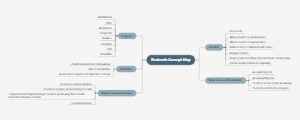
MindMap Gallery Basic Concepts of Chemistry
The Basic Concepts of Chemistry cover atoms and molecules, elements, and energy in chemistry. Atoms are the smallest units of matter that retain chemical properties, while molecules are composed of multiple atoms bonded together. Elements are pure substances composed of only one type of atom. Energy in chemistry involves transformations during chemical reactions, including endothermic and exothermic processes.
Edited at 2024-12-23 07:48:42In the introduction section, elastin is a protein that plays a crucial role in the body, endowing tissues with elasticity and toughness. Its properties include high elasticity and good ductility. Elastin has a wide range of sources and is commonly found in animal connective tissues such as skin and blood vessels. When using elastin in products, the amount and method of addition should be determined based on the characteristics of the product. It has many uses and can be added to skincare products to enhance skin elasticity and reduce wrinkles; Improving food texture and enhancing taste in the food industry; In the medical field, it can be used to make elastic scaffolds such as artificial blood vessels, providing support for tissue repair. Reasonable use can play its unique value.
This document aims to guide the proper use of proteins. Proteins are the fundamental substances that make up life and are essential for maintaining normal physiological functions in the body, with a wide variety of types. When using protein, daily diet is an important source, such as meat, eggs, etc., which are rich in high-quality protein. Measuring protein intake can be done using professional tools or methods to ensure that the intake meets the body's needs. When mixing protein powder, it should be prepared according to the recommended ratio, and the water temperature should not be too high to avoid damaging the protein activity. Different groups of people have different protein requirements, such as athletes and fitness enthusiasts who can increase their intake appropriately to meet the needs of body repair and muscle growth.
Introduction to Unsaturated Polyester Resin: It is an important thermosetting resin with various excellent properties. It has a wide range of applications and is used in the construction industry to produce fiberglass products such as doors, windows, decorative panels, etc; Used in the automotive industry for manufacturing body components. The advantages of use include simple molding process, low cost, and chemical corrosion resistance. However, it also faces challenges and limitations, such as relatively poor heat resistance and susceptibility to aging. During use, corresponding protective measures should be taken according to specific application scenarios, such as adding heat-resistant agents, antioxidants, etc., to extend their service life and fully leverage their advantages.
In the introduction section, elastin is a protein that plays a crucial role in the body, endowing tissues with elasticity and toughness. Its properties include high elasticity and good ductility. Elastin has a wide range of sources and is commonly found in animal connective tissues such as skin and blood vessels. When using elastin in products, the amount and method of addition should be determined based on the characteristics of the product. It has many uses and can be added to skincare products to enhance skin elasticity and reduce wrinkles; Improving food texture and enhancing taste in the food industry; In the medical field, it can be used to make elastic scaffolds such as artificial blood vessels, providing support for tissue repair. Reasonable use can play its unique value.
This document aims to guide the proper use of proteins. Proteins are the fundamental substances that make up life and are essential for maintaining normal physiological functions in the body, with a wide variety of types. When using protein, daily diet is an important source, such as meat, eggs, etc., which are rich in high-quality protein. Measuring protein intake can be done using professional tools or methods to ensure that the intake meets the body's needs. When mixing protein powder, it should be prepared according to the recommended ratio, and the water temperature should not be too high to avoid damaging the protein activity. Different groups of people have different protein requirements, such as athletes and fitness enthusiasts who can increase their intake appropriately to meet the needs of body repair and muscle growth.
Introduction to Unsaturated Polyester Resin: It is an important thermosetting resin with various excellent properties. It has a wide range of applications and is used in the construction industry to produce fiberglass products such as doors, windows, decorative panels, etc; Used in the automotive industry for manufacturing body components. The advantages of use include simple molding process, low cost, and chemical corrosion resistance. However, it also faces challenges and limitations, such as relatively poor heat resistance and susceptibility to aging. During use, corresponding protective measures should be taken according to specific application scenarios, such as adding heat-resistant agents, antioxidants, etc., to extend their service life and fully leverage their advantages.
Basic Concepts of Chemistry
Matter
Definition
Anything that has mass and occupies space
States of Matter
Solid
Definite shape and volume
Liquid
Definite volume, takes shape of container
Gas
No definite shape or volume
Expands to fill container
Properties of Matter
Physical Properties
Observable without changing the substance's composition
Color
Density
Melting point
Boiling point
Chemical Properties
Describes how a substance reacts with others to form new substances
Reactivity
Flammability
Atoms and Molecules
Atoms
Basic unit of matter
Composed of subatomic particles
Protons (positive charge)
Neutrons (neutral charge)
Electrons (negative charge)
Molecules
Two or more atoms bonded together
Formed by chemical reactions
Elements
Definition
Pure substances that cannot be broken down into simpler substances by chemical means
Periodic Table
Organizes elements by increasing atomic number
Groups elements with similar properties
Compounds
Definition
Substances composed of two or more different elements chemically combined
Formation
Atoms of different elements bond together
Chemical Reactions
Definition
Process that leads to the transformation of one set of chemical substances to another
Equations
Represent chemical reactions using symbols and formulas
Reactants (starting materials)
Products (resulting substances)
Measurement in Chemistry
Units
SI Units (International System of Units)
Base units (meter, kilogram, second, etc.)
Derived units (liter, mole, etc.)
Scientific Notation
Expresses very large or very small numbers as a product of a number between 1 and 10 and a power of 10
Energy in Chemistry
Types of Energy
Kinetic Energy
Energy of motion
Potential Energy
Stored energy due to position or composition
Laws of Thermodynamics
First Law (Conservation of Energy)
Energy cannot be created or destroyed, only transformed
Second Law
Energy transformations increase entropy (disorder) over time
Stoichiometry
Definition
Study of the quantitative relationships in chemical reactions
Mole Concept
A mole represents a specific number of entities (atoms, molecules, ions, electrons)
Avogadro's number (6.022 x 10^23)
Calculations
Balancing chemical equations
Determining amounts of reactants and products
Solutions
Definition
Homogeneous mixtures of two or more substances
Concentration
Measure of the amount of solute dissolved in a given quantity of solvent or solution
Molarity (moles of solute per liter of solution)
Molality (moles of solute per kilogram of solvent)
Mass percent (mass of solute per 100 mass units of solution)
Acids and Bases
Definitions
Acids
Substances that donate protons (H+ ions) in solution
Bases
Substances that accept protons or donate hydroxide ions (OH) in solution
pH Scale
Measures the acidity or basicity of a solution
Ranges from 0 to 14
Neutral solutions have pH of 7
Acidic solutions have pH less than 7
Basic solutions have pH greater than 7
Organic Chemistry
Definition
Study of carboncontaining compounds and their properties
Hydrocarbons
Compounds containing only carbon and hydrogen
Alkanes (saturated hydrocarbons)
Alkenes (unsaturated hydrocarbons with double bonds)
Alkynes (unsaturated hydrocarbons with triple bonds)
Functional Groups
Specific group of atoms within a molecule that gives the molecule its characteristic properties
Alcohols (OH)
Aldehydes (CHO)
Ketones (C=O)
Carboxylic acids (COOH)
Amines (NH2)