 Wondershare EdrawMind
MindMap Gallery Computer network principle
- 33
- 2
Computer network principle
The mind map created based on the course "Principles of Computer Networks" covers all core content, making it easy for people to remember and understand, and is very convenient for everyone to learn.
Edited at 2025-02-23 12:22:06
- Reproductive system
This template shows the structure and function of the reproductive system in the form of a mind map. It introduces the various components of the internal and external genitals, and sorts out the knowledge clearly to help you become familiar with the key points of knowledge.
- Interpretation and summary of relationship field e-book
This is a mind map about the interpretation and summary of the relationship field e-book, Main content: Overview of the essence interpretation and overview of the relationship field e-book. "Relationship field" refers to the complex interpersonal network in which an individual influences others through specific behaviors and attitudes.
- Accounting books and accounting records
This is a mind map about accounting books and accounting records. The main contents include: the focus of this chapter, reflecting the business results process of the enterprise, the loan and credit accounting method, and the original book of the person.
Computer network principle
- Reproductive system
This template shows the structure and function of the reproductive system in the form of a mind map. It introduces the various components of the internal and external genitals, and sorts out the knowledge clearly to help you become familiar with the key points of knowledge.
- Interpretation and summary of relationship field e-book
This is a mind map about the interpretation and summary of the relationship field e-book, Main content: Overview of the essence interpretation and overview of the relationship field e-book. "Relationship field" refers to the complex interpersonal network in which an individual influences others through specific behaviors and attitudes.
- Accounting books and accounting records
This is a mind map about accounting books and accounting records. The main contents include: the focus of this chapter, reflecting the business results process of the enterprise, the loan and credit accounting method, and the original book of the person.
- Recommended to you
- Outline
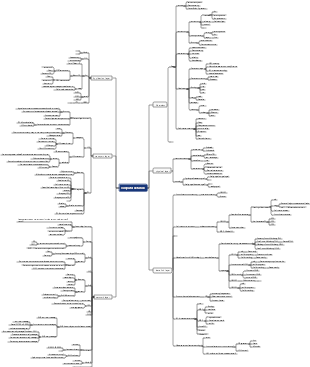

Computer network principle
Chapter 1 Computer Network Overview
Section 1 Basic concepts of computer networks
Definition of computer network: Use communication devices to interconnect computer systems with different geographical locations to realize data exchange.
Definition of protocol: rules or conventions that need to be followed between communication entities in the network.
Functions of computer networks: hardware resource sharing, software resource sharing, and information resource sharing.
Classification of computer networks: According to coverage, it is divided into individual area networks, local area networks, metropolitan area networks, and wide area networks; according to topological structure, it is divided into star, bus type, ring, mesh, tree, and hybrid topological structures.
Section 2 Computer network structure
Network edge: Connect to all end systems on the network (host, smartphone, etc.).
Access network: A network that realizes the connection between the end system and the network core, such as telephone dialing, ADSL, HFC, LAN, and mobile access network.
Network core: consists of packet switching devices (routers, switches) and is responsible for data relay and forwarding.
Section 3 Data Exchange Technology
Circuit switching: Establish a dedicated circuit for data transmission, suitable for voice communication.
Message exchange: The entire message is transmitted in storage-forwarding mode, suitable for burst data communication.
Packet switching: Split packets into packets and transmit them independently, suitable for computer networks.
Section 4 Computer network performance
Rate and bandwidth: Rate refers to the amount of data transmitted per unit time, and bandwidth refers to the maximum data rate of the link.
Delay: The transmission time of data from the source node to the destination node, including processing delay, queuing delay, transmission delay, and propagation delay.
Delay bandwidth product: the product of the propagation delay of the link and the bandwidth.
Packet loss rate: the proportion of packet loss caused by network congestion.
Throughput: The amount of data actually delivered within a unit time.
Section 5 Computer Network Architecture
OSI reference model: seven-layer model (physical layer, data link layer, network layer, transmission layer, session layer, presentation layer, application layer).
TCP/IP reference model: four-layer model (network interface layer, network interconnection layer, transport layer, application layer).
Five-layer reference model: five-layer model (physical layer, data link layer, network layer, transport layer, application layer) combining OSI and TCP/IP models.
Section 6 A brief history of the development of computer networks and the Internet
ARPAnet: The first packet switching network, laying the foundation for the Internet.
TCP/IP protocol cluster: the core protocol of the Internet, including TCP, UDP, IP, etc.
World Wide Web (WWW): An information retrieval system based on the HTTP protocol has promoted the popularization of the Internet.
Chapter 2 Network Applications
Section 1 Computer Network Application Architecture
Client/server (C/S) structure: The server provides centralized services, and the client requests services.
Pure P2P structure: direct peer communication, no central server.
Hybrid structure: Combining the characteristics of C/S and P2P, there is a central server and peer-to-peer communication.
Section 2 Basic principles of network application communication
Client/server communication: The client requests actively, and the server responds passively.
Application layer protocol: defines communication rules, such as HTTP, SMTP, FTP, etc.
Section 3 Domain Name System (DNS)
Hierarchical domain name space: Domain names are composed of top-level domain names, second-level domain names, etc.
Domain name server: Responsible for domain name resolution, divided into root domain name server, top-level domain name server, etc.
Domain name resolution process: recursive resolution and iterative resolution.
Section 4 World Wide Web Application
Web server and browser: communicate based on the HTTP protocol.
HTTP protocol: defines request and response formats, supports persistent and non-persistent connections.
Cookie mechanism: used for user tracking and session management.
Section 5 Internet Email
Email system: including mail server, SMTP, POP3/IMAP and other protocols.
SMTP protocol: used for mail transmission, based on TCP connection.
MIME extension: Supports the transmission of non-ASCII characters and multimedia content.
Section 6 FTP
File transfer protocol: used to transfer files on the network, based on TCP connection.
Control connection and data connection: Control connection is used for command transmission, and data connection is used for file transmission.
Section 7 P2P Application
Features of P2P technology: decentralization, high availability, load balancing.
Typical applications: BitTorrent, Gnutella, etc.
Section 8 Socket Programming Basics
Socket types: Streaming Sockets (TCP), Datagram Sockets (UDP), Raw Sockets (RAW).
Socket API functions: create sockets, bind, listen, accept, send and receive data.
Chapter 3 Transport Layer
Section 1 Basic Services of Transport Layer
Transport layer functions: multiplexing and decomposition, flow control, congestion control.
Port number: Identifies the process of the transport layer.
Section 2 Multiplexing and decomposition of transport layer
Connectionless multiplexing and demultiplexing: UDP protocol.
Connection-oriented multiplexing and demultiplexing: TCP protocol.
Section 3: Stop-Wait Agreement and Sliding Window Agreement
Reliable data transmission: Ensure the correctness of data through confirmation and retransmission.
Stop-Waiting Protocol: Only one packet can be sent at a time, and wait for confirmation before sending the next one.
Sliding window protocol: allows multiple packets to be sent to improve channel utilization.
Section 4 User Datagram Protocol (UDP)
UDP datagram structure: source port, destination port, length, checksum and other fields.
UDP checksum: Simple verification, does not guarantee the correctness of the data.
Section 5 Transmission Control Protocol (TCP)
TCP segment structure: source port, destination port, serial number, confirmation number and other fields.
TCP Connection Management: Three handshakes and four handshakes.
TCP reliable data transmission: serial number, confirmation number, and retransmission mechanism.
TCP flow control: sliding window mechanism.
TCP congestion control: Congestion avoidance and rapid retransmission based on AIMD algorithm.
Chapter 4 Network Layer
Section 1 Network Layer Service
Network layer addressing: IP addresses are used to identify devices in the network.
Forwarding and routing: Select the appropriate path to forward packets according to the destination address.
Section 2 Datagram Network and Virtual Circuit Network
Datagram network: Each packet selects a path independently, such as an IP network.
Virtual circuit network: establish a virtual connection, such as the X.25 network.
Section 3 Network interconnection and network interconnection equipment
Heterogeneous network interconnection: interconnection of different networks through routers.
Router functions: routing, data forwarding, isolated broadcast domain.
Section 4 Network layer congestion control
Traffic-aware routing: select paths based on link load.
Access control: Limit traffic entering the network.
Traffic regulation: Controls the speed at which data is injected into the network.
Load shedding: Discard overloaded packets to relieve network burden.
Section 5 Internet Network Layer
IPV4 protocol: Internet protocol with version 4, which stipulates IP address allocation and management.
ICMP protocol: used for network diagnosis and error reporting.
ARP protocol: convert IP address to MAC address.
RARP protocol: convert MAC address to IP address.
NAT protocol: network address translation to alleviate the problem of IP address shortage.
IPV6 protocol: Internet protocol with version 6, supports larger address space and automatic configuration.
Section 6 Routing Algorithm and Routing Protocol
Distance vector routing algorithm: such as RIP, routing is calculated based on distance vector.
Link state routing algorithm: such as OSPF, routing is calculated based on link state.
Hierarchical routing: manage routing information layered to improve scalability.
BGP protocol: Border gateway protocol, used for routing between Internet autonomous systems.
Chapter 5 Data Link Layer and Local Area Network
Section 1 Data Link Layer Service
Data link layer functions: frame synchronization, error control, and flow control.
Framing: encapsulate data into frames for transmission.
Section 2 Error Control
Basic methods of error control: parity check, cyclic redundancy check (CRC), etc.
Error detection and error correction capabilities of error encoding: The error detection and error correction capabilities of different encoding methods are different.
Section 3 Multiple Access Control Protocol
Channel division MAC protocols: such as TDMA, FDMA, and WDMA, multiple access is achieved by allocating different channels.
Random access MAC protocol: such as CSMA/CD, access the channel through competition.
Controlled access MAC protocol: such as CSMA/CA, access the channel through appointment.
Section 4 LAN
Features of LAN: high transmission rate, low bit error rate, short-distance transmission.
Ethernet: the most commonly used LAN technology, based on the CSMA/CD protocol.
The working principle of the switch: learn MAC address and realize the rapid forwarding of data frames.
Virtual Local Area Network (VLAN): Logically divides LANs to improve security and management flexibility.
Fifth Node-to-Point Link Protocol
PPP protocol: point-to-point link protocol, supporting multiple network layer protocols.
HDLC protocol: Advanced data link control protocol, commonly used for wide area network connections.
Chapter 6 Physical Layer
Section 1 Basics of Data Communication
Basic concepts of data communication: signal encoding, transmission medium, transmission mode.
Data communication system model: sending end, transmission medium, and receiver.
Section 2 Physical Media
Twisted pair: a commonly used transmission medium, low cost, suitable for short-distance transmission.
Coaxial cable: Good transmission performance, suitable for cable TV and broadband networks.
Fiber Optical: Large transmission capacity, suitable for long-distance high-speed transmission.
Wireless media: such as microwave, infrared, Bluetooth, etc., suitable for mobile devices and special environments.
Section 3 Channel and Channel Capacity
Channel classification and model: wired channels and wireless channels, bandwidth limits channel capacity.
Channel transmission characteristics: attenuation, noise, interference, etc. affect the transmission quality.
Channel capacity: Shannon formula calculates the theoretical maximum transmission rate.
Section 4 Baseband Transmission
Basic concept of baseband transmission: direct transmission of baseband signals, suitable for digital signals.
Digital baseband transmission encoding: such as Manchester code, differential Manchester code, etc., used for clock recovery and error control.
Section 5 Frequency Band Transmission
Basic concept of frequency band transmission: modulate high-frequency carrier transmission signals, suitable for frequency band transmission of analog signals and digital signals.
There are three modulation methods in frequency band transmission: amplitude modulation (AM), frequency modulation (FM), and phase modulation (PM).
Section 6 Physical Layer Interface Procedures
Physical layer interface overview: Define connection and communication rules for physical devices.
Physical layer interface characteristics: mechanical characteristics, electrical characteristics, functional characteristics, and procedural characteristics.
Chapter 7 Wireless and Mobile Networks
Section 1 Wireless Network
Basic structure of wireless network: base station, mobile terminal, access point, etc.
Wireless links and wireless network features: limited bandwidth, susceptible to interference, and complex mobility management.
Section 2 Mobile Network
Basic principles of mobile networks: cellular structure, frequency multiplexing, call processing.
Addressing and routing: Dynamic address allocation and routing algorithms adapt to mobility.
Section 3 Wireless LAN IEEE802.11
IEEE802.11 architecture: infrastructure model and peer model.
MAC Protocol (CSMA/CA): Random Access Protocol to Avoid Collision.
Frame structure: contains fields such as MAC header, payload and CRC check.
Section 4 Cellular Network
Cellular network architecture: composed of base station, mobile switching center, home location register, etc.
Mobility management: location update, call forwarding, roaming and other management functions.
Features of 2G/3G/4G/5G network: Continuously improve transmission rate and service quality.
Section 5 Mobile IP Network
Agent Discovery and Registration: The mobile node obtains the forwarding address through the agent and registers it with the hometown agent.
Tunneling technology: realizes data encapsulation and transmission across network segments.
Section 6 Introduction to other typical wireless networks
WiMax: Broadband wireless access technology based on IEEE802.16 standard.
Bluetooth: Short-range low-power wireless communication technology, suitable for data exchange between devices.
ZigBee: Low-power, low-speed wireless sensor network standard.
Chapter 8 Network Security Basics
Section 1 Overview of Cybersecurity
Basic concepts: Protect the confidentiality, integrity and availability of network data.
Cybersecurity threats: eavesdropping, tampering, denial of service attacks, etc.
Section 2 Data Encryption
Traditional encryption methods: symmetric key encryption and asymmetric key encryption.
Symmetric key encryption algorithms: DES, AES, etc., with fast encryption speed but difficult key management.
Asymmetric key encryption algorithm: RSA, ECC, etc., with high security but complex calculations.
Section 3 Message Integrity and Digital Signature
Message integrity detection method: digest algorithm (MD5, SHA) and hash function.
Digital signature: used to verify source and integrity, preventing forgery and tampering.
Section 4 Identity Authentication
Identity authentication based on shared symmetric keys: Both parties pre-share the key and authenticate through the pre-share key.
Public key-based identity authentication: Digital certificates and public key infrastructure (PKI).
The role of one-time random numbers: increase the unpredictability and security of authentication.
Section 5 Key Distribution Center and Certificate Certification Organization
The role of KDC: safely distribute keys and prevent key leakage.
The role of CA: issuance and management of digital certificates and establish trust mechanisms.
KDC or CA-based certification process: Simplify the certification process and improve security.
Section 6 Firewall and Intrusion Detection System
Basic concepts of firewalls: control traffic in and out of the network and protect internal network security.
Firewall classification: Packet filtering firewall, status detection firewall, application layer firewall.
Intrusion Detection System (IDS): Monitor and analyze network traffic, discover and alert intrusion behavior.
Section 7 Cybersecurity Protocol
Secure Email Protocol (S/MIME): Encrypt and signed emails to ensure safe transmission.
Secure Sockets Layer Protocol (SSL) and Transport Layer Security Protocol (TLS): Provides encryption and authentication services for web communication.
Virtual Private Network (VPN) and IP Security Protocol (IPSec): Remote secure communication through encrypted channels.