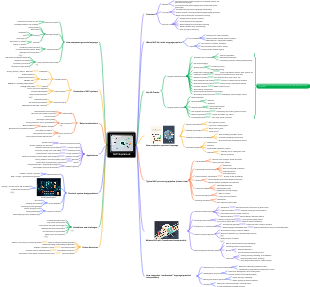
MindMap Gallery Facial Recognition Explained
Facial Recognition Explained is a comprehensive guide for students, technology professionals, and policy researchers, understanding the core principles, application workflows, and governance challenges of facial recognition technology. This framework explores six core dimensions: What Is Facial Recognition biometric technology identifying/verifying individuals by analyzing facial geometry (eye distance, nose shape, jawline). What Exactly Is Being Measured systems measure facial feature vectors—converting faces to high-dimensional numerical representations (embeddings) for similarity comparison. End-to-End Flow traces complete process: camera capture→face detection→landmark localization→normalization→feature extraction→embedding generation→similarity scoring→threshold decision. Performance Evaluation sorting out key metrics: accuracy, false acceptance rate, false rejection rate, ROC curve, equal error rate; dataset considerations (diversity, scale, labeling quality). Bias, Fairness, Ethics explores bias sources (training data, algorithm design), performance disparities across demographics, fairness assessment and mitigation. Security & Liveness analysis Anti-spoofing techniques protect against photos, videos, masks. Privacy & Compliance examines data minimization, consent, transparency, governance frameworks. This guide enables systematic grasp of facial recognition's technical potential and social risks, understanding complex balances between efficiency gains and rights protection.
Edited at 2026-03-20 01:40:07Mappa mentale per il piano di inserimento dei nuovi dipendenti nella prima settimana. Strutturata per giorni: Giorno 1 – benvenuto, configurazione strumenti, presentazione team. Secondo giorno – formazione su policy aziendali e obiettivi del ruolo. Terzo giorno – affiancamento e primi task guidati. Il quarto giorno – riunioni con dipartimenti chiave e feedback intermedio. Il quinto giorno – revisione settimanale, definizione obiettivi a breve termine e integrazione culturale.

Mappa mentale per l’analisi della formazione francese ai Mondiali 2026. Punti chiave: attacco stellare guidato da Mbappé, con triplice minaccia (profondità, taglio, sponda). Criticità: centrocampo poco creativo – la costruzione offensiva dipende dagli attaccanti che arretrano. Difesa solida (Upamecano, Saliba, Koundé). Portiere Maignan. Variabili: gestione infortuni e condizione fisica dei big. Ideale per scout, giornalisti e tifosi.
Mappa mentale per il piano di inserimento dei nuovi dipendenti nella prima settimana. Strutturata per giorni: Giorno 1 – benvenuto, configurazione strumenti, presentazione team. Secondo giorno – formazione su policy aziendali e obiettivi del ruolo. Terzo giorno – affiancamento e primi task guidati. Il quarto giorno – riunioni con dipartimenti chiave e feedback intermedio. Il quinto giorno – revisione settimanale, definizione obiettivi a breve termine e integrazione culturale.
Mappa mentale per l’analisi della formazione francese ai Mondiali 2026. Punti chiave: attacco stellare guidato da Mbappé, con triplice minaccia (profondità, taglio, sponda). Criticità: centrocampo poco creativo – la costruzione offensiva dipende dagli attaccanti che arretrano. Difesa solida (Upamecano, Saliba, Koundé). Portiere Maignan. Variabili: gestione infortuni e condizione fisica dei big. Ideale per scout, giornalisti e tifosi.
Facial Recognition Explained
Overview & Purpose
Goal: identify or verify a person using facial characteristics
Common uses
Device unlock and authentication
Access control (buildings, airports)
Photo organization and tagging
Law enforcement and public safety (with policy constraints)
Customer experience and personalization
Core Concepts
Identification vs Verification
Identification (1:N)
Find the best match among many enrolled identities
Output: ranked candidates + confidence score
Verification (1:1)
Confirm a claimed identity (e.g., “Is this Alice?”)
Output: match / no match based on a threshold
Pipeline Stages
Acquire image/video
Detect face region(s)
Align/normalize face
Extract features (embedding)
Compare to stored templates
Decide (thresholding) + log result
Template vs Raw Image
Template (embedding) is a numeric representation of the face
Typically smaller and faster to compare than images
Still sensitive personal data (can enable identification)
How Facial Features Are Analyzed
Step 1: Face Detection (finding the face)
Purpose
Locate face bounding box in an image
Handle multiple faces, partial faces, different scales
Typical methods
CNN-based detectors (e.g., multi-scale feature pyramids)
Landmark-aware detectors to improve robustness
Output
Bounding box + detection confidence
Often initial coarse landmarks (eyes/nose/mouth)
Step 2: Facial Landmark Localization (mapping key points)
What landmarks represent
Eye corners, pupils, eyebrows
Nose bridge and tip
Mouth corners and lip contour
Jawline, chin, facial outline
Why landmarks matter
Enable alignment (reduce pose variation)
Improve consistency across images and cameras
Help detect occlusions (mask, hair, glasses) and expression effects
Output
2D (or sometimes 3D) coordinates of key points
Landmark confidence per point
Step 3: Face Alignment & Normalization (making faces comparable)
Geometric normalization
Rotate/scale/translate to canonical pose (e.g., eyes on a line)
Correct for in-plane rotation and mild pose differences
Photometric normalization
Standardize brightness/contrast
Color normalization or grayscale conversion (depending on model)
Cropping & resizing
Standard input size (e.g., 112×112 or 160×160)
Center on landmarks to keep consistent facial region
Advanced alignment
3D frontalization for large yaw/pitch
Warping based on landmark geometry
Step 4: Feature Extraction (encoding facial characteristics)
What “features” mean in modern systems
Deep learned embeddings: a vector (e.g., 128–1024 floats)
Embedding captures identity-related patterns while compressing the image
What the model learns to encode
Relative geometry (e.g., distances between landmarks)
Texture and micro-patterns (skin texture, pores, subtle contours)
Shape cues (cheekbone prominence, jawline curvature)
Region interactions (eyes + nose + mouth configuration)
How features are produced
Convolutional neural networks (CNNs) or transformer-based vision models
Trained on large datasets with identity labels
Training objectives (common)
Classification losses (softmax) to separate identities during training
Metric-learning losses
Triplet loss: anchor closer to positive than negative
Contrastive loss: pull same-person together, push different-person apart
Angular-margin losses (ArcFace/CosFace): maximize inter-class angular separation
Output
Normalized embedding (often L2-normalized)
Optional quality score (pose/blur/occlusion)
Step 5: Similarity Computation (comparing faces)
Matching approaches
Verification: compare probe embedding to claimed identity template
Identification: search probe against a gallery of templates
Similarity metrics
Cosine similarity (common with normalized embeddings)
Euclidean distance
Learned similarity (e.g., small classifier on pair embeddings)
Score interpretation
Higher similarity (or lower distance) implies higher likelihood of same identity
Scores are probabilistic indicators, not absolute certainty
Step 6: Decision & Thresholding (making an ID call)
Threshold selection
Set to balance false accepts vs false rejects
Can be adjusted by use case (high-security vs convenience)
Operating points & metrics
FAR (False Acceptance Rate): impostors incorrectly accepted
FRR (False Rejection Rate): genuine users incorrectly rejected
EER (Equal Error Rate): point where FAR ≈ FRR
ROC/DET curves to visualize trade-offs
Multi-factor decisioning (optional)
Combine face match with liveness, device signals, or ID documents
What Exactly Is Being Measured
Geometry-based cues (classic + still relevant)
Distances/ratios between landmarks (inter-ocular distance, nose-to-mouth)
Angles and relative positions (nose bridge angle, jawline curvature)
Symmetry patterns (approximate, not exact)
Appearance-based cues (dominant in deep learning)
Local textures in periocular region, nose, cheeks, forehead
Edge and gradient structures around facial contours
Frequency patterns resilient to small lighting changes
3D and depth cues (when available)
Face depth map (structured light / time-of-flight)
Contour depth around nose, eye sockets, cheekbones
Stronger resistance to spoofing than 2D alone
Stability vs variability
More stable: bone structure, overall face shape, relative landmark geometry
More variable: facial hair, makeup, aging, weight changes, expression
Handling Real-World Challenges
Pose variation
Problem: profile views reduce visible features
Mitigations
3D alignment/frontalization
Multi-view training and augmentation
Use of periocular features for partial faces
Illumination changes
Problem: shadows, backlight, color shifts
Mitigations
Photometric normalization
Training augmentation (random brightness/contrast)
Infrared imaging (in some devices)
Occlusion
Examples: masks, sunglasses, hair, hands
Mitigations
Occlusion-aware models/attention mechanisms
Partial matching (focus on visible regions)
Quality gating (reject too-occluded images)
Expression and motion blur
Mitigations
Use multiple frames from video
Sharpness filters and frame selection
Temporal aggregation (average embeddings across frames)
Aging and appearance changes
Mitigations
Periodic template updates
Age-robust training data
Multiple templates per person (time-separated)
Image quality and camera differences
Issues: low resolution, compression artifacts, sensor noise
Mitigations
Super-resolution (sometimes)
Domain adaptation and camera-specific calibration
Quality scores to block poor inputs
Enrollment (Creating Reference Templates)
Enrollment process
Capture multiple images under varied conditions
Detect, align, and extract embeddings
Store one or more templates per identity
Template aggregation
Averaging embeddings from multiple samples
Keeping a set of templates to cover pose/lighting variability
Data storage choices
On-device secure enclave vs server-side database
Encryption at rest and in transit
Access controls and audit logging
System Architectures
On-device recognition
Benefits: privacy, low latency, offline capability
Constraints: compute, memory, model size
Cloud/server recognition
Benefits: scalable gallery search, easier updates
Risks: central data exposure, network dependence
Hybrid
On-device feature extraction + server-side matching
Reduces bandwidth vs sending full images
Performance Evaluation
Test protocols
Closed-set identification (all probes belong to known identities)
Open-set identification (unknown identities included)
Verification benchmarks with matched/unmatched pairs
Common metrics
Top-1 / Top-k accuracy (identification)
ROC-AUC, TAR@FAR (verification)
False match rate in large galleries (scalability)
Dataset considerations
Demographic balance and coverage
Variation in lighting, pose, occlusion, image quality
Avoiding train-test leakage (same person appearing across splits)
Bias, Fairness, and Ethical Considerations
Sources of bias
Skewed training data demographics
Different camera quality across environments
Unequal error costs across groups
Measuring fairness
Compare FAR/FRR across demographics
Evaluate performance under similar image quality conditions
Mitigation strategies
Diverse and balanced training data
Bias-aware training objectives and evaluation
Threshold calibration per deployment context (with caution)
Human oversight for high-stakes decisions
Security & Spoofing Resistance (Liveness)
Threats
Printed photos, replayed videos
3D masks and deepfakes
Adversarial examples (crafted perturbations)
Liveness techniques
Passive liveness
Texture cues (paper sheen, screen moiré)
Physiological signals (subtle skin reflectance changes)
Active liveness
Blink/smile/turn head prompts
Challenge-response sequences
Hardware-assisted
Depth sensors, IR cameras, structured light
Template security
Template encryption and access control
Cancelable biometrics (transform embeddings so they can be reissued)
Rate limiting and anti-enumeration for 1:N searches
Privacy and Compliance
Data minimization
Store embeddings when possible instead of raw images
Retention limits and purpose limitation
Consent and transparency
Clear notice of collection and use
Opt-in/opt-out mechanisms where applicable
Governance
Auditing, logging, and incident response
Third-party assessments and model updates tracking
Practical Example Flow (End-to-End)
User presents face to camera
System detects the face and estimates landmarks
Face is aligned to a canonical pose and normalized
Model outputs a normalized embedding vector
Embedding is compared to enrolled templates using cosine similarity
If similarity exceeds the chosen threshold
Verification: accept user
Identification: return best match (or “unknown” if below threshold)
Optionally run liveness checks and quality gating before final decision