Wondershare EdrawMind
MindMap Gallery What Is Virtual Reality
What Is Virtual Reality
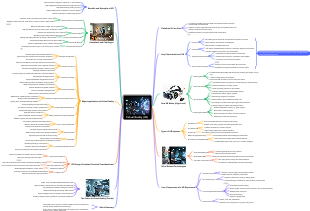
Virtual Reality Explained is a comprehensive guide for students, developers, and product designers, understanding VR as the core technology for immersive digital experiences. This framework explores seven core dimensions: Core Characteristics analyzes three hallmarks: immersion (reduced awareness of physical environment), real-time interactivity, 3D spatiality (depth perception, spatial audio, position tracking). How It Works tracking technical chain: presentation (stereoscopic displays, optics), interactivity (head tracking, controller/hand tracking), 3D spatiality (room-scale tracking, spatial audio). Key Components hardware: HMD (displays, lenses, refresh) rate), tracking systems (head, controller, eye, room-scale), input devices, audio (spatial, environmental); software: rendering/simulation, runtimes, content creation. Types of VR distinguishes fully immersive, seated/stationary, room-scale, social VR, multi-user spaces, 360° video vs interactive VR. Applications demonstrate VR in manufacturing, business collaboration, retail/marketing, art/design/creativity, tourism/cultural heritage. Benefits and Value sort out core value: safer practice, efficiency (context-dependent), better learning retention, improved design decisions, perspective-taking/empathy. Limitations and Challenges explores hardware cost/comfort, content ecosystem constraints, accessibility concerns, physical space requirements, accuracy/latency, user adaptation issues. This guide enables systematic grasp of VR's technical evolution and immersive experience essence, understanding its potential to reshape training, design, collaboration, and human interaction.
Edited at 2026-03-20 01:40:18
- New Employee First - week Onboarding Plan
Mappa mentale per il piano di inserimento dei nuovi dipendenti nella prima settimana. Strutturata per giorni: Giorno 1 – benvenuto, configurazione strumenti, presentazione team. Secondo giorno – formazione su policy aziendali e obiettivi del ruolo. Terzo giorno – affiancamento e primi task guidati. Il quarto giorno – riunioni con dipartimenti chiave e feedback intermedio. Il quinto giorno – revisione settimanale, definizione obiettivi a breve termine e integrazione culturale.
- Analisi del campo di allenamento inglese
Mappa mentale per l’analisi della formazione francese ai Mondiali 2026. Punti chiave: attacco stellare guidato da Mbappé, con triplice minaccia (profondità, taglio, sponda). Criticità: centrocampo poco creativo – la costruzione offensiva dipende dagli attaccanti che arretrano. Difesa solida (Upamecano, Saliba, Koundé). Portiere Maignan. Variabili: gestione infortuni e condizione fisica dei big. Ideale per scout, giornalisti e tifosi.
- Analisi della lineup francese
Mappa mentale per l’analisi della formazione francese ai Mondiali 2026. Punti chiave: attacco stellare guidato da Mbappé, con triplice minaccia (profondità, taglio, sponda). Criticità: centrocampo poco creativo – la costruzione offensiva dipende dagli attaccanti che arretrano. Difesa solida (Upamecano, Saliba, Koundé). Portiere Maignan. Variabili: gestione infortuni e condizione fisica dei big. Ideale per scout, giornalisti e tifosi.
What Is Virtual Reality
- New Employee First - week Onboarding Plan
Mappa mentale per il piano di inserimento dei nuovi dipendenti nella prima settimana. Strutturata per giorni: Giorno 1 – benvenuto, configurazione strumenti, presentazione team. Secondo giorno – formazione su policy aziendali e obiettivi del ruolo. Terzo giorno – affiancamento e primi task guidati. Il quarto giorno – riunioni con dipartimenti chiave e feedback intermedio. Il quinto giorno – revisione settimanale, definizione obiettivi a breve termine e integrazione culturale.
- Analisi del campo di allenamento inglese
Mappa mentale per l’analisi della formazione francese ai Mondiali 2026. Punti chiave: attacco stellare guidato da Mbappé, con triplice minaccia (profondità, taglio, sponda). Criticità: centrocampo poco creativo – la costruzione offensiva dipende dagli attaccanti che arretrano. Difesa solida (Upamecano, Saliba, Koundé). Portiere Maignan. Variabili: gestione infortuni e condizione fisica dei big. Ideale per scout, giornalisti e tifosi.
- Analisi della lineup francese
Mappa mentale per l’analisi della formazione francese ai Mondiali 2026. Punti chiave: attacco stellare guidato da Mbappé, con triplice minaccia (profondità, taglio, sponda). Criticità: centrocampo poco creativo – la costruzione offensiva dipende dagli attaccanti che arretrano. Difesa solida (Upamecano, Saliba, Koundé). Portiere Maignan. Variabili: gestione infortuni e condizione fisica dei big. Ideale per scout, giornalisti e tifosi.
- Recommended to you
- Outline