What UCAS Is
UCAS (Universities and Colleges Admissions Service)
Centralized application platform for most UK undergraduate courses
Manages application submission, routing, and many communications
What UCAS Does vs Universities
UCAS
Collects applications, fees, and references
Sends applications to chosen universities
Hosts the applicant portal (UCAS Hub)
Issues decision updates and tracks responses
Universities/colleges
Set entry requirements and selection criteria
Make admissions decisions (offers/rejections)
Interview/audition where relevant
Confirm places after results
Who Uses UCAS
UK applicants
Current school/college students applying through a centre
Independent applicants (no centre)
International applicants
Apply similarly; may need extra steps (visa, equivalencies, English tests)
Applicants with special routes
Part-time and some non-UCAS courses (often direct to provider)
What You Can Apply For
Undergraduate degrees (BA/BSc, integrated masters like MEng/MSci)
Foundation years (where offered via UCAS)
Higher National diplomas/certificates (where listed)
Conservatoire courses (via UCAS Conservatoires—separate section and deadlines)
Teacher training (note: in England, many use DfE Apply; UCAS Teacher Training legacy references may exist)
The UCAS Application Structure
UCAS account and UCAS Hub
Profile details, residency, fee status indicators
Application checklist and status tracking
Course choices
Up to 5 choices for most applicants
Medicine/Dentistry/Veterinary Medicine/Science
Maximum 4 choices in these subjects combined
Fifth choice typically a related/alternative course
Oxford or Cambridge rule
Can apply to either Oxford or Cambridge (not both) in the same cycle
Personal statement (or written sections)
Traditionally one statement sent to all choices
Used to show motivation, preparation, and suitability
Some courses/providers may use additional questions or alternative formats in addition to (or evolving from) the traditional statement
Education history
Qualifications achieved and pending (e.g., GCSEs, A levels, IB, APs)
Predicted grades (usually supplied by school/centre for pending quals)
Employment history
Often required if you have relevant work experience or gaps
Reference
Typically one academic reference from school/college/teacher
Independent applicants arrange a referee (academic preferred; professional acceptable depending on context)
Extra declarations (as applicable)
Disability and reasonable adjustments
Criminal convictions (where required to declare)
Contextual information (often assessed by universities from your data and school/area indicators)
Key Participants and Their Roles
Applicant
Selects courses, writes statement, enters data, pays fee
Tracks decisions and responds to offers
Ensures supporting tests/interviews are completed
School/college/centre (if applying through one)
Provides predicted grades and reference
Checks and submits the application
Advises on deadlines and choices
Universities/colleges
Assess application, request interviews/tests, make decisions
Set offer conditions (grades, subjects, language tests)
Confirm or reject after results
UCAS
Platform, routing, status updates, communication channel
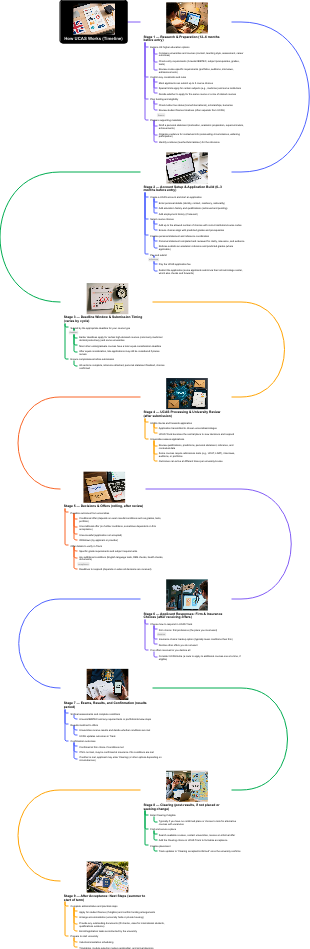
Timeline and Deadlines (Typical Pattern)
Research and preparation (months before submission)
Shortlist courses and universities
Check entry requirements and subject prerequisites
Consider admissions tests and portfolio/interview needs
Main deadlines (vary by cycle; always verify current year)
Early deadline (commonly mid-October)
Most Medicine, Dentistry, Veterinary Medicine/Science
Main equal consideration deadline (commonly late January)
Many courses consider applications equally up to this date
Later deadlines and “after deadline” submissions
Applications can still be submitted, but equal consideration may not apply
Decisions period
Universities respond over weeks/months
Some courses decide quickly; competitive/interview courses take longer
Applicant reply deadlines
Deadlines depend on when you receive decisions
You choose Firm and (if applicable) Insurance choices
Results and confirmation
UK qualification results days (A levels/IB timelines)
Universities confirm places if conditions met
How Universities Make Decisions
Types of decisions
Conditional offer
Place depends on meeting conditions (grades, tests, language)
Unconditional offer (less common; may include conditions like making the university your Firm choice)
Invitation to interview/audition or request for additional info
What they assess
Academic record and predicted grades
Subject relevance and prerequisites
Personal statement/answers
Admissions tests (where required)
Interview/audition performance (where required)
Contextual factors (depending on provider policies)
Offers and Conditions
Typical academic conditions
Specific grades (e.g., AAB) or points (e.g., UCAS Tariff)
Required subjects/levels (e.g., Maths for Engineering)
Non-academic conditions
English language tests (IELTS/TOEFL) for many international applicants
Portfolio submission (Art/Design/Architecture)
DBS checks/health requirements (some clinical or placement-heavy courses)
UCAS Tariff (when used)
Some universities use Tariff points; others use specific grade offers
Not all qualifications are treated equally; check provider requirements
Responding to Offers (Applicant Decisions)
Firm choice
Your first-choice course/university
Insurance choice
Backup option with typically lower requirements (if available)
Declining offers
You may decline offers you don’t want
If you receive all rejections or decline all offers
You may use UCAS Extra (if eligible) or consider Clearing later
UCAS Extra (If You Have No Offers)
When it applies
You used all 5 choices and have no offers (or declined all)
How it works
Add one extra choice at a time
Wait for a decision before adding another
Strategy
Target realistic entry requirements
Contact admissions teams to gauge suitability before adding
Clearing (Finding a Place After Results or Late in Cycle)
Who uses Clearing
Applicants without a confirmed place after results
Applicants who applied late
Applicants who want to change course/university (if eligible)
How it works
Search for courses with vacancies
Contact universities and receive a verbal/indicative offer
Add the Clearing choice in UCAS for formal confirmation
Key considerations
Have results and personal details ready when calling
Be flexible on location/course content
Adjustment and Changing Plans (Conceptual Overview)
Changing choices before submission
Edit choices freely until the application is sent
After submission
Limited ability to swap choices; policies vary by timing and UCAS rules
After results
If you exceed conditions, options depend on current UCAS features/policies that year
Many applicants use Clearing to change course/provider if they already hold a place
Fees and Payment
UCAS application fee
Amount varies by cycle and number of choices
Additional costs not paid to UCAS
Interview travel (if in-person)
Visa and immigration fees (international)
Admissions Tests, Interviews, and Portfolios
Admissions tests
Some subjects require tests (e.g., certain medicine, law, mathematics, or Cambridge/Oxford-specific tests)
Registration deadlines may be earlier than UCAS deadlines
Interviews/auditions
Common in Medicine, Dentistry, Nursing/Allied health (provider-dependent), Oxbridge, and performing arts
May be online or in-person
Portfolios
Art/Design/Architecture often require digital or physical portfolios
Deadlines and formats vary by provider
International Applicant Considerations
Qualification equivalency
Universities may publish country-specific entry requirements
UCAS lists qualifications; providers decide equivalence
English language proficiency
Accepted tests and minimum scores vary
Deadlines for providing scores can affect confirmation
Visa and CAS timeline (Student visa)
Need confirmed place and CAS from university
Plan for deposit payments and document lead times
Support, Accessibility, and Context
Disability and support needs
Disclose to access support and reasonable adjustments
Some courses have fitness-to-practise standards
Contextual offers
Some universities reduce grade requirements based on contextual criteria
Criteria and evidence requirements vary
Widening participation programs
Summer schools, access schemes, guaranteed interview/offer pathways (provider-specific)
Tracking and Communication
UCAS Hub updates
Shows application status, offers, and reply deadlines
University communications
Email/portals for interviews, documents, and accommodation
Keeping information accurate
Update contact details promptly
Monitor spam/junk folders
Common Pitfalls and Best Practices
Course research mistakes
Not checking subject prerequisites or module content
Choosing only aspirational options without backups
Personal statement issues
Too generic; not evidencing interest with specifics
Poor structure, weak reflection on experiences
Deadline and test registration misses
Admissions tests often require separate early registration
Data entry errors
Wrong qualification dates/grades; mismatched names/passport details
Offer response mistakes
Choosing an Insurance that is not meaningfully lower than Firm
Missing reply deadlines leading to lost offers
End-to-End Flow (Summary)
Choose courses and check requirements
Register for any required tests/portfolio/interviews
Complete UCAS application (choices, statement/sections, qualifications, reference)
Submit and pay → UCAS sends to universities
Universities assess → decisions (offers/rejections)
Choose Firm/Insurance (or use Extra if no offers)
Receive results → place confirmed if conditions met
If not placed (or changing plans) → use Clearing to find vacancies
 Wondershare EdrawMind