 Wondershare EdrawMind
MindMap Gallery CFRP-Ti Paper Summary Mind Map
- 90
CFRP-Ti Paper Summary Mind Map
This paper is about a tool deflection compensation method for orbital drilling of CFRP/Ti stacks that uses a cutting force observer. This method optimizes analysis by taking into account the effects of drill-tip deflections and feed-rate variations, resulting in improved accuracy and surface roughness. The proposed technique was verified through extensive experiments in order to determine its suitability for drilling curved surfaces. It can therefore be used as a great tool to create a mind map detailing an entire paper’s summary. Create similar mind maps using EdrawMind. With EdrawMind, you can create multiple mind maps in a single file.
Edited at 2022-12-18 07:06:48
- Recommended to you
- Outline
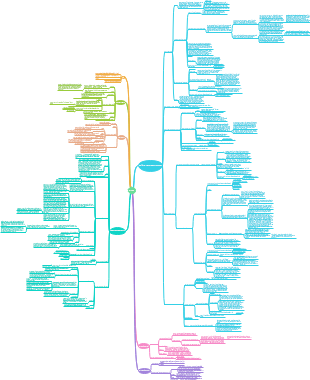

Study on Tool Deflection compensation method based on cutting force observer for orbital drilling of CFRP/Ti stacks
Abstract
Novel method fuses cutting force model prediction and feed-axis distubance observation to estimate radial cutting force
Tool deflection is calculated based on the equivalent diameter catilever beam model
Tool path is corrected by adjusting the tool eccentricity in real-time
Geometrical error was reducted by 50%
The requirement can be satisfied after one single shot of cutting
the cutting force was increased to twice of initial value cause by a tool wear
Cutting force of helical milliing
Kinematics of helical milling
tool eccentricity
Axial feed speed
Feed per tooth of tool front egde
Revolution speed
Feed per tooth of periphery edge
Helical Milling Process
both periphery and front edge tool participate in cutting at the same time
Two carterisan coordinate system of workpiece and tool are established: Workpiece coordinate system OhXhYhZh Tool coordinate system OtXhYhZh
OtXt can be obtained according to right-hand rule
Cutting force changes dual-periodically due to rotation and revolution
represent the angular position of the tool
represent the radial contact angle of the tool which caused the change of underformed chip thickness
is the angle formed by the line of OhOt and OhOp and bp
represent axial, radial, and tangential cutting forces acting on cutting edge
represent cutting widht and cutting thickness respectively
cutting width of periphery
cutting depth of the periphery edge
The cutting thickness and width of front edge are fixed values
Cutting force modelling
Cutting force on periphery edge
Periphery cutting force
divide the cutting into dz
N cutter teeth distribute the cutting tool
The tooth spacing angle
assuming that angular displacement of first cutting edge is
is tool helix angle
Then radial contact angle of micro cutting edge with axial height z on j tooth
are start end exit angle of the tool
start angle with height z while exit angle are constant
Force acting on cutting edge micro element
tangential cutting force
shearing force
edge force coefficient
radial cutting force
shearing force
edge force coefficient
Axial cutting force
shearing force
edge force coefficient
Component of cutting force infiniesimal in tool coordinate system
t represent the tool coordinate system
Cutting force generated by periphery cutting
Instantaneous cutting force on workpiece coordinate
w represent workpiece coordinate system
The axial Force Generated by front edge can be expressed as
are cutting force coefficient realated to front cutting edge
Axial cutting force observer
cutting force observer (CFOB)
calculation of tool radial deftection
Radial force of peripheral cutting is the main cause of tool deflecttion
Tool deflection can be expressed as:
tool overhang
elastic modulus of tool material
is moment of inertia of tool cross section
is the tool equvalent diameter
diameter factor
round bar with diameter of Deq after bending
Compensation method
Experiment and Result
Parameter Identification of cutting force model
mean value of 0.01s window
feed per tooth in revolution
0.003mm
0.004mm
0.005mm
0.006mm
axial cutting depth per revolution
0.1mm
0.12mm
Verification of compensation method
Lateral Force
Conclusion
Main Topic
Prediction of cutting forces in helical milling process
Abstract
both the periphery and botting cutting participate in machining process
novel analytic cutting force model based on the helical milling principle
cutting coefficient are identified based on experimental test
Helical milling kinematics
the process aslo referred as an orbital drilling
Three stages
moving from o1 to o2
helical milling from top to bottom
moving back from o2 to o1
helical milling reduces the thrust force
the process has double periodicity
process decription of helical milling
Geometry of the tool
Mechanics of helical milling
Analysis of motion vectors
Tool rotation and revolution
angular velocities corresponding to tool rotation
angular velocities of tool revolution
tool axial motion
axial feed rate
axial feed per tooth
Tool helical motion
travel distance per revolution
helical feed rate
ramp angle
Due to small value of
Feed rate per tooth front edge
measured along the feed axis of the tool
tangential to helical tool path
Feed per tooth periphery edge
Workpiece and Tool coordinate interface
Helical milling process is double periodicity at both
Tool passing frequency
tooth passing frequency
the instantenaeous is same as
Mechanistic cutting force model
Elemental Cutting force (Tangential, Radial, and Axial)
edge length of cutting segment
underformed chip thickness
Converted into tool coordinate system
integration of Forces acting on cutting edge
Converted into Workpiece coordinate system
axial forces are induced by the peripheral and bottom edges
Axial cutting iduced by bottom edge
While radial and tangential cutting forces are only impacted by periphery edges
The instantenous cutting forces on global coordinate sytem
Linear Force model
Edge forces
unrelated with cutting
cutting forces
depend on underformed chip thickness
Average forces per feed tooth
Edge cutting components are estimated by linear regression of test data
Identification of cutting force coefficient
Six cutting force coefficient must be identified
the cutting forces in every direction are measured and average to obtain forces at each revolution
can be expressed as function of feed per tooth
Edge cutting components
estimated by liniear regression of the cutting data
the average cutting force per orbit
average cutting force for each tooth
Average cutting forces per tooth over one full revolution
Edge cutting components are estimated by linear regression of test data
Cutting force cofficent are identified from
cutting forces during short time interval can be considered to be in steady state
Experimental setup and calibration
Results and discussion
Conclusion
Tool wear monitoring and prognostics challanges: a comparison of connectionist methods towardd an adaptive ensemble model
Abstract
Prognostic is applied
Predictiong tool wear
Estimating its life span
data-driven coonectionist is proposed
Ensemble of Summation Wavelet-Extreme Learning Machine (SW-ELM)
Incremental learning machhine
Contribution
Define prognostics modeling challanges
Compare SW-ELM with rapid learning approaches
Build SW-ELME with incremental learning scheme
Validate SW-ELME on unkown cutting tools data
Toward an enhanched data-driven prognostics
Data-driven tool wear monitoring framework
Data Acquisiton
Vibration
Force Signal
Data Processing
Monotic trends
Prognostic Modeling
Data-drivne tool wear
Learning
Learn relation between input and target
Testing
Predict tool condition online
provide confidence prediction
Open Challages of prognostic Modeling
highly complex and non-linear environtment makes it hard to establish prognostics models
Prognostic model should be enhanced by handling all three challanges
Robustness
The ability to insensitive to inherent variatiuons of input data
Reliability
the ability to be consistent in situation when new/unkown data are presented
Applicability
the ability to be practicallyu applied under industrial constraints
Choice of data-driven prognostics approach
Data-driven approaches have better applicabilty compared to other prognostics approaches
Bettter generality and system wide scope
Do not require degradation process model
Easy to implement and have low complexity
Require few knowlege of the equipment
Usually have low computation time
Brief overview of ANN architectures
The extreme learning machine
Benefits
ELM does not require slow iterative learning an it is one-pass algorithm
ELM has only one control parameter to be manually tuned
ELM is suitable fro
rapid learning ability
less human intervention
Proposed data-driven approach
Summation Wavelet-Extreme Learning Machine
Structure and parameters
Structure: Each hidden node holds a parallel cojunciton of two different activation functions, the output is the average
Activation function: inverse hyoperbolic sine and morlet wavelet
Parameter initialization
wavelets adapted by heuristic procedure
weight and bias initialization by Nguyen Widrow
Learning scheme
SW-ELM ensemble with incremental learning
Ensemble Method
Integrationg several SW-ELM-Models with different parameters
Averaging outputs
Tool wear continues with each input along the confidence bounds
The life span of cutting tool is estimated whe nthe predicted valie interserct the failure threshold
Incremental learning
During an online application a new cutting data and its predicted tool wear are stored sequentally to old cutting data
SW-ELME is updated before next input
Case Study: Tool Condition Monitoring
Experimental arrangements
Data acquisition and processing
Features
Force Signals
Maximum Force Level
Total Amplitude of cutting foce
Amplitudo ratio
Average force
Toolwear measurement
Tool wear model settings and performance metrics
A comparison of tool wear to encounter prognostics challages
Adaptive ensemble to predict tool wear and estimate lifespan with given confidence
aim to show improved reliability of proposed model and its applicability
leave-one-out strategy
learning/testing time in seconds
Comparison of connectionist approaches
Robustness and applicatbility : results discussions
evaluating the robustness in learning data having same context
SW-ELM showed better robustness
Reliability and applicability : results discussions
Reliability of partially known data
evaluating the reliability when exposed to variations in data of multipole cutters havinng different attributes
ELM is faster than ESN
Reliability of totally unkown data
Evaluating the reliability when unkown data with different attributes are presented
Leave-one-out strategy
SW-ELM has better reliability compared to ELM and ESN
The averaged accuracy performace of SW-ELM is also impoved
Adaptive SW-ELME and its reliability
The reliability of SW-ELM ensemble with incremental learning scheme
Simulation settings
For each test the lowwer and upper confidence of tool wear prediction and evolution of probaility density function are given to quantify the uncertainty
SW-ELME - results discussion
SW-ELME has better accuracy than single SW-ELM
Indicated by lower error value
Compared the previous result on the reliability of SW-ELM one by one
Conclusion
Data driven prognostic approach is proposed
Extreme Learning Machine (ELM) Summation Wavelet -Extreme Learning Machine (SW-ELM) Echo State Network (ESN) are used
SW-ELM outperform ELM and ESN in reliability and robustness without compromising rapid learning
An ensemble of SW-ELM (SW-ELME) modes are proposed with incremental learning
SW-ELME enables predicting the tool wear and estimating lifespaln online and provides confidence level
Sef-Supervised Learning: The dark matter of Intelligence
Self-supervised learning is predictive learning
self-supervised learning obtains superviosory signals from the data itself
the general technique of self-supervised learning is to predict any unobserved or hidden part of the input from any observed or unhidden part of the input
in self-supervised learning, the system is trained to predict hidden parts of the input(in gray) from visible parts of the input (in green)
Self-supervised learning for language versus vision
NLP
the system learns to represent the meaning of the text so that it can go a good job at filling in "correct" words
CV
more difficult to represent uncertainty in the prediction for images
Modeling the uncertainty in prediction
NLP
Predicting missing words involves computing a predictionscore for every possible word in the vocabulary
CV
predicting "missing" frames in a video. missing patches in an image or missing segment in speech signal involves a prediction of high dimensional continuous objects rather that discrete outcomes
it is not possible to explicitly represent all possible video frames and associate a prediction score to them
A Unified view of self-supervised methods
Think about SSL within the unified framework of an energy-based model (EBM)
EMB is trainable system that given two inputs, x and y, tell us how incompatible they are to each other
To indicate the incompability between x and y, the machine produces a signle number, called an energy
if the energy is low, they are compatible
if the energy is high, they are incompatible
Training an EBM consists of two parts
Showing it examples of x and y are compatible and training it to produce a low energy
Finding a way to ensure that for particular x, the y values that are incompatible wiht x produce a higher energy than the y values that are compatible with x
An energy based model (EBM) measures the compatibility between an observation x a proposed prediction y, if x and y are compatible, the energy is a small number, if they are incompatible, the energy is a larger number
Joint embedding, Siamese Networks
A particullar well-suited deep learning architecture to do so is the so-called Siamese networks
The function C at the top produces a scalar energy that measures the distance between the representation vectors (embeddings) produced by rwo identical twin networks sharing the same parameters (w)
The difficult part is to train the model so that it produces high energy for images that are different
Contrastive energy-based SSL
constructing pairs of x and y that are not compatible, and adjusting the parameters of the model so that the corresponding output energy is large
NLP
masking or substituting some input words belongs to the category of contrastive methods
use a arhitecture in which the model directly produces a prediction for y
currupts the input y by masking some words to produce the observation x
the currupted input is fed to a large neural network taht is trainded to produce the original thext y
if one interperts the represnet the reconstruction error as energy, it will have
low energy for "clearn" text
higher energy for "corrupted" text
CV
Latent-variable predictive arhitectures
Given an observation x, the model must be a able to produce a set of multible compatible predictions symbolized by S-shapped ribbon
A latent variable z varies within a set (symbolized by a gray square)
The output varies over the set of plausible predictions
Non-contrastive energy based SSL
Illustrating Reinforcement Learning from Human Feedback
Pretraining a Language model
RLHF use a language model that has already been pretrainied wiht the classical pretraining objectives
The initial model can also be fine-tuned on additional text or conditions
In general, there is not a clear answer on "which model" is the best for the starting point of RLHF
Gathering data and training a reward model
Generating a reward model (preference model) ,the goal is to get a model that takes in a sequence of text, returns a scalar reward which should numerically represent the human preference
the output being scalar reward is crucial for existing RL algorithms
The LM can be any model
The trainind dataset of prompt-generation pairs for the Reference Model (RM) is generated by sampling a set of prompts from a predefined dataset
The prompts are passed through the initial LM to generate new text
Human annotators are used to rank the generated text outputs from the LM
Preference model takes any text and assigns it a score of how well human precieve it
Fine-tuning the LM with reinforcement learning
fine-tuning some or all of the parameters of copy of the initial LM wiht a policy-gradient RL algoriith, Proximal Policy Optimization (PPO)
RL fine-tuning task formulation
the policy
langugage model that takes in a prompt an returns a sequence of text
The action space
all tokens corresponding to the vocabulary of the language model
Observation space
possible input token sequence
Reward function
combination of the preference model and constraint on policy shift
the text from current policy is passed preference model to produce
text is compared to text from initial model to compute a penalty on difference between them
The penlaty is a scaled version of KL divergence between the sequences of ditributions over tokens
the final reward
The update rule
Parameter update from PPO that maximize the reward metrics in current batch of data
Physic guided neural network for machine tool wear prediction
Abstract
A novel physics guided neural network model is presented
cross physic-data fusion (CPDF) is proposed
The information hidden in unlabelled sample is explored by physics-based model
a novel loss function is proposed
Introduction
Physic-based models are integrated with data driven models following three aspects
feature fusion
data augmentation
novel constraint loss term
The scheme of CPDF integrating the predictions of physics and data for addressing the prediting issues
Theoretical backgorud
physics-based and data-driven model depend on only on of the two variable information sources represent the two types of knowledge discovery
Direct application challanges of data driven model or physic-based model
Physic-based models usually infer assumptions on finite samples then generalize them to an ideal state of inifnite samples
The urgent requirement of data driven model is the experimental data used to train and test the model
the ppor interpertability and much less usage of domain knowledge make data driven model hard to keep consistency with physical principles
PGDD eliminates the physical inconsistency which conflicts with empirical knowledge or physical discipline
The effective PGDD models are conistent with physical principles with better generalizability than that of purely data-based conventional data driven models
The comparison of three different tool wear prediction models
physics-based model
data driven model
physics-guided data driven model
The models for describing the physical process can be devided into physical incosistent models and physical consistent models
High complex models
high accuracy
manifested as low generalization
poor performance when small changes occurs
Overly simple model
Robust and stable
low accuracy
the performance evaluation of physics guided neural network (PGNN)
performance = Acccuracy + Simplycity + Consistency
Physics Guided GRU model
Overview of PGGM
Local features regarded as the input of Bi-directional GRU model are extracted from cutting force and cutting velocity
Local feature extraction
a raw signal x is decomposed into sequence T segment evenly
features are extracted from each segment
Each raw signals split into T segment, then m features are extracted from each segment into matrix shape (1,m)
feature size for seven channels is (T, 7 m)
the cutting physical model is fitted using cutting forces and actual wear values
The use of unlabeled sample
The unlabeled sample is utilized as second data source of the PGGM model
The implementation contains the following steps
Te simplified model is expressed as
The nonlinear cure-fitting in least square is utilized of the physical based model
the physical model is fitted using labeled samples
unlabeled cutting force samples are pushed into the tool physical model
The estimation of tool wear is regarded as another input into PGGM
The calculating process is pocess is expressed as
The tool wear estimation is calculated by making additions fr the elements in the
The physics-guided input and local features are simmultaneously mapped to the tool wear space and with timing characteristics, and the results are the physical prediction and data prediction
Physical Mapper
Bi-Directional GRU
the physical prediction and data prediction are inserted into regression layer to predict tool wear condition
integrating both physical and data domains
Fully connected layer is constructed
Subtopic
a novel loss function is proposed to eliminate the physical inconsistency
regularization
Pysic-guided loss function
Standard Loss function
Proposed Model
The negative value are eliminated corredponding to the tool wear prediction which is inconsistent with the physical-based function
dropout and optimizer
performane evaluation
Experimental Evaluation
Experimental Setup
Has two types of data
Three sets of labeled samples
C1
C4
C6
Each labeled sample contains 315 samples
each samples has corresponding flankwear
Three sets of unlabeled samples
C2
C3
C5
Each data table consist of seven (7) columns of temporal signal
Force (x,y,z)
Vibrations (x,y,z)
Accoustic emmision
Data Preprocessing
Preprocessing of each dataset
dataset has 315 data tables
Preprocessing all channels in data tables
Each data tables has 7 channels
Preprocessing of each sample on each samples
original signal is broken up into 20 segments
10 features a re extracted from each segment to create matrix shape of (1, 10)
Final shape of local feature is
(20, 70, 315)
((#segment), (#featuresx#channel), (#datatables))
Testing process
Cross validation strategy
Performance Evaluation
Compared to
SVR
GRU
Bi-GRU
1DCNN
LSTM
C1 Testing
C4 Testing
C6 Testing
Discussion
Comparison of contributing factors
Split into four models
Model A : using Bi-Directional GRU
Model B: loss function is only MSE
Model C : the physical prediction is removed
Model D: proposed model
Result
Physical Mapper
Conclusion
The modelling strategy, a cross physics-data (CPDF), is poposed with improved prediction accuracy of Physic guided GRU model (PGGM)
the generalization and robustness of PGGM is improved by using unlabeled samples
Physics-guided loss function eliminates the physical inconsistency in predicting results
The fusion of multi-physics knowledge and data mining techniques will be further investigated
Active supperssion of milling chatter with LMI-based robust controller
Abstract
Proposed a discrete output feedback based on linear matrix inequality (LMI) to suppress chatter with an electromagnetic actuator
active milling chatter control system is also design
Uncertainties in the system such model parameter, axial cutting depth are also considered
simulation results show chatter-free milling process
experimental prototype also performed with chatter-free boundary improved significantly
Modelling of active control system for milling chatter suppression
Modelling miling process
Milling process model
The milling process is a 2-DOF System
vibration is due to self-excited
vibration causing regenerative effect
The Governing function for milling system
are modal matrix
static cutting
b is axial depth of cut
tool tip displacement
time delay
z is the number of teeth
is the time varying cutting force coefficient
is tangential force
is normal cutting force
is the cutting state function of j-th tooth that determines wetherth tooth is in cutting or not
is entrance angle
is exit angle
Modelling active control system
electro magnetic actuator
Active Control System
During the milling operation
eddy current sensor mounted aroud the electromagnetic actuator are utilized to measure spindle system vibration
the output of active control force is applied on the surface of rotating spindle
is control force, an can be linearized as
is current stiffness coefficient
is displacement stiffness coefficient
electromagnetic force model
the value of ki and kq are ultilized to model electromagnetic force in each direction
values are determinded by parameters of electromagnetic actuator
is input control current x
is input control current y
is displacement of spindle shaft at actuator's position x direction
is displacement of spindle shaft at actuator's position y direction
Control block diagram of active control system for chatter suppression
Active milling chatter control system
is a transfer function matrix between the tool tip and the mounting position of actuator in x and y direction
measured displacement of actuator's positon
actual displacement at tool tip
Displacement caused by static cutting force
displacement coused by dynamic cutting force
is a transfer function between mounting position of actuator and the tool tip in x and y direction respectively
applied force at actuator's position
equivalent control force at tool tip
is time-varying cutting coefficient
can be approximated to become time-invariant forms
static cutting force
dynamic cutting force
causing displacement
Static cutting force has no effect on stability of milling
can be neglected
Active milling chatter control system without static cutting force
it can be found that displacement by dynamic cutting force becomes the feedback of the whole system which can be called perturbation displacement
The discretizaition model can be expressed as
is discrete time
Define
Linear Matrix Inequality (LMI)-based robust controller design for active chatter suppression
spindle Speed
b is axial depth of cut
Controllers order n is determined by
is discrete time
upper boundary of time delay
lower boundary of time delay
nominal value of discrete time
n is fixed number
State Space Model
are matrixes caused by parameters uncertanties
are known real constant matrices
assume the feedback controller takes
is the gain matrix
positive skalar
can be solved with MATLAB LMI control box
Proof that state space model is global stable with controller
subtitute controller to state space
wil stable when
* means symmetric term
gain matrix
Obtained by Lemma 1
Given
Matrixes
Symmetric matrix
only holds if and only if
is exist as positive real number
S in arbitrary matrix
Based on Lemma 1
according to schur complement lemma
Based on lemma 1 and schur complemet lemma
Premultiplying and postmultiplying with diagonal
Defining
The active controller become
Construct Lyapunov function
P is symmetric positive definite matrix
Define
Simulation and experiments of active control system for milling chatter mitigation
Experimental setup and parameter identification
To identify the needed parameter for simulation and experimetal verification
Hardware Specification
Displacement sensors
Symmetricaly distributed around spindle
operating on dSPACE MicroLabBOX
Electromagnetic actuators
1A/V gain amplifier
Current stiffness matrix is diag {28.5, 28.5}
Displacement coefficient matrix is {2.6e5, 2.5e5}
Maximum control force is about 150N in x and y direction
Spindle
Max. speed of 24000 rpm
3.5 kW power
Parameter Identification
Impact Test for FRF and transfer function identification
Test setup
using dummy tool with diameter of 7mm and overhang of 35mm
Hammer sensor PCB086C03
LMS Test.Lab for signal prcessing
FRFs results
only first mode are utilized
first mode is more flexible than second mode
Transfer function results
Transfer function is constant at first mode (1kHz)
Error values between actual and assumed value are constant for box x and y at 0.2
Transfer function is a constant of 5 because
Cutting force coefficient identification
Setup
Workipece is AL6061
Tool is 7 flutes, 7mm diameter and 35mm overhang
Force sensor is Kistler 9129A
Results
Parameter uncertanties evaluation
evaluation of first natural frequency at different spindle speed
Process description
a sweeping voltage signal range from 0 Hz to 1200 Hz is outputed to actuator
The responses are picked up by displacement sensors
Results
frequency response of 1st natural frequency at 10k rpm
The natural frequencies varies in a range of 5%
Active robust controller design and simulation
Determined wih identified parameters and the behaviors with LMI-based controller
Parameters
Cutting parameters
Spindle speed
7000-10000
12000-15000
axial depth cut b
2 mm
3 mm
Num of teeth z
3
Controller Parameters
Controller's order n
10
Discrete time interval
Controller's uncertainty parameter
Simulation
Simulation procedure
discretization of spindle
500 rpm
axial cutting depth
0.1 mm
Simulation Results
stability boundaries througout different speed ranges
stabillity boundary is effectively enlarged
Rpm of 7000, axial depth of cut 2mm, radial depth of cut 7mm
displacement response without control
Milling is unstable
Displacement with control
Milling is stable
Current control
Performance with parameter uncertainties
Simulation results: (a), (c) and (e) are displacementresponse under an uncertainty of 1%, 2% and 5% respectively;
(b), (d) and (f) are control current under an uncertainty of 1%, 2% and 5% respectively.
Cutting Test
Experimental parameters
Control system
to remove the noise, a band pass filter is design with range of 10 Hz ~ 2000 Hz
Results
Stability lobe measurement
With controller
Without controller
Machining results
spindle speed 6000 rpm and depth of cut 2mm : controller was switched on at 50s.
(d) and (e): spectrum of vibration signals with and without control.
spindle speed 13,000 rpm and depth of cut 1.5mm: controller was switched on at 50s.
(d) and (e): spectrum of vibration signals with and without control.
Conclusion
an active milling chatter suppression system is developed, with LMI-based robust controller , and an electromagnetic actuator is utilized
uncertainties of modal parameters are also observed with sweeping experiments
the robustness is well verified and simulations also show that the performance when the uncertainties exist
Simulation results show the stability boundary is significantly enlarged with the designed controller
Experimental results show better surface finishes and chatter vibration is suppressed effectively with the designed controller