 Wondershare EdrawMind
MindMap Gallery Chapter 9 Endomembrane System and Proteins
- 35
Chapter 9 Endomembrane System and Proteins
The endoplasmic reticulum is one of the main sites for protein synthesis. It can synthesize various types of proteins, including proteins secreted out of cells, membrane integrated proteins, and soluble resident proteins that constitute organelles. They all play an important role in cellular life activities.
Edited at 2023-11-01 20:27:12
- bacteria
This is a mind map about bacteria, and its main contents include: overview, morphology, types, structure, reproduction, distribution, application, and expansion. The summary is comprehensive and meticulous, suitable as review materials.
- Plant asexual reproduction
This is a mind map about plant asexual reproduction, and its main contents include: concept, spore reproduction, vegetative reproduction, tissue culture, and buds. The summary is comprehensive and meticulous, suitable as review materials.
- Reproductive development of animals
This is a mind map about the reproductive development of animals, and its main contents include: insects, frogs, birds, sexual reproduction, and asexual reproduction. The summary is comprehensive and meticulous, suitable as review materials.
Chapter 9 Endomembrane System and Proteins
- bacteria
This is a mind map about bacteria, and its main contents include: overview, morphology, types, structure, reproduction, distribution, application, and expansion. The summary is comprehensive and meticulous, suitable as review materials.
- Plant asexual reproduction
This is a mind map about plant asexual reproduction, and its main contents include: concept, spore reproduction, vegetative reproduction, tissue culture, and buds. The summary is comprehensive and meticulous, suitable as review materials.
- Reproductive development of animals
This is a mind map about the reproductive development of animals, and its main contents include: insects, frogs, birds, sexual reproduction, and asexual reproduction. The summary is comprehensive and meticulous, suitable as review materials.
- Recommended to you
- Outline
Intimal membrane system and protein sorting
Overview
Membranous organelles and endomembrane system
The concept of the endomembrane system
Broadly speaking: all organelles with membrane structure in the cytoplasm.
Narrow sense: Refers to organelles that have membranes that flow with each other, are in dynamic balance, and are functionally coordinated with each other, including endoplasmic reticulum, Golgi apparatus, nucleus, lysosomes, and vacuoles.
The role and distribution of membranous organelles
All are involved in protein processing, sorting, and membrane vesicle transport.
Dynamics of the endomembrane system
1. Biosynthetic pathways
2. Secretory pathway
3. Endocytic pathway
The evolution and significance of the endomembrane system
evolution
Cause: expansion of the amount of genetic information, increase in volume, imbalance in the ratio of surface area to volume, and impairment of material metabolism speed.
Countermeasure: Regionalize the internal structure of cells.
Pathways: endosymbiosis pathway, plasma membrane invagination pathway.
significance
1. The synthesis and assembly of the membrane structures of each organelle in the endomembrane system are carried out in a unified manner, which not only improves the efficiency of synthesis, but more importantly ensures the consistency of the membrane structure.
2. The endomembrane system forms some specific functional areas and microenvironments within cells.
3. The inner membrane system completes membrane flow and directional transport of proteins with specific functions through vesicle secretion.
4. The formation of the inner membrane system prevents these enzyme reactions from interfering with each other.
5. Expand the surface area of the membrane and increase the ratio of surface area to volume.
6. The formation of compartments relatively increases the concentration of important molecules, thereby increasing the reaction rate.
Regeneration of membranous organelles
When cells proliferate through division, in addition to replicating chromosomes, they must also replicate the membranous organelles within the cell.
Protein sorting and membrane transport
Space-time concepts of protein sorting and transport
When are synthesized proteins transported?
What are the steric obstacles that synthetic proteins must overcome during transport?
Spatial obstacles in protein sorting and transport and mechanisms to overcome them
transmembrane transport
Nuclear pore transport
vesicle transport
Signal sequences direct the correct transport of proteins
signal sequence
15-60 aa in length, different membrane-bound organelles have different signal sequences for protein localization.
Transportation method
nuclear entry signal
Directs the transport of nuclear proteins.
lead peptide
Directs the transport of mitochondrial, chloroplast and peroxisomal proteins.
signal peptide
Directs protein transport in the endomembrane system.
Research methods of the endomembrane system
autoradiography
The secretion route is determined, starting from the endoplasmic reticulum through the Golgi apparatus and transported out of the cell.
Differential centrifugal separation
The roles of the main organelles involved in synthesis and secretion were determined. The endoplasmic reticulum is involved in protein synthesis and transport. The Golgi apparatus is not only a transfer station, but also has a processing role.
Mutant research
The genes related to secretion activity and the mechanism of secretion were revealed.
endoplasmic reticulum
Overview
Porter and Palade observed chicken embryo fibroblasts under an electron microscope and found a network of tubes of various sizes connected in the endoplasmic part of the cytoplasm, called the endoplasmic reticulum.
concept
The endoplasmic reticulum is a vesicular, vesicular and tubular structure formed by a layer of unit membrane, and forms a continuous omentum system. Because it is close to the inside of the cytoplasm, it is called the endoplasmic reticulum.
Morphological structure and chemical composition of endoplasmic reticulum
The morphological structure of the endoplasmic reticulum
Flat sac-like arrangement
tube-like arrangement
vesicular arrangement
Chemical composition of the endoplasmic reticulum
Proteins and lipids, metabolic enzyme systems, cytochrome P450 and electron transport chain.
Marker enzyme: Glucose-6-phosphatase
Functions of smooth endoplasmic reticulum
Glycogen breakdown releases free glucose
Carbohydrate metabolism.
Synthesis of membrane lipids and lipid bilayers
synthesis of steroid hormones
Secreted via vesicular form.
Binding via transporter proteins.
Participate in the detoxification of liver cells
The smooth endoplasmic reticulum contains a rich oxidase system (such as cytochrome P450, NADH cytochrome C reductase) that can detoxify many toxic substances and convert them into substances that are easy to be excreted.
Mixed function oxidase
One molecule of oxygen is required for each molecule of substrate to be oxidized, converting NADH into NADH.
This oxidation process consumes oxygen molecules, with one oxygen atom present in the water and another oxygen atom present in the product.
Participate in signal transduction and muscle contraction
The regulatory role of Ca2
Function of rough endoplasmic reticulum - protein transport
Discovery and confirmation of signal sequences
General characteristics
15-35 amino acid residues, the N-terminus contains one or more positively charged amino acids, which guide ribosomes into the endoplasmic reticulum during protein synthesis and are later removed.
signaling hypothesis
1. The synthesis of secreted proteins begins with free ribosomes in the cytoplasm.
2. After the N-terminal signal sequence of the nascent protein is exposed to the ribosome, it binds to the transport protein of the endoplasmic reticulum membrane by free collision, and then the N-terminal signal sequence is inserted into the aqueous channel of the transport protein.
3. The protein continues to be synthesized and passes through the endoplasmic reticulum membrane in the form of a loop.
4. Signal peptidase excises the signal peptide, and the completely synthesized new ecology enters the cavity of the endoplasmic reticulum.
Signal recognition particles and their functions
signal recognition particles
ribosomal protein complex
signal recognition granule receptor
It is an endoplasmic reticulum membrane protein that binds to SRP on the endoplasmic reticulum membrane. It is a dimer composed of α and β subunits. α is the SRP recognition and binding site, and β subunit is a transmembrane protein.
effect
Binds to SRP bound to the endoplasmic reticulum signal, guiding ribosomes that are synthesizing proteins to the membrane of the endoplasmic reticulum.
Mediates the binding of ribosomes to transport proteins in the uncoupled endoplasmic reticulum membrane, and then hydrolyzes SRP with GTP on the α subunit to release SRP. The mRNA on the ribosomes continues to complete the translation of the polypeptide and enters the endoplasm through the transport protein. The cavity of the net.
Secreted protein co-translational transport mechanism
The endoplasmic reticulum signal sequence has two basic functions
Binds to SRP bound to the endoplasmic reticulum signal, guiding ribosomes that are synthesizing proteins to the membrane of the endoplasmic reticulum.
Through the hydrophobic interaction of the signal sequence, the transmembrane transport of new ecology is guided.
The process by which secreted proteins enter the lumen of the endoplasmic reticulum
1. Secretory protein synthesis begins on ribosomes.
2. The signal sequence binds to SRP.
3. Ribosomes attach to the endoplasmic reticulum.
4. SRP release and opening of protein transport channels.
5. Under the action of signal peptidase, the signal peptide is removed and the secreted protein is released into the lumen of the endoplasmic reticulum.
Proteins are translated into the endoplasmic reticulum
There are many proteins in yeast, and a few proteins in mammals, that are not cotranslationally transported but are instead transported to the ER after translation by free ribosomes.
Protein insertion into the membrane and orientation of the endoplasmic reticulum
single transmembrane protein
Integration method
There is a cleavable signal peptide at the N-terminus and a stop transfer signal inside.
Formation of membrane proteins that penetrate twice and multiple times
Double membrane penetration means that there are two hydrophobic transfer sequences inside the protein polypeptide. One is the start transfer sequence and the other is the stop transfer sequence.
Multiple penetration of the membrane means multiple hydrophobic start transfer sequences and multiple hydrophobic stop transfer sequences.
Protein folding and modification in the endoplasmic reticulum
Molecular chaperones aid protein folding in the endoplasmic reticulum
Heavy chain binding protein (Bip): A type of molecular chaperone that binds to the heavy chain of IgG antibodies.
Glycosylation modification of proteins
The significance of glycosylation modification of proteins in the endoplasmic reticulum
Glycosylation of proteins has been demonstrated to play an important role in their correct folding in the endoplasmic reticulum.
Elimination of misfolded proteins
It is cleared from the endoplasmic reticulum and transported back to the cytoplasm for hydrolysis by the proteasome.
Requires unfolding, molecular chaperones, energy consumption, and transport proteins.
Misfolding signaling responses in the endoplasmic reticulum
Causes heat shock response and unfolded protein response.
Glycosylphosphatidylinositol synthesis and protein anchoring
Very similar to glycosylation of proteins, but catalyzed by aminotransferase complexes.
Many proteins are anchored to the inner surface of the cytoplasmic membrane through GPI anchors and participate in signaling reactions.
GPI-anchored proteins guide plasma membrane proteins into lipid rafts, thereby separating proteins from each other.
Lysosomes and vacuoles
Lysosomal enzymes and the discovery of lysosomes
Discovery of lysosomes
It is a membrane-bound organelle in animal cells. It is a small globule and is covered by a unit membrane.
lysosomal enzymes
Oligosaccharide chains consist of phosphorylated mannose residues.
Equivalent to the spheres and vacuoles of plant cells.
Types of lysosomes
primary
secondary
autophagolysosome
xenolysosome
Mixture
participating body
Lysosomal morphology
Lysosomal membrane characteristics
Embedded with proton pumps, it forms and maintains the acidic internal environment in lysosomes.
There are a variety of carrier proteins for transporting hydrolyzate products outward.
Membrane proteins are highly glycosylated, which helps prevent degradation of their own protein membranes.
Contains cholesterol that promotes membrane stabilization.
Marker enzyme: acid phosphatase.
The function of lysosomes
Main: digestion
autophagy
Remove damaged cell structures, aged organelles, and biological macromolecules that are no longer needed in degraded cells.
Phagocytosis
Cells phagocytose infected viruses, bacteria or other particles and protect cells from infection by bacteria and viruses, which is the defense function of cells.
autolysis
It is the self-destruction of cells, that is, lysosomes release enzymes to degrade their own cells.
Other functions
In secretory gland cells, lysosomes take up secretory granules and participate in the regulation of the secretion process.
Acrosome reaction of spermatozoa during fertilization.
Lysosomes and disease
lysosomal storage disease
Type II glycogen storage disease
Silicosis
shock
biological response
Synthesis, modification and sorting of lysosomal proteins
The nascent polypeptide chain enters the RER through a co-translational transport pathway.
N-linked glycosylation modifications occur within the RER lumen.
The membrane vesicle is transported and enters the GC surface membrane.
N-acetylglucosamine phosphotransferase catalyzes the formation of M6P.
Binds to the M6P receptor on the opposite membrane vesicle of the GC.
Transport vesicles form and bind to endosomes.
The enzyme precursor is dissociated from the M6P receptor and the receptor is recycled.
Lysosomal enzymes mature by dephosphorylation.
plant cell vacuole
Plant cells contain one or more fluid-filled vesicles called vacuoles, which account for 30%, and up to 90%, of the cell volume.
Contains a variety of hydrolytic enzymes.
Function
Serves as a reservoir of nutrients and waste, and is also a site for material degradation.
It can regulate the size of cells and control the turgor pressure of cells.
Make cells tolerant to different environmental changes.
Regulate the osmotic pressure of cells and regulate the degradation and synthesis of polymers.
In some cases, it can also change the transport speed of sugars, amino acids, and certain metabolites across the plasma membrane and tonoplast.
golgi apparatus
General properties of the Golgi apparatus
discovery naming
Camillo Golgi stained with silver nitrate and found a black mesh-like structure in the Purkinje cells of the owl's cerebellum. It was named "internal reticular apparatus" and later changed to Golgi apparatus.
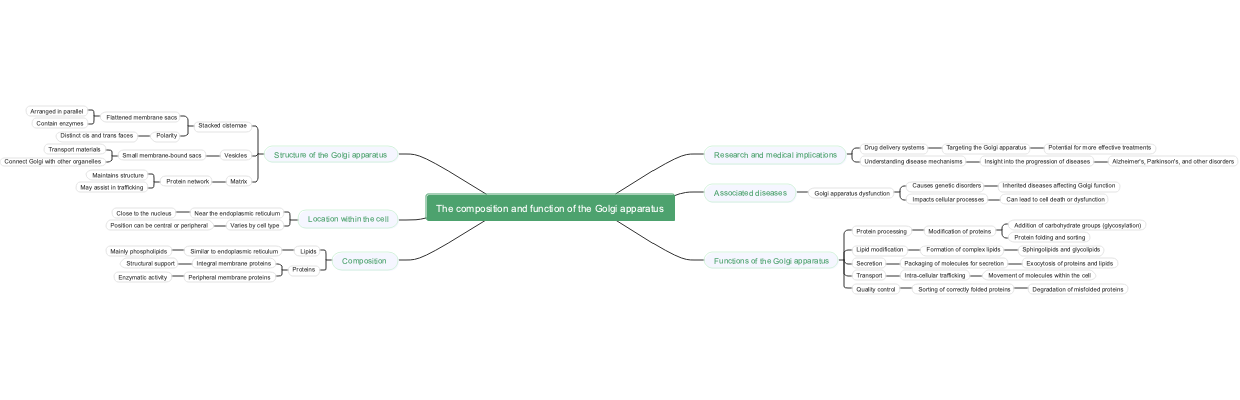
The Golgi apparatus is part of the endomembrane system and has a complex structure, consisting of many flat vesicles, vesicles, and large vesicles. This phenomenon is now called the Golgi complex.
The morphology of the Golgi apparatus
Some relatively neatly arranged flat membrane sacs are stacked together. Flat membrane sacs are mostly arcuate, and some are hemispherical or spherical.
flat vesicles
small bubbles
Golgi polarity
structure
Smooth surface, or form surface.
Golgi intermediate membrane vesicle.
Reverse Golgi network.
Function
When the Golgi apparatus performs its functions, it is a "flow-type" operation. Only after the previous process is completed can the next process be carried out.
Number and distribution of Golgi apparatus
The number varies, with an average of 20 per cell.
The Golgi complex is found only in eukaryotic cells and not in prokaryotic cells.
Chemical composition of the Golgi apparatus
protein and lipid
Marker enzyme: Glycosyltransferase.
Golgi apparatus function
Protein sorting by the Golgi apparatus
Sorting effect
It is determined by the interaction between the signal sequence and the receptor.
The lumen of the Golgi capsule is a water-soluble environment, and the working proteins in it are all membrane proteins.
The processing of protein oligosaccharides is carried out in various specific functional compartments, among which the most important processing modification is protein glycosylation.
Processing of N-linked oligosaccharide chains
high mannose oligosaccharides
Only 3 molecules of mannose are removed.
Complex oligosaccharides
Cut off 5 molecules of mannose and add 2 molecules of N-acetylglucosamine, 2 molecules of galactose, 2 molecules of sialic acid, and sometimes fucose.
Q-linked glycosylation modification of proteins
N-connection
Q-Connect
Transfer the sugar chain to the oxygen atom of the serine and threonine hydroxyl groups of the polypeptide chain.
Significance: The main function of glycosylation is to fold the protein into the correct conformation during the maturation process and increase the stability of the protein; in addition, the polyhydroxy sugar side chain 3 affects the water solubility of the protein and the nature of the charge of the protein.
Synthesis of sphingomyelin and glycolipids in the Golgi apparatus
Sphingomyelin is synthesized using ceramides.
Hemicellulose and pectin are also synthesized in the Golgi apparatus.
80% of the metabolic activity of the Golgi apparatus in plant cells is contributed to the synthesis of polysaccharides.
Golgi transport
Protein transport between the ER and Golgi apparatus.
Proteins are transported from the cis-Golgi network to the trans-Golgi network, and shuttle vesicles move from the cis-Golgi network to the trans-Golgi network.