MindMap Gallery chemical reaction rate
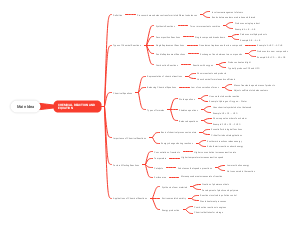
Chemical reaction rate, reaction rate equation aA bB=gC hH, r= k[c(A)]m*[c(B)]n k is the rate constant, m, n are the power exponents of the concentrations of A and B respectively.
Edited at 2023-10-29 22:58:22This is a mind map about bacteria, and its main contents include: overview, morphology, types, structure, reproduction, distribution, application, and expansion. The summary is comprehensive and meticulous, suitable as review materials.

This is a mind map about plant asexual reproduction, and its main contents include: concept, spore reproduction, vegetative reproduction, tissue culture, and buds. The summary is comprehensive and meticulous, suitable as review materials.
This is a mind map about the reproductive development of animals, and its main contents include: insects, frogs, birds, sexual reproduction, and asexual reproduction. The summary is comprehensive and meticulous, suitable as review materials.
This is a mind map about bacteria, and its main contents include: overview, morphology, types, structure, reproduction, distribution, application, and expansion. The summary is comprehensive and meticulous, suitable as review materials.
This is a mind map about plant asexual reproduction, and its main contents include: concept, spore reproduction, vegetative reproduction, tissue culture, and buds. The summary is comprehensive and meticulous, suitable as review materials.
This is a mind map about the reproductive development of animals, and its main contents include: insects, frogs, birds, sexual reproduction, and asexual reproduction. The summary is comprehensive and meticulous, suitable as review materials.
chemical reaction rate
reaction speed
Classification
average rate
instantaneous rate
Reaction rate equation aA bB=gC hH r= k[c(A)]m*[c(B)]n k is the rate constant, m and n are the power exponents of the concentrations of A and B respectively.
reaction mechanism
elementary reaction
Concept: a reaction in which reactant molecules are directly converted into products in one step
Number of reaction molecules: the number of (atoms, molecules, ions or free radicals) participating in the elementary reaction Non-elementary reactions do not have the number of reacting molecules
Classification: Single molecule reaction Number of reacting molecules = 1 Bimolecular reaction Number of reacting molecules = 2 Trimolecular reaction Number of reacting molecules = 3
Law of mass action aA bB=gC hH r= k[c(A)]a*[c(B)]b The law of mass action only applies to elementary reactions The rate equation measured experimentally is consistent with the rate equation written by the law of mass action, which does not mean that the reaction is an elementary reaction.
Mechanism discussion
The slowest elementary reaction in the reaction mechanism controls the rate of the overall reaction. Steps to control the reaction rate
Reaction series
Concept: The sum of the power exponents of the substance concentration in the rate equation (usually not equal to the stoichiometric coefficient in the reaction equation)
The greater the reaction order, the greater the impact on the reaction rate.
zero order reaction
Features: Reaction rate has nothing to do with reactant concentration
Rate equation -dc(A)/dt=k C(A)=Co(A)-kt
Half-life t½=Co(A)/2k
first order reaction
Rate equation -dc/dt=kc ln(Co/C)=kt lgC=lgCo-kt/2.303
Half-life t½=ln2/k=0.693/k
Secondary reaction
Rate equation 1/C-1/Co=kt
Half-life t½=1/kCo
Tertiary reaction
Half-life t½=3/2kCo²
rate constant
Definition: The reaction rate when the concentration of various reactants is 1mol/dm³ at a given temperature
characteristic
The size of k directly determines the reaction rate and the difficulty of the reaction.
k is a function of T. For the same reaction, if T is different, k will be different.
k is related to reactants, reaction media, catalysts, reaction vessels, etc.
unit
Zero order mol/(L³*s)
Level 1 s⁻¹
Secondary mol⁻¹/(L*s⁻¹)
n level mol¹⁻ⁿ/(Lⁿ⁻¹*s⁻¹)
Effect of temperature on chemical reaction rates
Aronius formula k=Ae⁻Ea/RT lnk=-Ea/RT lnA lgk=-Ea/2.303RT lgA lgk₂/k₁=Ea/2.303R[(T₂-T₁)/T₂T₁
The same reaction at different temperatures. When Ea is constant, the higher the temperature, the greater the k value and the greater the r value. Different reactions at the same temperature. For reactions with a large Ea, the k value will be small and the r value will be small. For the same reaction, the same temperature is raised. When the temperature is raised in the high temperature zone, the k value increases by a small factor. Different reactions, raising the same temperature. For a reaction with a large Ea, the k value increases by a larger multiple.
reaction rate theory
collision theory
Prerequisite: The collision between reactant molecules is the reaction The higher the frequency of collisions between reactant molecules, the greater the reaction rate.
Effective collision: A collision that can produce a chemical reaction
Activating molecules: molecules capable of efficient collisions
Activation energy: The lowest energy that an activated molecule has
Boltzmann distribution f=e⁻Ea/RT f is the energy factor
r=ZfP=ZPe⁻Ea/RT P is the orientation factor Z is the total number of collisions
transition state theory
The reactant molecules must pass through an intermediate transition state to form an activated complex. Chemical equilibrium is quickly reached between the reactants and activated complexes.
The greater the activation energy of a reaction at a certain temperature, the higher the energy peak, and the reactants that can cross the energy peak The smaller the ratio of molecules, the slower the reaction rate