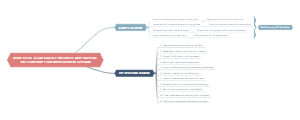
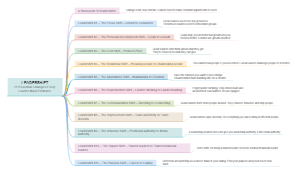
This is a mind map of Interpersonal Skills at Work. You can make and share your own mind maps easily. Just try EdrawMind mind mapping software for free!
This book provides a clearly structured and comprehensive overview of the interpersonal skills required for effective functioning at work and pre- sents a micro-skill approach to skill development.
The book is the inclusion of a wide range of exercises designed to help us monitor our own behavior, identify areas for improvement, and practice new ways of relating to others.
1.THE NATURE OF
INTERPERSONAL SKILLS
After reading this chapter I was
Be able to define interpersonal skill, and recognise that it involves the use of goal-directed behaviours to achieve desired outcomes.
Understand the difference between those behavioural approaches that restrict attention to observable behaviours and those behavioural approaches that pay attention to the intention that lies behind the behavior.
Be able to compare and contrast the behavioural and cognitive approaches to studying social interaction.
Summary
In this chapter, interpersonal skills have been defined as goal directed behaviours used in face-to-face interactions to bring about a desired state of affairs.
2.DEVELOPING INTERPERSONAL SKILLS
After reading this chapter I was
Be aware of how the hierarchical model of interpersonal skills can be used to help individuals to critically assess the effectiveness of their social skills at every level.
Be able to describe the hierarchical structure of interpersonal skills and explain how this offers the possibility of breaking down complex interpersonal skills into their component parts.
Understand how isolating and practising these component parts (micro skills) can aid the development of more complex interpersonal skills.
Recognise the importance of an individual’s own subjective theory of social interaction and the role it plays in guiding behaviour.
Summary
This chapter has examined how the hierarchical model of interpersonal skills can facilitate a micro-skills approach to training.
3.LISTENING TO NON-VERBAL MESSAGES
After reading this chapter I was
Understand the relationship between verbal and non-verbal signals.
Be aware of how emotions are reflected by body language.
Recognise how to determine the meaning of non-verbal signals.
Understand how to decipher the meaning of contradictory signals.
Understand how the face, looking behaviour, gestures, touching, pos- ture, the use of furniture, spatial behaviour, appearance and vocal cues can convey meaning.
Summary
This chapter has considered how attention to non-verbal behaviour can affect the ability to diagnose emotional states and understand other people’s intentions.
4.QUESTIONING AND THE INFORMATION GETTING INTERVIEW
After reading this chapter I was
Understand the importance of defining the purpose of any information- getting activity.
Be aware of the main sources of bias in interviews.
Understand the importance of building rapport.
Be able to explain how the use of directive and non-directive probes can affect the information available to interviewers.
Summary
This chapter has presented the interview as a social encounter, and has argued that the nature of this encounter will influence both the way in which the interviewer and respondent interpret the behaviour of the other and the quantity and quality of the information they will exchange.
5.HELPING AND FACILITATING
After reading this chapter I was
Be able to compare and contrast five different approaches to helping.
Be aware of your own helping style.
Be aware of the wide range of interpersonal skills that can facilitate the helping process.
Understand how core values such as respect and genuineness can affect the helping relationship.
Summary
A three-stage model of helping has been discussed. The first stage of the model is concerned with identifying and clarifying problems and unused opportunities, the second with goal setting, and the third with action planning.
The importance of two core values, respect and genuineness, have also been discussed in the context of their impact on the helping relationship.
6.NEGOTIATING
After reading this chapter I was
Be aware of the difference between explicit and implicit negotiation.
Understand how motivational orientation can influence a person’s pre- ferred negotiating style.
Recognise how limits and targets can affect the process of negotiation.
Understand the importance of opening bids and counter-bids and the relationship between bids and outcomes.
Summary
The aim of this chapter is to help you develop a better understanding of the process of negotiation and to help you identify the skills you need if you are to become a more successful negotiator.
7.WORKING WITH GROUPS
After reading this chapter I was
Understand the importance of being able to identify powerful and man- ageable factors that can affect group performance.
Be able to define group effectiveness in terms of three different kinds of output.
Recognise what you could do to improve your contribution to group performance.
Summary
This chapter provides a set of guidelines designed to help you work more effectively in groups. The underlying theme has been that, to achieve this end, you need to develop diagnostic skills that will help you identify the group’s strengths and weaknesses, and action skills that will enable you to intervene to correct weaknesses and, where appropriate, build on strengths.
8.MANAGING RELATIONSHIPS MORE EFFECTIVELY
After reading this chapter I was
Be more aware of roles and role relationships.
Be familiar with the basics of transactional analysis and understand how ego states can affect interpersonal transactions.
Conclusion
Interpersonal competence involves the ability to understand the nature of social interactions, to be able to read behavior and to act in ways that will bring about desired outcomes. This book provides a clearly structured and comprehensive overview of the interpersonal skills essential for effective functioning in a business environment.